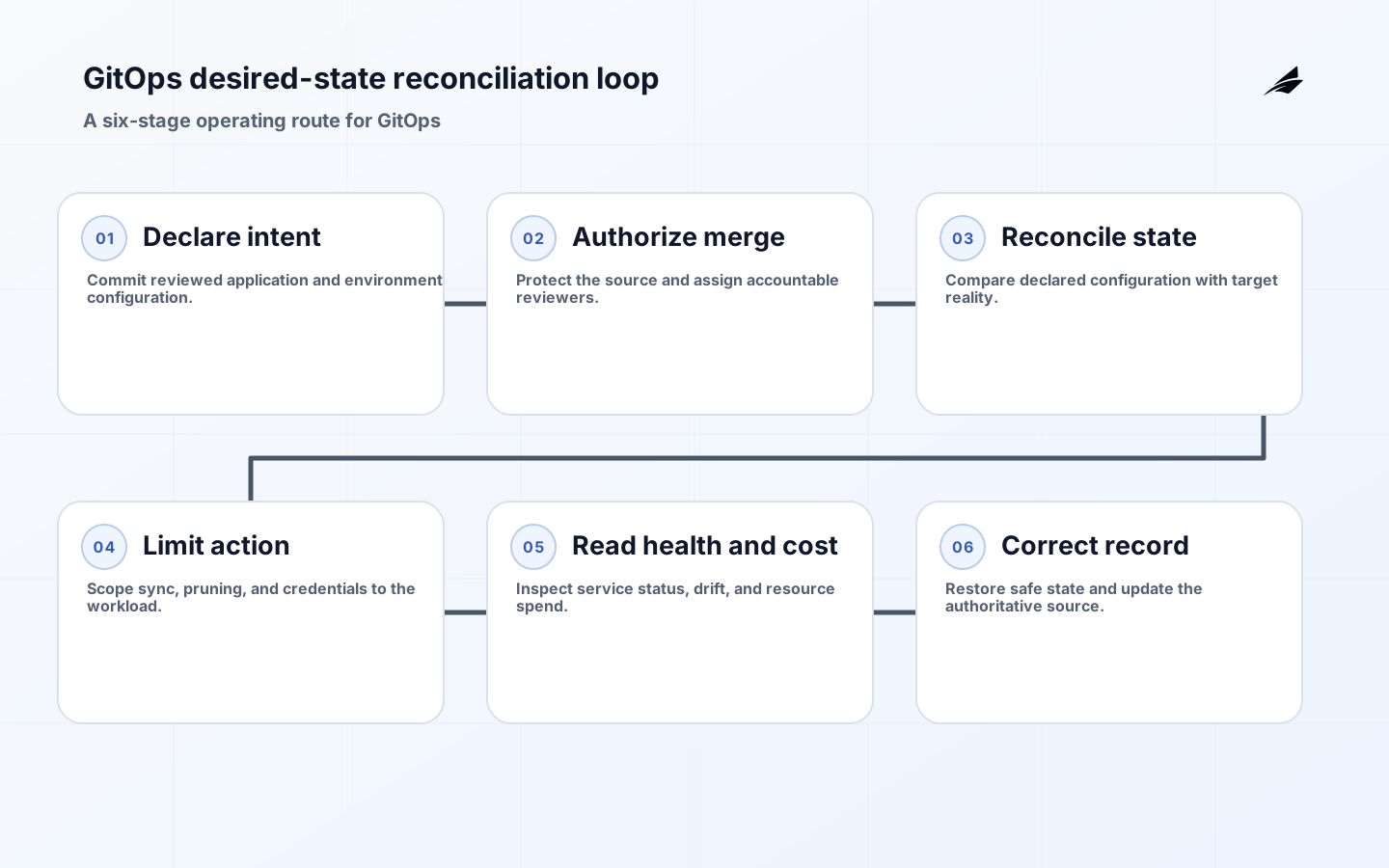
GitOps needs an operating model, not a loose collection of tools. GitOps uses a version-controlled, declarative source of desired state and an automated reconciler that brings an environment toward that state. It changes where operational intent is recorded, but it does not eliminate operational judgment. The design must still answer which repository is authoritative, who may change it, how the reconciler is authorized, and what happens when reality and intent disagree. This guide focuses on the choices that make the work inspectable by the people who build, operate, and support it.
Key takeaways
- Define the boundary and accountable owner before standardizing GitOps.
- Keep the records that explain an outcome close to the action that created it.
- Use controls that match the consequence of failure instead of copying generic checklists.
- Test an uncomfortable but realistic failure path while impact is bounded.
- Measure recovery and operating effort alongside speed or throughput.
- Turn repeated exceptions into an owned improvement rather than private knowledge.
What GitOps means in practice
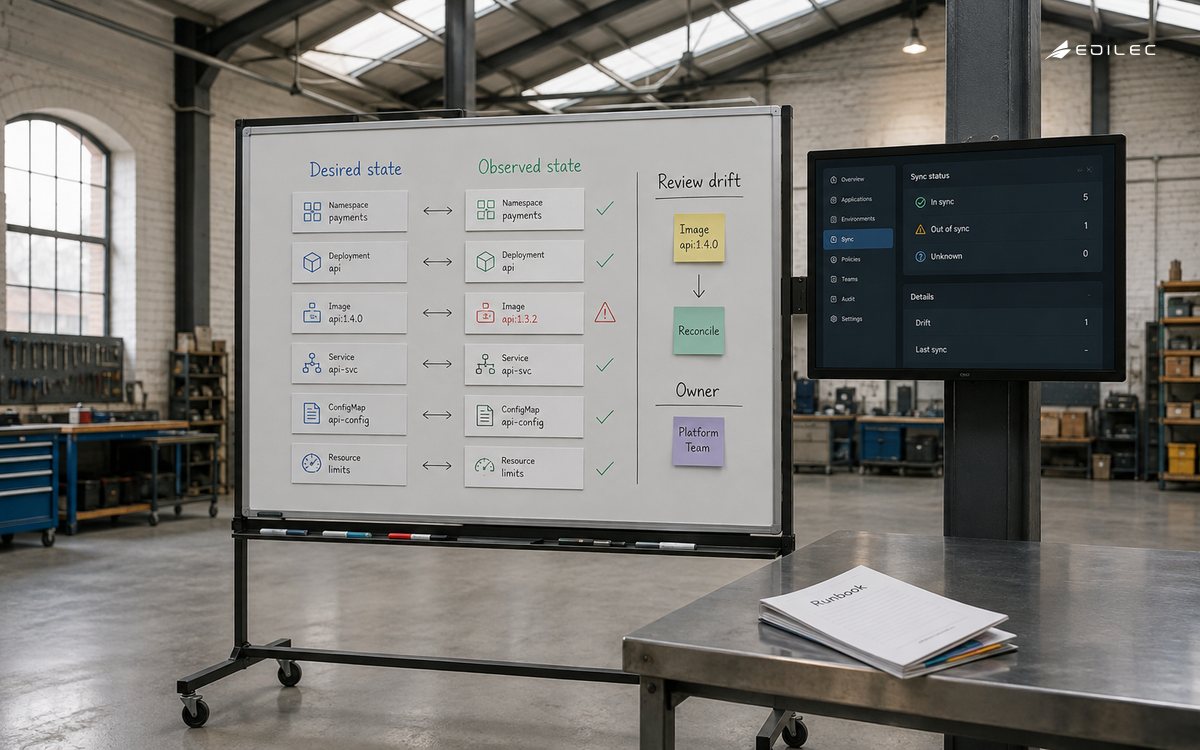
A pull request is not itself a deployment; it is a proposed change to desired state. A controller such as Argo CD or Flux continuously compares the declared configuration with the target environment and may correct drift. That loop is powerful because it creates an audit trail, but it can be destructive if a stale or overly broad declaration is allowed to reconcile unchecked. For adjacent operating decisions, compare Terraform modules and Kubernetes deployments.
| Decision area | Question to settle | Useful evidence |
|---|---|---|
| Boundary | What part of GitOps is in scope? | Named owner, entry point, and expected outcome. |
| Identity | Which version, record, or state is authoritative? | An inspectable identifier tied to the action. |
| Control | What condition must hold before expansion? | A test, review, or policy result with a decision rule. |
| Recovery | How will the team verify a safe outcome? | A documented action, check, and accountable responder. |
An operating model for GitOps
Separate application delivery, shared platform components, and environment configuration where ownership and release cadence differ. Use protected branches, code review, signed or otherwise trusted artifacts where appropriate, and scoped repository or cluster credentials. Define the reconciliation interval, pruning behavior, sync policy, health checks, and emergency procedure so teams know when automation will act and when it must be paused. The design should make the next decision easier for someone who did not create the original implementation.
A practical implementation path
Pilot a low-risk workload in one environment. Make the source hierarchy and ownership visible, validate manifests before merge, and set alerts for failed reconciliation or unhealthy resources. Start with manual synchronization when the team is learning the control loop, then enable automation only after rollback, drift, and dependency behavior are understood. Cost tags, requests, and retention settings belong in the desired state because they are operational decisions, not afterthoughts. Prefer a sequence that creates evidence at every stage rather than a broad first release that makes causality difficult to recover.
Risks and controls to make explicit
A GitOps repository can become a high-value control plane. Broad write access, unreviewed generated changes, or a reconciler that can administer every namespace expands the blast radius. Cost also scales through invisible defaults: replicas, autoscaling ceilings, persistent volumes, log retention, and cross-region transfers can be declared once and charged continuously. Review these choices with the same care as application code. Write the exception route down as well: an emergency action may be necessary, but it should leave an attributable record and return to normal control once the immediate condition is resolved.
| Stage | What to check | Decision rule |
|---|---|---|
| Prepare | Scope, identity, access, and prerequisites. | Do not proceed when ownership or required evidence is unclear. |
| Change | The control that addresses the main failure mode. | Pause when a required test, policy, or review fails. |
| Observe | Technical and user-facing consequences. | Expand only when the agreed signals remain inside bounds. |
| Recover | State, data, and follow-up work. | Close only after the relevant verification is recorded. |
Signals that show whether it is working
Track reconciliation latency, failed or suspended syncs, drift frequency, change lead time, rollback events, and the proportion of resources with an accountable owner. For cost, compare requested and actual resources, idle replicas, storage growth, egress, and the cost of repeated controller work or duplicated environment stacks. A low cloud bill after an outage may simply indicate that a reconciler removed needed capacity. Review the signals with a real example, because a metric becomes useful only when it changes a decision or confirms that an earlier decision was sound.
A GitOps checklist for the next change
Introduce an intentional, safe drift in a non-production environment and observe the result. The team should know whether the controller detects it, corrects it, or waits for a decision, and should be able to pause reconciliation without losing the recorded desired state. Pair that exercise with a cost review of one scaled service to expose the defaults that multiply when the pattern is reused. The result should be a short, owned change to the routine, not a retrospective statement that the team should have been more careful.
A worked decision example
A platform team enables automatic pruning for a shared namespace. A migration commit temporarily omits a resource that another service still needs, and the reconciler deletes it. The correction separates ownership, adds dependency-aware review, requires a staged migration sequence, and limits pruning scope. The team also adds a budget alert for a new autoscaling configuration that had doubled replica count during a traffic test.
How to phase adoption
Phase GitOps with a single environment and a workload whose owners understand both the repository and target cluster. Start with visible reconciliation status and a manual synchronization decision, then exercise a safe drift case and a rollback. Enable automatic behavior only after the team can explain pruning, ordering, health checks, and the pause procedure. Treat changes to the reconciler or its credentials as platform changes with their own review because they can affect many workloads at once.
Decision records and ownership
The desired-state record should identify the repository, branch or revision, environment, accountable team, reconciler identity, synchronization policy, resource scope, and cost-bearing defaults such as requests, retention, and replica limits. Keep an emergency action record if a responder operates outside the normal path, then reconcile it back into source. This prevents the repository from becoming an attractive but misleading record of intent while production silently diverges.
Design boundaries that matter
Repository structure should follow authority boundaries, not an aesthetic preference for one repository or many. A team that owns an application may reasonably own its deployment configuration, while a platform team may own shared ingress, policy, and cluster add-ons. Document how these layers are promoted together and which change has precedence when a dependency evolves. Generated configuration needs an especially clear review path because a machine can create a large, plausible diff that hides a broad deletion or access change. The reconciler should consume only sources that have passed the appropriate human and automated controls.
Deeper operating considerations
Scaling a GitOps pattern means scaling review and recovery, not just adding clusters. Measure controller capacity, repository fetch failures, dependency ordering, secrets delivery, and the time needed to halt or revert a bad declaration across environments. Keep environment overlays constrained so they do not become divergent copies of the same application with unknown behavior. When a platform offers self-service, give users a paved route with validated inputs and budget-aware defaults rather than unrestricted access to shared control repositories. That preserves the audit value of GitOps while allowing teams to move at a practical pace.
A useful review cadence
Review GitOps through a successful reconciliation, a failed dependency, and an intentional drift or suspended sync. Check whether the system exposes the difference between declared and actual state, whether a human can halt automation safely, and whether spend changed because configuration scaled or retained more than expected. Assign an owner for every recurring mismatch. The practice is working when a team can use the same evidence to discuss release safety, platform authority, and cloud cost.
Frequently asked questions
GitOps does not require every operational action to be fully automatic. An emergency change may need a controlled break-glass route, but it should be reconciled back into the declared source as soon as practical so the record does not diverge. Reconciliation is not a substitute for monitoring: it can prove declared state was applied, not that users received a healthy service.
Before expanding the practice
Before enabling self-service through GitOps, design the request path for capabilities that should not be granted by a raw manifest alone. A team may need a database, public endpoint, or higher resource limit, but those requests can pass through a reviewed template, policy check, or platform service that records cost and security context. This preserves the declarative workflow while avoiding a repository that exposes every low-level privilege to every contributor. The goal is not to slow teams with ceremony. It is to give them a repeatable route for high-consequence changes and make the platform’s guardrails visible enough that exceptions can be discussed honestly.
A final field test
Field test: pause reconciliation, make a safe drift, and restore the declared state while measuring the decision and recovery path. This shows whether automation remains understandable when it must be intentionally interrupted.
Conclusion
GitOps is most useful when desired state, authority, and reconciliation behavior are explicit. Start with narrow scope, control the reconciler, and make cost-bearing defaults visible in the same review as functional changes.