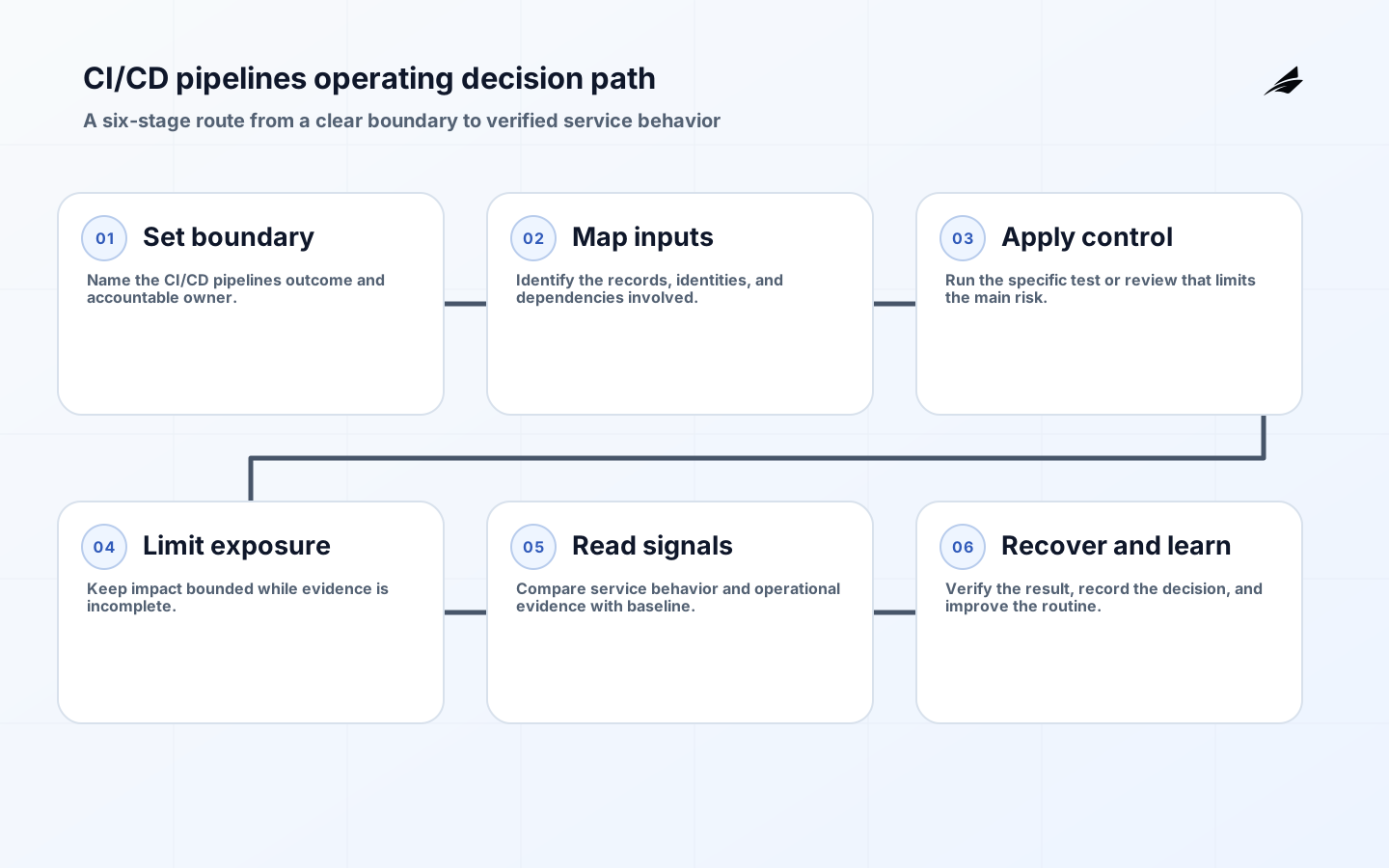
CI/CD pipelines deserves a plain-language operating model because engineering teams need to make choices that remain understandable after the first implementation. A CI/CD pipeline is the repeatable route from a reviewed change to a running service. It earns its keep when a team can answer four ordinary questions without reconstructing history: what changed, which artifact was built, which environment received it, and how the outcome was checked. Continuous integration is the habit of integrating and testing changes frequently; continuous delivery makes a validated release candidate ready to deploy. Continuous deployment is the narrower policy of releasing automatically after those conditions are met. Treating all three as one magic button is how release speed turns into uncertainty.
Key takeaways
- Build an artifact once and promote its digest rather than rebuilding per environment.
- Make every release record connect a change, test evidence, configuration, cohort, and owner.
- Use progressive exposure with a written stop rule for changes that can affect customers.
- Design schema and external-side-effect changes for compatibility before relying on rollback.
- Review manual overrides; they are evidence of a missing capability or a deliberate exception.
- Measure recovery as carefully as release speed.
What CI/CD pipelines mean in practice
The operating boundary is not the build server. It begins with a change that has an owner and ends when the intended service behavior is observed. Capture the commit or change request, dependency and secret inputs, immutable artifact digest, deployment configuration, target cohort, approver where needed, and rollback decision. A version tag alone is not enough because tags can be moved; a digest identifies the actual built artifact. The SRE release-engineering guidance is useful here because it frames reliable releases as reproducible, intentional work rather than a one-off production ceremony.
| Decision area | Question to settle | Useful evidence |
|---|---|---|
| Artifact identity | Which digest is running? | Build output and attestation tied to the change. |
| Promotion | What moves between environments? | The same immutable artifact plus reviewed configuration. |
| Exposure | Who sees the change first? | A bounded cohort and defined observation period. |
| Recovery | Who can stop or reverse it? | Named authority, runbook, and verification query. |
An operating model for CI/CD pipelines
Separate the pipeline into build, verification, promotion, deployment, and observation. Build once, attach provenance and test results to that artifact, then promote the same digest through environments. A deployment job should receive configuration by reference and short-lived credentials, not a long-lived administrator secret copied into a variable. Tests need a purpose: unit tests catch local logic errors; integration and contract tests test boundaries; smoke checks confirm the deployed path can answer. This shape also makes a failed stage diagnosable. The run record becomes an evidence trail rather than a green badge with no explanation.

A practical implementation path
Start with a thin service and one low-risk deployment path. Define a release window, a named release owner, and an explicit stop rule before exposing users. For example, route a small cohort to a new version, compare request error rate and latency with the baseline, and expand only if both stay inside agreed bounds. Database changes deserve a separate compatibility plan: deploy additive schema changes first, run code that tolerates old and new shapes, migrate data, and remove obsolete fields later. That sequence gives rollback a realistic chance; rolling back application code cannot automatically undo a destructive data change.
Risks and controls to make explicit
The important controls are proportional. A documentation-only change may need linting and preview review. A payment-flow or permission change needs a testable authorization decision, a limited cohort, and a visible recovery owner. Protect the build path as software supply chain infrastructure: restrict who can alter workflows, pin third-party actions or dependencies where practical, and keep production deployment permissions out of ordinary developer sessions. NIST's Secure Software Development Framework gives a useful vocabulary for securing the practices around producing and releasing software, not just the final binary.
| Stage | What to check | Decision rule |
|---|---|---|
| Build | Compile, package, scan, and record provenance. | Proceed only when required checks pass. |
| Verify | Run targeted tests and inspect deployment prerequisites. | Fix a failed control instead of bypassing it silently. |
| Expose | Deploy to a small cohort and compare baseline signals. | Pause when error, latency, or business signals cross the stop rule. |
| Recover | Contain impact and confirm service plus data state. | Close only after the reconciliation evidence is recorded. |
Signals that show whether it is working
Measure both throughput and safety. Deployment frequency says whether the path is usable; lead time for changes exposes waiting and queueing; change failure rate shows how often releases require remediation; time to restore shows whether the team can return service after a bad change. Pair those with operational signals such as failed deployment steps, manual overrides, rollback duration, and the percentage of releases that have linked test evidence. A fast pipeline that creates noisy pages or forces an operator to inspect four consoles is not yet a reliable delivery system.
A CI/CD pipelines checklist for the next change
Before standardizing a pipeline, run one deliberately awkward exercise: ship a compatible configuration change, stop it during partial exposure, restore the previous behavior, and prove that the record and alerts match what happened. The result usually identifies missing ownership or hidden state more honestly than a happy-path demo. Link the routine to Kubernetes deployments when the delivery target is a cluster and to distributed tracing when a canary needs request-level evidence.
One useful boundary test is to remove a pipeline permission in a staging environment and confirm that the failure is explicit, limited, and attributable. The desired result is not that every job has broad access and never fails. It is that a required deployment action has the narrow credential it needs, a denied action leaves a useful record, and an operator can distinguish a policy problem from an application failure. This makes later permission changes safer to review.
A worked decision example
A customer-profile release adds a new address field. The team first makes the database change additive, deploys code that reads both representations, and sends a small internal cohort through the address workflow. The release record ties that cohort to a single artifact digest, configuration revision, and synthetic verification. If the new parser misclassifies an address, exposure stops and the prior compatible code is restored; the data migration is reconciled separately rather than erased by wishful rollback.
How to phase adoption
Phase CI/CD pipelines through one bounded service or workflow first. Establish the owner, evidence record, access boundary, and stop rule before standardizing a template or expanding automation. The first implementation should expose its awkward dependency, not hide it behind a happy-path demonstration. After the team can explain why the control exists and show its outcome, reuse only the conventions that made the decision clearer. This avoids turning a local tool choice into a broad platform mandate before its operating assumptions are tested.
Keep the working record close to the change. For CI/CD pipelines, that means retaining the version or configuration involved, the person or automated identity that acted, the signal examined, the exception if there was one, and the recovery decision. This is not paperwork for its own sake. During a later failure, those few facts prevent responders from confusing an old condition with a new one or repeating an action whose effect is still unknown.
A useful review cadence
Review CI/CD pipelines with real examples rather than a generic scorecard. Sample one normal outcome, one unexpected outcome, and one manual exception. Ask whether a new owner could locate the relevant evidence, understand the boundary, and decide what to do next without relying on private memory. A repeated exception points either to a missing capability or to a constraint that should be made explicit. In both cases, the review should create a small, owned improvement.
Run a deliberately limited exercise before widening use. Change one safe input, observe the stated signals, invoke the documented containment or recovery step, and verify that the intended service behavior returns. Record where access, timing, or ownership was unclear. An exercise is successful when it reveals a practical weakness early enough to repair it, not when every participant follows the expected script. That habit makes CI/CD pipelines more dependable under ordinary pressure as well as during an incident.
Frequently asked questions
A pipeline does not have to deploy every commit to count as continuous delivery; it must keep a verified candidate deployable. Manual approval can be appropriate for high-consequence changes, but the approval should inspect concrete evidence and not become a vague queue. Rollback is also not a substitute for forward-compatible data design. If a release changes a durable record or calls an external system, define the compensating action and reconciliation query before promoting it.
Conclusion
CI/CD pipelines are valuable because they turn change into an observable routine. Begin with an artifact that can be identified, tests that answer a named risk, gradual exposure, and a recovery path that has been tried. Once those basics are trusted, automation removes waiting without removing judgment.