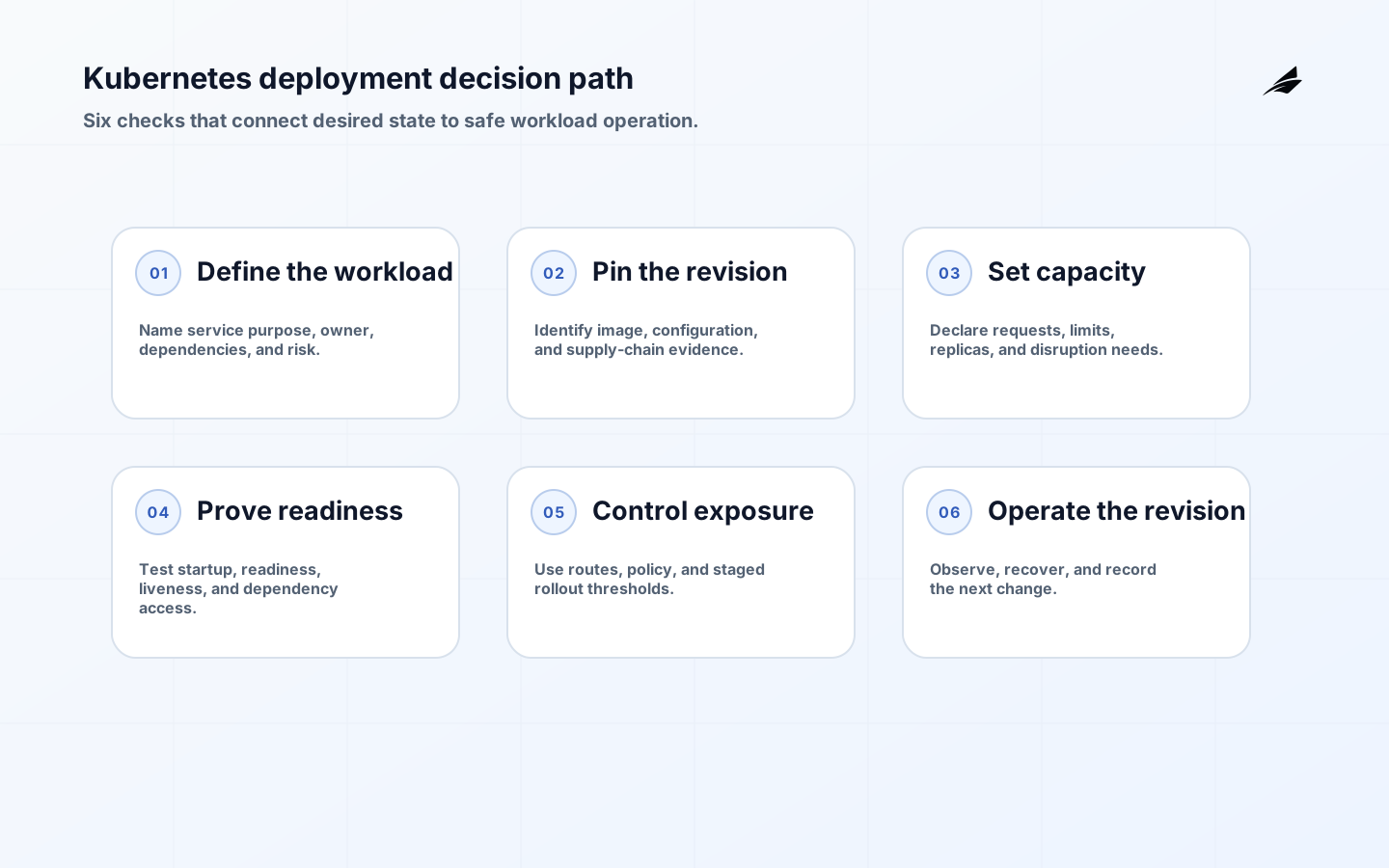
Kubernetes deployments deserve a plain-language operating model because product teams need to make choices that remain understandable after the first implementation. Kubernetes Deployments describe a desired application state and manage ReplicaSets to move a workload toward it. They are not simply a command that starts containers. A Deployment gives a team a revision history and a controlled rolling-update mechanism, while Services, Ingress or Gateway resources decide how traffic reaches healthy pods. The plain-language goal is straightforward: declare the version and availability behavior you want, then make the cluster's progress visible enough to intervene safely.
Key takeaways
- Use Deployments to manage replicated desired state and revision history.
- Make readiness, liveness, and startup probes answer different questions.
- Deploy immutable image identities with declared resource requests and limits.
- Tune surge and unavailability to the service's actual capacity margin.
- Connect rollout status to customer-facing service signals.
- Treat identity and policy as part of the deployment, not an afterthought.
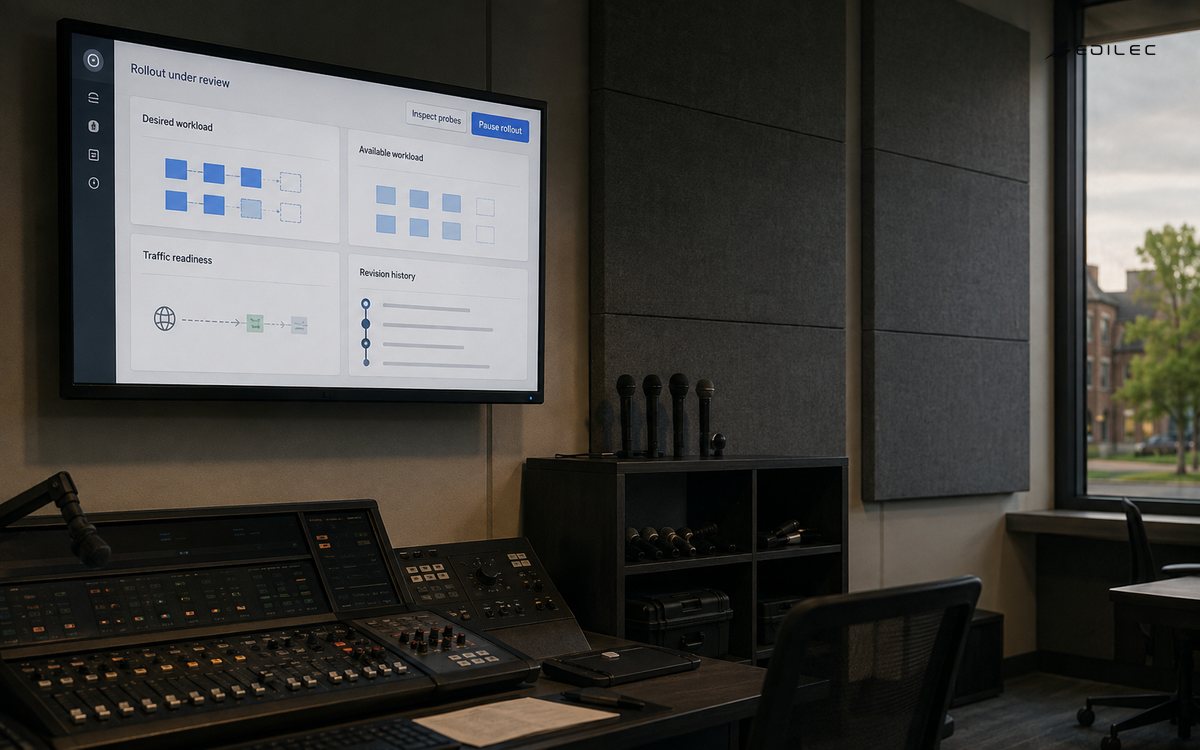
What Kubernetes deployments means in practice
A deployment boundary includes the workload manifest, image digest, service account, configuration references, resource requests and limits, probes, disruption settings, and rollout policy. Keep those concerns separate enough that a reviewer can see which part of a change alters application code, traffic, identity, or capacity. The official Deployment documentation explains why a Deployment manages ReplicaSets and why status conditions matter; in practice, those conditions are the first evidence that desired and available replicas are diverging.
| Decision area | Question to settle | Useful evidence |
|---|---|---|
| Pod template | What process and image should run? | Digest, command, probes, resources, and security context. |
| Traffic eligibility | When can this pod receive requests? | A readiness signal that reflects serving capability. |
| Update policy | How quickly may replicas change? | maxSurge, maxUnavailable, and a pause or rollback plan. |
| Identity | What may the pod access? | Scoped service account and relevant namespace policy. |
An operating model for Kubernetes deployments
Use readiness probes to say when a pod can receive traffic, liveness probes only for failures where a restart helps, and startup probes for slow initialization. These answers are different. A pod that is warming a cache may be alive but not ready; a bad liveness check can restart healthy but overloaded replicas and amplify an outage. Declare CPU and memory requests so the scheduler has a real placement contract, then set sensible limits based on observed behavior. Add a PodDisruptionBudget only after understanding the application's quorum or capacity needs; it protects availability during voluntary disruption but cannot create capacity that is not there.
A practical Kubernetes rollout path
For a new version, make the image identity immutable, apply the manifest through a reviewed path, and watch rollout status plus user-facing indicators. Configure maxSurge and maxUnavailable according to the service's ability to absorb extra capacity and reduced replicas. A stateless API with headroom can surge; a constrained stateful dependency may need a slower, more deliberate plan. Test a revision rollback in a non-critical environment, but remember that reverting the manifest does not repair an incompatible database migration or an external side effect. Pair cluster status with a request-level view from observability.
Kubernetes rollout risks and explicit controls
Avoid treating YAML as the entire security model. The pod's service account, namespace policy, container security context, image provenance, admission controls, and network policy all influence what a workload can do. Set a namespace and ownership model before copying production manifests into another team. A configuration reference that is missing, a secret whose key changed, or an image pull error should be observable as a deployment condition rather than discovered only by a customer. Use a dry run and policy check where possible, then make a specific human decision for changes that widen permissions.
| Stage | What to check | Decision rule |
|---|---|---|
| Plan | Review manifest, permissions, capacity, and dependency compatibility. | Proceed only with a known owner and rollback or fix-forward choice. |
| Roll out | Apply the revision and inspect Deployment conditions. | Pause when availability or request signals depart from baseline. |
| Verify | Exercise the user path and inspect telemetry by revision. | Continue only when both cluster and service behavior are healthy. |
| Learn | Capture the revision outcome and missed assumptions. | Update probes, limits, or tests before the next similar change. |
Signals that show rollout health
Watch desired versus available replicas, readiness failures, restart reasons, pending duration, rollout duration, resource throttling, evictions, and request success from the service perspective. Cluster-level CPU remaining is not enough: one workload may be CPU-throttled despite apparent capacity, and a request may fail even while every pod reports Ready. Record the revision, namespace, image digest, and configuration revision in telemetry so an alert can be connected to a deployment event without guesswork.
A Kubernetes deployments checklist for the next change
Practice the unpleasant case: a rollout introduces a dependency failure that passes process startup but fails the real user path. Pause the rollout, reduce exposure, inspect readiness and application signals, rollback or fix forward according to the data contract, then document why the earlier check missed it. For configuration-driven reconciliation, connect the approach to GitOps, which makes desired state and drift visible in version control.
Capacity planning belongs in the rollout decision. A Deployment that requests too little memory may schedule successfully and then be killed under normal load; one that requests far more than it uses may block other workloads from scheduling. Use observed production behavior, traffic shape, and a margin for the rollout surge to refine requests and limits. Revisit those values after meaningful code or dependency changes rather than treating the first setting as permanent infrastructure truth.
A worked deployment decision
An API revision needs two minutes to warm a cache. A single health endpoint used for every probe causes the kubelet to restart pods before warm-up finishes, while traffic has nowhere healthy to go. The safer manifest uses a startup probe for initialization, readiness for serving eligibility, and liveness only for a recoverable stuck process. The rollout pauses when new replicas miss the readiness window or request errors exceed the agreed baseline.
How to phase Kubernetes deployment adoption
Phase Kubernetes deployments through one bounded service or workflow first. In Kubernetes deployment work, establish the owner, evidence record, access boundary, and stop rule before standardizing a template or expanding automation. In Kubernetes deployment work, the first implementation should expose its awkward dependency, not hide it behind a happy-path demonstration. In Kubernetes deployment work, after the team can explain why the control exists and show its outcome, reuse only the conventions that made the decision clearer. In Kubernetes deployment work, this avoids turning a local tool choice into a broad platform mandate before its operating assumptions are tested.
Keep the working record close to the change. For Kubernetes deployments, that means retaining the version or configuration involved, the person or automated identity that acted, the signal examined, the exception if there was one, and the recovery decision. This is not paperwork for its own sake. In Kubernetes deployment work, during a later failure, those few facts prevent responders from confusing an old condition with a new one or repeating an action whose effect is still unknown.
A useful deployment review cadence
Review Kubernetes deployments with real examples rather than a generic scorecard. In Kubernetes deployment work, sample one normal outcome, one unexpected outcome, and one manual exception. In Kubernetes deployment work, ask whether a new owner could locate the relevant evidence, understand the boundary, and decide what to do next without relying on private memory. In Kubernetes deployment work, a repeated exception points either to a missing capability or to a constraint that should be made explicit. In Kubernetes deployment work, in both cases, the review should create a small, owned improvement.
Run a deliberately limited exercise before widening use. In Kubernetes deployment work, change one safe input, observe the stated signals, invoke the documented containment or recovery step, and verify that the intended service behavior returns. Record where access, timing, or ownership was unclear. In Kubernetes deployment work, an exercise is successful when it reveals a practical weakness early enough to repair it, not when every participant follows the expected script. That habit makes Kubernetes deployments more dependable under ordinary pressure as well as during an incident.
Kubernetes deployments are a coordination mechanism for desired workload state, not a substitute for application readiness or network design. The Kubernetes Deployment documentation explains revision and rollout behavior; the guidance on liveness, readiness, and startup probes separates starting, serving, and recovering. Kubernetes also documents resource management and NetworkPolicy, two areas that often determine whether a rollout is actually safe. Read together, these sources point to a simple operating rule: only promote a revision when the workload can receive traffic, fit its resource envelope, reach the dependencies it needs, and be observed by the people responsible for it.
For the next change, write down the image digest, replica expectation, probe behavior, resource requests and limits, dependency permissions, rollout thresholds, and rollback action. Test a slow startup and a dependency denial rather than only a healthy pod. Adjacent Edilec guides on observability, GitOps, and Kubernetes platform operations help extend the practice while keeping the deployment contract visible. These companion articles are The Plain-language Guide to Serverless Architecture, The Plain-language Guide to Backup and Restore, Kubernetes Deployments: Implementation Checklist.
Frequently asked questions
Question: Are Kubernetes Deployments only for rolling updates? Answer: No; they also provide desired-state management, revision history, rollout status, and a basis for controlled recovery. Question: What should be checked before a change? Answer: Image identity, probes, resources, disruption behavior, traffic readiness, dependencies, and the operator's intervention path.
What does Kubernetes deployment readiness include?
Answer: It includes rollout state, probes, resource and disruption behavior, policy, observability, ownership, and a recovery route—not only a running Pod.
How should a team choose its first deployment path?
Answer: Start with a repeatable workload and a supported template, then prove health, scaling, upgrade, and rollback behavior before widening adoption.
What should happen when a rollout stalls?
Answer: Stop further exposure, inspect events and dependencies, communicate the impact, and return to a known version or bounded repair path.
A Deployment is appropriate for stateless replicated workloads; StatefulSets, Jobs, and DaemonSets model different lifecycle needs. A readiness probe should not be a slow end-to-end test of every dependency, because that can remove all capacity during a downstream outage. A rollback restores a prior pod template, not every related system's state. Plan schema changes and feature flags so old and new revisions can coexist during the rollout window.
Conclusion
Kubernetes deployments reward explicitness. Declare the resource and identity contract, distinguish readiness from liveness, use rollout settings that fit available capacity, and observe customer behavior while revisions change. The result is not zero-risk deployment; it is a system where risk is bounded and explainable.