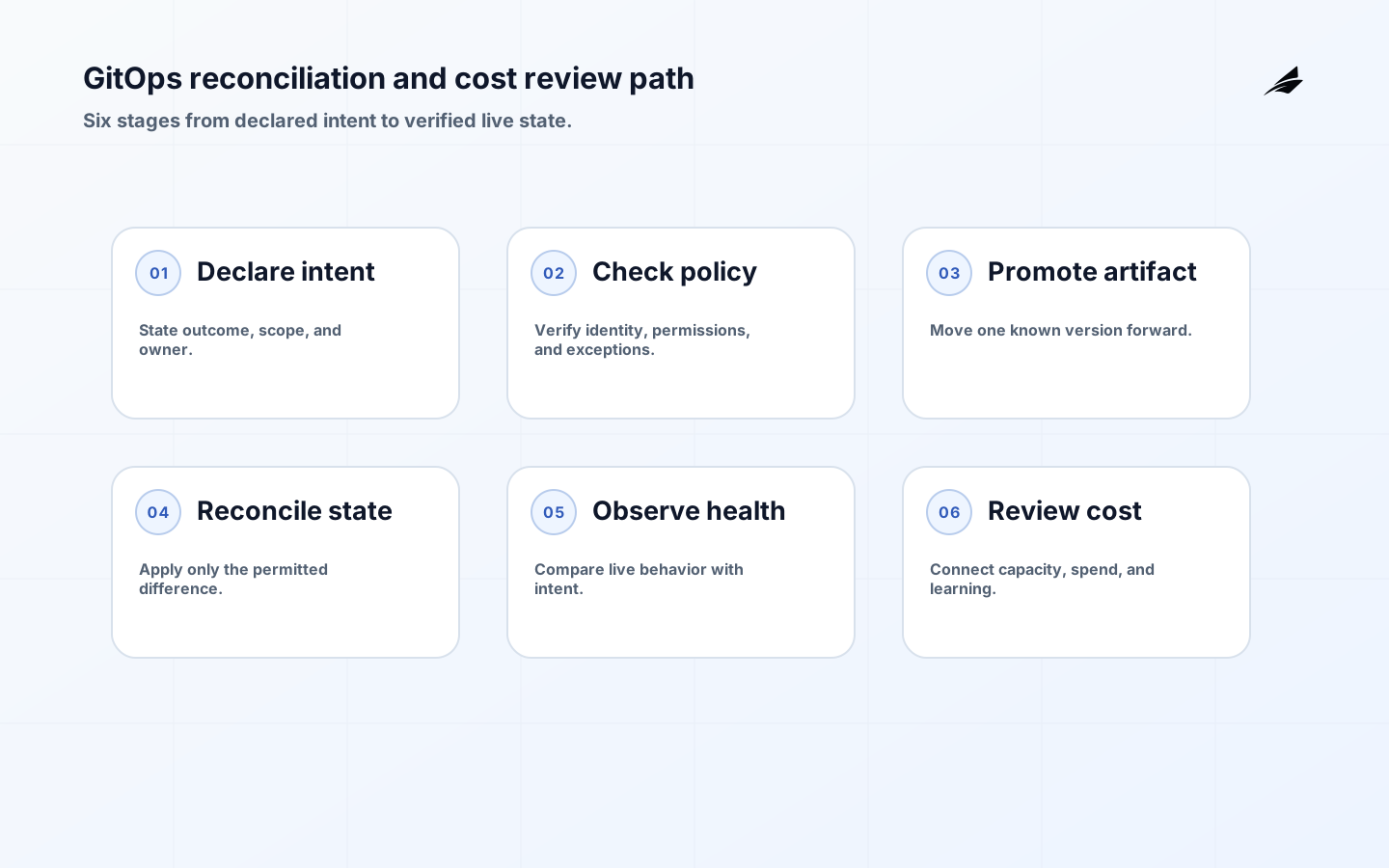
GitOps is a delivery model in which desired system state is versioned, reviewed, and applied by an agent that continually compares that declaration with a live environment. Its strength is not that Git becomes a universal control plane. Its strength is that intent, ownership, and promotion history can become visible while environment-scoped agents perform changes with constrained authority. The OpenGitOps Principles v1.0.0 principles are a useful starting point, but a repository commit is not proof that production is healthy. Reconciliation can also amplify a bad declaration, so policy, observation, cost context, and break-glass behavior belong in the design. Connect the decision to canary releases and CI/CD pipelines when the release path crosses delivery boundaries.
Define what belongs in desired state
Put repeatable configuration with clear ownership into the declared path: workload manifests, deployment references, network policy, environment settings, and selected infrastructure resources. Keep secrets and dynamic runtime observations in protected systems, using references rather than literals. A manual incident action may be necessary, but the resulting state should be reconciled back into an explainable declaration when safety is restored. The Kubernetes declarative configuration guidance illustrates the distinction between describing an object and issuing a sequence of imperative commands. That distinction helps teams decide what reviewers can meaningfully approve.
| State category | Good GitOps fit | Boundary to make explicit |
|---|---|---|
| Application configuration | Manifests, versions, replicas, and policy references. | Which team owns the service and its environment overlay? |
| Shared platform | Controllers, baseline policy, and cluster add-ons. | Who can change controls with cross-team blast radius? |
| Runtime observation | Health, drift, capacity, and current state. | How is live evidence surfaced without becoming desired state? |
| Emergency action | A reviewed follow-up declaration after containment. | Who may act immediately and how is the action recorded? |
Treat reconciliation as a controlled actuation system
A reconciler observes a difference and acts toward the declared state. That creates an important control boundary: the agent needs enough authority to make the intended change, but not broad access to every namespace or cloud account. Use separate identities for shared platform and service-owned resources, require review for high-impact changes, and make policy checks run before actuation. Kubernetes RBAC documentation provides the vocabulary for scoping permissions. Test that a compromised or misconfigured controller cannot cross its intended boundary, and make failed reconciliation visible rather than repeatedly retrying an unsafe action.
Drift should be classified, not automatically erased. A harmless label change, an emergency scale-out, and a security-relevant policy change deserve different responses. Show the declared version, live version, actor, reason, and age of drift. Avoid hiding differences through a normalization rule that makes the dashboard look clean. The Google SRE release engineering guidance is relevant here because repeatable delivery depends on controlled automation, clear artifacts, and a path for safe exceptions.
Design the GitOps decision path
Model the path from proposal to live evidence: author a change, run tests and policy checks, approve according to blast radius, promote a known artifact, reconcile in the target, observe health, and record whether the result matched intent. Store the application version and configuration revision together where possible. A layout with one folder per environment can work; so can a release record that updates a target reference. The choice matters less than the ability to explain why a version reached an environment and which checks were active at the time.
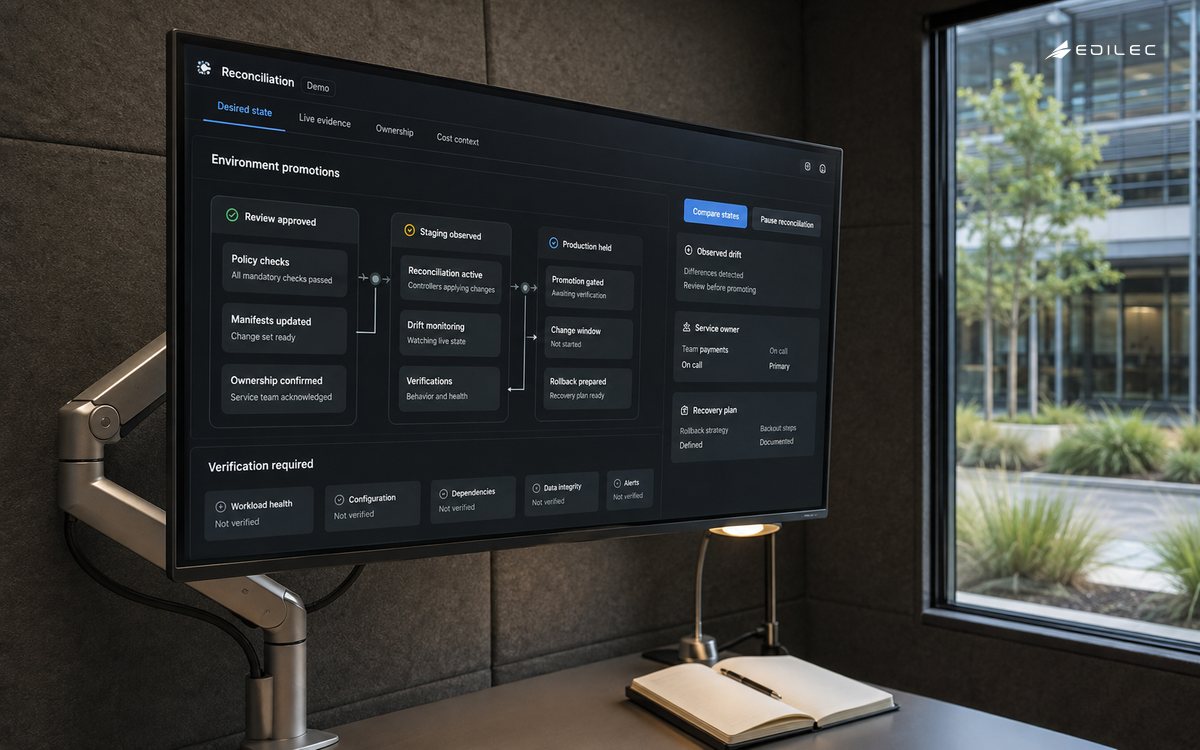
| Stage | Decision | Useful evidence |
|---|---|---|
| Proposal | What outcome and scope does this change target? | Change description, owner, and affected resources. |
| Policy | May this identity and artifact act here? | Check result, permission scope, and exception expiry. |
| Promotion | Which environment should receive it next? | Approval, artifact digest, and target reference. |
| Reconciliation | Did live state converge safely? | Controller event, health signal, and drift status. |
| Review | Was the result worth the cost and risk? | Outcome, spend attribution, and follow-up. |
Keep scaling and cost decisions visible
Scaling configuration can turn a small repository change into a material cost change. Require resource requests and limits where the platform supports them, tag resources by service and environment, and show the expected capacity effect in the change review. Compare declared capacity with observed utilization and customer demand rather than treating a larger replica count as success. Separate availability protection from a permanent allocation. A useful GitOps cost review asks whether the change improved a business or reliability outcome, whether spend is attributable, and how a team can reverse it without losing evidence.
Use live evidence to evolve the declared system
The repository tells you what the team intends; telemetry tells you what the environment is doing. Reconcile both views in reviews. Inspect failed deployments, restart patterns, drift age, rollback frequency, controller queue pressure, and cost variance. When a recurring emergency action appears, decide whether the declared model is missing a capability or whether the exception should remain deliberately manual. Keep the Kubernetes deployments guide nearby when workload rollout behavior affects the reconciliation contract.
A worked GitOps decision
A service team proposes increasing workers for a seasonal workload. The review includes the artifact, configuration diff, expected request rate, resource budget, autoscaling boundary, and rollback route. Policy checks confirm that the team identity can change its namespace but not shared ingress. The reconciler applies the version, health checks pass, and cost attribution shows the expected increase. A later queue spike reveals that the worker count is not enough; the team changes the autoscaling rule through the same path instead of issuing an unrecorded production command. The operating record now contains intent, action, evidence, and learning.
Repository structure should help a reviewer see blast radius. Keep shared controllers, platform policy, service configuration, and environment-specific values distinct enough that a small application change does not look like a cluster-wide change. If a promotion updates many references, generate a readable release record that names the affected services and owners. Reviewers should not need to reconstruct dependency order from a large diff or a private message thread.
Cost review also needs a correction path. If a declared resource limit creates throttling, the service team should be able to adjust it with the same evidence and approval pattern used for the original change. If a scale rule creates waste, record the demand assumption that proved wrong. This keeps cost management from becoming a separate manual report and makes it possible to connect spend movement with configuration, workload behavior, and business demand.
Design repository ownership around the consequences of a change. A platform repository may define controllers and baseline policy, while a service repository declares application versions and environment overlays. Shared ownership should be explicit where a change crosses namespaces, accounts, or billing boundaries. Avoid a layout that gives every team write access to cluster-wide controls merely because centralization is convenient. The review boundary should match the blast radius visible in the live system.
Reconciliation needs a behavior for each class of drift. A harmless generated label may be corrected automatically; an emergency capacity increase may be recorded and reviewed; a security policy difference may block further action. State which differences are tolerated, which are repaired, and which require a person. The controller should expose why it stopped or retried rather than making repeated changes that obscure the original condition. These distinctions make automation safer under pressure.
Review the cost of the control plane itself. More repositories, environments, controllers, and reconciliation loops can increase storage, compute, query, and operator burden. Measure failed syncs, queue age, API pressure, and the time teams spend diagnosing a difference. Simplify boundaries that no longer reflect ownership. A scalable GitOps system is not the one with the most automation; it is the one whose decisions remain legible as services and environments grow.
Retirement should be a first-class GitOps operation. When a service is decommissioned, stop promotion, remove workload and policy declarations in dependency order, preserve the release and cost record, and verify that credentials and controllers no longer retain access. Delete stale overlays and dashboards only after the evidence needed for audit or incident review is preserved. A clean exit prevents old desired state from recreating resources that the business believes it has removed.
Separate workload capacity from reconciliation pressure
GitOps scaling decisions need two capacity views. The first is the workload view: requests, limits, replicas, queue depth, and autoscaling thresholds that describe how much application work a service can absorb. The second is the control-plane view: repository size, manifest generation time, API-server pressure, controller queue age, and the number of resources a reconciler must inspect. A change can improve the first while damaging the second. If a team raises replica counts for a seasonal workload but the controller cannot apply the resulting changes promptly, the declared state is correct while the operating path is not.
Make both views part of the change record. State the demand assumption, expected resource and billing effect, reconciliation deadline, and signal that proves the new state is healthy. Review queue age, sync latency, throttling, failed applies, restart patterns, and cost per completed unit after promotion. If the evidence shows control-plane saturation, pause expansion and reduce the change surface before increasing authority. A useful GitOps policy can permit service-owned capacity within a bounded range while requiring platform review for namespace, account, or controller changes. This keeps scaling reversible and gives finance, platform engineering, and service owners a shared explanation for why a configuration change was accepted, delayed, or rolled back.
Key takeaways
- Use GitOps for owned, reviewable desired state, not every runtime fact.
- Treat reconciliation as an actuator with least-privilege identity and policy gates.
- Classify drift instead of erasing every difference automatically.
- Make artifact, configuration, approval, live health, and cost evidence travel together.
- Keep emergency actions authorized, time-bounded, observable, and reconciled later.
- Review recurring exceptions as design feedback for the platform and service boundary.
Frequently asked questions about GitOps
Question: What should teams define before using GitOps reconciliation? Answer: State which resources belong in desired state, who owns them, and which changes require exception handling. Git history should clarify intent without pretending to describe live health.
Does GitOps remove emergency change processes? No. It makes the normal path auditable while allowing bounded emergency authority with a follow-up record. Can GitOps manage more than Kubernetes? Yes, where a reconciler and clear resource contract exist; the same ownership and permission questions still apply. Does a green reconciliation mean success? No. It means declared state was applied; service health, user impact, and cost still need observation. Should every repository be centralized? Not necessarily. Choose boundaries that match ownership, blast radius, and promotion needs.
Conclusion
GitOps scales when it preserves a useful chain from intent to live evidence. Declare what teams can own, constrain the agent that acts, review changes in the language of outcome and cost, and treat drift and incidents as information. A repository is valuable because it clarifies a decision; it is not valuable merely because every operational fact has been forced into it.