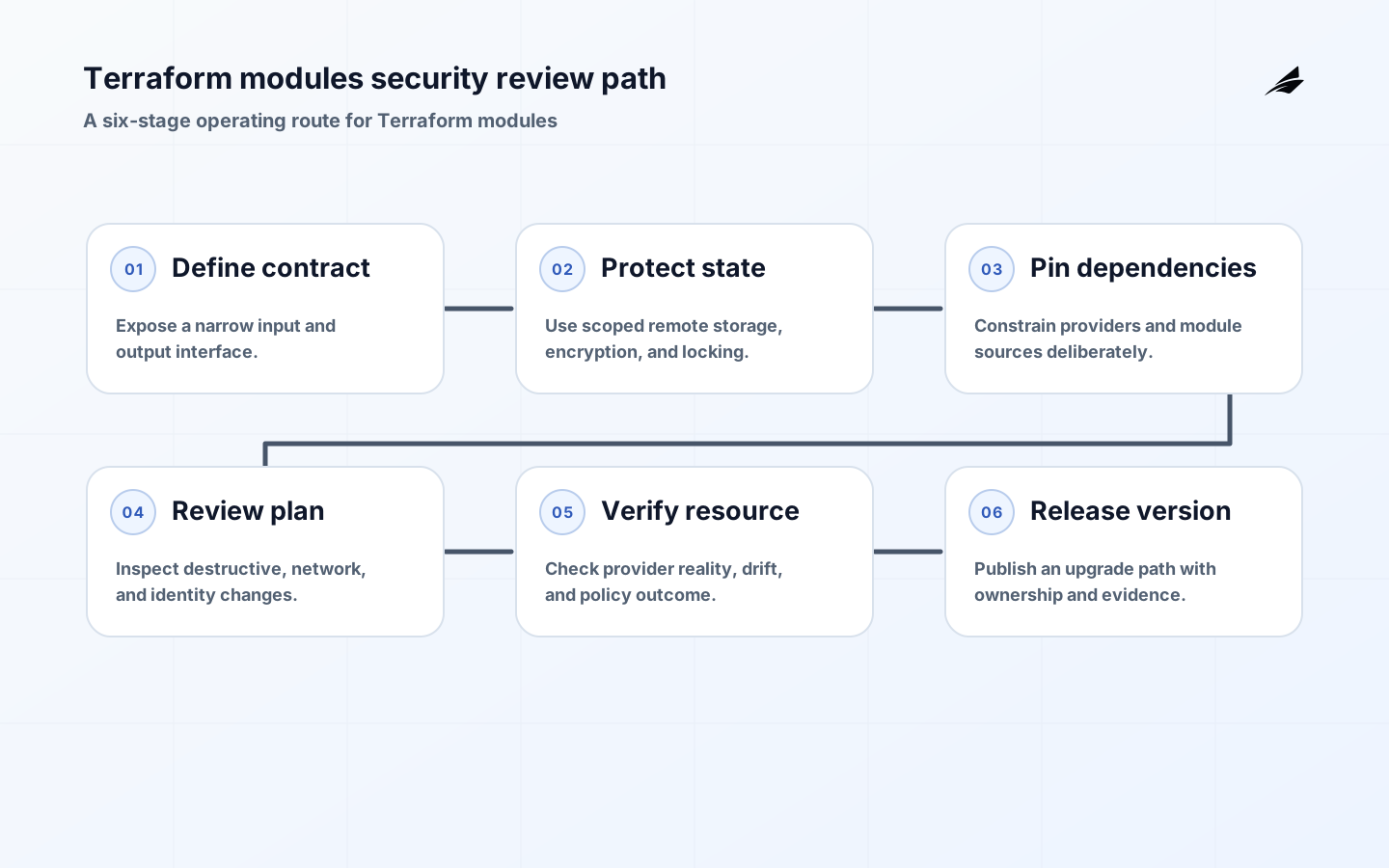
Terraform modules needs an operating model, not a loose collection of tools. Terraform modules package related resources behind an input and output interface. Their value is not reuse alone; it is the ability to make a proven infrastructure decision repeatable without concealing the security, network, identity, and lifecycle choices that still require review. A module that merely shortens files can spread a mistake quickly. This guide focuses on the choices that make the work inspectable by the people who build, operate, and support it.
Key takeaways
- Define the boundary and accountable owner before standardizing Terraform modules.
- Keep the records that explain an outcome close to the action that created it.
- Use controls that match the consequence of failure instead of copying generic checklists.
- Test an uncomfortable but realistic failure path while impact is bounded.
- Measure recovery and operating effort alongside speed or throughput.
- Turn repeated exceptions into an owned improvement rather than private knowledge.
What Terraform modules means in practice
A root module describes a particular deployment; child modules provide composable building blocks. Variables define the caller contract and outputs expose values that other configurations may consume. Version constraints communicate compatibility expectations, while the state file records managed resource data and can contain sensitive values. Treat both the module code and its state backend as part of the production control plane. For adjacent operating decisions, compare GitOps and cloud cost optimization.
| Decision area | Question to settle | Useful evidence |
|---|---|---|
| Boundary | What part of Terraform modules is in scope? | Named owner, entry point, and expected outcome. |
| Identity | Which version, record, or state is authoritative? | An inspectable identifier tied to the action. |
| Control | What condition must hold before expansion? | A test, review, or policy result with a decision rule. |
| Recovery | How will the team verify a safe outcome? | A documented action, check, and accountable responder. |
An operating model for Terraform modules
Give each module a narrow purpose, explicit required inputs, safe defaults only where the default is genuinely safe, and outputs that do not casually expose credentials or broad resource details. Separate environment-specific composition from reusable logic. Pin module sources and provider versions, format and validate plans in CI, and require a human review of the planned destructive or privilege-changing actions. The design should make the next decision easier for someone who did not create the original implementation.

A practical implementation path
Begin by extracting one repeated, understood pattern such as a private service with logging and restricted ingress. Write examples and a short contract before moving callers. Store remote state in a protected backend with encryption, locking, and access limited to the identities that need it. Use separate state boundaries when the blast radius, ownership, or access model differs, rather than one monolithic state for convenience. Prefer a sequence that creates evidence at every stage rather than a broad first release that makes causality difficult to recover.
Risks and controls to make explicit
Security failures often arrive through permissive defaults, opaque variables, and state exposure. A module should not make public ingress or administrator roles easy to create without a deliberate value and review. Do not print secrets in outputs, commit local state, or assume a sensitive variable will disappear from state automatically. Validate policy before apply and inspect the plan for changes that affect deletion protection, encryption, logging, or identity. Write the exception route down as well: an emergency action may be necessary, but it should leave an attributable record and return to normal control once the immediate condition is resolved.
| Stage | What to check | Decision rule |
|---|---|---|
| Prepare | Scope, identity, access, and prerequisites. | Do not proceed when ownership or required evidence is unclear. |
| Change | The control that addresses the main failure mode. | Pause when a required test, policy, or review fails. |
| Observe | Technical and user-facing consequences. | Expand only when the agreed signals remain inside bounds. |
| Recover | State, data, and follow-up work. | Close only after the relevant verification is recorded. |
Signals that show whether it is working
Track module version adoption, plan failures by cause, policy denials, drift findings, state access events, and time between a critical module fix and caller upgrades. Watch for modules with sprawling inputs or frequent environment-specific exceptions; they can indicate that one abstraction is trying to own unrelated decisions. An accepted plan is evidence of intent, not evidence that the provider resource now behaves as expected. Review the signals with a real example, because a metric becomes useful only when it changes a decision or confirms that an earlier decision was sound.
A Terraform modules checklist for the next change
Test a module in an isolated account or project with both its normal input and a boundary input that should fail, such as public access without an exception. Review the plan and the resulting provider configuration, then destroy the test resources or confirm lifecycle protections where destruction is not safe. This catches misleading defaults before a shared module becomes difficult to change. The result should be a short, owned change to the routine, not a retrospective statement that the team should have been more careful.
A worked decision example
A team has six near-identical storage configurations. The first module exposes only location, retention class, and an explicitly reviewed access mode; encryption and audit logging are enforced internally. A caller that tries to enable public access fails policy unless a documented exception is supplied. Remote state is separated from the workload state, so the deployment identity cannot rewrite its own control records.
How to phase adoption
Adopt Terraform modules by extracting a pattern that has stable intent and at least two real consumers, rather than turning every resource file into an abstraction. Capture the existing security decisions in a contract, add an example, and test normal and disallowed inputs in an isolated environment. Migrate one caller, inspect the plan and resulting provider state, then publish a versioned module with a clear upgrade note. This reduces the chance that a new module spreads a hidden local assumption across every environment.
Decision records and ownership
Keep a module decision record with its purpose, supported versions, state boundary, required identities, enforced controls, allowed exceptions, and owner. Link module releases to the plans that exercised meaningful changes. This evidence matters when an inherited default needs to change, because maintainers can identify callers and assess whether a migration affects public exposure, encryption, deletion protection, or audit behavior. A large variable list without this context is an interface that asks consumers to guess the security model.
Design boundaries that matter
Module interfaces should expose decisions a caller is qualified to make. A product team may choose an approved region or retention class, while a platform team should enforce encryption, logging, ownership tags, and a private network posture. If a caller needs a dangerous option, make it explicit, validate it, and require an exception path rather than burying it among dozens of permissive variables. This division keeps a module adaptable without turning every consumer into a security architect. It also produces clearer deprecation work: maintainers can identify which inputs represent real policy choices and which merely mirror provider defaults without value.
Deeper operating considerations
Drift deserves a stated response model. Some changes are emergency repairs that must be imported or represented in configuration later; others are unauthorized or accidental changes that should be reversed after review. Detecting drift without an owner leaves the team with a noisy report and no safe action. Define which identity may reconcile, when a refresh or import is appropriate, and how the original change is recorded. Then test the model on a harmless resource. This makes the difference between a desired-state tool and a tool that repeatedly overwrites real operations without understanding why the difference occurred.
A useful review cadence
Review modules through an ordinary upgrade, a policy denial, and a drift finding. Confirm that the version constraint behaves as intended, the plan explains consequences, and the state backend audit trail identifies the acting identity. Remove variables that are merely pass-through noise, but preserve explicit inputs for high-impact decisions. Each review should create a small change to documentation, tests, or policy so the module remains a trustworthy building block instead of an increasingly opaque convenience layer.
Frequently asked questions
Terraform modules should not become a single internal cloud product before their contracts are proven. Start with stable patterns that have several real consumers. A module version upgrade is an infrastructure change: inspect its release notes and plan, test it in an appropriate environment, and do not assume semantic versioning can explain a provider-side behavior change by itself.
Before expanding the practice
Before publishing a module to broad internal use, decide how it will be supported. State who reviews security changes, how breaking changes are announced, which provider versions are tested, and when an obsolete module version will stop receiving fixes. Publish examples that demonstrate the intended safe path and tests that exercise the controls maintainers promise to enforce. Consumers should be able to understand the module contract without reading every resource it creates, while maintainers retain enough transparency to explain important defaults. This support model prevents a module registry from becoming a collection of abandoned snippets that carry production authority without a current owner.
A final field test
Field test: plan a normal input and a prohibited input in an isolated environment, then inspect both the provider result and the state record. A module control is credible only when it is observable in both places.
Conclusion
Terraform modules should make infrastructure choices easier to inspect and safer to repeat. Keep the interface narrow, protect state, review plans, and prove the resulting resources match the intended control.