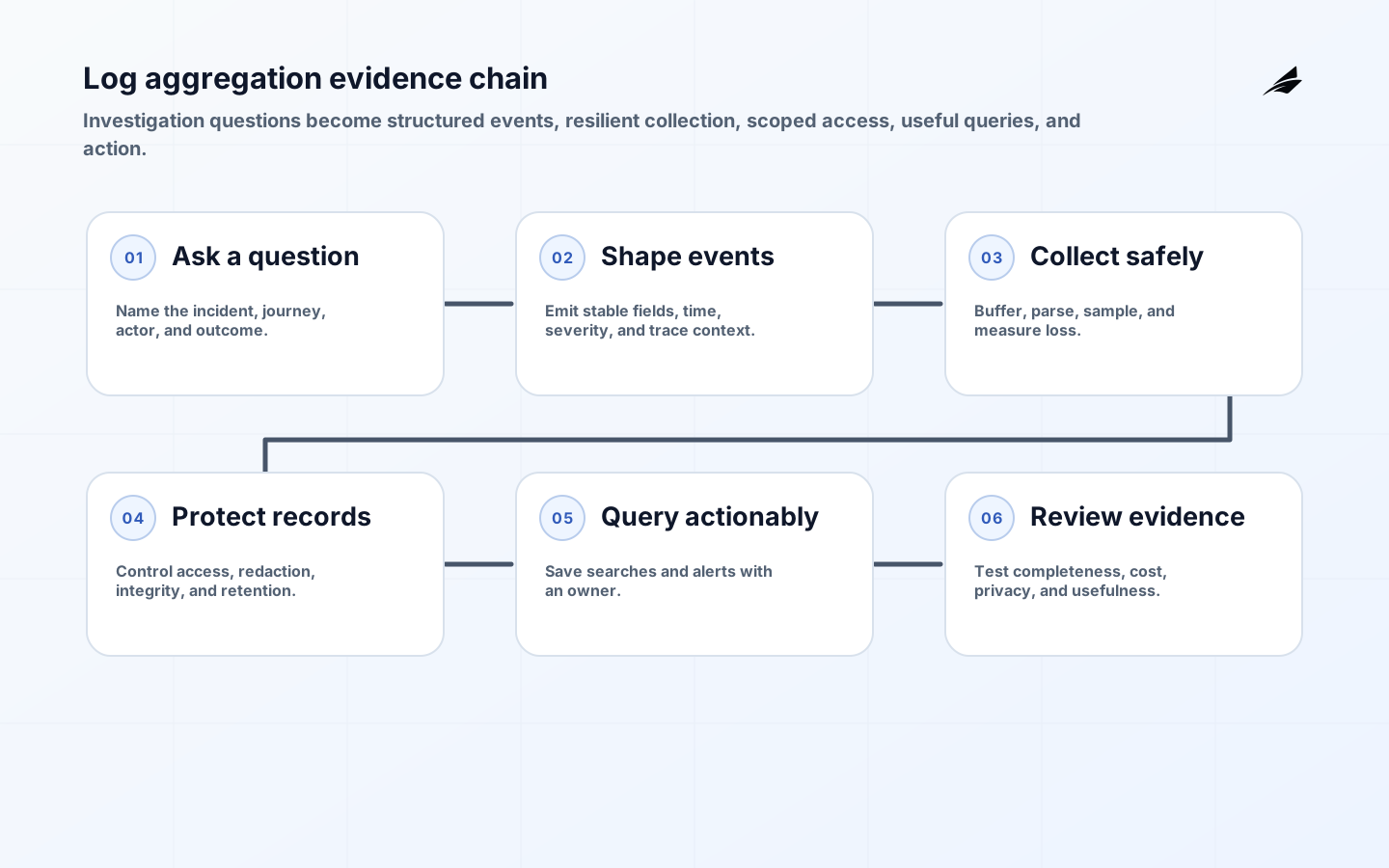
Log aggregation is useful when it helps an operator answer a specific question about a running system: which request failed, which version served it, what dependency changed, whether a customer action completed, or what evidence should be preserved for an incident. It is not an archive of every string a process emitted. The OpenTelemetry Logs Data Model defines common fields such as timestamps, trace context, severity, resource, body, and attributes. NIST SP 800-92 frames log management as an enterprise process of infrastructure, collection, protection, and maintenance.
Define investigation questions before choosing a collector or storage tier. Edilec’s SLO checklist, service mesh guide, and audit trail guide help separate diagnostic telemetry from audit evidence. Kubernetes’ logging architecture and Elastic’s log field guidance provide implementation references, but the useful schema is the one that supports the work and privacy boundary.
Start with the investigation question
List the questions an on-call responder, security investigator, product owner, and support operator must answer. Then identify the event, actor, service, environment, version, request or trace identifier, outcome, and time context required for each question. Distinguish logs from metrics, traces, and audit records; they complement one another. Avoid logging sensitive payloads merely because they might be convenient later. Capture a stable reference to the authoritative record and an explanation of what happened instead.
| Investigation need | Fields to preserve | Safe design |
|---|---|---|
| Trace a request | Trace ID, span ID, service, route, version, outcome. | Use correlation context and avoid raw payloads. |
| Explain a business action | Actor, subject, action, previous/result state, reason. | Store audit evidence in a protected authoritative system. |
| Find a platform failure | Resource, event time, observed time, severity, error type. | Normalize fields and retain raw context where needed. |
| Measure impact | Tenant or cohort reference, status, latency, completion. | Use pseudonymous identifiers and access controls. |
Design structured, stable fields
Use a small required field set and a controlled vocabulary for event names, severity, service, environment, deployment version, and outcome. OpenTelemetry distinguishes the event time from the time a collector observed the record; that distinction matters when queues or agents delay ingestion. Preserve trace and span context when available. Use attributes for event-specific facts but control cardinality so a label does not create an unbounded index. A schema should be versioned and documented with examples, not left to individual logging statements.
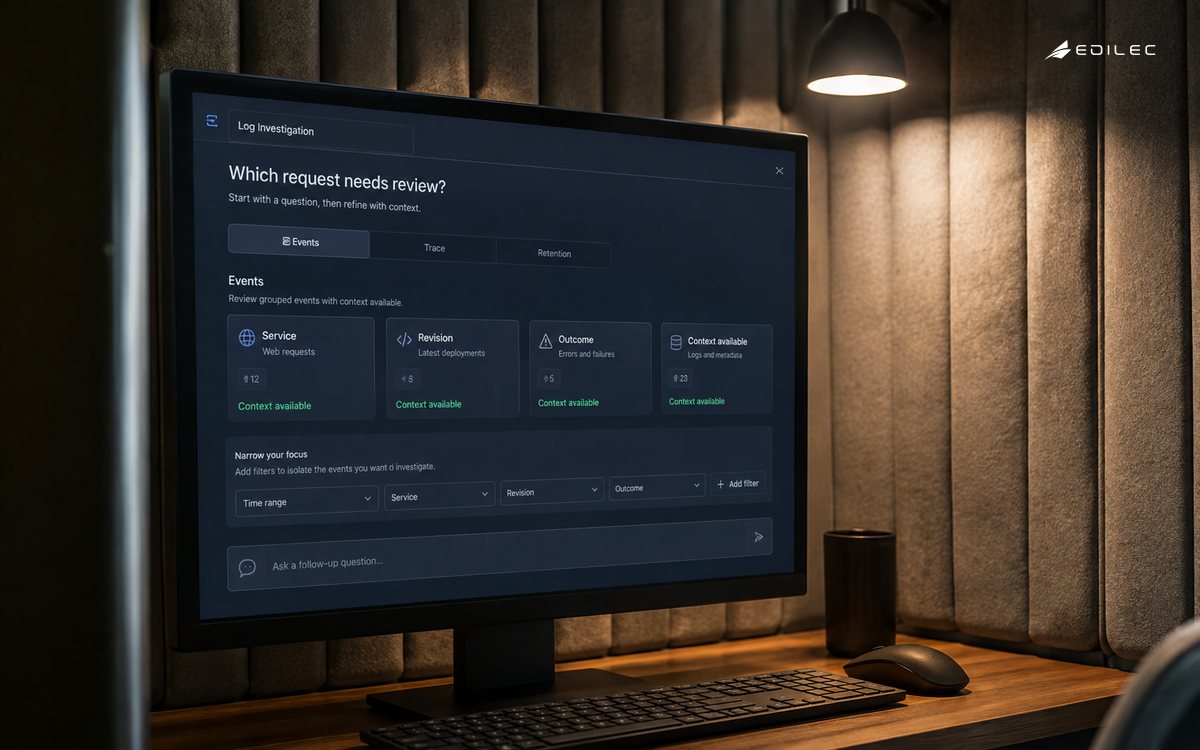
Build a resilient collection path
Decide what happens when a collector is unavailable, a destination is slow, or a node is under pressure. Buffer where the loss and disk risk are understood; sample noisy events while preserving security, error, and audit records. In Kubernetes, account for container lifecycle, node-level collection, stdout and stderr, ephemeral storage, and workload-specific side effects. Monitor ingestion lag, dropped records, parser failures, queue depth, and storage health. A central backend cannot recover an event that was never emitted or was silently discarded.
| Failure | Why it matters | Control |
|---|---|---|
| Clock skew | Events appear in the wrong order. | Time synchronization and both event and observed timestamps. |
| Collector loss | Incident evidence disappears at the source. | Bounded buffering, loss metrics, and fallback path. |
| Schema drift | Queries stop matching new versions. | Versioned contract and compatibility checks. |
| Sensitive data | Central storage expands exposure. | Classification, redaction, access, and retention rules. |
| Cost spike | High-volume logs crowd out useful evidence. | Sampling, quotas, tiers, and review by query value. |
Protect access, integrity, and privacy
Treat logs as sensitive operational data. Restrict who can search, export, change retention, and alter collection. Separate application writers from privileged readers where the evidence requires it. Redact tokens, passwords, personal data, and large payloads before aggregation, and test redaction on error paths. Keep audit events protected from the administrators who might be investigated. Retention should reflect operational, legal, security, and deletion obligations; longer is not automatically better.
Design queries and alerts around action
A query should lead to a decision: page a responder, open an investigation, reconcile a record, or explain a customer report. Save queries for common incident paths and test them against delayed, partial, duplicated, and out-of-order data. Pair a technical signal with a user outcome where possible. Avoid alerting on every error; alert when a threshold, pattern, or missing event crosses a defined consequence boundary. Document the owner and next action beside each alert.
Operate the logging service
Assign ownership for emitting useful events, maintaining collectors and storage, approving access, and reviewing cost and retention. Measure query latency, ingestion delay, dropped records, field completeness, redaction findings, access anomalies, retention consumption, and alert usefulness. Review one normal request, one boundary case, and one incident trace each month. If an operator still needs to log into several systems and guess at timestamps, improve correlation and source contracts before buying another dashboard.
Run a drill in which one service emits a new schema, the collector is delayed, and a request crosses three services. The operator should identify what evidence is trustworthy, which records are missing, how to reach the raw source, and whether the customer action completed. This tests the evidence chain rather than merely the availability of the logging backend. Record whether the fix belongs in instrumentation, collection, query design, access policy, or runbook ownership.
Review evidence quality, not volume
A logging review should take one investigation question and trace it from event emission to collection, storage, query, access, and decision. Check whether fields preserve meaning across services, whether event and observed times explain delay, whether trace context joins the path, and whether sensitive values were excluded. Review dropped events, parser failures, high-cardinality attributes, retention changes, and query latency. A large volume of records can still be poor evidence if an operator cannot identify the affected request or distinguish a source event from a collector symptom.
Consider a failed customer export that crosses an API, queue, worker, object store, and notification service. A useful record includes a stable export ID, trace context, tenant-safe reference, version, state transition, attempt number, dependency result, and final outcome. It does not include the full customer file or access token. With those fields, an operator can find the delayed worker, inspect the object-store result, and explain whether the notification was sent. Without them, the team may increase retention and still be unable to reconstruct the case.
Set a recurring sample review with responders, service owners, security, and finance or platform cost owners. Retire fields that do not support a question, improve fields that do, and test saved queries after schema or collector changes. Review whether alerts lead to action and whether the action improved a user outcome. Logging maturity grows through small corrections to instrumentation, collection, redaction, query, or ownership—not through an unbounded accumulation of events.
Preserve meaning when evidence is incomplete
An operator may investigate during ingestion delay, collector loss, clock skew, partial deployment, or a provider outage. Make those conditions visible in the logging system itself. Distinguish “no event occurred” from “the event was not observed,” and preserve source and observed timestamps where possible. Mark sampled or redacted records so a reviewer does not mistake an incomplete view for proof. Queries that expose their own evidence limits are more trustworthy than queries that silently return an empty result.
Be careful when joining records across tenants, environments, or retention tiers. Stable correlation is valuable, but a broad identifier can expose unrelated activity or encourage operators to bypass access controls. Use tenant-safe references, scoped search, and an audited route to privileged evidence. Test common investigations with the permissions an on-call responder actually has. Escalation should be a defined workflow rather than an invitation to copy sensitive logs into an unprotected channel.
Log quality is shared across the service team that emits events, the platform team that collects and stores them, and the security or governance owner that controls access and retention. Incident responders need a documented route to each owner when a query is incomplete or a sensitive record is required. Cost ownership also matters: a service that emits unbounded debug data can consume the budget and hide important events. Make these responsibilities visible in the schema, runbook, and review cadence.
Log aggregation should serve different audiences without creating a single unrestricted data lake. On-call responders need fast, scoped operational queries; security investigators may need protected access to a longer history; product and support teams need customer-safe evidence; and service owners need feedback on event usefulness. Define views and permissions for those purposes. Keep raw records, normalized fields, derived alerts, and audit evidence distinguishable. This design improves privacy and makes retention decisions more precise because each record has a stated role instead of being kept indefinitely “just in case.”
Keep a small evidence pack for common investigations: one request trace, one failed transition, one access-denial case, and one delayed-ingestion case. Re-test it after instrumentation, collector, schema, or retention changes. This simple practice exposes whether logging remains usable for the questions it was designed to answer.
Key takeaways
- Design logging from investigation questions and user outcomes.
- Use stable structured fields, trace context, event time, observed time, and controlled attributes.
- Make collection loss, schema drift, privacy, retention, and cost visible.
- Separate diagnostic telemetry from protected audit evidence.
- Connect saved queries and alerts to an owner, a decision, and a recovery path.
Frequently asked questions
Question: Is collecting more logs always better? Answer: No; structured fields, trustworthy timestamps, privacy controls, useful retention, and an investigative question matter more than volume. Question: What should an aggregation design preserve? Answer: Event identity, source context, correlation, access history, and the ability to reconstruct an incident without exposing unnecessary data.
What makes aggregated logs useful during an incident?
Answer: Stable fields, trustworthy timestamps, searchable correlation IDs, complete collection, appropriate retention, and a query that leads to a decision make logs useful.
Should every log be retained forever?
Answer: No. Retention should match investigation, security, legal, and cost requirements. Keep high-value evidence longer and remove sensitive or low-value noise deliberately.
How should missing logs be handled?
Answer: Treat collection gaps as an observable failure, state the evidence limitation, use another signal where possible, and repair the source or transport rather than guessing.
Should every request be logged? Not necessarily; preserve meaningful transitions, security events, failures, and enough context for the stated investigations. Are logs the same as traces? No; logs record events, while traces connect spans across a request. How long should logs be retained? Match operational, security, legal, and privacy needs, then tier or delete deliberately. Who owns log quality? Service teams own useful emission, platform teams own collection, and security or governance owners set access and retention boundaries.
Conclusion
Log aggregation produces operational evidence when events remain structured, correlated, protected, and usable under pressure. Begin with questions, build a resilient collection path, protect sensitive fields, and test the queries that support decisions. The goal is not more logs; it is faster, fairer, and more explainable action when the system behaves unexpectedly.