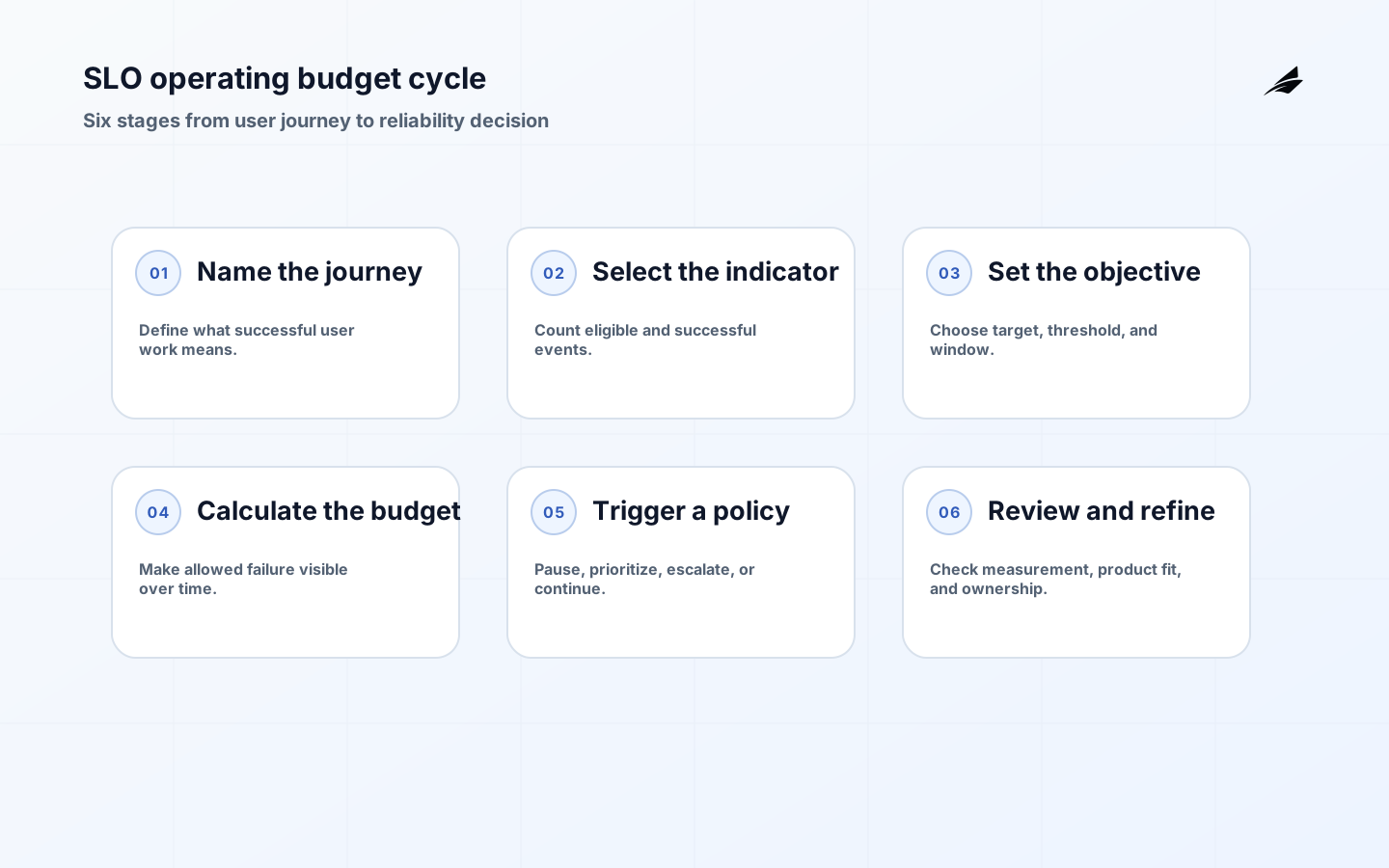
Service level objectives, or SLOs, are reliability targets measured against a service level indicator that represents a user experience. They matter because every service will fail sometimes; the engineering question is how much failure is acceptable for a defined period and what trade-off the team makes as it approaches that limit. An SLO is not an uptime slogan printed on a dashboard. It is a decision tool for prioritizing reliability work, release risk, capacity, and customer communication. The Google SRE Book's SLO chapter remains a strong starting point because it ties objectives to the user-visible service rather than the health of individual machines.
An SLO practice needs an owner, trusted indicator, policy boundary, recovery path, and evidence that the objective reflects user impact. The NIST AI Risk Management Framework and NIST Generative AI Profile provide lifecycle context for AI systems, especially when user impact must govern the objective. For Cloud and DevOps work, Google SRE release engineering, Kubernetes documentation, and NIST incident response guidance anchor repeatable change and recovery, especially when user impact must govern the objective. The OWASP LLM guidance adds a threat lens for model-connected services, and OpenSLO specification makes service objectives portable, especially when user impact must govern the objective. Connect the decision to Docker images, Kubernetes deployments, and SLOs when the decision crosses delivery boundaries, especially when user impact must govern the objective. Test ordinary work, missing evidence, stale state, unauthorized requests, partial failure, and recovery, especially when user impact must govern the objective. Keep the first bounded result in a change record, review exceptions with the people who own the work, and use the evidence to decide whether to expand, narrow, or stop, especially when user impact must govern the objective. The boundary is part of the service operating record.
Choose a user-centered indicator
Begin with a critical journey and ask what a user considers successful. For an API, that may be valid responses within a latency threshold; for checkout, completed payments; for a document service, accepted and retrievable documents. Define the eligible events, successful events, exclusions, data source, and aggregation window. Avoid indicators that are easy to collect but disconnected from the experience, such as host uptime. A healthy process can still return incorrect results or make users wait. The Google SRE Workbook on implementing SLOs recommends starting small; one meaningful indicator is better than many targets nobody uses.
| Term | Purpose | Example |
|---|---|---|
| SLI | Measured behavior | Successful checkout requests |
| SLO | Target over a window | 99.9 percent success in 28 days |
| Error budget | Allowed failure | 0.1 percent of eligible requests |
| SLA | External commitment | Contractual service term |
Set an objective and window that fit the service
A target must reflect user expectations, business cost, architecture, and the team's ability to respond. A very high number can consume engineering capacity without meaningful customer benefit; a weak target can normalize avoidable harm. Choose a rolling or calendar window deliberately. A rolling window smooths the boundary and is often easier to operate; a calendar window can match reporting needs but creates reset behavior. State how planned maintenance, client errors, dependency failures, and low traffic are treated. The objective becomes credible when a reviewer can reproduce it from the data and explain its limitations.
- Set targets from observed service behavior and customer need, then review them as the product changes.
- Keep event definitions versioned so changes in measurement do not masquerade as reliability improvement.
- Use a reasonable minimum traffic rule for sparse services.
- Pair availability objectives with latency or correctness when users need both.
Turn the error budget into a policy
The error budget is useful only when it changes behavior. Agree on actions before it is exhausted: increased review for risky releases, a hold on discretionary changes, focused reliability work, or an incident review when burn accelerates. Do not use it as an automatic punishment mechanism. A rapid burn can justify immediate containment even when the remaining monthly budget looks healthy; a slowly consumed budget may reveal chronic quality issues. Google Cloud SLO monitoring guidance describes burn-rate alerting, which is valuable when paired with an explicit on-call and product response.
| Budget state | Interpretation | Typical response |
|---|---|---|
| Healthy | Normal risk capacity | Release through ordinary controls |
| Elevated burn | Failure is consuming budget quickly | Investigate, increase release scrutiny |
| Near exhaustion | Little room for new risk | Prioritize reliability and limit change |
| Exhausted | Objective missed | Restore service and review policy or design |
Protect measurement integrity
The SLO is only as trustworthy as its data pipeline. Monitor missing telemetry, denominator shifts, delayed events, label changes, and alert delivery. Keep a clear source of truth for the calculation rather than letting several dashboards show slightly different percentages. If a new release changes an endpoint or instrument name, update measurement with the release and record the transition. The OpenSLO specification can help make definitions portable, but it does not remove the need to validate that the generated query matches the customer journey. Treat an unknown data state as a reliability concern, not as evidence of success.
Review objectives with product and engineering
Review SLOs on a cadence that matches service change. Look at missed objectives, top contributors to error, release correlation, customer impact, and whether the budget policy actually guided decisions. Invite product partners because reliability targets are business choices as much as technical ones. Retire indicators that no longer represent the journey and add segmentation only when it supports a distinct decision, such as separating paid tiers or regions. An SLO program matures by keeping a small set of targets consequential, not by producing an exhaustive reliability catalog.
Put SLO decisions into the operating routine
- Define the operating boundary for service level objectives in terms of user journey, eligible event, success definition, error budget, and response policy; this turns a broad technical theme into work that an accountable team can review and improve.
- Name the user outcome and safety signals before changing anything. For this practice, compare indicator freshness, budget burn, customer impact, release correlation, and measurement gaps with an explicit baseline rather than relying on a tool status alone.
- Record assumptions that affect the decision, including demand, dependencies, time windows, and ownership, especially when user impact must govern the objective. An assumption that stays implicit cannot be tested when conditions change.
- Choose a reversible first action and document the recovery path. This limits the cost of learning and gives the responder a known control when the observed result differs from expectation, especially when user impact must govern the objective.
- Keep the evidence close to the service: versioned configuration, a short decision record, relevant dashboards, and the runbook used by the person who receives the alert, especially when user impact must govern the objective.
- Review the change at a cadence that matches its risk. Look for a target detached from customer value, untrusted telemetry, or a budget with no decision rule; treat recurring exceptions as design feedback rather than as a reason to normalize manual work.
- Separate what the service team owns from what a shared platform or partner owns, especially when user impact must govern the objective. The boundary should state who acts, who supplies evidence, and who approves an exception, especially when user impact must govern the objective.
- Test the uncomfortable path deliberately. A quiet success case is not enough; exercise degraded dependencies, delayed work, recovery, and the handoff between ordinary operation and incident response, especially when user impact must govern the objective.
- Use a small representative pilot before broad rollout. Capture what users actually did, which controls confused them, and whether the intended guardrail was visible at the moment of decision, especially when user impact must govern the objective.
- Make exceptions visible, time-bound, and reviewable. An exception is useful when it reveals a real constraint; it becomes debt when it quietly replaces the supported path, especially when user impact must govern the objective.
- Avoid measuring activity as proof of value. Count completed, safe outcomes and the effort required to achieve them, then use both quantitative evidence and operator feedback to choose the next improvement, especially when user impact must govern the objective.
- Preserve context after an incident or failed change: identifiers, configuration state, timing, observed behavior, and the recovery action, especially when user impact must govern the objective. This is more useful than a generic summary when the pattern returns, especially when user impact must govern the objective.
- Review interfaces and contracts at the same time as the primary control, especially when user impact must govern the objective. Many failures appear at boundaries: a client behavior, a delayed message, an identity assumption, or a shared dependency, especially when user impact must govern the objective.
- Give the normal path a clear owner and a usable escalation route, especially when user impact must govern the objective. Teams adopt controls that help them act quickly under pressure and abandon ones that require private knowledge to recover, especially when user impact must govern the objective.
- Retire outdated rules when architecture, product demand, or customer commitments change. Keeping old controls without their original context can create risk as surely as leaving a system unconfigured, especially when user impact must govern the objective.
- Turn the result into the next default for service level objectives: keep what protected the outcome, simplify what caused friction, and schedule the next review while the evidence is still fresh.
Annotate the indicator when a telemetry change or known measurement gap affects it, so a sudden budget movement can be interpreted without confusing instrumentation behavior for customer harm.
Key takeaways
- An SLO begins with a user-visible successful outcome.
- Define event eligibility, measurement source, and exclusions so the target can be reproduced.
- Use the error budget to guide release and reliability decisions before pressure arrives.
- Monitor the measurement pipeline as carefully as the service signal.
- Review objectives with product and engineering as customer needs evolve.
Frequently asked questions about service level objectives
Question: Is 99.99 percent always a better SLO? Answer: No. The target should reflect user need, business cost, architecture, measurement confidence, and the team’s response capacity. Question: Do dependencies belong in an SLO? Answer: Include them when users experience their failure through the service, and document the indicator, exclusions, and ownership clearly.
Is 99.99 percent always better? No. The right objective balances customer need and engineering cost. Do dependencies count? They count when users experience their failure through your service; define the treatment clearly. Can low-volume services have SLOs? Yes, but use longer windows, synthetic checks, or careful minimum-event rules. Are SLAs and SLOs the same? No. An SLA is an external commitment; an SLO is an internal operational target that may inform it.
Conclusion
An SLO review should include the people who experience the journey, not only the team that owns the telemetry. Product can explain which failures matter; support can identify confusing degradation; engineering can test the indicator; and operations can connect budget movement to release or capacity decisions. Revisit targets after a material product, dependency, or traffic change. If an objective is routinely met without influencing decisions, it may be measuring the wrong thing or lack an attached policy. If it is routinely missed, first inspect event eligibility and instrumentation before lowering the target. Reliability improves when the number changes behavior.
Well-designed SLOs make reliability work easier to prioritize because they connect technical signals to a user promise and a response policy. Start with one important journey, protect the measurement, and let the error budget shape real decisions.