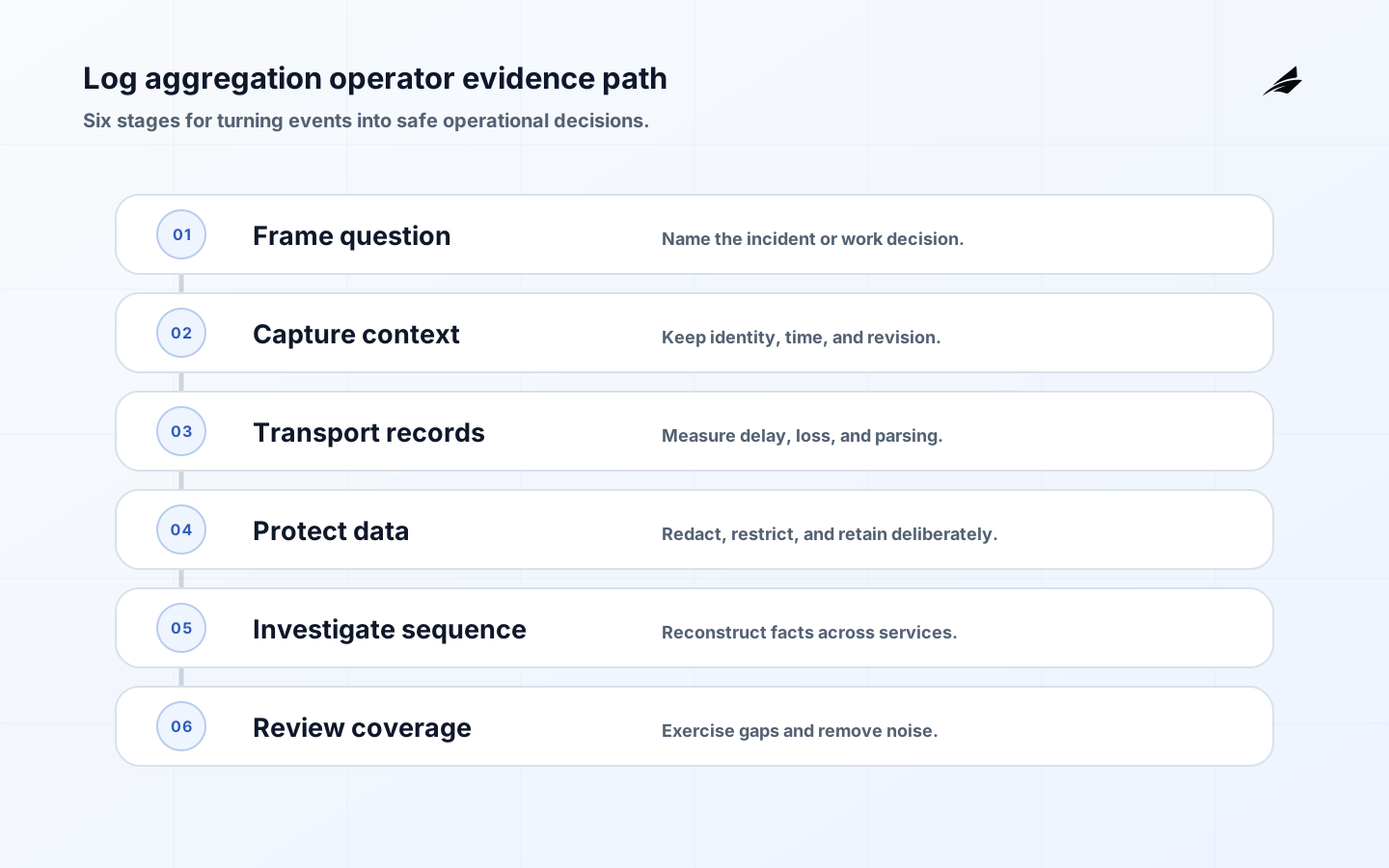
Log aggregation is useful when it helps someone make a real operational decision: identify the affected customer path, distinguish a bad release from a failing dependency, contain a security event, or prove that recovery occurred. A central store is not automatically trustworthy. Records can be incomplete, duplicated, delayed, too expensive to query, or so sensitive that responders cannot access them. The AWS Well-Architected Framework treats architecture as a set of trade-offs to review, while the Google SRE Book emphasizes monitoring that supports action. Start with the question an operator must answer and design the evidence path around it. Related decisions are covered in observability before the first build and incident response before the first build.
Define the decision boundary for log aggregation
Name the service or workflow, the event an operator needs to reconstruct, the owner who may act, and the retention and access boundaries. For a checkout failure, useful records may include request identity, release revision, dependency result, latency, and customer-safe outcome; copying full payment content into every log is unnecessary and risky. The OpenTelemetry logs guidance provides shared concepts for instrumentation, but the local contract should state which fields are authoritative, how clocks are interpreted, and what evidence is required to close an incident. Scope creates a useful test rather than a platform-sized aspiration.
| Log question | Evidence to collect | Boundary |
|---|---|---|
| What happened? | Event name, timestamp, service, revision, and outcome. | Do not infer sequence from arrival order alone. |
| Who or what acted? | Authenticated actor, workload identity, and correlation ID. | Minimize personal data and protect access. |
| Where did it fail? | Dependency, status, retry, and error category. | Avoid raw secrets and uncontrolled payloads. |
| Can it be replayed? | Schema, source, retention, and sampling state. | State what evidence may be missing. |
Design the log architecture around evidence
Collect structured events close to the action, preserve a stable correlation identifier, transport them reliably, and make parsing failures visible. Separate application events, security events, audit records, and diagnostic detail where their access and retention needs differ. Normalize only enough to support the questions that matter; a lossy transformation can remove the context needed for investigation. Keep source timestamps and arrival timestamps when delay matters. In distributed systems, an aggregation tier should make a late or missing event visible rather than presenting a clean but incomplete timeline.

Kubernetes workloads add lifecycle and identity context that should survive collection: namespace, workload, pod or task identity, node where relevant, container image, and deployment revision. Do not let an ephemeral instance name become the only key. Record schema version so parsers and dashboards can evolve deliberately. A log pipeline is part of the production path; monitor its queue, drop rate, delivery delay, storage health, and query availability. If the logging service is degraded during an incident, the responder needs to know what confidence to place in its absence of evidence.
Apply controls that match log aggregation risk
Logs often contain identifiers, user input, stack traces, and business context. Define redaction rules before collection, not after a sensitive record has spread across replicas and backups. Restrict write and read paths separately, use role-based access, encrypt transport and storage, and establish retention by purpose. Audit access to high-sensitivity records. Never put credentials, session tokens, or full payment details in routine logs. The Kubernetes concepts documentation is a useful reminder that workload and namespace boundaries affect the context an operations system must preserve; they do not replace a data-classification decision.
| Risk | Consequence | Control |
|---|---|---|
| Sensitive payload | A diagnostic record becomes a data exposure. | Redact at source and test representative inputs. |
| Unbounded retention | Cost and access risk grow without a purpose. | Set retention by evidence need and legal policy. |
| Dropped events | An investigation misses the decisive moment. | Measure loss, queue pressure, and fallback behavior. |
| Schema drift | Queries silently stop finding important events. | Version schemas and validate producer changes. |
Roll out log aggregation in increments
Choose one customer path and one incident question. Instrument the producers, prove the fields, test redaction, and run an investigation from the aggregated view. Compare the result with the existing local logs before removing any source. Add a second dependency only after the first path has an owner and a useful runbook. This approach exposes clock, identity, and cost problems while the team can still repair them. A central system that absorbs every source before anyone knows how it will be used usually becomes a large archive rather than an operational capability.
Operate log aggregation with decision-ready signals
Monitor ingestion rate, delay, drop rate, parser failures, storage growth, query latency, retention compliance, and access anomalies. Pair platform signals with investigation outcomes: could a responder reconstruct the timeline, locate the owner, identify the change, and verify recovery? Review a normal request, a dependency failure, a security-relevant event, and a missing-log scenario. Use the observability engineering notes and SLO guide when aggregation must support broader reliability decisions.
Review log evidence trade-offs
More detail can improve diagnosis and increase privacy and cost exposure. Longer retention can support trend analysis and create a larger breach impact. Aggressive sampling can make routine queries cheaper and hide rare failures. Make those trade-offs explicit per event class. If an operator needs a high-detail trace for a short period, provide a controlled path with an approval and expiration rather than permanently collecting everything. The review should ask whether the evidence changed a decision, whether users were protected, and whether the data cost is justified by the value of the questions it answers.
Log ownership should include the producer contract. Give each important event class a steward who can explain its fields, timestamp, sensitivity, and expected consumers. When a service changes a schema, run representative queries and incident exercises before retiring the old field. A parser that fails silently can create more danger than a visible ingestion outage because responders may trust an incomplete view. Treat schema review as part of the change process. This boundary belongs in the service review record.
Build a small evidence catalogue for responders. For each high-value journey, state where request identity, deployment revision, dependency result, and user outcome can be found. Include access instructions that work during an incident and a fallback when the primary store is unavailable. This is more useful than a catalogue of every dashboard because it tells a responder which records support a decision and which are only diagnostic context. This boundary belongs in the service review record.
Cost controls should preserve the ability to investigate rare but important events. Keep security, authorization, state-change, and recovery records out of aggressive sampling, while applying shorter retention or summarized storage to routine detail. Review query patterns and remove unused copies rather than reducing evidence blindly. If a cost increase follows a new source, compare its investigation value with the data volume and adjust collection at the producer. This boundary belongs in the service review record.
Practice the absence case deliberately. Stop a collector, delay a transport, corrupt a schema in a test stream, and ask whether the monitoring system tells the team what is missing. Confirm that the responder can distinguish no events from no traffic and can use a local or upstream source to continue the investigation. Trust grows when the logging system reports its own limits honestly. This boundary belongs in the service review record.
Give each event family a contract that names its producer, semantic version, clock basis, sensitivity, and expected consumer. A checkout log, deployment event, and security audit record can share correlation conventions while requiring different retention and access. Put the contract beside the producer so a schema change is reviewed before downstream queries begin to drift.
When a log schema changes, publish an overlap window with representative queries, parser checks, and an incident exercise. Keep old and new fields distinguishable, state which one is authoritative, and set the removal date in the change record. This turns migration into an observable operation rather than a quiet rewrite that leaves responders guessing.
Treat a parser failure as a data-quality incident even when the transport remains green. Compare producer counts with parsed counts, surface malformed records, and route the discrepancy to the team that owns the event format. A visible partial view is safer than a polished dashboard that implies complete coverage while silently dropping the records needed for diagnosis.
Practice an absence case that matches the log system’s real failure modes: delayed batches, a rejected schema, a full buffer, and a query that crosses a retention boundary. Ask the responder to prove whether no events means no traffic, no collection, or no access. The exercise should end with a documented alternate source and a repair owner.
Key takeaways
- Start with a decision and an investigation question, not a storage product.
- Preserve identity, time, schema, revision, and correlation across the event path.
- Redact sensitive data at the producer and separate access from collection authority.
- Measure missing, delayed, and malformed evidence as operational failures.
- Roll out one customer path at a time and prove the evidence with a real exercise.
- Balance detail, retention, privacy, query cost, and the consequence of missing logs.
Frequently asked questions about log aggregation
Should every application log the same fields? Use shared identity and time conventions, but allow domain fields that answer local questions. Is centralized logging always better? It can improve correlation, but local fallback and source ownership still matter. How long should logs be retained? Long enough for the stated investigation and compliance purpose, with shorter high-detail retention where possible. Are logs an audit trail? Some records may be, but diagnostic logs should not be treated as authoritative unless their integrity and access controls support that use. Can sampling be safe? Yes when the missing evidence is understood and important event classes are protected.
Conclusion
Log aggregation earns trust when it turns scattered events into evidence a responsible operator can use without creating a new privacy or cost problem. Define the question, preserve meaningful context, control access and retention, test the missing path, and review whether the records improve decisions. A smaller, dependable evidence path is more valuable than an enormous archive nobody can safely interpret.