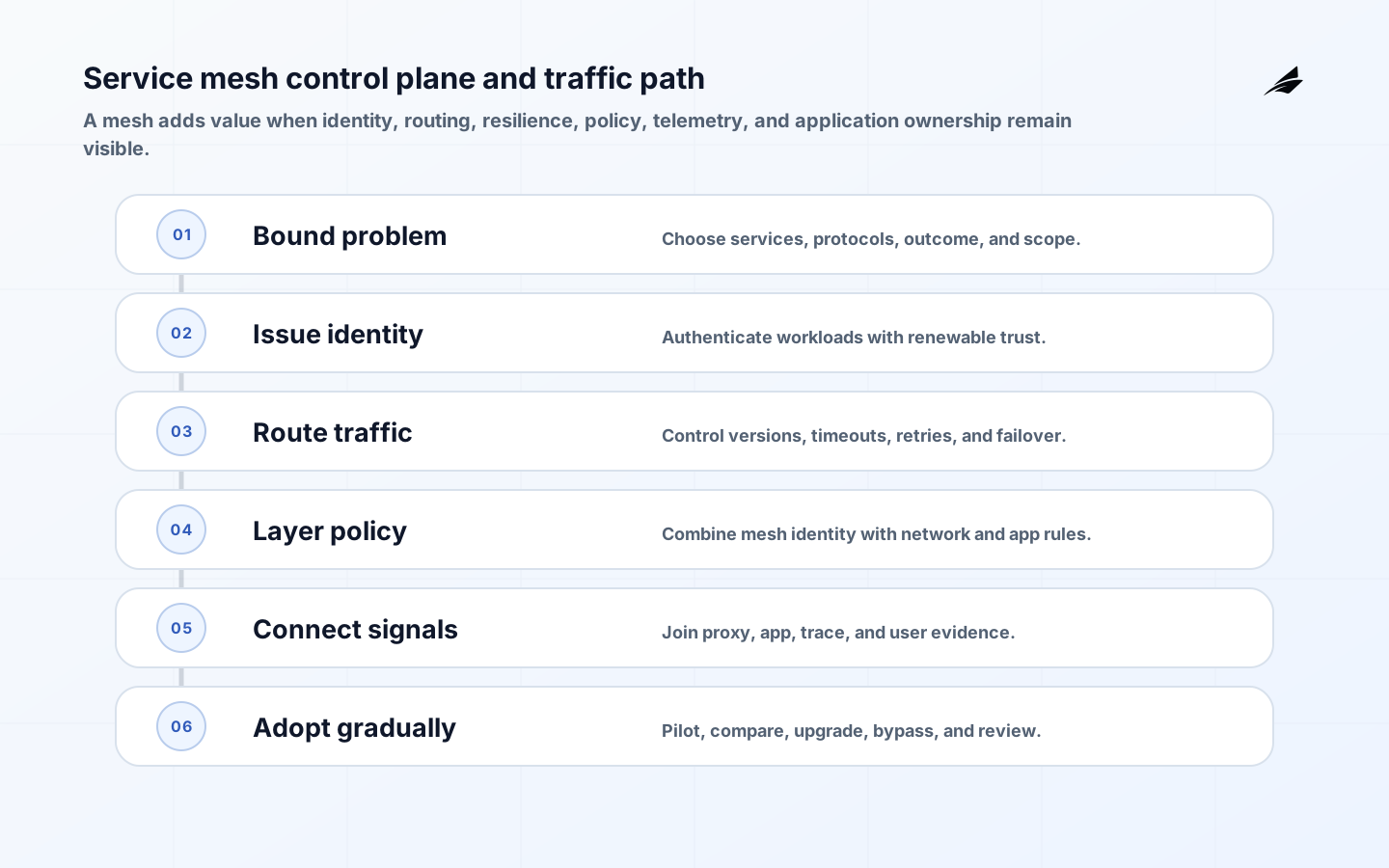
A service mesh is a platform layer for controlling and observing communication among workloads. It can provide traffic routing, retries, timeouts, mutual authentication, authorization, and telemetry without requiring every application team to implement each mechanism separately. That power is also the risk: a mesh can multiply configuration, hide application semantics, and create a new control plane whose failure affects every service. The Istio traffic-management guide shows how proxies and routing rules shape traffic; the NIST zero trust architecture keeps identity and policy at the centre rather than network location.
Use a service mesh to solve a defined cross-service problem, such as workload identity, controlled canary routing, or consistent telemetry. Edilec’s service mesh decisions guide, container security guide, and Kubernetes deployment checklist help separate mesh benefits from general platform requirements. SPIFFE’s identity overview provides a useful model for workload identities that do not depend on mutable network addresses.
Define the problem and boundary
Name the services, protocols, environments, owners, and user outcomes in scope. Decide whether the mesh will handle east-west traffic, ingress, egress, or only a bounded namespace. Record what remains the application’s responsibility: business authorization, input validation, transaction semantics, retries that are safe for the operation, and domain-level observability. A mesh should provide a consistent substrate, not obscure the contract of the service it carries.
| Capability | Useful decision | Boundary to protect |
|---|---|---|
| Traffic routing | Can traffic shift or fail over safely by version and locality? | Application compatibility and business signal. |
| Workload identity | Can a workload prove who it is without shared credentials? | Identity issuance, trust domain, and rotation. |
| Authorization | Which service calls are allowed and under what context? | Application-level decision and data ownership. |
| Resilience | Which retries, timeouts, and circuit breaks are safe? | Idempotency, queue semantics, and user latency. |
| Telemetry | Which signals help an operator answer a real question? | Cardinality, privacy, cost, and access. |
Build identity before policy complexity
Use workload identity that can be issued, rotated, verified, and revoked. SPIFFE describes a standard way to identify workloads through a SPIFFE ID and obtain verifiable identity documents. Bind policy to workload identity and request context, not merely namespace or IP address. Keep application authorization in the service because the mesh may know that service A called service B but not whether the user may access a particular record. Test identity expiry, trust-domain migration, clock skew, and a workload that should be denied.

Control traffic without surprising applications
Istio’s virtual services and destination rules can decouple a client-facing host from service versions and support percentage-based routing, timeouts, retries, circuit breakers, mirroring, and fault injection. These features are valuable only when the application contract supports them. Retrying a non-idempotent write can duplicate a business action; a timeout that is shorter than a downstream transaction can create ambiguous completion. Start with explicit routes, conservative retries, and a clear owner for every policy.
| Failure mode | Why a mesh can amplify it | Control |
|---|---|---|
| Retry storm | A shared policy retries an already overloaded dependency. | Retry budgets, idempotency, backoff, and dependency signals. |
| Policy shadowing | A broad rule hides a narrower rule or applies unexpectedly. | Configuration validation, scopes, and review of effective policy. |
| Identity outage | Workloads cannot establish or renew trust. | Expiry monitoring, controlled fallback, and recovery exercise. |
| Telemetry overload | Every proxy emits high-cardinality data. | Sampling, quotas, data classification, and useful queries. |
| Sidecar mismatch | An application bypasses or misunderstands the proxy path. | Admission checks, compatibility tests, and documented exceptions. |
Layer mesh policy with network controls
The Kubernetes NetworkPolicy documentation describes network-layer allow and deny rules. Use those rules as a complementary boundary, not a replacement for identity-aware authorization. Confirm which CNI and enforcement behaviour the cluster provides, test default-deny assumptions, and include DNS, observability, control-plane, and egress dependencies. A policy that works in one namespace may fail when a service moves, a new gateway is added, or a worker uses a different protocol.
Make mesh telemetry answerable
Expose request rate, errors, latency, retries, response codes, connection state, policy denials, identity failures, and version. Link proxy evidence to application logs and traces with stable context. Keep an operator path from user symptom to service, route, policy, and workload. Watch control-plane convergence and configuration distribution as well as data-plane traffic. A dashboard with thousands of proxy metrics is not observability if no one can identify the failing customer journey or safe next action.
Adopt the mesh incrementally
Start with a small service group and one measurable problem. Run in permissive or observational mode where the product risk permits, validate identity and telemetry, then enforce one policy at a time. Establish compatibility tests, configuration review, upgrade procedure, and a way to remove a workload from the mesh safely. Compare latency, failure, operational effort, and incident evidence before expanding. If the mesh adds more complexity than the problem requires, stop or narrow it.
Rehearse a control-plane outage, certificate expiry, proxy resource pressure, bad route, denied egress, and a retry storm. The team should know which services remain available, how to pause policy delivery, where the authoritative configuration lives, and how to restore a safe route. Record whether the failure belongs in identity, platform, application, or runbook design. This is the difference between a mesh that demonstrates features and one that improves operations.
Review the mesh by service outcome
A mesh review should begin with a service journey and then inspect the effective route, identity, authorization, network policy, timeout, retry, circuit-breaker, telemetry, and control-plane state that shaped it. Do not review only the YAML or only the proxy dashboard. Ask which policy applies to a real request, which identity the target verifies, what happens during certificate renewal, and how an operator can disable a bad route. Effective configuration and observed behaviour are the evidence that matters.
Suppose a new catalogue version receives ten percent of traffic. A mesh can shift requests precisely, but the catalogue may call a pricing service with a different contract. A retry on a price lookup may be safe, while a retry on an inventory reservation may not be. The review should combine route weights, application idempotency, downstream saturation, user conversion, and rollback. This keeps traffic management from becoming a platform-only exercise that misses the business effect.
Set a cadence for identity expiry, policy review, telemetry cost, version upgrades, and resilience exercises. Revisit the mesh boundary when services, clusters, protocols, or trust domains change. Remove rules that have no owner or observed value, and document exceptions that bypass the proxy or network policy. A growing team benefits when the mesh reduces repeated implementation work while preserving the ability to reason about a single request from edge to service and back.
Keep mesh exceptions visible
A service may bypass the mesh for a legacy protocol, a high-throughput path, a vendor connection, or a workload that cannot tolerate proxy overhead. That can be a rational boundary, but it must be documented with identity, network, telemetry, and recovery implications. Do not let an exception silently become a second architecture. Record who approved it, what control replaces the mesh policy, how it is tested, and when the boundary will be revisited.
Likewise, do not assume a mesh policy can see every business context. A proxy can enforce that a workload may call an endpoint, while the application must still decide whether the authenticated user may view a particular account or whether a write is idempotent. Make the handoff between platform policy and application policy explicit. This reduces both overconfidence and duplicate rules, and it gives incident responders a way to identify which layer made the wrong decision.
A mesh needs clear ownership across control plane, workload identity, traffic policy, network enforcement, application authorization, and user-facing reliability. Do not assign all failures to the platform team when a service owns idempotency or data access. Conversely, do not ask every service team to invent its own trust and telemetry controls. An ownership map and a short escalation path make it possible to locate the right layer quickly when a route, certificate, policy, or dependency behaves unexpectedly.
A mesh rollout should include a way to compare the application with and without the mesh. Measure added latency, resource use, failure behaviour, configuration convergence, certificate operations, and responder effort. Keep a removal or bypass procedure for the bounded pilot and prove that it does not strand traffic or weaken a necessary control. This comparison gives a growing team permission to narrow the platform when a feature does not earn its cost. It also prevents the service mesh from becoming a requirement that no one can safely question after adoption.
Keep mesh policies small enough to review. Every timeout, retry, route, identity rule, and exception should have an owner and a reason. Remove rules whose purpose is no longer clear, and test upgrades against the effective policy rather than only the control-plane version. This keeps the service mesh understandable as the team and service graph grow.
Key takeaways
- Choose a service-mesh problem with a measurable cross-service outcome.
- Use workload identity for service trust and retain business authorization in applications.
- Treat retries, timeouts, and traffic shifts as application-contract decisions.
- Layer mesh policy with Kubernetes network controls and test effective configuration.
- Adopt incrementally with telemetry, upgrade safety, and a rehearsed fallback.
Frequently asked questions
Question: Does every service need a mesh? Answer: No; adopt one for a repeated identity, traffic, policy, or telemetry problem that other controls cannot solve reliably. Question: What is the main operating risk? Answer: A shared control plane can multiply configuration and failure impact, so ownership, rollback, and application-level evidence must remain clear.
When does a growing team need a service mesh?
Answer: Adopt one when repeated identity, traffic, resilience, or telemetry problems exceed what application libraries, gateways, and network policy can maintain reliably.
Does a mesh replace application contracts?
Answer: No. It can enforce transport and traffic behavior, but application teams still own idempotency, semantics, data access, and user-facing recovery.
How should a team introduce a mesh safely?
Answer: Start with a bounded service path, test identity and failure behavior, measure overhead, and expand only when control-plane and proxy operations have clear owners.
Does every microservice need a service mesh? No; a mesh earns its cost when consistent cross-service identity, routing, resilience, or telemetry solves a real problem. Does mTLS replace authorization? No; it authenticates workloads but does not decide whether a user may access a record. Are retries always helpful? No; they can duplicate work or overload a dependency. What should a growing team do first? Define one bounded outcome, instrument it, and test the policy and recovery path before adding broad features.
Conclusion
A service mesh is useful when it makes communication more explicit, observable, and controllable. Start from identity and user impact, keep application semantics visible, constrain traffic policies, and expand only with evidence. The mesh should reduce repeated risk, not become an opaque distributed system of its own.