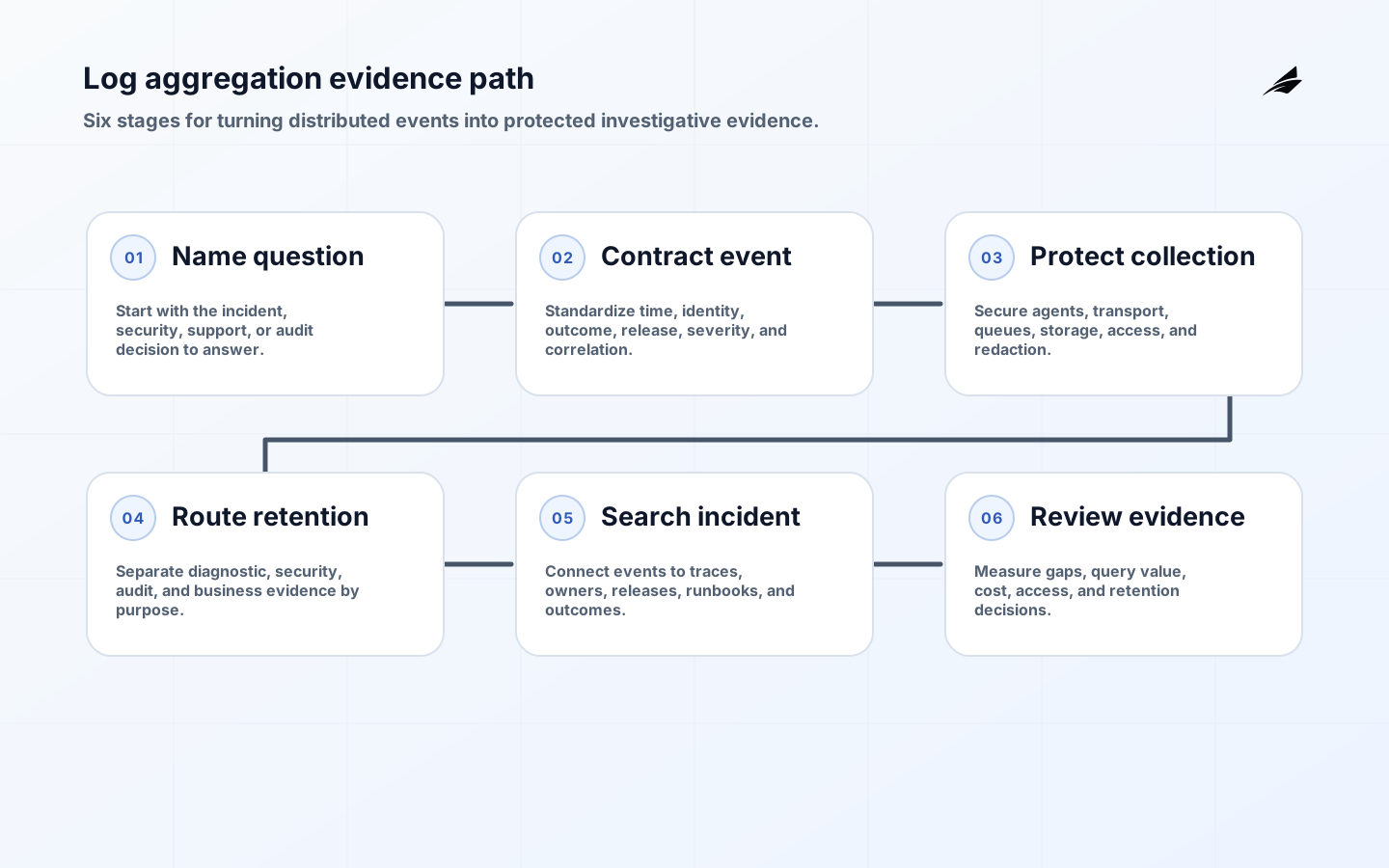
Log aggregation is not the act of placing every line in one expensive system. It is the design of an evidence path from a service event to a question an operator, security analyst, or auditor needs to answer. Growing teams usually feel the problem when incidents cross service boundaries, identifiers are inconsistent, sensitive values appear in messages, or retention costs rise faster than investigative value. NIST SP 800-92 treats log management as a lifecycle of generation, collection, storage, analysis, and disposal. The observability checklist is a useful companion, but the workflow focuses on the event contract and operating choices that make aggregation dependable.
Start with evidence questions
Before selecting a collector or backend, list the questions the team must answer during a normal support task and a serious incident. Which request failed, which user or tenant was affected, which release handled it, which dependency was called, and what action followed? Security questions may ask who changed access, whether a token was used unusually, or whether a sensitive record was exported. The answer determines which fields are necessary, how long the evidence must remain available, and who can access it. This keeps logging attached to operational work rather than encouraging an unbounded stream of messages.

| Question | Useful fields | Design caution |
|---|---|---|
| Why did a request fail? | Trace ID, service, release, status, error class | Do not log full secrets or unrestricted payloads. |
| Who changed access? | Actor, target, action, policy result, timestamp | Protect integrity and restrict sensitive audit events. |
| What happened to a job? | Job ID, attempt, queue, duration, outcome | Use stable IDs so retries can be grouped. |
| Which customers were affected? | Tenant or subject reference, region, feature | Minimize personal data and define access scope. |
| Did a dependency fail? | Dependency, endpoint class, status, latency, retry | Avoid logging high-cardinality raw URLs or credentials. |
Create a durable event contract
Use structured events with consistent fields for timestamp, severity, service, environment, release, trace or correlation identifier, operation, outcome, and error category. OpenTelemetry's Logs data model provides a useful vocabulary for relating logs to traces and other telemetry. A common schema is valuable only when teams agree what the fields mean and how they are populated. Define whether a timestamp is event time or collection time, whether an ID is a request or business identifier, and which values may be omitted. Version the contract and test it in CI so a refactor does not silently remove the field that an incident query depends on.
- Use structured fields for identifiers, outcomes, severity, and release context.
- Define event time, collection time, and ordering limitations.
- Correlate logs with traces and metrics without copying unnecessary payload data.
- Classify security, audit, business, and diagnostic events separately.
- Version the schema and validate it before events reach the central store.
Protect collection and access
The log pipeline is part of the security boundary. Protect agents, transport, queues, storage, indexes, and administrative interfaces. Apply least-privilege access by team, environment, tenant, and event class. OWASP's Logging Cheat Sheet emphasizes excluding or protecting sensitive data and making security events useful for detection. Define redaction at the source where possible, then add pipeline checks for known secrets and personal fields. Record access to sensitive logs and test whether an operator can investigate without receiving data unrelated to the incident.
Choose retention and routing
Retention should follow the purpose and sensitivity of the event. High-volume diagnostic events may need a short searchable window, while security or audit records may need longer protected retention. Route events by type and value rather than storing every stream at the same tier. Sample or aggregate repetitive health signals, but do not sample away rare security events or the evidence needed for a high-consequence workflow. Document deletion, archival, legal hold, and backup behavior. Cost visibility should include ingestion, indexing, storage, egress, and the operational time required to maintain the pipeline.
| Event class | Retention approach | Access approach |
|---|---|---|
| Diagnostic | Short searchable window with selective sampling | Service team and on-call roles. |
| Security | Protected, integrity-aware retention based on policy | Security team and approved investigators. |
| Audit | Defined retention with export or archive controls | Narrow role access with access logging. |
| Business event | Retain according to product and data policy | Domain owners with subject limitations. |
| Debug payload | Avoid or redact; retain only when justified | Temporary, controlled access and review. |
Connect logs to incident work
A log query is useful when it shortens the path from symptom to decision. Create saved views for the main user journeys, deploy markers, dependency failures, authentication events, and recovery actions. Include runbook links and the meaning of important fields. During an incident, record the query or evidence used for a conclusion so the investigation can be reconstructed. Correlation identifiers should survive asynchronous boundaries where possible, with clear handling for jobs, queues, and retries. If a team cannot connect an event to a service owner, a release, or a current runbook, aggregation has created volume but not observability.
Improve signal before volume
More logs can make search slower and incidents harder. Review high-volume event types and ask whether they support a question, alert, audit requirement, or debugging task. Remove repeated prose, normalize error categories, and turn important state transitions into deliberate events. Elastic Common Schema demonstrates the value of shared fields for cross-service search, but a schema cannot rescue meaningless messages. Measure query success, time to find relevant evidence, redaction failures, dropped events, parsing errors, and storage cost. Use those signals to improve the contract and routing rules before buying more capacity.
Test failure and recovery
The logging path can fail independently of the application. Test collector outage, queue saturation, malformed events, clock skew, backend unavailability, credential expiry, and regional loss. Decide what must block a request, what may be buffered, and what may be dropped. Never make a core transaction depend on an unbounded logging call. Verify that security events receive stronger handling than debug messages and that the team can identify gaps after a recovery. A mature log design makes loss visible; it does not claim completeness when the pipeline has been degraded.
Design instrumentation at the source
Central aggregation cannot repair an event that was never emitted or lacks the context needed to interpret it. Instrument important state transitions at the source: request accepted, authorization decided, job queued, attempt started, dependency called, record committed, and user outcome completed. Keep messages concise and use stable identifiers. The emitting service knows whether an operation succeeded, was retried, or was rejected; a downstream parser should not have to infer that from prose. This also reduces the temptation to copy raw payloads into the log stream just in case they become useful later.
Time is an operational field, not a formatting detail. Record an event timestamp with a known clock source and preserve collection time separately. Expect clock skew, delayed batches, retries, and out-of-order delivery. Queries and alerts should make those limitations visible. For asynchronous systems, use a durable correlation or causation identifier so an operator can follow the journey even when events arrive in different services. If an identifier can contain personal data, use a stable reference with controlled lookup rather than embedding the raw value everywhere.
Collection topology should match failure and access boundaries. A small team may begin with local agents and a central backend, while a larger system may need regional buffers, separate security pipelines, or a dedicated audit store. Define what happens when the central service is unavailable: buffer, sample, drop, or block a specific operation. Protect queues from unbounded growth and monitor the age of the oldest event. The architecture should tell operators which time ranges or event classes may be incomplete after a degradation.
Privacy controls work best as a development habit. Maintain fixtures that contain fake secrets, personal fields, tokens, and large payloads, then verify that the expected redaction occurs. Review log statements during code review and make sensitive event types opt-in. Do not rely on a regex to recognize every identifier or secret. Minimize collection first, separate audit from diagnostic data, and restrict search access so a broad incident query does not expose unrelated subjects. Record redaction failures as incidents because they weaken both security and trust.
Create a small query book for the workflows that matter. Each entry should name the user journey, owner, fields used, expected result, time range, and escalation path. Include a query for the absence of expected events, because a silent pipeline can be more dangerous than a loud error. Review the query book after incidents and remove views that nobody uses. This turns log aggregation into shared operational knowledge and makes onboarding easier for engineers who did not design the original event stream.
Backpressure and loss policy should be visible to service owners. Decide whether a diagnostic event can be sampled, whether a security event must be durably queued, and whether an audit event should block a sensitive action when it cannot be recorded. Do not make these choices implicitly through a full buffer or a best-effort network call. Expose dropped counts, delayed counts, parsing failures, and storage rejection so an incident investigator knows how much confidence to place in the record. Evidence quality includes knowing where evidence is incomplete.
Log access is itself an auditable workflow. Define who can search broad time ranges, who can view sensitive fields, and how temporary access is approved and revoked. Separate operational debugging from security investigation when their data needs differ. Review access patterns for unusual searches and include log-store permissions in offboarding. A central store can accelerate response, but it also creates a high-value target. The protection model should be designed at the same time as the aggregation model, not after the first sensitive event appears.
Use retention reviews to remove events that no longer support a decision. Ask whether a record is needed for incident response, audit, security detection, product debugging, or legal policy, then choose the shortest useful period and the least sensitive representation. A shorter, better-scoped dataset lowers cost and reduces the amount exposed by a compromised account. Retention is not a static storage setting; it is a recurring product and risk decision that should change when the workflow or policy changes.
A retention review should include the evidence needed after a delayed incident. If a security team may discover misuse weeks later, the relevant audit trail needs a protected archive or a documented export path. If a diagnostic event has no value after a short investigation window, delete or sample it rather than keeping it indefinitely. Make deletion observable and verify that indexes, replicas, backups, and analyst exports follow the intended rule. This keeps retention aligned with both investigative value and data minimization.
Frequently asked questions
Question: Does serverless remove operational responsibility? Answer: No; teams still own event contracts, state, retries, permissions, observability, cost, and recovery. Question: What is a good first serverless workload? Answer: A bounded event-driven task with idempotency, a measurable user result, controlled retries, and a provider failure plan.
What makes log aggregation trustworthy?
Answer: A stable event contract, source-side context, complete collection, protected access, useful retention, and a known response path make aggregated logs trustworthy.
How should sensitive log fields be controlled?
Answer: Minimize them at source, classify and redact deliberately, restrict queries, protect exports, and test that secrets or personal data do not leak.
What should happen when logging fails?
Answer: Raise a signal, preserve alternate evidence, communicate the investigation limitation, and repair collection without silently lowering the security or retention contract.
Should every service send logs to one backend? Central search is useful, but routing and retention may differ by event class and sensitivity. Compare log aggregation decisions and incident response decisions when defining the operating boundary. What fields matter most? Stable service, release, operation, outcome, timestamp, correlation, and error fields are a strong foundation; add domain fields for real questions. How do we avoid sensitive data? Minimize at the source, redact in the pipeline, test with secret fixtures, and restrict access. Is structured logging enough? No. The team also needs ownership, retention, protection, search views, and incident practice. When should a team add more storage? After improving event quality, sampling, routing, and query design so the added volume has a defined purpose.
Key takeaways
- Start from the investigations and decisions the logs must support.
- Create a versioned structured event contract with consistent identifiers and outcomes.
- Protect collection, transport, storage, and access as a security-sensitive path.
- Route and retain by event purpose, sensitivity, and investigative value.
- Test pipeline failure and make missing evidence visible during incidents.
Conclusion
Log aggregation becomes an operating advantage when it turns distributed events into trustworthy evidence. Define the questions, standardize the fields, protect the path, connect records to incident work, and control retention with purpose. Growing teams gain more from a smaller, coherent event stream than from a vast archive that nobody can search confidently.