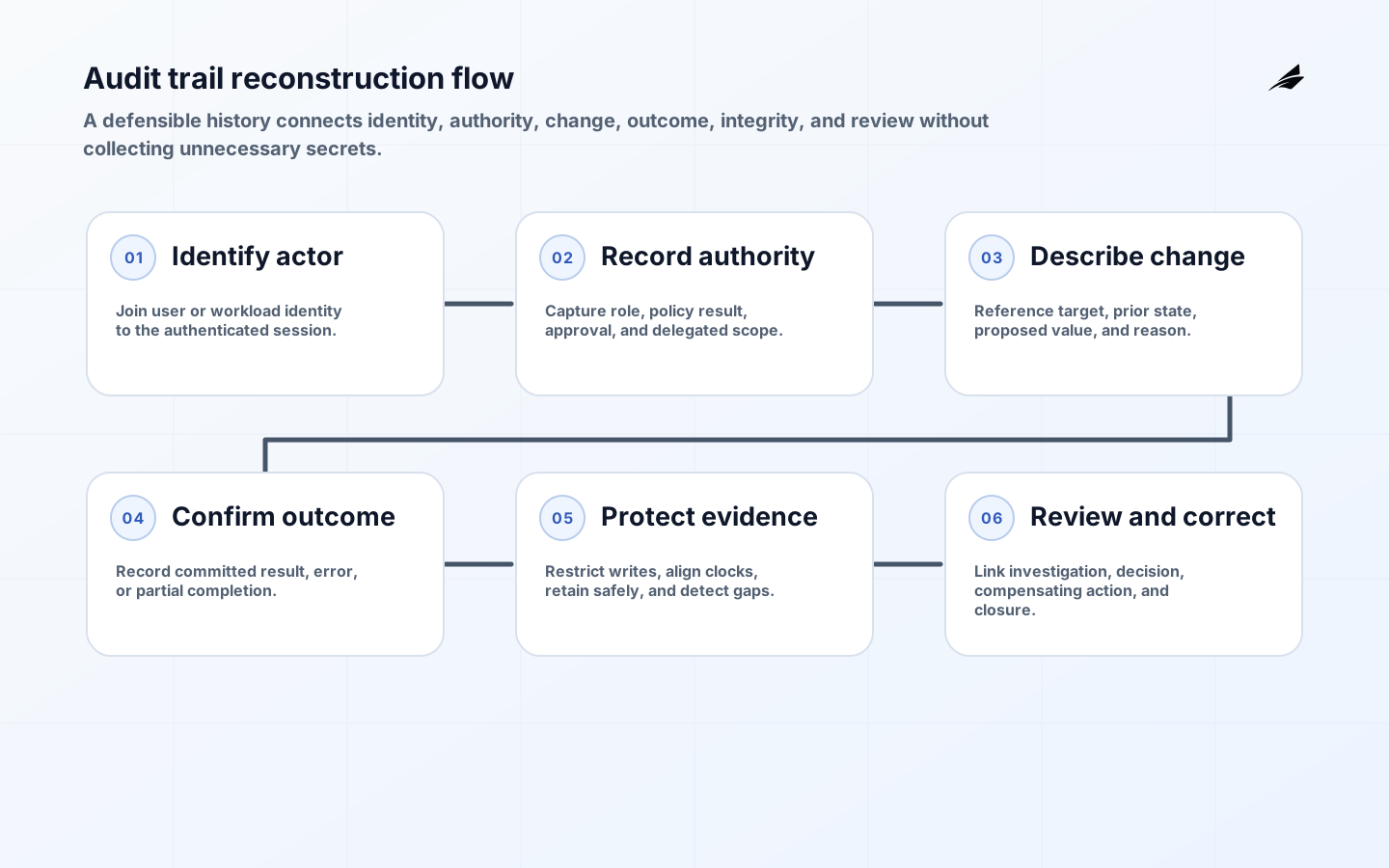
Audit trail meaning is not “store every log forever.” An audit trail is a controlled history that lets an authorised reviewer reconstruct a material action: who or what acted, under which authority, on which record, when it happened, what changed, whether the action succeeded, and how an exception was resolved. The distinction matters because ordinary diagnostic logs optimise for engineering investigation, while audit evidence must remain interpretable after staff, software versions, and business context have changed. A useful design begins with the decisions the organisation may need to explain, then captures the minimum reliable evidence for those decisions. This guide turns that definition into event, access, retention, review, and recovery choices that a product and operations team can test before release.
The evidence model in this guide draws on the NIST log-management guide, the OWASP Logging Cheat Sheet, the audit-and-accountability controls in NIST SP 800-53 Rev. 5, and the FDA guidance on electronic records and signatures. Apply those principles in context rather than copying a retention number from another organisation. Related Edilec guides explain audit trails for product leaders, RBAC responsibilities in software, and compliance-ready delivery evidence.
What audit trail meaning means in practice
A useful audit trail distinguishes business events from technical telemetry. A failed database connection may matter to an engineer, while an approved refund or entitlement override matters to a service owner; one record can reference the other without treating them as interchangeable. For material business actions, capture a stable subject or case identifier, actor or service identity, action, relevant previous and resulting state, time source, decision reason where appropriate, outcome, and correlation to surrounding work. The trail must have a defined authority and retention rule. A customer-history screen or editable note may be helpful, but it is not the controlling evidence store if privileged users can alter it without trace.
Define scope, ownership, and the authoritative boundary
Classify events by consequence before deciding detail and retention. High-impact financial, security, privacy, or contractual actions may warrant strong identity assurance, immutable storage or tamper-evidence, segregation of duties, and regular review. Low-risk informational activity may need only operational logging. Document what is intentionally excluded, who may query the trail, and how legal, regulatory, or customer obligations affect retention. Include automated actors and integrations in scope; an unexplained service account change is still an organisational action. Plan the relationship between audit evidence and data deletion carefully. Retaining a minimal event about a deletion may be necessary, but it should not recreate the sensitive data that the deletion policy removed.
| Decision question | Decision-ready answer | Risk if omitted |
|---|---|---|
| What is the protected outcome? | A defined business result supported by audit trail meaning. | The build optimises a feature instead of the operating decision. |
| Who owns the rule? | A named business owner approves policy while technical owners operate the service. | Technical configuration silently becomes business policy. |
| Where is authority? | A documented source record or policy decision is authoritative; displays and copies are not. | Teams resolve disagreement by choosing the most convenient screen. |
| What proves completion? | An observable result, record, and exception route are agreed before release. | A successful request is confused with completed business work. |
| Who repairs failure? | A named queue and response expectation handle failed, disputed, or delayed work. | Staff rely on inboxes, spreadsheets, and undocumented overrides. |
Design the operating path and evidence
Emit material events from the service path that performs the action, using a consistent event contract and protected write route. Include correlation and request identifiers so an inquiry can join related steps without relying on timestamp guesses. Use dependable time synchronisation and record timezone or standardised time semantics. Separate writers, readers, and administrators according to the risk: an operator who changes a customer record should not be able to erase the evidence of that change. Protect storage, monitor ingestion failures, and give reviewers a search experience that can locate a case across systems. Where data is replicated for analysis, preserve source identity and integrity metadata so a report cannot silently replace the authoritative evidence.

Build controls and exception handling into the work
Design for integrity, confidentiality, and availability together. Restrict event production and modification, encrypt or otherwise protect sensitive trails, minimise personal data, and guard access with least privilege. Detect gaps, duplicate sequences, unexpected privileged reads, and changes to logging configuration. Make operational overrides first-class events with a reason, approver where required, and follow-up review. A trail is only valuable if staff can investigate within a meaningful time, so test search, export, and access controls during normal operation. Avoid shared administrator accounts and direct production edits; both make attribution unreliable and complicate a fair investigation.
| Condition | Required response | Operating evidence |
|---|---|---|
| Required information is missing | Hold or decline the work with an actionable reason. | Validation result, source context, and named follow-up owner. |
| An automated step fails | Preserve context, apply a safe retry rule, and route unresolved work. | Correlation identifier, attempt history, and queue status. |
| Authority is unclear | Do not infer permission; escalate to the accountable owner. | Decision request, approver, and policy reference. |
| A material correction is needed | Correct through a governed path without obscuring the original state. | Reason, actor, effective time, and before-and-after record. |
| A control is bypassed | Contain impact, record the exception, and conduct follow-up review. | Exception evidence, expiry or remediation action, and outcome. |
Deliver a thin, operable first release
Deliver audit evidence alongside the first consequential workflow, not as a later compliance project. Create test cases for a normal approval, a denied action, a partial failure, a retry, a manual correction, and a privileged query of the trail itself. Ask an independent reviewer to reconstruct a case from the records without access to developer explanations. Set ownership for event taxonomy, storage operation, retention review, and customer or regulatory requests. In the first operating reviews, compare planned event coverage with real incidents and support investigations. Missing context, not an empty dashboard, is the signal that the event contract needs improvement.
Measure the operating result, then review it
Track coverage of defined material events, ingestion loss or delay, time to reconstruct a sampled case, privileged read volume, override rate, retention-review completion, and investigation findings caused by missing context. Measurements should distinguish the health of logging infrastructure from the quality of the business evidence it contains.
Use governance and procurement evidence to make the decision durable
Audit evidence should be included in design review and supplier acceptance, not inferred from a product’s claim to be compliant. Choose a recent or simulated material case and ask an independent reviewer to identify the actor, authority, decision inputs, changes, subsequent actions, and any privileged access to the trail. Confirm that the reviewer can do so without reading raw production databases or relying on a developer’s memory. Specify search availability, export controls, integrity expectations, retention ownership, and incident support in the operating agreement. Where a sector has formal record requirements, translate them into event fields and review practices rather than applying a label loosely. The result is evidence that supports fair investigation and repeatable correction.
Give investigators a documented evidence-handling route. It should preserve the query, relevant exports, access approvals, and interpretation notes so a later reviewer can understand what was examined without modifying the underlying event record.
Test the audit trail with a reconstruction exercise
Before accepting an audit design, choose one consequential scenario and ask a person who did not build the feature to reconstruct it. For example, a supplier bank account changes at 10:42, a payment is approved at 10:49, and an operator later reports that the change was unauthorised. The reviewer should be able to identify the authenticated actor, session or service principal, source channel, policy decision, previous value reference, new value reference, approval chain, resulting transaction, and any later correction. The exercise exposes gaps that a field inventory misses: clocks may disagree, identifiers may not join, an administrator may be able to edit the evidence, or the application may record the request but not the committed outcome. NIST SP 800-92 treats log management as an organisational process rather than a storage product, which is the right framing for this test.
The reconstruction should also prove restraint. Secrets, authentication tokens, payment data, and unnecessary personal information do not become safer because they are inside an audit store. Record a stable reference, classification, or protected before-and-after representation when full values would create a second sensitive database. Define who can search the history, who can export it, how access to the audit system is itself logged, and what happens when collection fails. For regulated electronic records, the FDA Part 11 guidance is a useful reminder that controls should be interpreted in the context of trustworthy records and the predicate requirements that apply to the business. The acceptance question is therefore not “did an event arrive?” but “can an authorised reviewer reach a defensible conclusion without compromising the people or systems represented in the evidence?”
| Reconstruction question | Evidence required | Failure the test reveals |
|---|---|---|
| Who initiated the change? | User or workload identity, authentication context, delegated role | Shared accounts or identity lost between services |
| What was authorised? | Policy result, approval record, scope and version | A click recorded without the authority behind it |
| What actually changed? | Target identifier, committed outcome, prior-state reference | Request logs that disagree with database state |
| Can the record be trusted? | Protected transport, restricted write path, integrity and clock evidence | Editable history or events that cannot be ordered |
| How was it corrected? | Case, compensating action, reviewer and closure reason | Investigation detached from operational recovery |
Key takeaways for audit trail meaning
- Record material actions, not indiscriminate noise.
- Capture actor, action, state, time, authority, outcome, and correlation.
- Keep the authoritative trail distinct from editable user-facing history.
- Protect writers, readers, and administrators according to risk.
- Design retention and privacy boundaries together.
- Test whether an independent reviewer can reconstruct a real case.
Frequently asked questions
What is the difference between an audit trail and a log?
Logs support technical operation broadly. An audit trail is a defined evidence record for material actions and decisions, with stronger requirements for attribution, integrity, retention, and review.
Should audit events contain full before-and-after values?
Only when needed to explain the decision and permitted by privacy policy. Sensitive values can sometimes be represented by a change marker, reference, or protected comparison instead of copied in full.
Who should review audit trails?
The service owner, security or compliance function, and independent reviewers each have different needs. Define recurring review around risk and triggered review around incidents or disputes.
Conclusion
An audit trail becomes a useful planning concept when it is connected to a real decision, an accountable owner, a protected operating path, and evidence that a reviewer can understand. Do not begin with a vendor feature list or a generic architecture diagram. Start with the outcome that must be dependable, test the awkward cases with the people who will run the work, and make the first release small enough to observe. That approach gives a client team a clearer basis for investment and a service it can improve without losing control of the business facts that matter.