Secrets management is the practice of controlling sensitive values and the identities that can use them, from creation through retirement. A secret can be a database password, signing key, API token, webhook credential, or certificate private key. The central risk is not only accidental disclosure in source control. It is an unbounded lifecycle: nobody knows which workload uses a value, a long-lived credential cannot be rotated safely, or broad access lets a routine deployment read more than it needs. Kubernetes is explicit that Secret objects require safeguards such as encryption at rest and least-privilege access; read the Kubernetes Secrets documentation as a baseline, not a guarantee supplied by the object name.
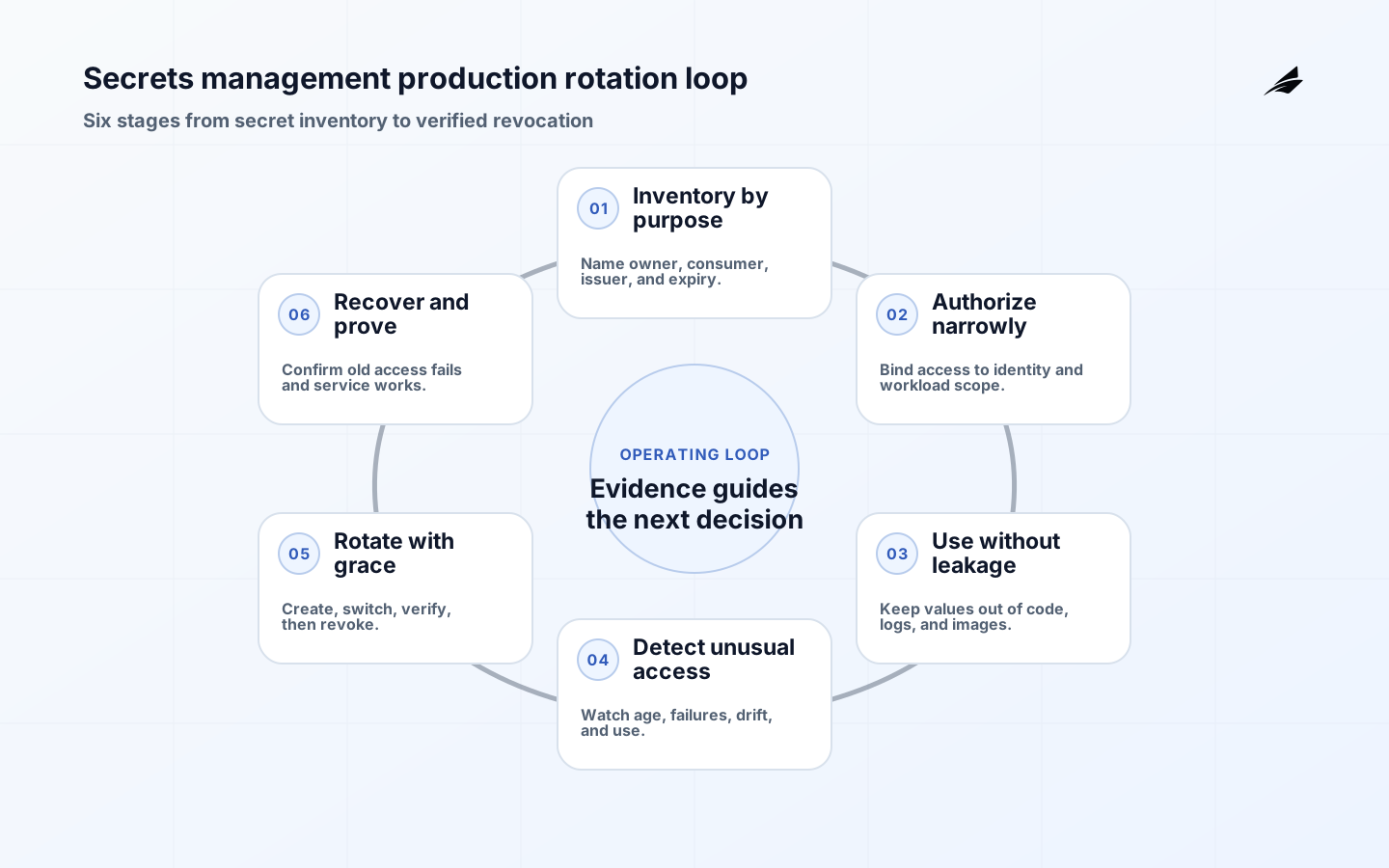
A production secret lifecycle makes ownership, access, rotation, revocation, and recovery observable without exposing the value. The OWASP Secrets Management Cheat Sheet covers inventory, least privilege, rotation, monitoring, and avoiding values in code or logs. Kubernetes Secrets explains the resource model and protection requirements. Vault secrets engines support centralized and dynamic issuance, while AWS Secrets Manager documents managed retrieval and rotation. Connect this checklist to Edilec secrets management, container security, and Terraform modules. Inventory purpose, owner, consumer, environment, issuer, audience, expiry, last use, and recovery. Safe rotation creates the replacement, validates the consumer, switches use, confirms success, then revokes the old value after a defined grace period. Test startup-loaded credentials, dynamic retrieval, cache behavior, failed rotation, compromised identity, and backup exposure. Measure stale use, retrieval failures, unusual access, rotation duration, and dependencies on retired values. A reference to a secret is not proof of entitlement; narrow authorization plus evidence of revoked access is the control.
Inventory secrets by purpose and dependency
Begin with an inventory that explains why each secret exists. Include its owning service, target system, environment, credential type, issuer, permitted operation, consumers, rotation method, last rotation, and emergency revocation contact. Do not place secret values in the inventory. The record should answer impact questions quickly: if this database credential is compromised, which workloads fail when it is disabled and which users or records could be exposed? Separate human administrator credentials from workload identities; they have different access patterns, review cycles, and incident procedures. An unknown secret is a liability even when its value is well encrypted.

| Secret class | Preferred access pattern | Lifecycle concern |
|---|---|---|
| Service-to-service credential | Short-lived workload identity | Audience and token renewal |
| Database credential | Per-service account with limited grants | Rotation and connection draining |
| Third-party API token | Scoped integration identity | Vendor scope and revocation |
| Signing key | Restricted signer service or HSM | Key rollover and verification window |
Design the secret lifecycle
Prefer a workload identity that obtains short-lived credentials over distributing a static value to every runtime. Where static credentials remain necessary, retrieve them at runtime from a managed store, authorize the workload rather than a shared environment, and limit the value's scope and lifetime. Avoid command-line arguments, ordinary logs, container images, and configuration snapshots as delivery channels. The OWASP Secrets Management Cheat Sheet emphasizes storage, handling, and rotation controls; the operating detail is to test every handoff. A rotation design is incomplete until an application can accept old and new values for the transition window or reconnect predictably when a token changes.
- Use distinct identities for development, staging, production, and emergency access.
- Grant a workload only the secret and action it needs, not namespace-wide read permission.
- Redact known secret fields at application, collector, and support-tool boundaries.
- Treat an exposed value as compromised even when repository history is later rewritten.
Make access reviewable and narrow
Access control should express intent at the workload and secret level. A deployment identity may update a reference, while a running service identity reads one credential; neither needs permission to enumerate every secret. Review indirect paths too: anyone who can create a pod in a namespace may be able to mount a secret available there. The Kubernetes good practices guide calls out this relationship between workload permissions and secret exposure. Record privileged reads and administrative changes, but do not log the value. Those events let reviewers spot dormant integrations, unusual access locations, and an emergency exception that was never withdrawn.
| Control | What it prevents | Evidence to review |
|---|---|---|
| Encryption at rest | Direct datastore disclosure | Cluster and key configuration |
| Workload-level authorization | Namespace-wide credential sprawl | Role bindings and service accounts |
| Runtime retrieval | Values copied into build outputs | Application and store access logs |
| Rotation alerting | Credentials that outlive their policy | Age, expiry, and rotation result |
Rotate without making recovery harder
Rotation changes a production dependency, so plan it like a release. Establish a new credential, authorize the intended consumer, update or refresh the runtime, verify successful use, and only then revoke the old credential. For a database password, account for pooled connections; for a signing key, ensure verifiers accept the correct key set during rollover; for a vendor token, confirm scopes before cutover. Managed systems such as AWS Secrets Manager can automate parts of this sequence, but automation does not choose application compatibility for you. Keep a manual emergency revocation path with named authority and a clear communication trigger.
Respond to suspected exposure with facts
When a secret appears in a commit, ticket, log, or chat transcript, assume it may have been copied beyond the original location. Identify the value and issuer, rotate or revoke it, constrain affected access, preserve audit evidence, and search downstream systems that may have received the disclosure. Removing a public trace is useful but is not containment. The incident review should discover why the value was available: missing pre-commit scanning, an unsafe debug path, a broad service account, or a manual process without an approved delivery mechanism. Fix the control close to the source so the same error is less likely to recur.
Put secrets management into practice
- Define the operating boundary for secrets management in terms of credential issuer, consumer identity, delivery path, rotation window, and audit trail; this turns a broad technical theme into work that an accountable team can review and improve.
- Name the user outcome and safety signals before changing anything. For this practice, compare successful authentication, denied access, refresh behavior, and audit completeness with an explicit baseline rather than relying on a tool status alone.
- Record assumptions that affect the decision, including demand, dependencies, time windows, and ownership, especially when rotation and exposure response must remain recoverable. An assumption that stays implicit cannot be tested when conditions change.
- Choose a reversible first action and document the recovery path. This limits the cost of learning and gives the responder a known control when the observed result differs from expectation, especially when rotation and exposure response must remain recoverable.
- Keep the evidence close to the service: versioned configuration, a short decision record, relevant dashboards, and the runbook used by the person who receives the alert, especially when rotation and exposure response must remain recoverable.
- Review the change at a cadence that matches its risk. Look for a copied credential, a stale consumer, or an emergency path with excessive access; treat recurring exceptions as design feedback rather than as a reason to normalize manual work.
- Separate what the service team owns from what a shared platform or partner owns, especially when rotation and exposure response must remain recoverable. The boundary should state who acts, who supplies evidence, and who approves an exception, especially when rotation and exposure response must remain recoverable.
- Test the uncomfortable path deliberately. A quiet success case is not enough; exercise degraded dependencies, delayed work, recovery, and the handoff between ordinary operation and incident response, especially when rotation and exposure response must remain recoverable.
- Use a small representative pilot before broad rollout. Capture what users actually did, which controls confused them, and whether the intended guardrail was visible at the moment of decision, especially when rotation and exposure response must remain recoverable.
- Make exceptions visible, time-bound, and reviewable. An exception is useful when it reveals a real constraint; it becomes debt when it quietly replaces the supported path, especially when rotation and exposure response must remain recoverable.
- Avoid measuring activity as proof of value. Count completed, safe outcomes and the effort required to achieve them, then use both quantitative evidence and operator feedback to choose the next improvement, especially when rotation and exposure response must remain recoverable.
- Preserve context after an incident or failed change: identifiers, configuration state, timing, observed behavior, and the recovery action, especially when rotation and exposure response must remain recoverable. This is more useful than a generic summary when the pattern returns, especially when rotation and exposure response must remain recoverable.
- Review interfaces and contracts at the same time as the primary control, especially when rotation and exposure response must remain recoverable. Many failures appear at boundaries: a client behavior, a delayed message, an identity assumption, or a shared dependency, especially when rotation and exposure response must remain recoverable.
- Give the normal path a clear owner and a usable escalation route, especially when rotation and exposure response must remain recoverable. Teams adopt controls that help them act quickly under pressure and abandon ones that require private knowledge to recover, especially when rotation and exposure response must remain recoverable.
- Retire outdated rules when architecture, product demand, or customer commitments change. Keeping old controls without their original context can create risk as surely as leaving a system unconfigured, especially when rotation and exposure response must remain recoverable.
- Turn the result into the next default for secrets management: keep what protected the outcome, simplify what caused friction, and schedule the next review while the evidence is still fresh.
Key takeaways
- Manage the identity and lifecycle around a secret, not only the encrypted value.
- Prefer short-lived workload credentials and narrow access grants.
- Test rotation as a production compatibility change.
- Log access events, never secret material.
- Assume disclosed credentials are compromised and revoke them promptly.
Frequently asked questions
Question: Where should production secrets live? Answer: Use a managed secret system with access control, audit history, rotation support, and runtime retrieval appropriate to the workload. Keep secrets out of source, images, logs, and ordinary configuration files.
Question: How can teams rotate secrets without causing an outage? Answer: Support overlapping credentials or staged consumers where possible, verify the new path, revoke the old value after confirmed use, and rehearse recovery. Rotation is a dependency change, not merely a string replacement.
Question: What should happen after suspected exposure? Answer: Preserve evidence, identify affected values and consumers, revoke or rotate by priority, limit access, inspect logs and downstream use, and record the recovery decision. Avoid deleting evidence before the scope is understood.
Are Kubernetes Secrets enough? They are a mechanism, not a complete program; configure encryption, RBAC, and delivery practices. How often should values rotate? Set a period based on exposure and operational ability, then automate and test it. Should applications receive secrets as environment variables? It can be workable, but mounted files or runtime retrieval may reduce accidental exposure in diagnostics; assess the application and platform. Who owns a secret? Name both the business or service owner and the platform owner of its delivery control.
Conclusion
Mature secrets management makes credentials boring: scoped, discoverable, rotated, and revocable without a frantic search. Build that lifecycle into identity, deployment, and incident practices, and the system becomes safer without making delivery slower.