Terraform modules deserve a plain-language operating model because founders need to make choices that remain understandable after the first implementation. Terraform modules are reusable packages of infrastructure configuration. A root module is the configuration in a working directory; child modules are called from it to model a repeatable capability such as a network, service account, database, or application environment. A module is not automatically a platform. It becomes useful when its inputs, outputs, ownership, state implications, and upgrade path are understandable to the teams that consume it.
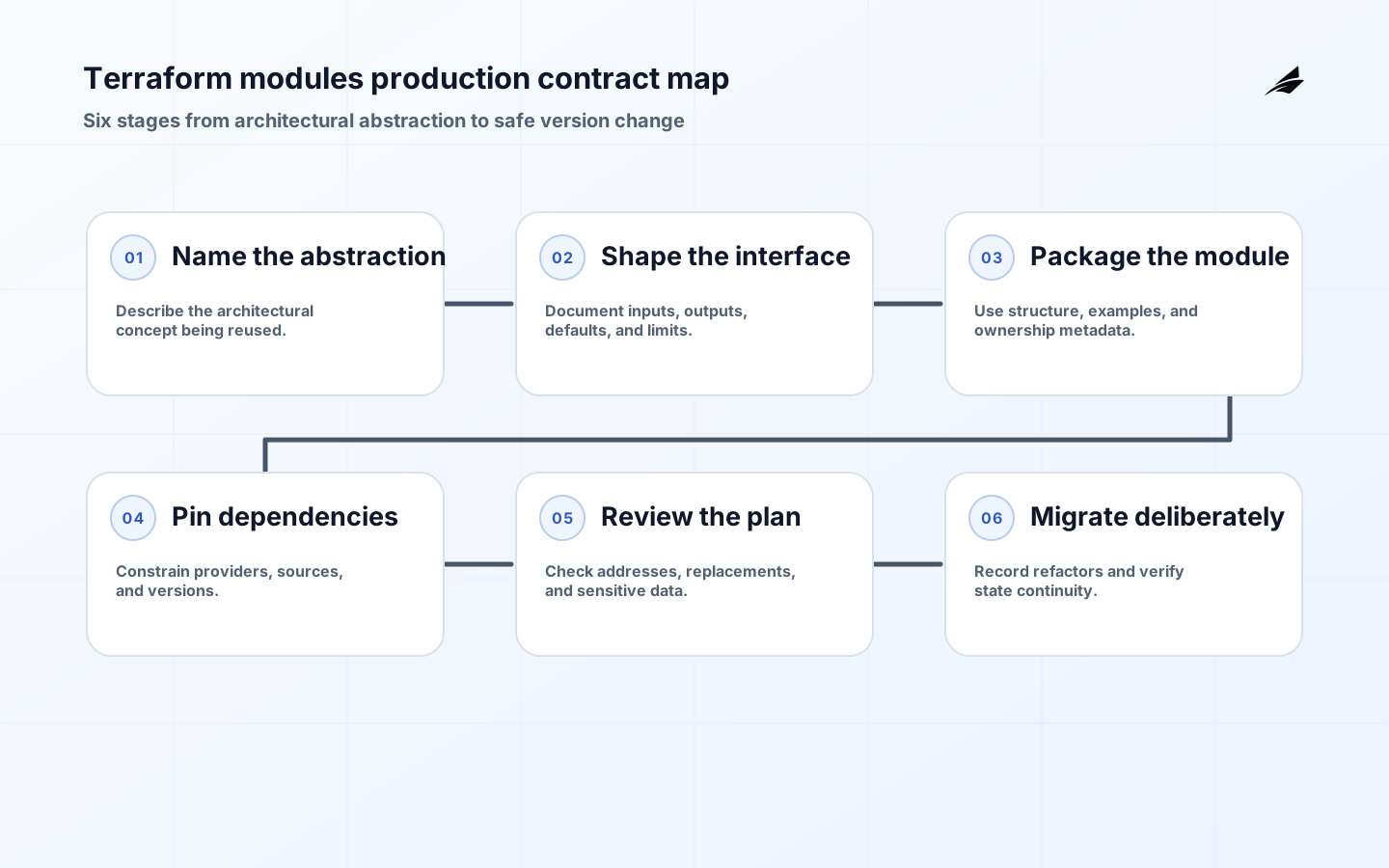
Terraform modules are reusable abstractions with an interface, versioning policy, documentation obligation, and state implications. The Terraform modules overview describes root and child modules and the develop, distribute, and provision workflow. Creating Modules recommends higher-level architectural concepts without thin-wrapper overuse. The standard module structure explains root files, documentation, variables, outputs, nested modules, and examples, while dependency lock guidance explains provider selections and checksums. Connect the operating model to Edilec platform engineering, secrets management, and deployment rollbacks. Define inputs and outputs as a contract, document assumptions and ownership, constrain versions deliberately, and expose only understandable controls. Test representative values, invalid inputs, provider upgrades, refactors, and a change that could replace an existing resource. Review plans for address changes and sensitive data before applying. A module succeeds when it reduces repeated reasoning without hiding decisions affecting security, cost, reliability, or recovery.
Key takeaways
- Model one owned capability per module and state its boundaries plainly.
- Use root modules for composition and child modules for stable reuse.
- Pin versions and isolate state according to operational blast radius.
- Review creates, replacements, and destroys as business decisions.
- Prefer small interfaces over toggle-heavy generic abstractions.
- Reconcile emergency drift into configuration or document its retirement.
What Terraform modules mean in practice
Start by naming the capability a module owns and what it deliberately does not own. A module that creates an application service might accept a name, environment, image identity, and policy choices, then output the service endpoint and identity reference. It should not silently create unrelated networks, teams, or billing controls. HashiCorp's module development guidance emphasizes composition and clear interfaces. In practice, a small interface protects consumers from provider detail while still exposing decisions that materially affect cost, access, or availability.
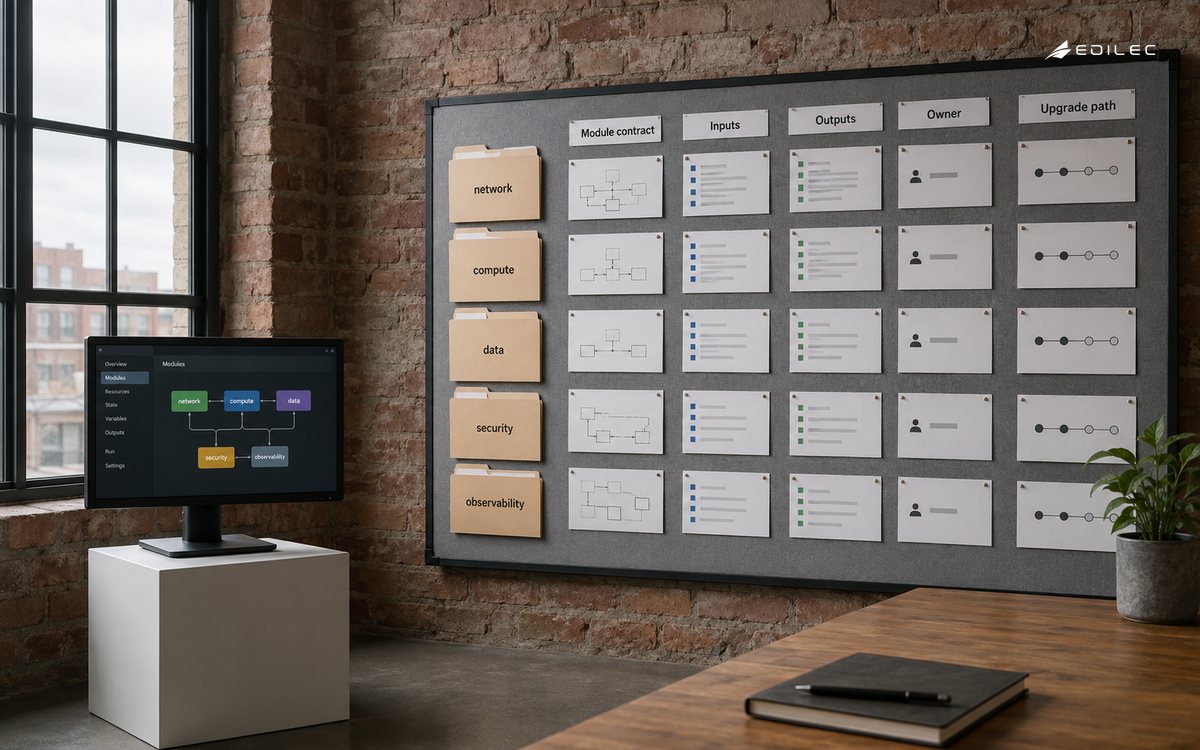
| Decision area | Question to settle | Useful evidence |
|---|---|---|
| Interface | What choices may a caller make? | Typed, validated inputs with meaningful defaults. |
| State | Which resources change together? | Remote, access-controlled state boundary with ownership. |
| Output | What may another component depend on? | Small, documented values rather than internal implementation. |
| Version | How do consumers upgrade? | Pinned release and compatibility notes. |
An operating model for Terraform modules
Use root modules to compose environment-specific resources and child modules to encapsulate stable patterns. Pin provider and module versions, give each environment an isolated state boundary appropriate to its blast radius, and use remote state with access controls and locking where the backend supports it. State is sensitive because it can contain resource metadata and sometimes values that should not be broadly visible. Do not pass whole state files around as an integration mechanism. Prefer outputs with a clear contract, and use a data source only when its lifecycle and ownership are understood.
A practical Terraform module implementation path
A disciplined change path is format and validate locally, create a speculative plan in the same context that will apply it, have an owner review the proposed creates, updates, and destroys, then apply through a controlled identity. The plan is not a promise about an unchanging world: another actor can alter cloud resources between plan and apply, and providers can report values differently over time. Treat unexpected replacement or destruction as a decision point. For a production data store, an in-place update, replacement, backup policy, and migration sequence should be visible before approval.
Risks and controls for Terraform modules
Avoid over-general modules that accept dozens of toggles and conceal mutually incompatible combinations. They are harder to test and easier to misuse than a few purpose-built modules. Defaults can be helpful for a low-consequence naming convention, but defaults for public exposure, encryption, retention, or administrator access should be deliberate and documented. Run policy checks to detect prohibited patterns, but keep a human review for changes whose consequences depend on business context. A plan with no errors can still be the wrong operational decision.
| Stage | What to check | Decision rule |
|---|---|---|
| Design | Define ownership, inputs, outputs, and excluded concerns. | Do not expose a choice without an operational reason. |
| Plan | Generate proposed changes in the target context. | Stop on unexplained replacement, destruction, or privilege expansion. |
| Apply | Use a controlled identity and capture the result. | Record the module and revision that own the resources. |
| Reconcile | Inspect drift and emergency actions. | Update configuration or explicitly retire the unmanaged resource. |
Signals that Terraform modules are working
Watch plan failures, drift findings, state-lock contention, module-version adoption, apply duration, failed provider calls, manual cloud changes, and resources whose tags or owners are missing. Drift is information, not always a defect: an emergency change may have been necessary. The useful follow-up is to reconcile it into configuration or formally retire it, not to overwrite it blindly. Record which root module and version own a resource so an incident does not begin with a repository archaeology exercise.
A Terraform modules checklist for the next change
Choose one mature pattern and build it as a module with a concise README, examples, input validation, outputs, and automated tests. Ask a different team to use it in a non-production account. Their friction will expose whether the module is a genuine interface or just a copied directory. Connect the change path to GitOps when infrastructure and workload desired state are both reviewed in version control.
Use provider-version upgrades as planned maintenance, not an incidental result of a new machine or unbounded dependency constraint. Test the upgrade against representative plans and modules, read relevant provider release notes, and identify resources whose behavior or defaults may change. Capture the decision in version constraints and the review record. This limits the chance that an ordinary infrastructure edit also carries an unexamined provider behavior change.
A worked Terraform module decision
A database module accepts legitimate choices such as engine version, capacity, retention, and network identifiers while it owns stable tags, encryption defaults, and concise outputs. It does not hide public exposure behind an obscure flag or create a network owned by another team. The production root module pins a released version and its plan shows whether a database updates in place or must be replaced. That plan is reviewed with a migration and recovery decision before apply.
How to phase Terraform module adoption
Phase Terraform modules through one bounded service or workflow first. Establish the owner, evidence record, access boundary, and stop rule before standardizing a template or expanding automation, especially when a module interface must remain stable for consumers. The first implementation should expose its awkward dependency, not hide it behind a happy-path demonstration, especially when a module interface must remain stable for consumers. After the team can explain why the control exists and show its outcome, reuse only the conventions that made the decision clearer, especially when a module interface must remain stable for consumers. This avoids turning a local tool choice into a broad platform mandate before its operating assumptions are tested, especially when a module interface must remain stable for consumers.
Keep the working record close to the change. For Terraform modules, that means retaining the version or configuration involved, the person or automated identity that acted, the signal examined, the exception if there was one, and the recovery decision. This is not paperwork for its own sake. During a later failure, those few facts prevent responders from confusing an old condition with a new one or repeating an action whose effect is still unknown, especially when a module interface must remain stable for consumers.
A useful Terraform module review cadence
Review Terraform modules with real examples rather than a generic scorecard. Sample one normal outcome, one unexpected outcome, and one manual exception. Ask whether a new owner could locate the relevant evidence, understand the boundary, and decide what to do next without relying on private memory, especially when a module interface must remain stable for consumers. A repeated exception points either to a missing capability or to a constraint that should be made explicit, especially when a module interface must remain stable for consumers. In both cases, the review should create a small, owned improvement.
Run a deliberately limited exercise before widening use. Change one safe input, observe the stated signals, invoke the documented containment or recovery step, and verify that the intended service behavior returns, especially when a module interface must remain stable for consumers. Record where access, timing, or ownership was unclear. An exercise is successful when it reveals a practical weakness early enough to repair it, not when every participant follows the expected script, especially when a module interface must remain stable for consumers. That habit makes Terraform modules more dependable under ordinary pressure as well as during an incident.
Frequently asked questions
Question: What belongs inside a Terraform module? Answer: A module should own a coherent infrastructure capability with a stable interface, sensible defaults, documented assumptions, outputs, validation, and lifecycle boundaries. Keep provider-specific details behind the interface when that improves safe reuse.
Question: How should module changes be reviewed? Answer: Test plans and representative configurations, inspect generated changes, check backward compatibility and state behavior, and document migrations or replacement risk. Require a versioned release when consumers can observe a material change.
Question: When should a team avoid creating a module? Answer: Avoid a module when the configuration is used once, has no stable contract, or would hide important differences between environments. Duplication can be safer than premature abstraction while the design is still changing.
A module should not be reused merely because two resources look similar; reuse is justified when the ownership and lifecycle are also similar. Terraform state should not be committed to source control because it can contain sensitive values and lacks the access and locking behavior needed for shared operations. Import can bring an existing resource under management, but it should be followed by configuration that describes the intended state rather than leaving an unexplained imported object.
Conclusion
Module review should cover the boundary between configuration intent and stateful reality. A renamed resource, changed key, or altered for_each expression can produce a replacement even when the module interface looks compatible. Use explicit refactoring records where supported, inspect plans for address changes, and keep examples that exercise upgrades from the previous release. Do not hide provider aliases, credentials, or lifecycle assumptions behind a convenient default. Consumers need to know which choices remain theirs. A module is easier to operate when its documentation explains not only how to call it, but also what it will never change implicitly.
Terraform modules make infrastructure easier to change when they expose a stable, scoped contract. Keep state boundaries intentional, review plans for their operational effect, version reusable modules, and treat drift as something to understand. That makes infrastructure automation a maintained product rather than a collection of powerful one-off scripts.