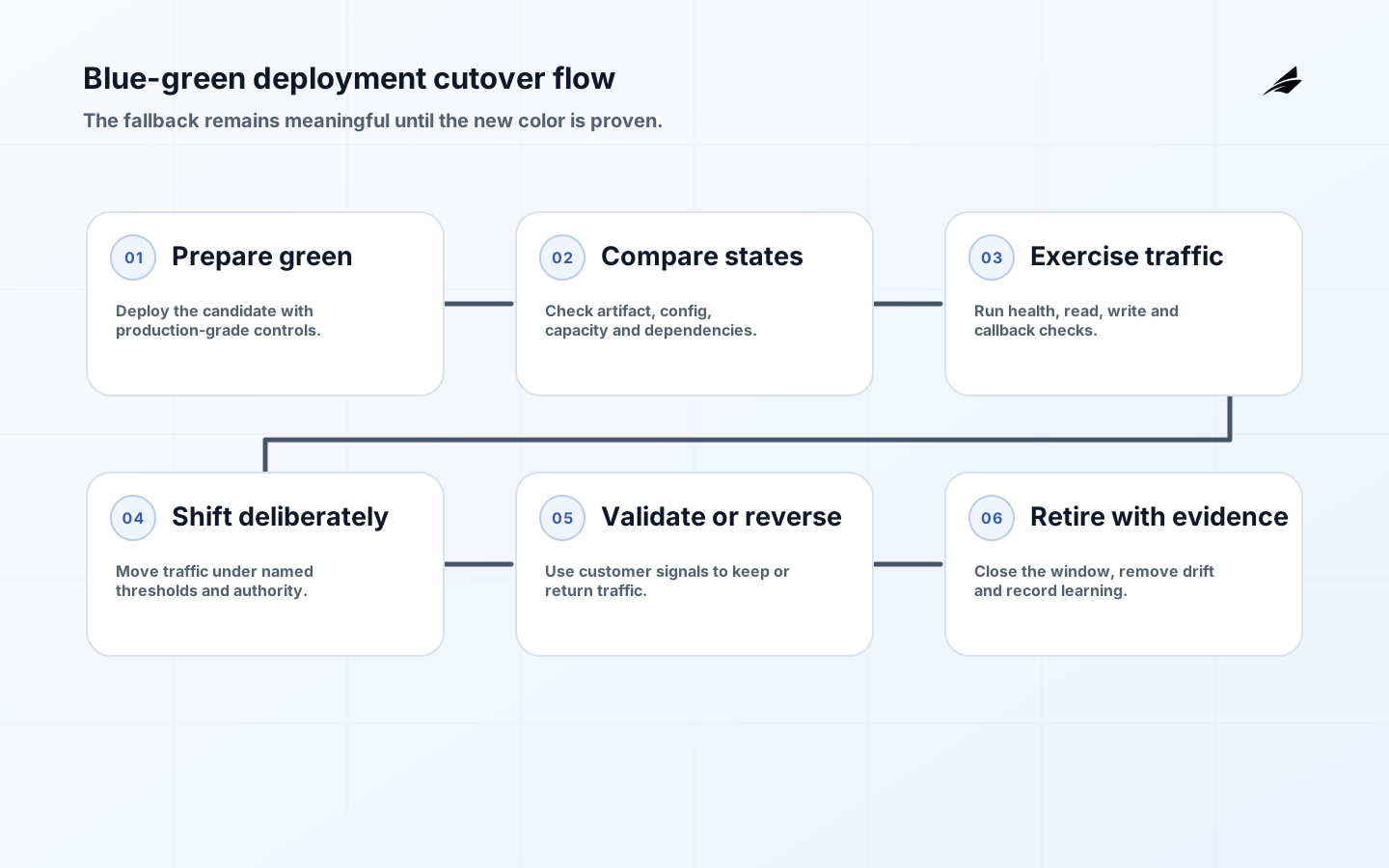
Blue-green deployment runs two production-capable versions of a service and changes traffic from the current environment to the prepared one. The appeal is obvious: if the new version is unhealthy, traffic can return to the prior environment quickly. The hidden work is equally important. Both environments must be valid for the same live dependencies, routing must be deliberate, and the old environment must remain available long enough to prove the cutover. Azure safe deployment practices treats blue-green as a progressive option, which is a useful reminder that a named strategy does not eliminate the need for evidence.
Prepare two valid environments
Blue and green should be comparable where it matters: artifact provenance, configuration sources, identity policies, network controls, capacity, observability, and access to dependencies. They do not have to duplicate unrelated shared services, but every difference must be intentional and visible. Before cutover, validate the candidate with production-like traffic or representative synthetic checks, including authentication, read and write paths, async consumers, and external callbacks. Do not use a staging environment as the fallback merely because it has an older build. A rollback target must meet production reliability and security expectations at the moment it is needed.
| Readiness area | Blue-green question | Proof |
|---|---|---|
| Artifact | Is green the reviewed immutable release? | Build digest and release record |
| Configuration | Are differences intended and versioned? | Rendered config comparison |
| Capacity | Can green carry the planned cohort? | Load and saturation evidence |
| Observability | Can teams compare both sides? | Shared dashboards, logs, and trace labels |
Design for data compatibility first
The technique is strongest for stateless or backward-compatible changes. A database schema, message contract, cache key, or external API behavior can outlive a traffic shift. Use expand-contract sequencing: add compatible structures, deploy code that can work with old and new forms, migrate or backfill deliberately, then remove obsolete forms only after the old version is retired. Keep writers especially conservative. A blue-green switch does not make a destructive migration reversible. The Google Cloud deployment strategy guidance can guide platform mechanics, but application teams must state their own contract compatibility and recovery limits.
- Version APIs and events where old and new consumers may coexist.
- Make background workers and scheduled jobs aware of the active version and ownership.
- Avoid sharing mutable local state between colors.
- Plan cache warming and session behavior before the traffic change.
Control the traffic cutover
Treat routing as a release control with an owner, a documented starting state, and a reversal action. A load balancer, service mesh, DNS, gateway, or feature routing layer may perform the switch; each has different propagation and session behavior. Start with a cohort when customer risk warrants it, then expand based on outcome signals rather than elapsed time alone. Amazon ECS deployment strategies describes blue-green and canary approaches as distinct traffic patterns. Choose blue-green when a clean environment switch and readily available fallback fit the application; do not force it onto state changes that require a slower compatibility plan.
| Cutover control | Strength | Operational watchpoint |
|---|---|---|
| Load-balancer weight | Fast, visible shift | Connection draining and sticky sessions |
| Gateway route | Cohort-specific exposure | Identity and route-rule correctness |
| DNS change | Simple for coarse switches | Caching and propagation delay |
| Feature flag | Separates behavior from artifact | Flag cleanup and data side effects |
Validate and reverse with discipline
Watch the customer transaction, error rate, tail latency, resource saturation, and dependency behavior for both environments. Record the observation window and the action threshold before changing traffic. If green fails, return traffic to blue, freeze further changes, and establish whether the failure is code, configuration, data, capacity, or a dependency coincidence. Do not immediately rebuild blue; preserving the known state makes comparison possible. The HashiCorp deployment guidance correctly warns that database constraints remain central to zero-downtime methods.
Retire safely and learn from the release
Once green is stable, end or repurpose blue through a controlled process: drain traffic, stop background work, preserve release evidence, reconcile configuration, and remove temporary routing and access rules. Leaving both colors live indefinitely creates cost, drift, and ambiguity about which environment is authoritative. Review whether the chosen cohort, checks, and compatibility plan caught useful signals. If manual steps were needed, encode them in release automation or a short runbook. The goal is not to make every deployment look identical; it is to make the decision to expose or reverse a change legible and repeatable.
Run the blue-green cutover rehearsal
- Define the operating boundary for blue-green deployment in terms of environment parity, data compatibility, traffic routing, background work, and fallback state; this turns a broad technical theme into work that an accountable team can review and improve.
- Name the user outcome and safety signals before changing anything. For this practice, compare customer completion, routing errors, latency, queue processing, and record reconciliation with an explicit baseline rather than relying on a tool status alone.
- For blue-green delivery, record assumptions that affect the decision, including demand, dependencies, time windows, and ownership. An assumption that stays implicit cannot be tested when conditions change.
- Choose a reversible first action and document the recovery path. For blue-green delivery, this limits the cost of learning and gives the responder a known control when the observed result differs from expectation.
- For blue-green delivery, keep the evidence close to the service: versioned configuration, a short decision record, relevant dashboards, and the runbook used by the person who receives the alert.
- Review the change at a cadence that matches its risk. Look for a green-only dependency difference, incompatible state, or a fallback that cannot safely serve; treat recurring exceptions as design feedback rather than as a reason to normalize manual work.
- For blue-green delivery, separate what the service team owns from what a shared platform or partner owns. For blue-green delivery, the boundary should state who acts, who supplies evidence, and who approves an exception.
- Test the uncomfortable path deliberately. For blue-green delivery, a quiet success case is not enough; exercise degraded dependencies, delayed work, recovery, and the handoff between ordinary operation and incident response.
- Use a small representative pilot before broad rollout. For blue-green delivery, capture what users actually did, which controls confused them, and whether the intended guardrail was visible at the moment of decision.
- Make exceptions visible, time-bound, and reviewable. For blue-green delivery, an exception is useful when it reveals a real constraint; it becomes debt when it quietly replaces the supported path.
- Avoid measuring activity as proof of value. For blue-green delivery, count completed, safe outcomes and the effort required to achieve them, then use both quantitative evidence and operator feedback to choose the next improvement.
- For blue-green delivery, preserve context after an incident or failed change: identifiers, configuration state, timing, observed behavior, and the recovery action. For blue-green delivery, this is more useful than a generic summary when the pattern returns.
- For blue-green delivery, review interfaces and contracts at the same time as the primary control. For blue-green delivery, many failures appear at boundaries: a client behavior, a delayed message, an identity assumption, or a shared dependency.
- For blue-green delivery, give the normal path a clear owner and a usable escalation route. For blue-green delivery, teams adopt controls that help them act quickly under pressure and abandon ones that require private knowledge to recover.
- Retire outdated rules when architecture, product demand, or customer commitments change. For blue-green delivery, keeping old controls without their original context can create risk as surely as leaving a system unconfigured.
- Turn the result into the next default for blue-green deployment: keep what protected the outcome, simplify what caused friction, and schedule the next review while the evidence is still fresh.
During the first cutover, rehearse a reversal with a harmless request path and record DNS or load-balancer propagation time. That timing turns the fallback from an assumption into an operationally credible control.
Key takeaways
- Blue-green deployment needs two production-valid states, not one production and one staging environment.
- Data and contract compatibility determine whether traffic reversal is meaningful.
- Use traffic controls with explicit owners, thresholds, and reversal steps.
- Observe customer outcomes on both colors before retiring the fallback.
- Remove temporary environments and rules deliberately to prevent drift.
Frequently asked questions
Question: Does blue-green deployment guarantee zero downtime? Answer: No. It can make traffic reversal simpler, but downtime still depends on environment readiness, connection handling, data compatibility, health checks, routing behavior, and dependent services. Test the whole cutover path.
Question: How should data changes work with blue-green releases? Answer: Prefer backward-compatible changes that both versions can tolerate, stage migrations separately, and verify reads and writes before shifting all traffic. A database change that cannot coexist may require a different release strategy.
Question: What should trigger reversal after cutover? Answer: Use predefined thresholds for user-facing errors, latency, saturation, correctness, and dependency health. Make the decision observable, preserve evidence, and verify the old environment remains capable of serving traffic before switching back.
Is blue-green always zero downtime? Not automatically; session, DNS, data, and dependency behavior can still interrupt users. Can we use it for database changes? Yes when changes are backward compatible and sequenced, not as a substitute for migration design. How long should blue remain? Through the agreed stabilization window and any delayed-job horizon that could reveal faults. Is it the same as canary? No. Blue-green centers on ready environments and a switch, while canary progressively exposes a candidate cohort.
Conclusion
Blue-green deployment earns its speed through preparation: compatible data, comparable environments, controlled traffic, and a genuine fallback. Build those conditions into the release system and a cutover becomes an informed operational decision rather than a hopeful handoff.
Rehearse cutover and reversal
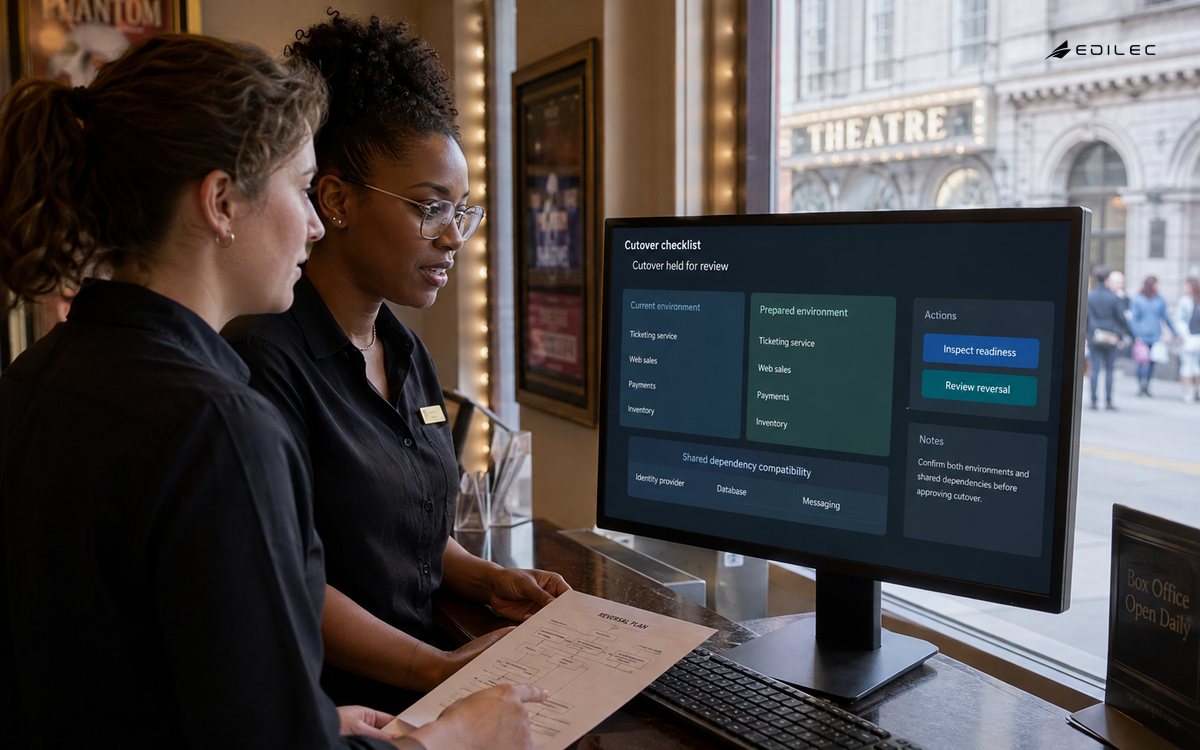
Before a blue-green release, compare the two environments using the same artifact identity, configuration contract, credentials, network permissions, health checks and dependency versions. AWS CodeDeploy describes traffic rerouting from the original to a replacement environment, while Azure App Service slots documents warm-up and preview validation. These details matter because the fallback is only useful while the old environment still has valid access and compatible data.
Measure propagation and stabilization time with a harmless request path, then test a reversal that includes reads, writes, asynchronous jobs and external callbacks. Keep the original environment until the agreed delayed-fault window closes. For related planning, compare blue-green decision guidance, canary releases, and deployment rollbacks.
Further Edilec context: Blue-green decision guide, Canary checklist, Deployment rollback guide. The production path applies those references specifically to blue-green deployment: a practical cutover checklist.
Source trail: AWS CodeDeploy blue-green integrations explains rerouting to a replacement environment; CodeDeploy documents traffic-shift choices; Azure deployment slots describes warm-up and preview; and Kubernetes Deployments grounds readiness and rollout checks. The operational question is whether the old color remains usable.