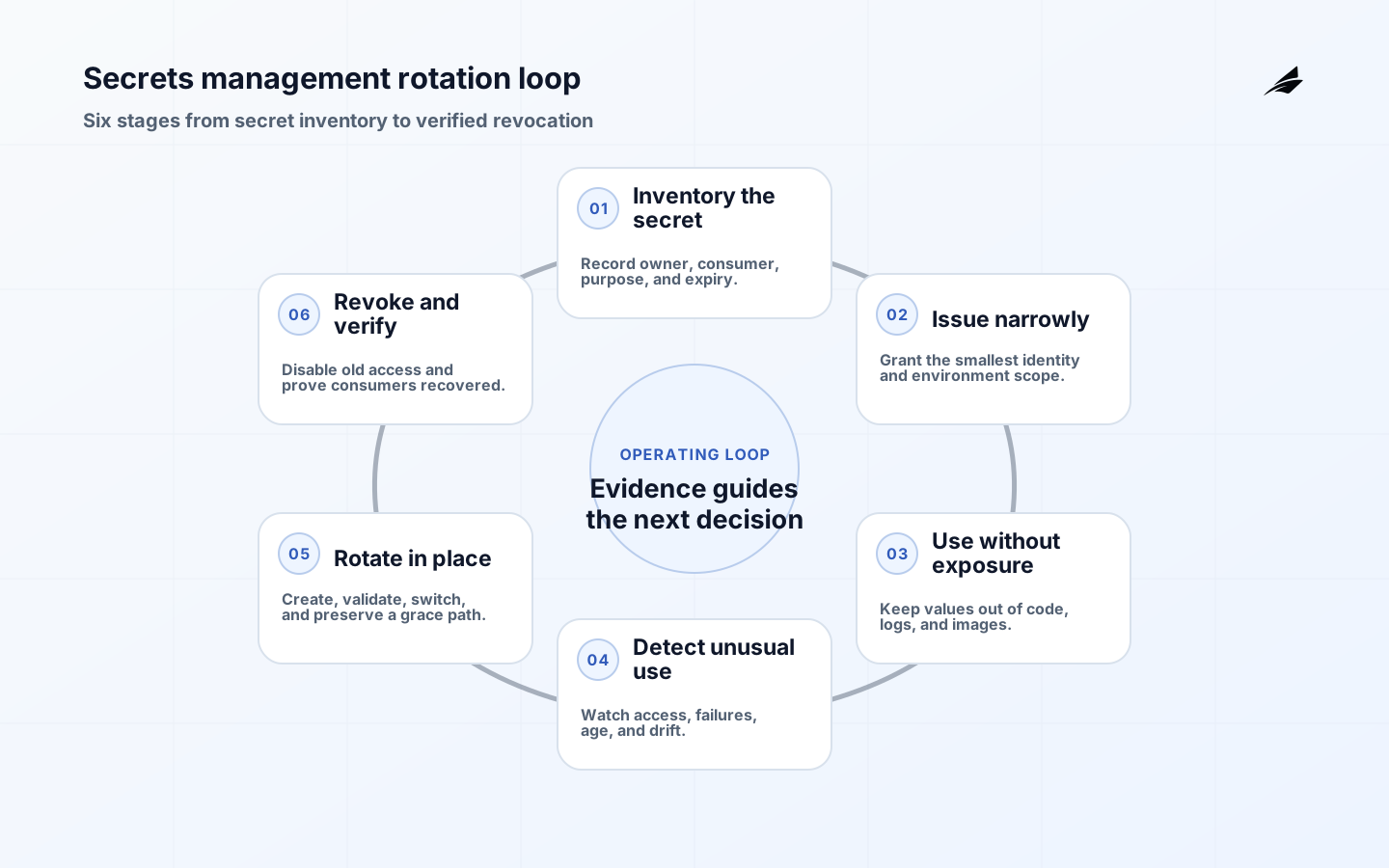
Secrets management is an operating discipline for credentials, tokens, keys, certificates, and other values that grant power. The common failure is treating it as a storage migration: move values from a repository into a vault and declare success. That leaves unanswered questions about who can retrieve them, which workloads receive them, how old values are revoked, and what an engineer does during an outage. A useful implementation reduces the places a secret can appear while preserving a reliable, auditable route for legitimate work.
Secrets management should make ownership, source of truth, permitted access, enforcement, recovery, and rotation evidence explicit for every secret class. The NIST AI Risk Management Framework and NIST Generative AI Profile provide lifecycle context for AI systems, especially when rotation and exposure response must remain recoverable. For Cloud and DevOps work, Google SRE release engineering, Kubernetes documentation, and NIST incident response guidance anchor repeatable change and recovery, especially when rotation and exposure response must remain recoverable. The OWASP LLM guidance adds a threat lens for model-connected services, and OpenSLO specification makes service objectives portable, especially when rotation and exposure response must remain recoverable. Connect the decision to Docker images, Kubernetes deployments, and SLOs when the decision crosses delivery boundaries, especially when rotation and exposure response must remain recoverable. Test ordinary work, missing evidence, stale state, unauthorized requests, partial failure, and recovery, especially when rotation and exposure response must remain recoverable. Keep the first bounded result in a change record, review exceptions with the people who own the work, and use the evidence to decide whether to expand, narrow, or stop, especially when rotation and exposure response must remain recoverable. The boundary is part of the service operating record.
Establish the secrets management operating boundary
Make an inventory before choosing a product. Classify every secret by owner, environment, consumer, privilege, rotation capability, expiry, and recovery dependency. Include credentials in CI variables, laptops, SaaS integrations, infrastructure providers, backups, and vendor portals. Distinguish authentication material from ordinary configuration and identify shared values that obscure accountability. This exposes costly coupling: one unrotatable database password or broad administrator token is both a technical and business-continuity risk.

| Decision area | Working rule | Evidence to keep |
|---|---|---|
| Ownership | A service or business owner is accountable for purpose and retirement. | Inventory record and escalation contact. |
| Consumers | Named workloads and approved human roles only. | Policy bindings and deployment references. |
| Rotation | Automated, staged, or exception-approved with review date. | Last rotation and test result. |
| Exposure | Revocation and replacement steps exist before use. | Incident contact and recovery procedure. |
Design secrets management for safe change
Design retrieval around workload identity where the platform supports it. A running service should authenticate as itself, receive only the values it needs, and avoid turning a secret into a broad environment variable visible to unrelated processes or diagnostics. Human access should use short-lived, attributable sessions with a documented break-glass route. Keep metadata useful but non-sensitive: owner, purpose, expiry, and rotation state should be visible without exposing the value. The vault matters, but identity and delivery mechanics limit blast radius.
Control the risks around secrets management
Access review must cover people and machines. Review roles that read a secret, identities that can impersonate those roles, and pipeline jobs that export values into untrusted contexts. Separate production from non-production; a production credential is not a debugging shortcut. Alert on unusual read volume, failed retrievals, disabled rotation, and unexpected workload identity. Do not require people to inspect every read manually. Focus review on privilege changes, emergency access, and anomalous patterns.
| Scenario | Expected response | Verification |
|---|---|---|
| New workload | Authenticate identity and grant one scoped read. | Access is limited to environment and secret. |
| Rotation | Create, distribute, validate, then revoke old material. | All consumers use the replacement. |
| Break glass | Use time-bounded attributable approval. | Emergency session is reviewed. |
| Vault failure | Invoke contingency with defined expiry. | Recovery creates no unmanaged copy. |
Test secrets management under pressure
Test rotation as end-to-end service behavior. Create a replacement value, distribute it normally, observe readiness and dependency authentication, revoke the prior value, and confirm that no consumer silently falls back. Test a lost vault or identity-provider dependency too: the aim is not a permanent bypass but a known recovery method, duration, and audit trail. Search representative logs, CI output, deployment records, and source history for the old identifier to find residual exposure.
Operate and improve secrets management
Secrets drift when services are copied, vendors change authentication models, or expedient exceptions are added during incidents. Review values without rotation, secrets with too many readers, and accounts not used. Retire credentials with retired integrations and reconcile inventory against vault usage. An exposure incident should lead to revocation, investigation, and correction to the delivery path. A promise to be more careful is not a durable control when the next build runs at speed.
- Assign ownership and expiry to every production secret.
- Prefer workload identity over static cloud credentials.
- Make rotation observable without logging values.
- Restrict CI jobs that inject sensitive values.
- Search for leaked identifiers after high-risk migrations.
Implementation field notes for secrets management
Architecture review for secrets management starts with the workload identity, vault policy, CI variable, certificate, service account, and vendor credential. Give each element an owner, an authoritative source, and expected failure behavior, especially when rotation and exposure response must remain recoverable. Follow a normal request across automation, people, and vendor boundaries, then test late, denied, stale, and partial outcomes, especially when rotation and exposure response must remain recoverable. For secret rotation, that turns a feature list into an operating design. It makes the route from ordinary work to accountable recovery visible and reveals assumptions that belong in a runbook, configuration review, or smaller scope rather than in private memory, especially when rotation and exposure response must remain recoverable.
Acceptance evidence must be practical. Define what proves the intended control works in representative conditions, who reads the proof, and what result stops expansion, especially when rotation and exposure response must remain recoverable. Evidence can be a versioned configuration comparison, scoped identity decision, customer-safe synthetic transaction, audit event, or reconciliation record, especially when rotation and exposure response must remain recoverable. Keep it with the release or operating decision. When an operator must gather proof from dashboards, chat threads, and private notes, the control becomes slow exactly when speed and clarity matter, especially when rotation and exposure response must remain recoverable. A secret change needs proof from every real consumer: application, worker, CI job, migration utility, and recovery process. A vault audit event must be tied to the consuming workload and rotation window.
Decision rights are part of secrets management. Separate authority to observe, change, approve, and override. The person running routine work needs a fast supported path; the person accepting a material exception needs context and a durable record, especially when rotation and exposure response must remain recoverable. Define the escalation route before the exception, including the point at which work pauses rather than silently continuing, especially when rotation and exposure response must remain recoverable. This avoids broad permanent privilege and makes handoffs inspectable by engineering, security, product, and support without forcing each group to master every implementation detail, especially when rotation and exposure response must remain recoverable.
Use a failure exercise that crosses the boundary instead of a healthy-path demonstration, especially when rotation and exposure response must remain recoverable. In the secrets workflow, a database credential is incomplete until jobs, migration tools, and recovery paths use the replacement. The response should name containment, stakeholder communication threshold, evidence preservation, and the reconciliation action that proves closure, especially when rotation and exposure response must remain recoverable. Rehearse it in non-production where possible, then run a tabletop with the people who would decide and communicate, especially when rotation and exposure response must remain recoverable. These exercises expose unavailable permissions, incomplete audit context, undocumented dependencies, and unclear ownership before customers depend on the path, especially when rotation and exposure response must remain recoverable.
Measure behavior rather than activity volume. Combine an outcome relevant to secrets management with a review of operator confusion, support contacts, recurring overrides, and workarounds. Version the calculation and alert separately when evidence is incomplete; a quiet chart is not proof of health if collection failed or people stopped recording exceptions, especially when rotation and exposure response must remain recoverable. This lets the team distinguish genuine improvement from a reporting change and gives leadership a defensible reason to prioritize a repair, investment, or retirement, especially when rotation and exposure response must remain recoverable.
Cost and capacity belong in the operating review. Estimate direct infrastructure spend alongside release delay, support demand, training, investigation time, and recurring exception cost, especially when rotation and exposure response must remain recoverable. Start with one representative workflow and a success and stop criterion rather than a broad commitment based on feature lists, especially when rotation and exposure response must remain recoverable. Expand only when teams can explain the value, operate the path without private expertise, and show that it removes a meaningful risk or handoff instead of moving it to another queue, especially when rotation and exposure response must remain recoverable. For secrets management, review the economic trade-off with the owner who experiences it.
Publish what changed, what stays deliberately out of scope, the evidence collected, and the date owners will retest the assumption, especially when rotation and exposure response must remain recoverable. Revisit after architecture, ownership, customer-commitment, or incident changes. This keeps secrets management connected to live operations and makes continual improvement normal delivery work rather than a retrospective promise that disappears after the immediate problem has passed.
Field application: A secret change needs proof from every real consumer: application, worker, CI job, migration utility, and recovery process. Tie each Vault audit record to the consuming workload and the rotation window so exposure analysis has operational context. In the next operating review, compare that evidence with the stated risk boundary and decide whether the control can expand, needs correction, or remains limited, especially when rotation and exposure response must remain recoverable. Record the decision with its accountable owner so later changes do not recreate the same uncertainty, especially when rotation and exposure response must remain recoverable.
Key takeaways for secrets management
- Define the customer, service, or risk boundary before implementing secrets management.
- Make the normal path observable and exceptions attributable.
- Use rehearsals to prove recovery, not dashboards to claim readiness.
- Review the model when architecture, ownership, or commitments change.
Frequently asked questions about secrets management
Question: Are Kubernetes Secrets a complete secrets-management solution? Answer: No. They need encryption, access control, rotation, workload boundaries, audit evidence, and a plan for values exposed through logs or backups. Question: How often should secrets rotate? Answer: Set the interval by exposure, credential type, provider capability, and recovery cost; rotate immediately when compromise is suspected.
Are Kubernetes Secrets a complete solution?
They are a distribution primitive, not a complete program. Teams still need encryption, access control, lifecycle ownership, rotation, audit, and protection across CI, source control, and external services.
How often should secrets rotate?
Use the shortest practical period based on privilege, exposure, provider support, and recovery cost. Automatic rotation is preferable to a calendar reminder, but it must be exercised.
Should developers read production secrets?
Default access should be no. Grant narrow, attributable, time-bounded access only for a real operational task and make the supported debugging path work without routine disclosure.
Conclusion: make secrets management an operating capability
Rotation is a service transition, not a calendar event. A safe sequence creates the replacement, validates that the consumer can use it, switches traffic or configuration, confirms successful use, and revokes the old value after a defined grace period. Applications that read once at startup need a restart or reload plan; applications that fetch dynamically need cache and failure behavior. Record the secret version without recording the secret itself. During an incident, distinguish exposure, misuse, and inability to rotate because each calls for a different response. The runbook should include ownership, communication, rollback, and proof that old access is no longer accepted.
Effective secrets management turns a sensitive value into a lifecycle with known owner, narrow delivery path, measured use, tested rotation, and reliable revocation. Start with the inventory and highest-privilege shared credentials, then make the secure route easier than copying a value into a ticket or local file.