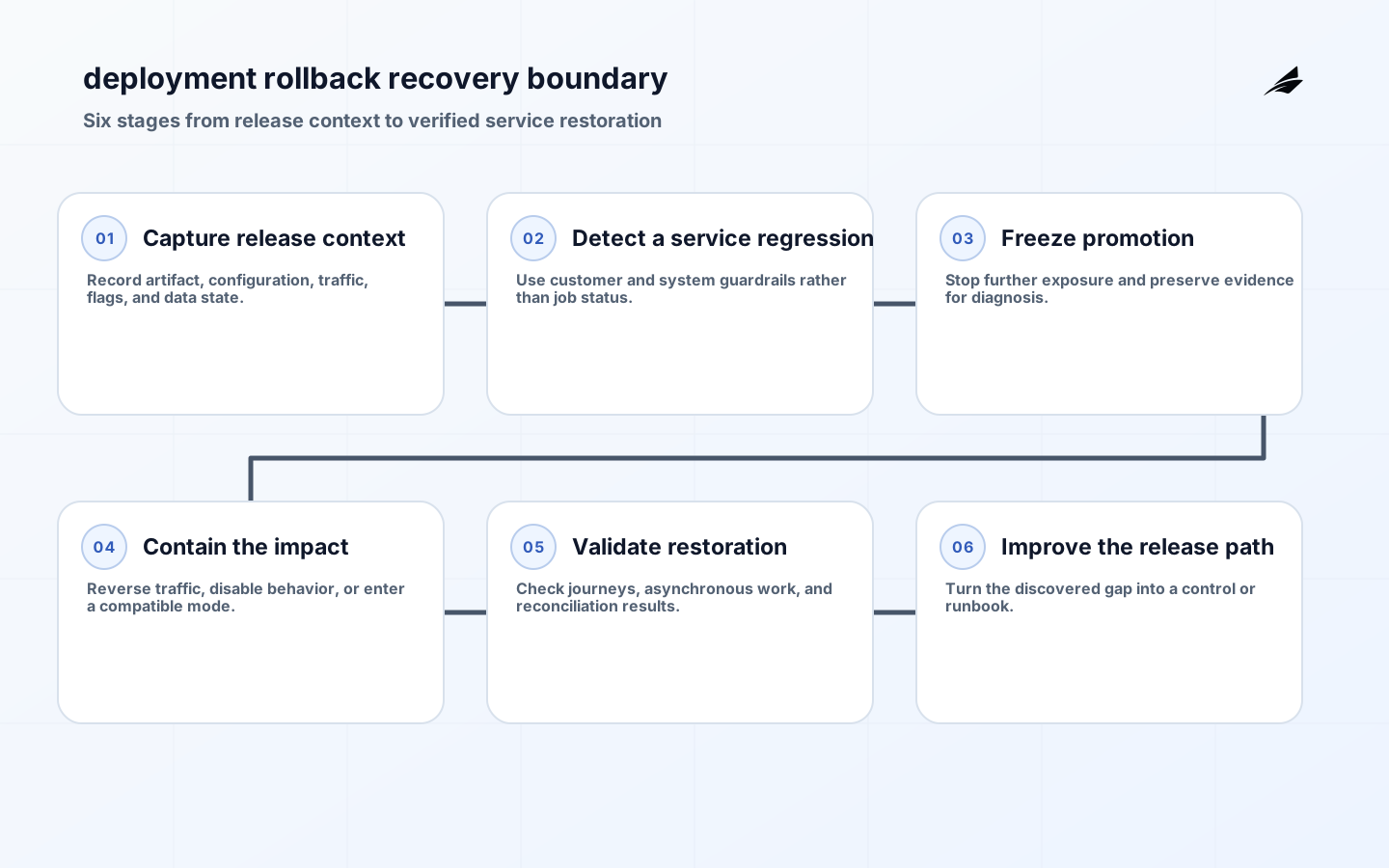
The Plain-language Guide to Deployment Rollbacks starts with an operating question: how can a team make a change or establish a practice that protects the outcome it is responsible for? Deployment rollbacks are restoring intended service behavior after a release by changing the smallest safe set of code, traffic, configuration, and data states. The useful unit is not a tool purchase or a one-time project. It is the release artifact, configuration, feature state, traffic route, data compatibility plan, and authority to stop promotion. When that boundary is visible, people can distinguish a healthy exception from missing information, assign a decision owner, and explain what evidence would change the decision. This guide uses the practical controls described in Google SRE Book: Release Engineering and Google SRE Workbook: Canarying Releases to turn the subject into routine work rather than a vague aspiration.
Key takeaways
- Define deployment rollbacks around a specific service outcome, owner, and boundary before selecting tools.
- Keep the decision record close to the release artifact, configuration, feature state, traffic route, data compatibility plan, and authority to stop promotion; it must be usable during ordinary work and recovery.
- Use user-journey success, error rate, latency, saturation, queue age, failed background work, and data reconciliation results as evidence, and state the observation window before acting.
- Prefer a bounded, reversible change while uncertainty remains; expand only after the outcome is verified.
- Treat exceptions and incidents as input to the operating model, not as reasons to bypass it permanently.
- Review the practice after material product, traffic, dependency, or policy changes.
What deployment rollbacks means in practice
Deployment rollbacks are best understood through detection, containment, restoration, and verification. That framing prevents a familiar mistake: optimizing a local technical measure while losing the customer or business outcome. The first task is to name the system boundary and the evidence source. The second is to say which decisions are inside it and which are not. Record the deployed artifact digest, configuration revision, feature flags, migration state, and target cohort in the release record before exposure. The guidance in Kubernetes Deployments documentation is valuable because it makes the control surface concrete: configuration, identity, artifacts, and operational feedback all matter, not only the most visible dashboard.
| Decision area | Question to settle | Evidence to retain |
|---|---|---|
| Scope | What outcome does deployment rollbacks protect or improve? | Named journey or workload, owner, and stated exclusions. |
| State | What is true before action? | Version, configuration, baseline, and dependency context. |
| Authority | Who can proceed, pause, or recover? | Named role, escalation route, and decision record. |
| Verification | What proves the result? | A time-bounded view of user-journey success, error rate, latency, saturation, queue age, failed background work, and data reconciliation results. |
Build an operating model for deployment rollbacks
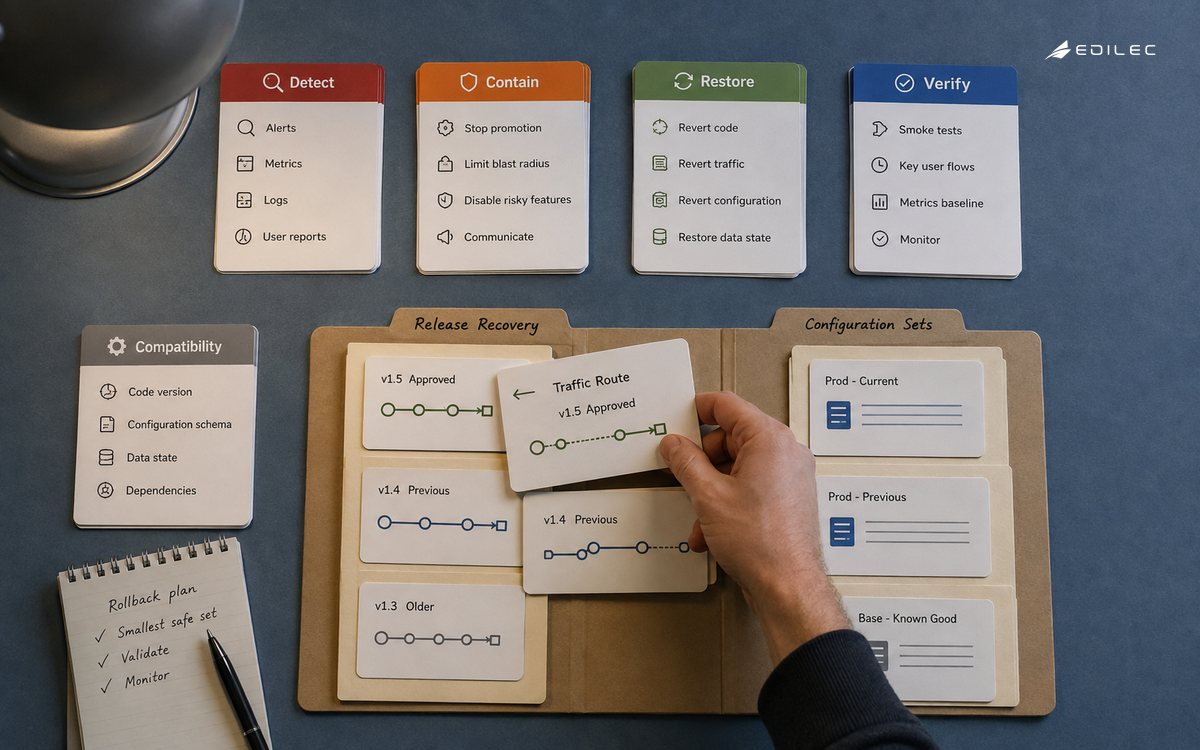
A dependable operating model makes the safe path easier than improvisation. For deployment rollbacks, make rollback a tested recovery path, not a button assumed to undo every side effect. Write down the trigger for action, the owner, the smallest action that can test the assumption, and the stop rule. The same record should identify dependencies that could invalidate a simple reversal. This is especially important when changes cross data, permissions, billing, or asynchronous work. AWS deployment circuit breaker guidance reinforces the broader point: mature technical practice is a chain of evidence and accountable decisions, not a collection of isolated checks.
A practical implementation path
Start small but make the path complete. Establish an inventory for the assets and decisions inside the release artifact, configuration, feature state, traffic route, data compatibility plan, and authority to stop promotion; choose one representative workload or journey; collect a baseline; and rehearse the action that will limit exposure. Use a traffic or feature reversal first when it contains harm without discarding evidence. Roll back an artifact only when it is compatible with current data and dependencies; otherwise move forward with a narrow corrective release under tighter controls. Do not postpone documentation until the end. A compact runbook containing the owner, input state, command or policy reference, expected signal, stop condition, and recovery action is more useful than a long architecture narrative that nobody can consult under pressure.
| Stage | Concrete action | Common trap |
|---|---|---|
| Baseline | Measure the current user-journey success, error rate, latency, saturation, queue age, failed background work, and data reconciliation results. | Comparing a changed population with an old or incomplete baseline. |
| Bounded action | Limit scope, time, or exposure while evidence is incomplete. | Changing several variables at once and losing causal clarity. |
| Decision gate | Use a written threshold and named owner. | Treating a green technical job as proof of service health. |
| Follow-through | Record result, exception, and next review date. | Leaving temporary access, capacity, policy, or routing in place. |
Controls and trade-offs in deployment rollbacks
Controls should match harm, reversibility, and uncertainty. A low-impact internal change may need a peer review and a scheduled check. A customer, security, financial, or data-integrity path needs stronger identity boundaries, progressive exposure, independent verification, and a practiced recovery route. The trade-off is real: every control has operating cost. The answer is not to remove controls blindly; it is to make their purpose visible, automate repeated evidence collection, and retire controls that no longer manage a meaningful risk. This keeps deployment rollbacks proportionate while preserving accountability.
Use a decision record for deployment rollbacks
A short decision record prevents later guesswork. Record the reason for the work, the current state, the change owner, the dependency assumptions, the expected benefit, and the conditions that require a pause or reversal. Include a link to the query, policy, or release record that will be used to verify the result. This is not paperwork for its own sake. In deployment rollbacks, the state can change while a team is still discussing it; a dated, inspectable record lets an on-call engineer or reviewer understand which assumption was tested and which authority approved the next step. Update the record when the population, dependency, or risk changes rather than overwriting history.
Work a real deployment rollbacks example
Suppose a team sees a material change in one of the relevant signals. The first response is to establish whether the change is real, scoped, and correlated with a known event. Compare the current population with the stated baseline, inspect recent configuration and dependency changes, and identify whether the evidence is complete enough for action. Then choose the smallest response that can limit harm: reduce exposure, restore a known configuration, revoke a narrow permission, or pause a promotion. After the immediate condition is stable, reconcile delayed work and update the decision record. This sequence keeps deployment rollbacks grounded in observable behavior instead of an intuition about what probably changed.
Keep deployment rollbacks transferable
A durable practice survives a handoff. Give the next operator enough context to answer what is being protected, where the current state is recorded, which inputs are trusted, and who can make the next decision. Test the handoff during routine work rather than waiting for an incident. For deployment rollbacks, a new owner should be able to find the baseline, reproduce the meaningful check, identify the recovery boundary, and see why an exception exists. This reduces dependence on individual memory and makes a review more valuable than a status meeting. It also exposes stale assumptions early, when a correction is cheap and evidence is still available.
Measure deployment rollbacks as an operating practice
Choose measures that combine outcome and control health. Track user-journey success, error rate, latency, saturation, queue age, failed background work, and data reconciliation results. Pair a leading signal, such as an unsafe policy denial or an unusual variance, with a lagging outcome such as customer failure or reconciliation loss. Review the measures at a cadence that matches the subject: some are continuous, while ownership, policy, and economic decisions may be monthly or release-driven. When a metric changes, investigate the population and conditions before declaring success. A tidy graph can conceal missing events, an unrepresentative cohort, or a shared dependency that changed both the control and candidate.
Failure modes that weaken deployment rollbacks
The recurring failure is reverting code while a destructive schema migration, emitted message, or third-party side effect remains incompatible with the old version. Another is separating the people who observe the outcome from the people who can change the system. Close that gap with shared evidence, clearly scoped access, and an escalation route that works outside normal business hours where the service requires it. Avoid compensating for weak design with permanent manual intervention. Repeated exceptions are diagnostic data: they may reveal an omitted dependency, a missing interface, an unsafe default, or an ownership boundary that needs repair.
Deployment rollbacks FAQ
When is a rollback unsafe?
It is unsafe when the previous binary cannot read the current data or when the release has already caused irreversible effects. That is why additive migrations, idempotent handlers, and explicit reconciliation plans matter.
Should every failed deployment roll back automatically?
Automation should act only on well-understood, high-confidence signals with a clear rollback action. Ambiguous symptoms need a human decision because a blind reversal can widen an outage.
What proves recovery?
A green deployment job is not proof. Verify the critical user journey, relevant asynchronous work, service guardrails, and the absence of a growing reconciliation backlog during a defined observation window.
Conclusion: make deployment rollbacks reviewable
The practical goal of deployment rollbacks is a decision that can be explained, repeated, and improved. Begin with a clear boundary and baseline, keep change reversible where possible, observe the outcome that matters, and leave a durable record for the next person. That discipline makes technical work calmer in normal operations and more reliable when conditions are changing quickly.