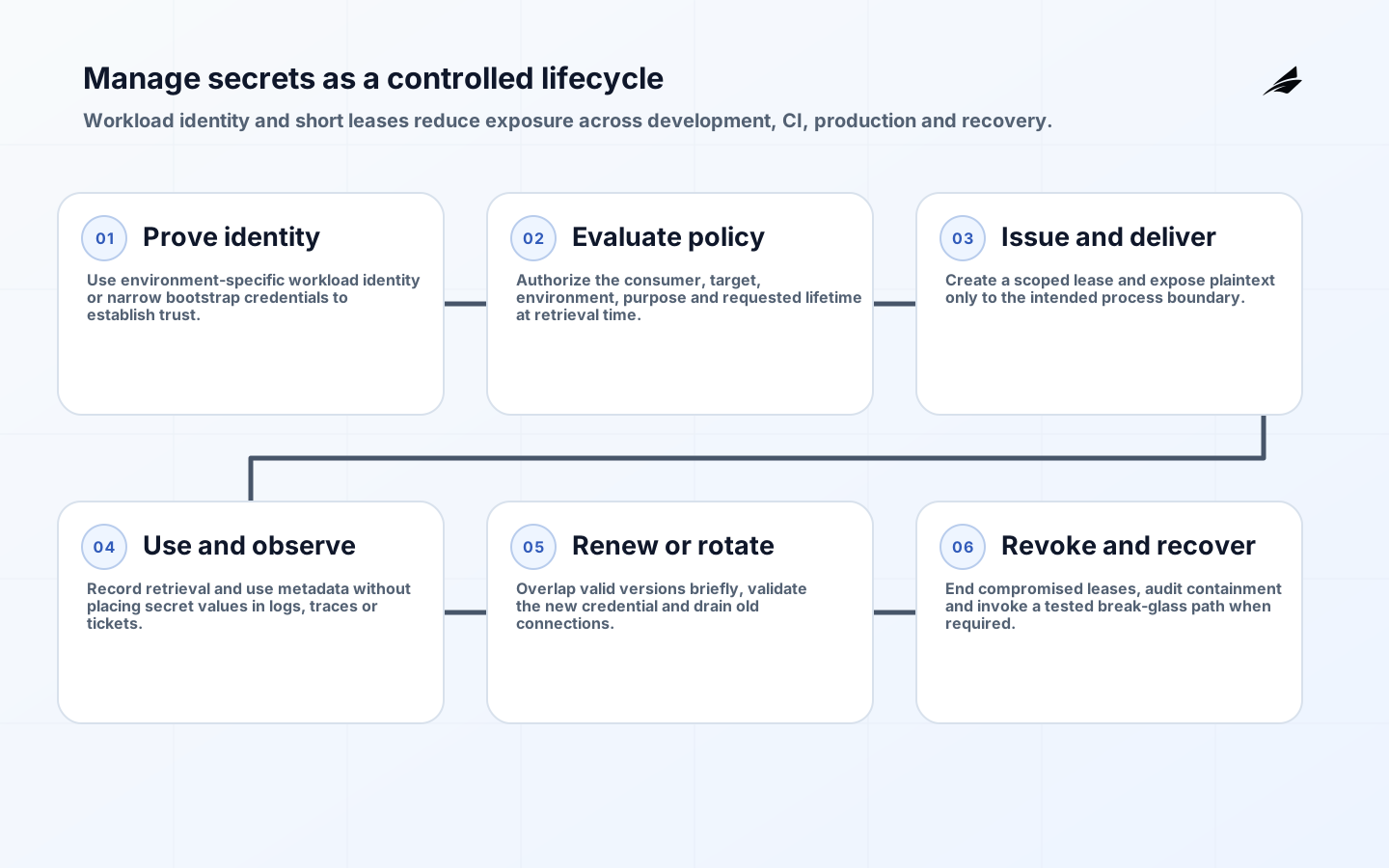
A secret is any value whose disclosure permits an action that should be controlled: a password, API token, private key, signing material or recovery credential. The management problem is not simply encrypted storage. Teams must know what exists, who or what may retrieve it, how it reaches a workload, when it expires, how use is observed and how compromise is contained. Development, CI, test, production and disaster recovery need distinct trust boundaries even when they use one management service.
The first design artifact should state the operating outcome: Make credential exposure short-lived, attributable and recoverable without turning every release into a manual ticket. Translate that promise into named records, decisions, controls and measures. Tool selection becomes easier when vendors and implementation teams must demonstrate the difficult exception, the unavailable dependency and the recovery path rather than only the happy path.
Define scope in business and risk terms
Interview application owners, platform engineers, security responders and database administrators about how credentials are created, copied, rotated and revoked today. Trace several real secrets from request to retirement, including an emergency replacement. Bound the first migration by environment and consumer type, and record systems that cannot yet use workload identity or overlapping credential versions.
- Inventory secrets by owner, consumer, target system, environment, sensitivity, lifetime and rotation method.
- Separate human administration, workload identity, build-time access and runtime access.
- Prefer workload identity or dynamically issued credentials where the target supports them.
- Define a controlled exception for legacy systems that require static credentials.
- Prevent secret values from entering source, images, logs, traces, tickets or analytics.
- Design emergency revocation and recovery before enforcing broad migration.
Design the lifecycle, decisions and boundaries
Model a secret as a lifecycle with discovered, approved, issued, active, rotating, revoked and expired states. Retrieval authorization belongs at the secret service and must bind the requesting workload to a narrowly scoped policy. Runtime clients need explicit behavior for cache expiry, renewal failure and revocation. Rotation jobs must be idempotent and verify both the target system and every consumer before invalidating an old version.

| Area | Question | Practical design |
|---|---|---|
| Identity bootstrap | How does a workload prove what it is without another long-lived secret? | Platform identity, attestation or narrowly scoped bootstrap |
| Storage | Where is the encrypted authoritative value and its metadata? | Central service with policy, versioning and audit |
| Delivery | How does the value reach only the intended process? | Authenticated runtime retrieval or managed injection |
| Rotation | Can producer and consumer overlap versions safely? | Staged update, validation and revocation |
| Recovery | What happens if the service or key hierarchy is unavailable? | Documented break-glass path and tested restoration |
Resolve implementation details early
Assign owners for each secret, its access policy, the target account and the rotation automation. Keep development, CI and production identities separate even when one vault serves them. Test with non-production credentials that have equivalent policy shape, never copied production values. Document key hierarchy recovery, regional replication, lease behavior, audit retention and what applications do when the secret service is temporarily unavailable.
A payment worker needs database access in test and production. Give each deployment its own workload identity and database role; do not copy one password between namespaces. The worker requests a short lease at runtime, renews it only while healthy and closes connections before expiry. The test role cannot reach production. A rotation exercise verifies new issuance, connection draining, revocation and the evidence available to responders.
Build security, privacy and accessibility into acceptance
Threat-model bootstrap identity, policy administration, secret injection, local caches, logs and build artifacts. Limit retrieval to the precise workload and environment, and separate vault administration from use of protected credentials. Secret values should never enter telemetry, command history or support tickets. Human break-glass retrieval requires strong authentication, a reason, short duration and immediate review; machine access should remain non-interactive and attributable.
Roll out with observable gates
- Baseline the current outcome, delay, failure demand and risk before changing the process.
- Build a thin end-to-end path and test contracts, permissions, telemetry and recovery.
- Run in simulation, shadow or limited-production mode where the control permits it.
- Release to a named cohort with an owner, support coverage, stop conditions and rollback steps.
- Review technical signals and business outcomes together; investigate segment differences.
- Expand only when exceptions are handled reliably and operating documentation matches reality.
- Retire the previous path, credentials, jobs and access after evidence and retention needs are satisfied.
A secrets migration gate should prove that the workload starts, renews and reconnects with newly issued credentials, and that emergency revocation is understood. Do not advance merely because values were imported into a vault. Verify old copies are removed from repositories, deployment variables and images. If a target cannot support seamless rotation, approve a maintenance and rollback procedure with the application owner before production enforcement.
Risks and measures
| Risk | Response | Evidence to watch |
|---|---|---|
| Secret sprawl | Discovery scans plus owned inventory and expiry | Unknown or ownerless credentials |
| Broad access | Per-workload policy and environment isolation | Consumers and denied retrievals |
| Rotation outage | Dual-version rollout and rehearsed rollback | Rotation success and stale use |
| Logging exposure | Redaction tests and structured logging rules | Detected secret patterns |
| Control-plane outage | Caching policy, bounded leases and recovery design | Retrieval failures and recovery time |
Track unknown and ownerless secrets, consumers per credential, denied retrievals, lease-renewal failures, rotation completion and use of superseded versions. A rising retrieval count may reflect scaling or a retry fault, while zero audit events can mean broken collection. Review measures by environment and workload identity. Pair inventory coverage with rotation exercises and incident-response evidence so a clean dashboard does not hide unusable controls.
Operate the capability after launch
Name an accountable secrets service owner and separate ownership of individual credentials. Review privileged policies, stale leases, rotation exceptions, replication health and break-glass activity on a defined cadence. Exercise a leaked CI token, unavailable vault region, failed database rotation and lost root recovery material. Update automation and runbooks from observed timing and dependencies, not from the intended design.
Operational details that determine reliability
Prefer identity federation from the deployment platform to the secret service so CI jobs and workloads do not carry durable bootstrap tokens. Bind access to repository, environment, service account and approved workflow claims. Protect the policy that makes this mapping as carefully as the stored values. A secret manager cannot compensate for a build identity that any branch or untrusted pull request can assume.
Rotation must cover the consumer and the target, not merely create a new value. Classify targets by whether they support overlapping credentials, dynamic accounts, certificate renewal or only disruptive replacement. For static credentials, stage the new version, update consumers, verify successful use, identify stragglers and revoke the old version. Measure actual use of versions rather than treating a successful API call as completed rotation.
Decide whether a runtime keeps a secret in memory, a mounted file, a local agent or an application cache, and document the exposure and outage tradeoff. Never put secret values in environment-wide diagnostics. Retrieval failures need bounded retry and a clear startup or continued-operation rule. Long caching improves availability but extends exposure and delays revocation; short leases require reliable renewal and graceful connection turnover.
Incident response begins with scope. From the inventory and access logs, responders should identify affected consumers, environments, target permissions and recent retrievals. Revoke or disable the credential, replace dependent access in a controlled sequence, search code and artifacts for copies, and preserve evidence without reproducing the value. A quarterly rotation is not a substitute for tested emergency revocation.
Procurement and architecture review should use scenario-based evidence for secrets management, cloud security, credential rotation. Ask each proposed solution to perform the representative case, reject an unauthorized action, survive an unavailable dependency, expose an understandable status, produce investigation evidence and export the owned data. Record configuration and integration work needed to achieve the demonstration. A feature visible in a product list is not proof that the complete control or journey will operate in the organization’s environment.
Acceptance should connect design claims to repeatable evidence. For identity bootstrap, retain tests or records that show platform identity, attestation or narrowly scoped bootstrap. For the risk of secret sprawl, assign the response before launch and review unknown or ownerless credentials. Add load, recovery, permission and accessibility evidence in proportion to impact. The release decision should identify residual risks, their owners and the conditions that would pause further rollout.
Key takeaways
- Start from a complete business outcome and the evidence needed to trust it.
- Make identity, authority, state, exception handling and ownership explicit.
- Design failure, recovery and reconciliation before expanding volume.
- Roll out to controlled cohorts with measurable gates and practiced rollback.
- Treat configuration, policy, access and retirement as continuing product work.
FAQ
Should we buy a product or build?
Compare managed services and self-operated vaults on identity integration, dynamic-secret support, target plugins, policy model, audit export, availability and recovery. Custom code may bridge a legacy target, but it should not become an unreviewed credential store. Include migration of secret versions and policies, operator skills, key custody, regional design and a tested export or replacement path in the decision.
What belongs in the first release?
Begin with one workload whose target supports controlled credential change and whose owner can test failure. Implement workload authentication, least-privilege policy, runtime retrieval, redaction, rotation, revocation and audit search end to end. Include a deployment rollback and a vault-outage test. A pilot that only reads a static test value does not establish that production rotation will be safe.
How should success be measured?
Measure the share of inventoried secrets with owners, applications using federated identity, credential lifetime, rotation success, stale-version use, unauthorized requests and emergency-revocation time. Add application availability during rotation and secret-service failures. Define data sources and exclusions clearly; a short nominal expiry is meaningless when consumers retain connections or copies beyond the lease.
When can the old process be retired?
Retire the former secret path only after every consumer uses the managed mechanism, old credentials are revoked at the target, repository and artifact scans are clean, and recovery is tested. Remove obsolete CI variables, mounted files, service accounts and rotation jobs. Preserve required audit metadata without preserving the secret value. Watch for attempted use of retired credentials as evidence of a missed consumer.
Conclusion
Effective secrets management makes credential authority temporary, narrow and observable across environments. An owned inventory, strong workload identity, controlled delivery, rehearsed rotation and prompt revocation matter more than the presence of a vault alone. Teams should migrate representative consumers in measured waves and close every old distribution path, leaving responders able to scope and contain exposure quickly.