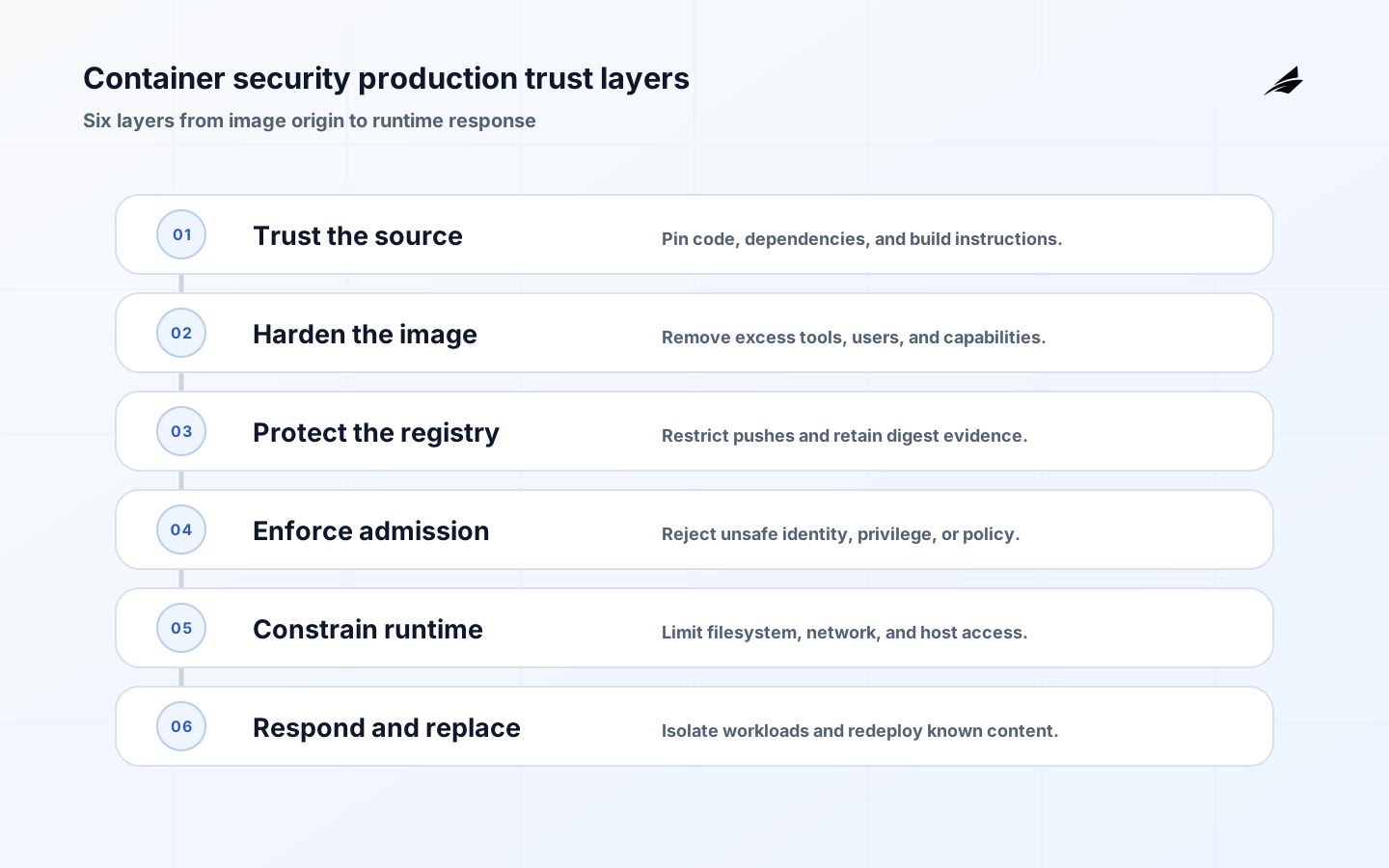
Container security is not achieved by scanning an image once and adding a policy later. A service crosses trust boundaries at source, build worker, registry, manifest, admission, runtime identity, network, storage, and observability. Product teams need an engineering model that follows the workload through those boundaries. The aim is to make a compromised dependency, risky configuration, or unexpected runtime action harder to introduce and easier to contain without turning every release into expert-only work.
Container security is a chain from source and build inputs to registry, admission, runtime, and response. NIST SP 800-190 organizes container risks across images, registries, orchestration, and hosts. Kubernetes Pod Security Standards provides enforceable profiles, Docker Engine security explains isolation and daemon concerns, and the CIS Docker Benchmark gives a hardening reference. Connect this note to Edilec Docker image architecture, Kubernetes deployments, and secrets management. Assign an owner to each boundary. Build evidence should identify source, dependencies, base image, builder, scan, attestations, and digest. Admission should enforce identity, privilege, capabilities, host access, and allowed registries. A finding is actionable only when it names workload, exposure, owner, due date, and decision. Exercise compromised-image response by stopping promotion, identifying digests, isolating workloads, rotating credentials, preserving evidence, and redeploying known content. Review exceptions whenever digest, workload, cluster policy, or threat model changes.
Establish the container security operating boundary
Define workload privilege. Record service purpose, data handled, image origin, runtime identity, reachable dependencies, and host or cluster capabilities truly required. Separate public workloads from internal processors, and do not assume a namespace is a complete boundary. This map exposes high-value work: a service running as root with broad cloud credentials and unrestricted egress deserves more attention than a low-privilege batch task with a narrow role.
| Decision area | Working rule | Evidence to keep |
|---|---|---|
| Build | Reviewed inputs create the image. | Revision, builder, provenance, and digest. |
| Registry | Images are immutable and access controlled. | Publisher role and scan state. |
| Admission | Risky configuration is rejected or excepted. | Policy decision and expiry. |
| Runtime | Privilege and reach match function. | Identity, network policy, runtime events. |
Design container security for safe change
Secure the chain first because runtime controls cannot prove an image came from reviewed input. Pin base images, record provenance, restrict registry publishing, and keep build credentials out of images and logs. Choose a minimal image, run non-root where feasible, drop unused capabilities, use read-only filesystems when possible, and separate service accounts. Express the small set of required destinations through network policy rather than allowing broad lateral reach.
Control the risks around container security
Put policy checks near delivery and make failures actionable. Pipelines can flag prohibited images, missing signatures, insecure manifests, and risky secret use, but results need owner and remediation path. Admission controls should stage durable baseline rules: audit legacy estates first, then warn or block after teams have a workable route. Emergency exceptions need an expiry and reason. An unbounded exception becomes an invisible configuration standard.
| Scenario | Expected response | Verification |
|---|---|---|
| Privileged manifest | Reject or require expiring exception. | Decision identifies capability. |
| Vulnerable base | Locate consumers and rebuild. | Affected inventory and deployment. |
| Unauthorized secret | Deny at identity boundary. | No value in diagnostics. |
| Unexpected egress | Block or flag outside allowlist. | Workload and destination context. |
Test container security under pressure
Attempt a prohibited privileged configuration, retrieve a secret from an unauthorized identity, connect to an unapproved destination, and run an unexpected binary in non-production. Verify policy blocks or records the action and explains it to the developer. Rebuild after a critical base-image update and measure how quickly affected services can be identified and redeployed. That tests remediation throughput, the capability that matters after disclosure.
Operate and improve container security
Review image age, unresolved exceptions, unowned services, privileged workloads, and policies producing noisy false positives. Incident learning should refine defaults, not add permanent approval to every release. The operating question is whether ordinary changes can travel through a secure path without bypassing it. When not, improve the path before demanding more compliance from people under delivery pressure.
- Inventory images by digest and owner.
- Use minimal runtime identity.
- Audit before enforcing baseline on legacy workloads.
- Measure image rebuild speed.
- Expire and review every exception.
Implementation field notes for container security
Architecture review for container security starts with the source input, builder, registry, image digest, manifest, runtime identity, and network policy. Give each element an owner, an authoritative source, and expected failure behavior, especially when image provenance must meet runtime policy. Follow a normal request across automation, people, and vendor boundaries, then test late, denied, stale, and partial outcomes, especially when image provenance must meet runtime policy. For container trust boundary, that turns a feature list into an operating design. It makes the route from ordinary work to accountable recovery visible and reveals assumptions that belong in a runbook, configuration review, or smaller scope rather than in private memory, especially when image provenance must meet runtime policy.
Acceptance evidence must be practical. Define what proves the intended control works in representative conditions, who reads the proof, and what result stops expansion, especially when image provenance must meet runtime policy. Evidence can be a versioned configuration comparison, scoped identity decision, customer-safe synthetic transaction, audit event, or reconciliation record, especially when image provenance must meet runtime policy. Keep it with the release or operating decision. When an operator must gather proof from dashboards, chat threads, and private notes, the control becomes slow exactly when speed and clarity matter, especially when image provenance must meet runtime policy. Container acceptance connects image digest, admitted manifest, runtime identity, and observed network reach. That establishes the baseline for the running workload, not merely the artifact scanned before deployment.
Decision rights are part of container security. Separate authority to observe, change, approve, and override. The person running routine work needs a fast supported path; the person accepting a material exception needs context and a durable record, especially when image provenance must meet runtime policy. Define the escalation route before the exception, including the point at which work pauses rather than silently continuing, especially when image provenance must meet runtime policy. This avoids broad permanent privilege and makes handoffs inspectable by engineering, security, product, and support without forcing each group to master every implementation detail, especially when image provenance must meet runtime policy.
Use a failure exercise that crosses the boundary instead of a healthy-path demonstration, especially when image provenance must meet runtime policy. In the operating model, an approved image stays risky when its manifest mounts a host path and grants an unrelated cloud role. The response should name containment, stakeholder communication threshold, evidence preservation, and the reconciliation action that proves closure, especially when image provenance must meet runtime policy. Rehearse it in non-production where possible, then run a tabletop with the people who would decide and communicate, especially when image provenance must meet runtime policy. These exercises expose unavailable permissions, incomplete audit context, undocumented dependencies, and unclear ownership before customers depend on the path, especially when image provenance must meet runtime policy.
Measure behavior rather than activity volume. Combine an outcome relevant to container security with a review of operator confusion, support contacts, recurring overrides, and workarounds. Version the calculation and alert separately when evidence is incomplete; a quiet chart is not proof of health if collection failed or people stopped recording exceptions, especially when image provenance must meet runtime policy. This lets the team distinguish genuine improvement from a reporting change and gives leadership a defensible reason to prioritize a repair, investment, or retirement, especially when image provenance must meet runtime policy.
Cost and capacity belong in the operating review. Estimate direct infrastructure spend alongside release delay, support demand, training, investigation time, and recurring exception cost, especially when image provenance must meet runtime policy. Start with one representative workflow and a success and stop criterion rather than a broad commitment based on feature lists, especially when image provenance must meet runtime policy. Expand only when teams can explain the value, operate the path without private expertise, and show that it removes a meaningful risk or handoff instead of moving it to another queue, especially when image provenance must meet runtime policy. For container security, review the economic trade-off with the owner who experiences it.
Publish what changed, what stays deliberately out of scope, the evidence collected, and the date owners will retest the assumption, especially when image provenance must meet runtime policy. Revisit after architecture, ownership, customer-commitment, or incident changes. This keeps container security connected to live operations and makes continual improvement normal delivery work rather than a retrospective promise that disappears after the immediate problem has passed.
Field application: Reconcile the admitted manifest and running identity with observed network reach, then compare that evidence with the stated risk boundary. Decide whether the control can expand, needs correction, or remains limited, especially when image provenance must meet runtime policy. Record the decision with its accountable owner so later changes do not recreate the same uncertainty, especially when image provenance must meet runtime policy.
Runtime example: take one internet-facing workload and write the exact permissions it requires to read configuration, reach its database, emit telemetry, and receive traffic. Attempt each disallowed operation with a test identity and capture the resulting policy decision. Then update the base image and verify that the deployed digest, manifest, and runtime process information converge on the same release record. This gives product and security teams evidence that controls protect the actual workload rather than an idealized container definition that was never promoted.
Key takeaways for container security
- Define the customer, service, or risk boundary before implementing container security.
- Make the normal path observable and exceptions attributable.
- Use rehearsals to prove recovery, not dashboards to claim readiness.
- Review the model when architecture, ownership, or commitments change.
Frequently asked questions about container security
Question: Is an image scan enough for container security? Answer: No. Scanning is one signal. Teams also need provenance, dependency and base-image context, registry controls, admission policy, runtime permissions, workload identity, and a way to trace and recover a deployed digest.
Question: When should a container run with additional privileges? Answer: Only for a documented requirement that cannot be met with a narrower capability or identity. Make the exception time-bound, approve it through the right owner, and monitor the workload so the privilege does not become a silent default.
Question: What is the first control to improve? Answer: Start with one representative workload and connect its source, build, image digest, admission decision, runtime identity, and recovery action. This exposes inventory and ownership gaps before a broad policy creates noisy exceptions.
Is an image scan enough?
No. It does not control provenance, runtime privilege, identity, network reach, cluster configuration, or remediation speed.
Must every image be distroless?
Minimal images often reduce surface, but operational needs matter. Preserve required debugging and compatibility without carrying unnecessary packages.
What control comes first?
Start with an accurate inventory and baseline against obviously dangerous configurations, paired with a usable remediation and exception path.
Conclusion: make container security an operating capability
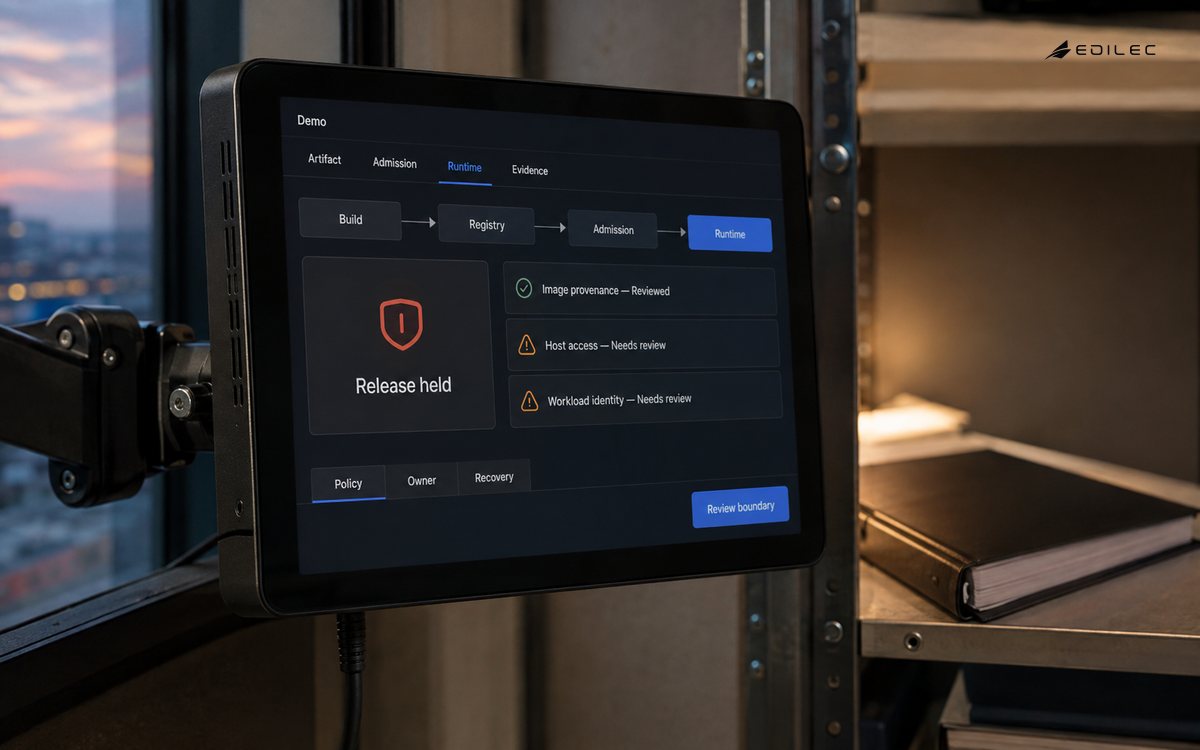
Runtime evidence should connect policy to an actual workload. Record image digest, pod identity, service account, namespace, host interfaces, capabilities, network exposure, and admission decision. During a finding, this allows responders to distinguish an image that is present in a registry from one that is running with reachable privilege. Keep accepted exceptions time-bound and review them when the workload or cluster changes. A secure default is valuable only when teams can understand why a deployment was rejected and what supported path will satisfy the policy. That usability determines whether the control is adopted or bypassed.
Container security becomes manageable when images, manifests, identities, and runtime behavior are one delivery system. Reduce privilege, verify provenance, enforce a comprehensible baseline, and practice remediation.