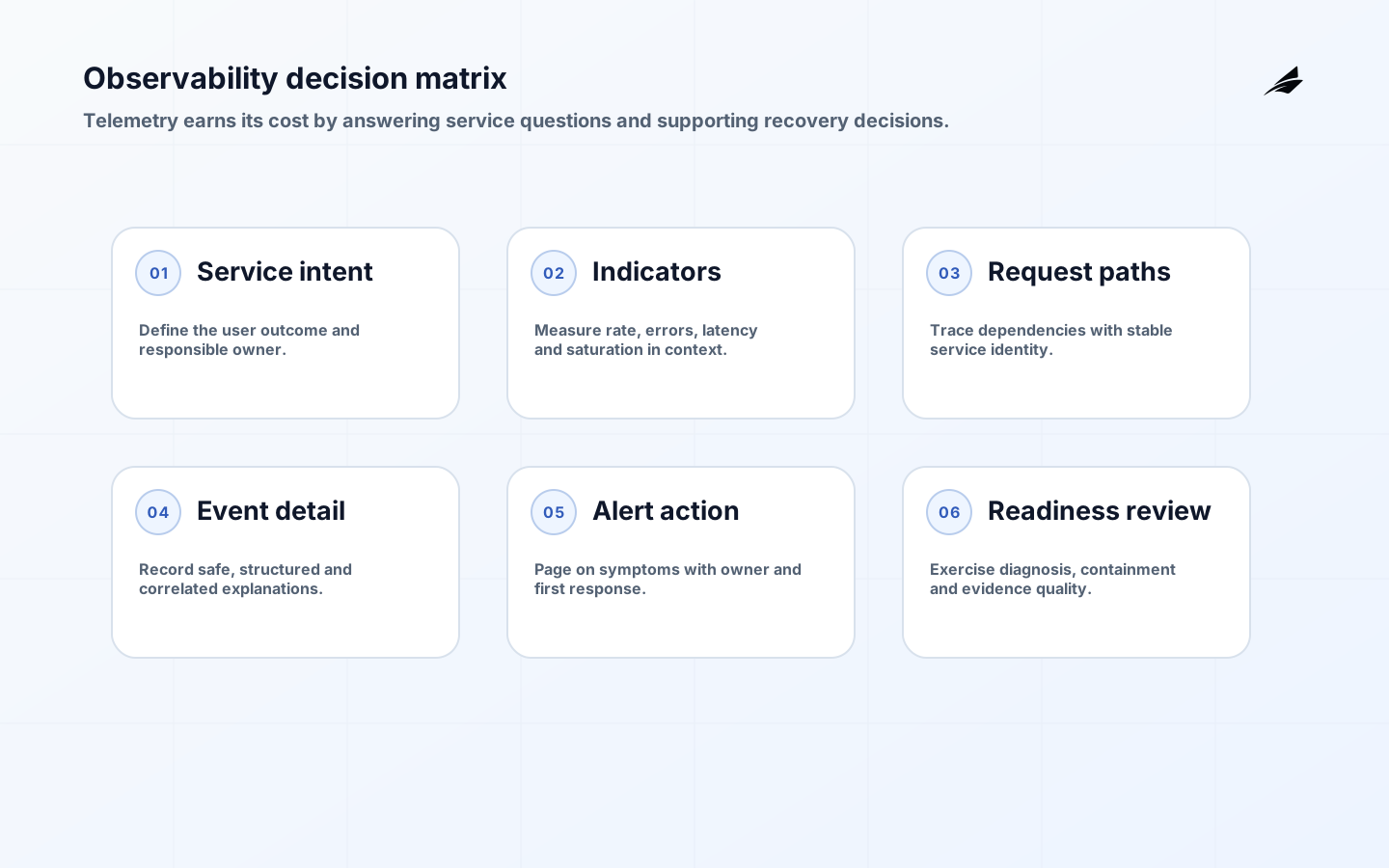
Observability for engineering teams becomes important when a team can no longer rely on shared memory to make a production decision. Observability is the ability to ask useful questions about a running system without first adding bespoke instrumentation during an outage. Engineering teams achieve it by connecting service intent to well-designed metrics, logs, and traces, not by collecting every possible event. The starting point is the customer outcome the service owns and the decisions an on-call engineer must make when that outcome degrades. This guide treats the work as an operating system for change: name the service obligation, make the boundary inspectable, choose controls that match risk, and retain evidence that lets a different responder act safely. The companion observability engineering notes is useful context when the topic touches a related production concern.
Current practice is grounded in the OpenTelemetry observability primer, its instrumentation guidance and metrics model, together with Google SRE practical alerting. These sources distinguish correlated telemetry from operational decisions: signals must be instrumented consistently, governed for cost and sensitivity, and connected to an actionable response. For deeper implementation, use Edilec's distributed tracing guide and SLO planning guide to connect request evidence and reliability objectives to the service boundary.
Key takeaways
- Make observability for engineering teams answer a concrete service decision, not a tool-adoption question.
- Document the boundary, owner, and recovery action before broad production use.
- Use evidence from customer outcomes and technical signals together.
- Start with a bounded implementation, then standardize what survives a real exercise.
Set the purpose and boundary for observability for engineering teams
The first design task is deciding what belongs inside the system and what remains an explicit dependency. Define the service and its dependencies before selecting tools. Name the user journey, service-level indicator, ownership boundary, and data classification. Then design telemetry that relates an alert to investigation: metrics reveal a change in behavior, traces reveal a request path, and structured logs provide event detail. Correlation identifiers and consistent resource attributes keep these signals usable across services. That description should be short enough to use during a release or incident and specific enough to expose missing owners. It also prevents an attractive platform feature from being mistaken for an end-to-end guarantee. A reliable operating boundary tells a team what it can change, what it must observe, and when it needs another owner involved.
For telemetry, state the user behavior that must be understood and the operational questions that signals must answer. The failure statement should name missing context, alert noise, sensitive data exposure, or a blind dependency path, along with the team that can correct it.
| Question | Primary signal | Context needed |
|---|---|---|
| Are users succeeding? | Service-level indicator | Journey, cohort, and result |
| Where is time spent? | Trace duration and spans | Dependency and release version |
| Why did this request fail? | Structured error event | Trace link and safe category |
Build an operating model for observability for engineering teams
A workable model gives routine operators authority to make the ordinary safe action and makes escalation predictable when evidence is incomplete. Establish semantic conventions, cardinality budgets, retention classes, access rules, and redaction tests. High-cardinality attributes can make metrics expensive or unusable; sensitive identifiers in logs or spans can create a different risk. Instrument once at common boundaries where possible, but retain domain events for the decisions only the product team can answer. The model should identify the accountable service owner, the platform or security partners who set shared guardrails, and the person who validates customer recovery. It should also preserve a narrow exception path. Teams will bypass controls that block urgent recovery; a reviewed, recorded exception is safer than an invisible workaround.
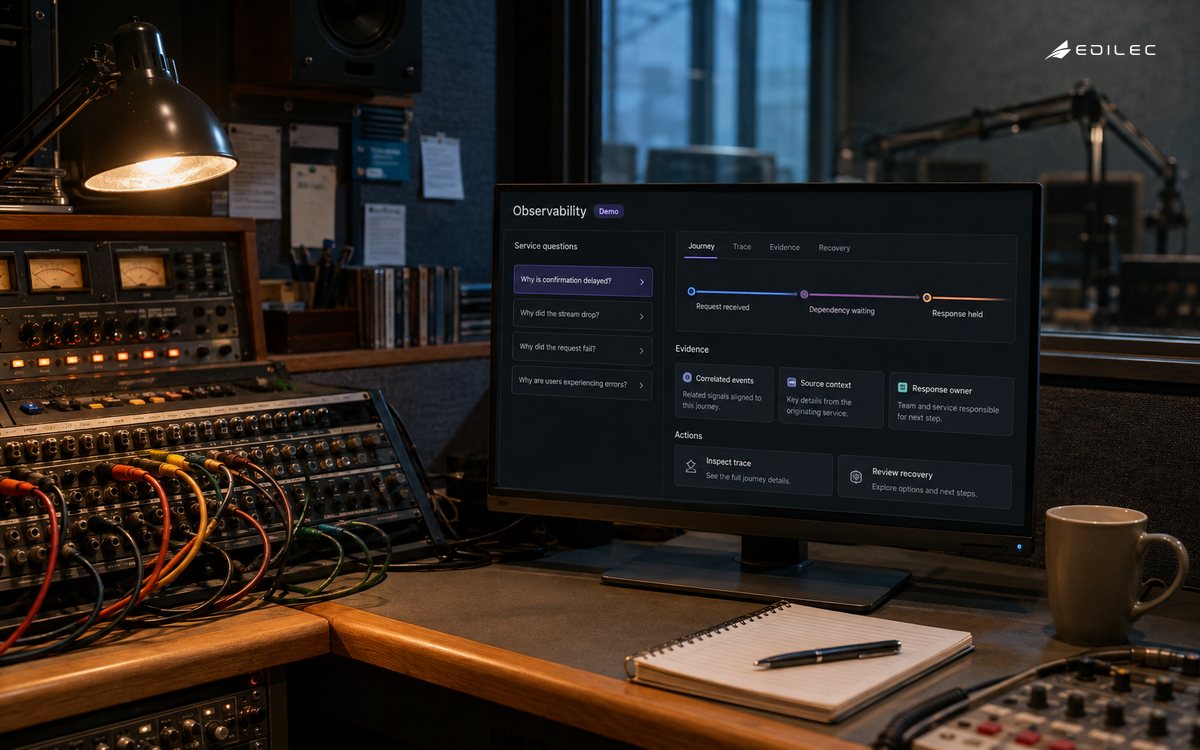
Use proportionate controls and retained evidence
Controls should reduce a specific uncertainty rather than add ceremony. Establish semantic conventions, cardinality budgets, retention classes, access rules, and redaction tests. High-cardinality attributes can make metrics expensive or unusable; sensitive identifiers in logs or spans can create a different risk. Instrument once at common boundaries where possible, but retain domain events for the decisions only the product team can answer. Keep a durable record of the relevant revision, the target or affected cohort, the decision maker where needed, the observed condition, and the recovery action. This lets an on-call engineer distinguish a known change from an unknown symptom. It also makes a later review about the system and its evidence rather than recollection. For related release containment, see distributed tracing guide.
| Telemetry risk | Control | Review trigger |
|---|---|---|
| Metric cardinality growth | Limit unstable attributes | Cost or query performance change |
| Sensitive event data | Redact and restrict access | New field or partner payload |
| Alert noise | Tie alert to actionable condition | Repeated non-actionable pages |
Measure the service outcome and operating health
A dashboard should help someone decide what to do next. Measure the reliability indicator itself, alert quality, time to detect and understand a failure, telemetry ingestion error, cost by signal type, and the percentage of high-priority services with current runbooks and ownership. Review false positives and missing context after incidents. A quiet pager is not proof that observability works if customers discover the problem first. Define a baseline before changing the system, label new revisions or cohorts where useful, and avoid treating a single aggregate as the whole story. Pair a leading signal that helps contain harm quickly with a customer or business signal that confirms whether the service obligation was restored. Review the signals after a real event and remove measurements that cannot support an action.
Adopt observability for engineering teams in deliberate increments
Broad mandates often hide unresolved edge cases. Choose one important transaction and make it explainable end to end. Add a customer-facing indicator, a focused dashboard, structured error context, and a trace across its main dependencies. Run a game day or a retrospective query against a known failure. Standardize only the pieces that proved useful, such as service naming or HTTP attributes, rather than imposing an enormous schema at once. Publish the reference path, its owner, and the conditions under which a team may use an exception. Then revisit the reference after an incident, recovery exercise, or significant architectural change. The point of standardization is not uniformity for its own sake; it is to make the next decision faster, safer, and easier to explain.
Worked operating scenario
Consider a concrete situation rather than an idealized diagram. A team sees an error-rate alert on its order API but cannot distinguish payment declines from internal failures. It changes the metric to classify safe error categories, adds a trace link from the API to the payment adapter, and records a scrubbed partner response code in structured logs. During the next problem, the operator can identify an upstream decline spike without reading millions of log lines. The system became observable because it answered a decision question. This kind of scenario is valuable because it tests the handoffs between engineering, operations, product, and security. Ask who observes the first signal, who has authority to contain the effect, which records or customers need repair, and what evidence proves normal service has returned. When those answers are clear before pressure arrives, the system can change with considerably less guesswork.
Run a readiness review for observability for engineering teams
A readiness review turns observability for engineering teams from a proposed design into a demonstrated operating capability. Review one alert from page through diagnosis. Confirm that the indicator represents a user outcome, that the dashboard leads to a dependency or release question, and that logs and traces carry safe correlation context. Inspect the telemetry bill and access path too; a signal that cannot be retained or safely read will fail when the incident arrives. Capture the result as a small decision record: the scenario, participants, observed evidence, elapsed time, unresolved assumptions, and the owner for each correction. Repeat after a material architecture or ownership change. This is deliberately practical work. It shows whether instructions, permissions, telemetry, and decision rights still line up when a team must protect a real service rather than explain an ideal workflow.
Frequently asked questions about observability for engineering teams
Are logs, metrics, and traces interchangeable?
No. Metrics summarize behavior over time, traces show the path of individual work, and logs capture detailed events. They are most effective when they share service identity and correlation context, while each is governed for its own volume and sensitivity.
What should be instrumented first?
Start with the highest-value customer journey and its likely failure modes. Add enough context to identify the responsible service, dependency, release, and cohort. Instrumentation that cannot inform an action should be reconsidered.
What evidence should leaders ask for?
Ask for evidence that the stated boundary, controls, and recovery path work in the environment that matters. For observability for engineering teams, that normally includes a named owner, a current revision or configuration record, service and customer signals, and the result of a relevant test or exercise. Prefer a small set of evidence tied to a decision over a large inventory that nobody uses under pressure.
For observability, treat a new attribute as a product and security decision, not a harmless logging detail. Its cardinality, sensitivity, retention, and query value should be understood before broad collection. This keeps future incident evidence useful instead of expensive or restricted.
Conclusion
Observability for engineering teams are most useful when they make production work more understandable and recoverable. Start with one service promise and one bounded path, assign ownership, collect only the evidence that supports a decision, and practice the recovery action. The resulting discipline gives teams room to move faster without losing track of what customers experience.