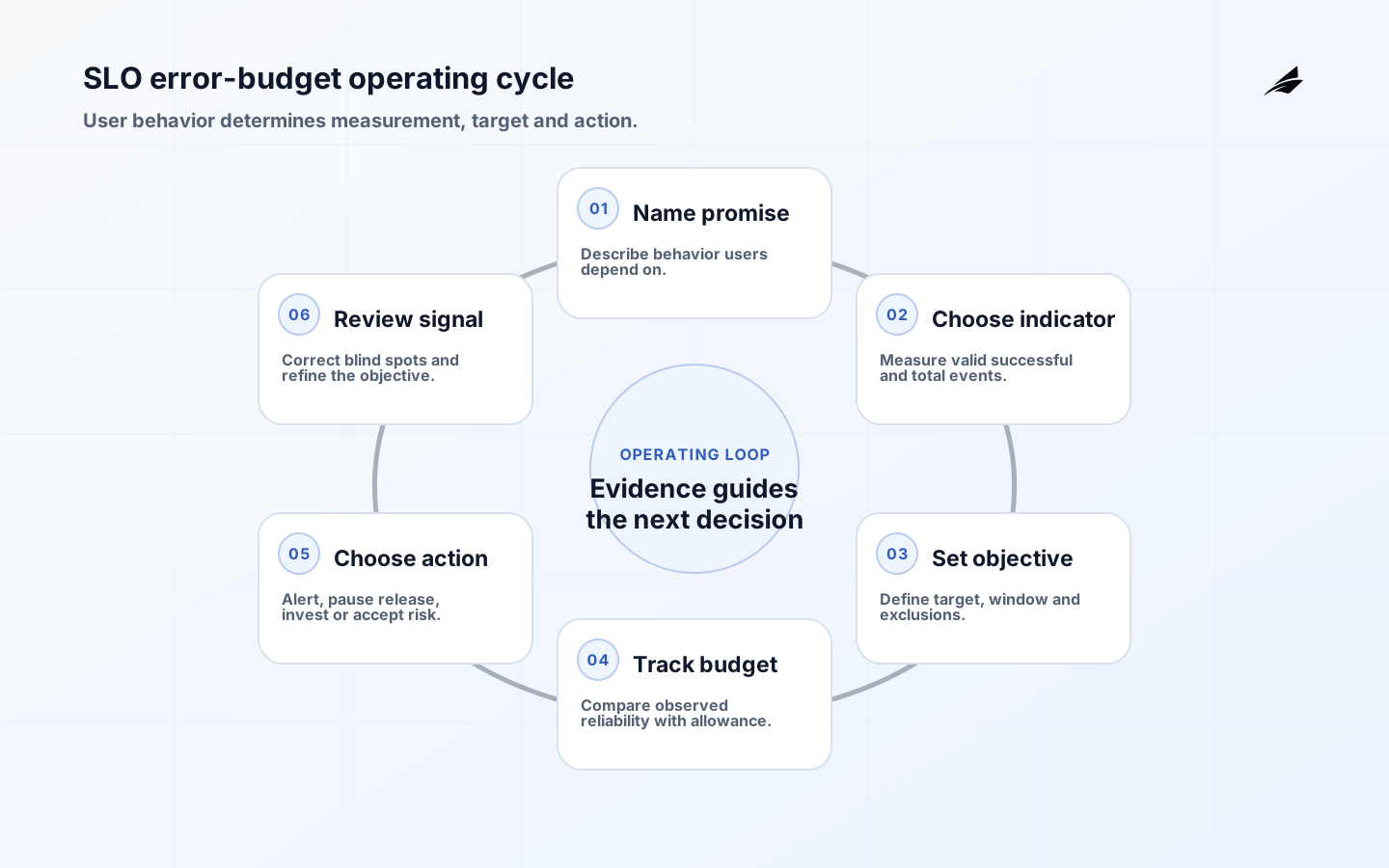
Service level objectives turn reliability from a vague aspiration into a decision system. They do not mean selecting an impressive percentage for a dashboard. A founder needs an SLO to answer whether the product is dependable for the workflow customers pay for, how much change risk is acceptable, and when to pause feature work to restore reliability. Planning forces agreement about the user journey, measurement boundary, and cost of being wrong.
Establish the SLOs operating boundary
Choose one user-visible outcome before listing infrastructure metrics. A customer may care that an order is placed, a report is available by deadline, a document saves, or an account signs in. State eligible events, bad events, population, and justified exclusions. Avoid measuring an easy HTTP endpoint when it does not represent the promise. Include dependencies whose failure customers experience; users see the assembled service, not the ownership chart.
| Decision area | Working rule | Evidence to keep |
|---|---|---|
| User outcome | What customer action is protected? | Completed transaction or sign-in. |
| Indicator | Which events are good or bad? | Versioned query and samples. |
| Objective | What reliability supports commitment? | History and expectation. |
| Budget policy | What changes when burn is fast? | Owner, release rule, cadence. |
Design SLOs for safe change
A service-level indicator must be independently checkable and stable enough to guide decisions. Define source, aggregation, window, retries, late events, maintenance, and missing telemetry. Keep separate diagnostic views for dependency or regional detail. Choose a target from observed performance, expectation, and intervention cost. Perfection is rarely right because it consumes capacity that could reduce a more meaningful risk.
Control the risks around SLOs
Connect the error budget to a release rule people can apply. When performance stays within budget, take normal change risk; when it burns too quickly, slow high-risk release activity, investigate, and restore capability. The rule should not punish one unusual event or become permanent freeze. Name the product and engineering owners, review cadence, and resume conditions. Protect measurement credibility by versioning the query and alerting on missing data separately.
| Scenario | Expected response | Verification |
|---|---|---|
| Known success | Counts once despite normal retry. | Matches trace or business record. |
| Known failure | Counts bad with diagnostic context. | Visible in objective and incident view. |
| Telemetry gap | Raises measurement-health signal. | Completeness alert and owner. |
| Rapid burn | Triggers agreed release response. | Decision is recorded. |
Test SLOs under pressure
Generate known success, known failure, timeout, retry, and dependency error, then confirm each counts correctly. Compare a sample to application and support records, especially where asynchronous completion complicates timing. During a game day, simulate rapid budget spend, practice release decisions, and verify product, engineering, and support roles. The rehearsal exposes teams that can see an objective but have not agreed on safe action.
Operate and improve SLOs
Review whether the indicator still represents value, target remains credible, and budget policy led to useful decisions as workflows and architecture change. Do not use a growing list as substitute for prioritization. Retire obsolete objectives and investigate services without owners. Mature practice is a recurring conversation where reliability evidence changes delivery plans before customers have to complain.
- Choose a customer outcome.
- Document retries and exclusions.
- Set target from evidence and trade-offs.
- Make budget response a product agreement.
- Run a game day.
Implementation field notes for SLOs
Architecture review for SLOs starts with the user journey, event definition, telemetry query, budget rule, dependency signal, and incident record. Give each element an owner, an authoritative source, and expected failure behavior for the SLO and error-budget review. Follow a normal request across automation, people, and vendor boundaries, then test late, denied, stale, and partial outcomes for the SLO and error-budget review. For SLO decision model, that turns a feature list into an operating design. It makes the route from ordinary work to accountable recovery visible and reveals assumptions that belong in a runbook, configuration review, or smaller scope rather than in private memory for the SLO and error-budget review.
Acceptance evidence must be practical. Define what proves the intended control works in representative conditions, who reads the proof, and what result stops expansion for the SLO and error-budget review. Evidence can be a versioned configuration comparison, scoped identity decision, customer-safe synthetic transaction, audit event, or reconciliation record for the SLO and error-budget review. Keep it with the release or operating decision. When an operator must gather proof from dashboards, chat threads, and private notes, the control becomes slow exactly when speed and clarity matter for the SLO and error-budget review. SLO acceptance means known good and bad events, retry, telemetry gap, and dependency failure behave as defined. Product and engineering also rehearse the release decision after rapid budget burn for the SLO and error-budget review.
Decision rights are part of SLOs. Separate authority to observe, change, approve, and override. The person running routine work needs a fast supported path; the person accepting a material exception needs context and a durable record for the SLO and error-budget review. Define the escalation route before the exception, including the point at which work pauses rather than silently continuing for the SLO and error-budget review. This avoids broad permanent privilege and makes handoffs inspectable by engineering, security, product, and support without forcing each group to master every implementation detail for the SLO and error-budget review.
Use a failure exercise that crosses the boundary instead of a healthy-path demonstration for the SLO and error-budget review. In the operating model, a sign-in indicator must not count a redirect when session establishment never reaches the customer. The response should name containment, stakeholder communication threshold, evidence preservation, and the reconciliation action that proves closure for the SLO and error-budget review. Rehearse it in non-production where possible, then run a tabletop with the people who would decide and communicate for the SLO and error-budget review. These exercises expose unavailable permissions, incomplete audit context, undocumented dependencies, and unclear ownership before customers depend on the path for the SLO and error-budget review.
Measure behavior rather than activity volume. Combine an outcome relevant to SLOs with a review of operator confusion, support contacts, recurring overrides, and workarounds. Version the calculation and alert separately when evidence is incomplete; a quiet chart is not proof of health if collection failed or people stopped recording exceptions for the SLO and error-budget review. This lets the team distinguish genuine improvement from a reporting change and gives leadership a defensible reason to prioritize a repair, investment, or retirement for the SLO and error-budget review.
Cost and capacity belong in the operating review. Estimate direct infrastructure spend alongside release delay, support demand, training, investigation time, and recurring exception cost for the SLO and error-budget review. Start with one representative workflow and a success and stop criterion rather than a broad commitment based on feature lists for the SLO and error-budget review. Expand only when teams can explain the value, operate the path without private expertise, and show that it removes a meaningful risk or handoff instead of moving it to another queue for the SLO and error-budget review. For SLOs, review the economic trade-off with the owner who experiences it.
Publish what changed, what stays deliberately out of scope, the evidence collected, and the date owners will retest the assumption for the SLO and error-budget review. Revisit after architecture, ownership, customer-commitment, or incident changes. This keeps SLOs connected to live operations and makes continual improvement normal delivery work rather than a retrospective promise that disappears after the immediate problem has passed.
Field application: SLO acceptance means known good and bad events, retry, telemetry gap, and dependency failure behave as defined. Product and engineering also rehearse the release decision after rapid budget burn during the SLO and error-budget review. In the next operating review, compare that evidence with the stated risk boundary and decide whether the control can expand, needs correction, or remains limited. Record the decision with its accountable owner so later changes do not recreate the same uncertainty.
Planning example: start with a customer action such as completing a purchase, not a gateway response. Define the event emitted after durable acceptance, the failure event, retry treatment, and the maximum delay before a late event changes the result. Compare a sample week with finance or support records, then spend a simulated budget rapidly and ask the product lead which releases would pause. This validates both the indicator and the decision rule; without the second test, a budget is merely a chart with no operating consequence.
Key takeaways for SLOs
- Define the customer, service, or risk boundary before implementing SLOs.
- Make the normal path observable and exceptions attributable.
- Use rehearsals to prove recovery, not dashboards to claim readiness.
- Review the model when architecture, ownership, or commitments change.
Frequently asked questions about SLOs
Question: How many SLOs should a new service have? Answer: Begin with one or two user-visible indicators that drive decisions, then add another only when it represents a distinct reliability promise or dependency contract.
Question: What if a dependency consumes the error budget? Answer: Attribute the impact, pause risky changes when appropriate, coordinate with the dependency owner, and record the decision so recovery work is visible.
How many SLOs should a new service have?
Start with one or two important journeys. More are useful only when each changes a decision and has an owner.
Is 99.9% always good?
No. Suitability depends on workflow, window, dependencies, and capacity needed to meet it.
What if a dependency fails?
Count visible customer harm, then use dependency views to diagnose and manage the relationship. Excluding it because another team owns it makes the objective less honest.
Conclusion: make SLOs an operating capability
SLO planning links customer experience to engineering trade-offs. Start with one outcome, make its indicator trustworthy, and tie budget to a release decision. The goal is not perfection; it is rational room to change safely.
Turn SLOs into operating decisions
An SLO is useful when it changes what a team does. Start with a user-visible behavior, define the SLI and valid measurement window, set a target that reflects the product promise, and name the action when the error budget is being consumed. Google SRE Service Level Objectives warns against choosing only what is easy to measure; Service Best Practices connects user-centered objectives and error budgets to release choices.
Review one good period, one budget-consuming period and one period where the measurement was misleading. Look for excluded traffic, retries counted twice, synthetic checks that do not represent users, or a dependency whose failure is hidden by caching. Use alerts for actionable symptoms, dashboards for investigation and an error-budget policy for prioritization. For deeper operational context, compare SLOs for Cloud and DevOps, observability engineering notes, and incident response planning.
Further Edilec context: SLOs practical guide, Observability engineering notes, Incident response planning. The operating decision applies those references specifically to slos: a hands-on planning guide for reliable services.
Source trail: Google SRE Service Level Objectives defines user-centered indicators and targets; Service Best Practices connects error budgets to releases; Embracing Risk frames reliability trade-offs; and the OpenTelemetry primer connects telemetry to user behavior. Use the set to ensure an SLO changes an operational decision.