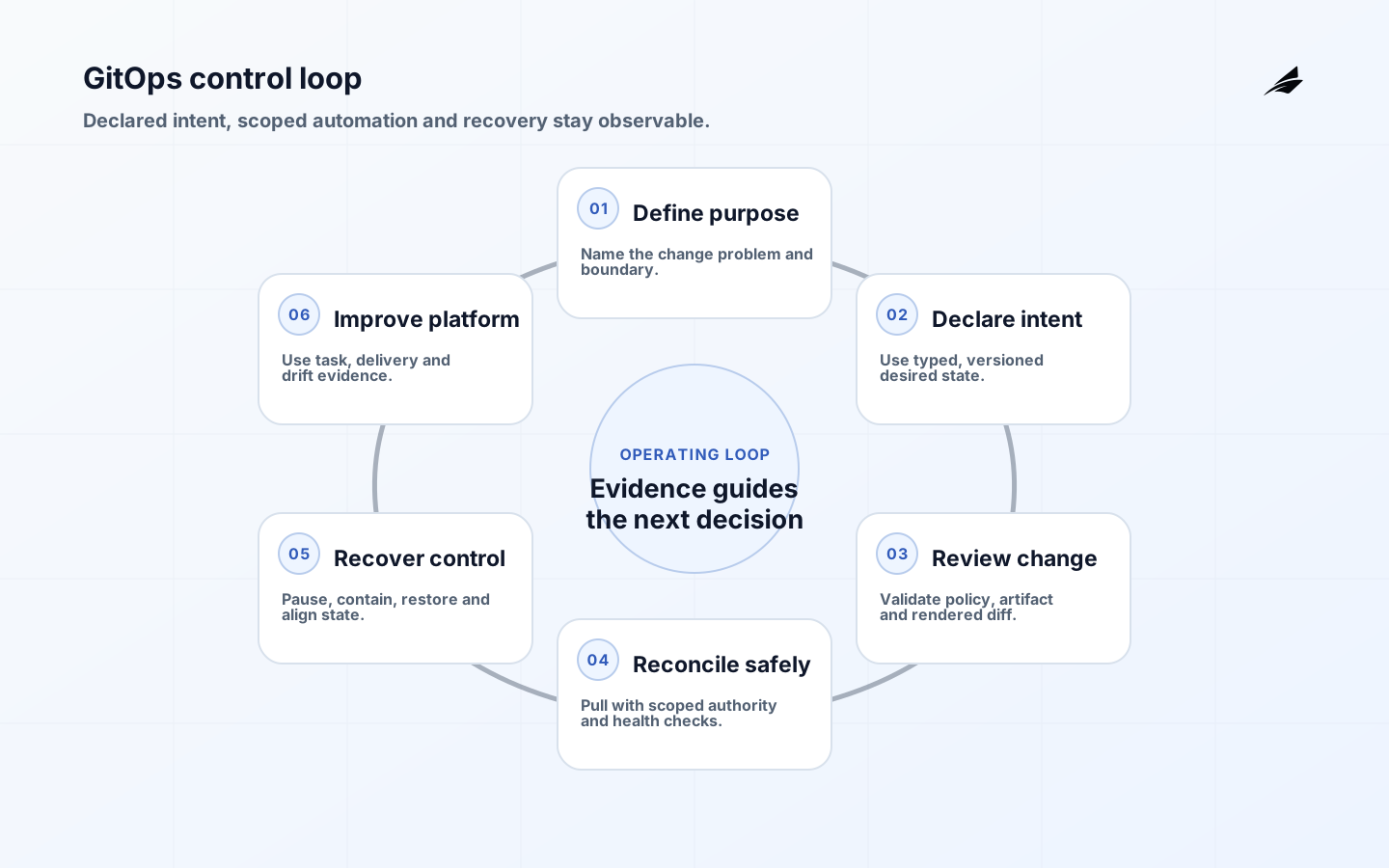
GitOps for CTOs is a platform and control decision, not a mandate to put every operational action in Git. The model is valuable when declared intent, reviewed change and continuous reconciliation reduce undocumented production access and make recovery easier to reason about. It can also amplify poor repository governance, excessive controller authority and opaque templating. Leaders should judge GitOps by service outcomes, operator experience, security and reversibility rather than adoption count.
Use this perspective with Edilec's GitOps cost and scaling guide, platform engineering cost guide and observability decisions guide. Together they connect reconciliation to platform economics and production signals.
Decide what GitOps should improve
Baseline production change paths, credential use, lead time, drift, failed changes, recovery, audit effort and developer task success. Name the problem: uncontrolled manual change, inconsistent clusters, slow promotion, weak evidence or difficult recovery. GitOps is not automatically the best answer for database transactions, one-time incident actions or systems without a reliable declarative interface. Define the desired-state boundary and what remains an explicit operational procedure.
The OpenGitOps principles define a GitOps-managed system as declarative, versioned and immutable, pulled automatically and continuously reconciled. Use these principles as design tests rather than a product checklist. A repository alone is insufficient if agents do not reconcile, and a push pipeline with broad credentials has a different risk model. State which source is authoritative, how changes are approved and how actual state is observed.
| Decision surface | Leadership question | Control | Evidence |
|---|---|---|---|
| Desired state | Which resources belong in scope? | Typed, validated declaration | Rendered and approved revision |
| Source | Who may propose and approve intent? | Protected change workflow | Commit, review and policy result |
| Reconciler | What production authority is needed? | Scoped pull identity | Access and reconciliation events |
| Drift | When should automation correct or pause? | Policy by resource and condition | Diff, action and exception |
| Emergency | How is containment protected? | Break-glass and reconciliation process | Timeline and restored authority |
Design repository and controller boundaries
Separate application source, build definitions, deployable artifact, environment configuration, secret references and controller administration according to ownership and threat. Avoid one repository whose approval grants organization-wide production change. Use environment or tenant boundaries, scoped service accounts and independent policy for the GitOps control plane. Render templates deterministically and review the result or meaningful diff; abstraction should not hide the production object being authorized.
Argo CD illustrates the components common to a Kubernetes implementation. Its architecture documentation describes an API server, repository server and application controller; the controller compares live state with the repository target and can take corrective action. Regardless of tool, protect repository and cluster credentials, isolate rendering of untrusted configuration, monitor controller health and constrain what each reconciler can change.
Treat reconciliation as production automation
Kubernetes controller documentation describes control loops that move current state toward desired state. This is powerful because automation keeps operating after a merge. Define convergence time, retries, dependency ordering, deletion behavior, health and pause conditions. Test a stale source, unavailable API, partial apply, invalid dependency and controller restart. A green commit does not prove that production converged or that the service is healthy.
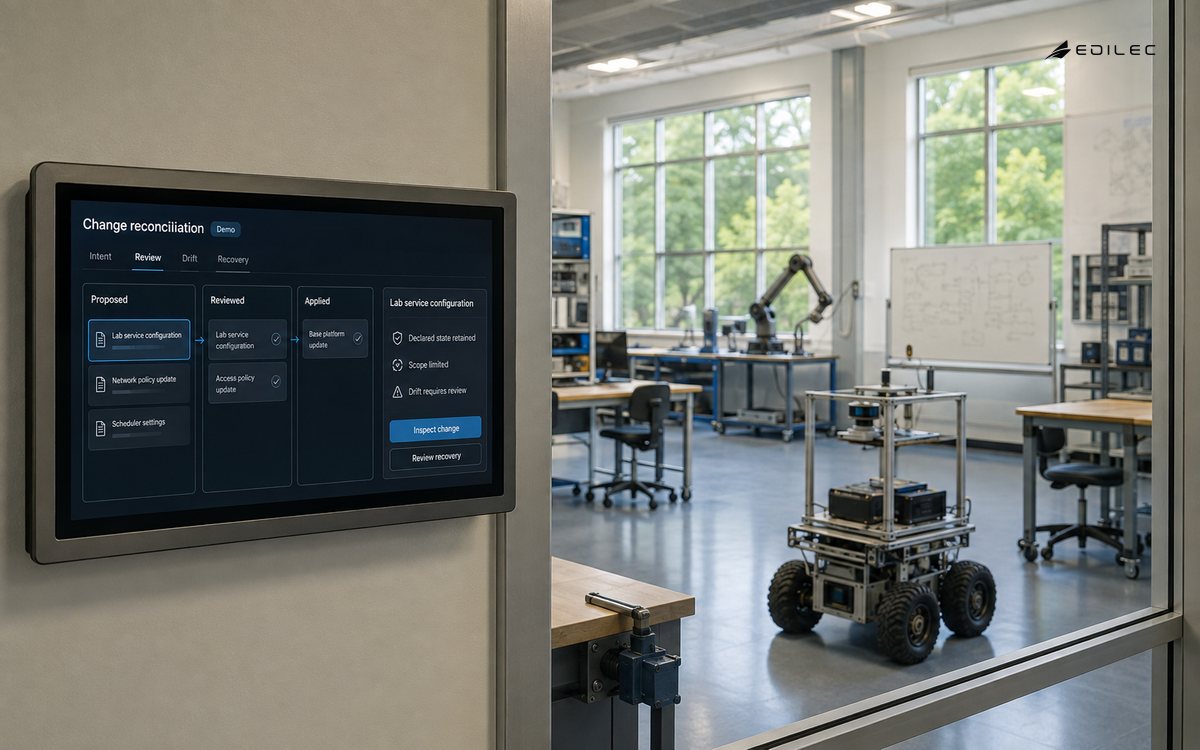
Classify drift. Some drift is harmful and should be corrected automatically; some represents autoscaling or another controller's legitimate output; some is emergency containment that must not be overwritten. Configure ignore rules narrowly and review them. Alert on sustained divergence, unknown field ownership and repeated correction. Keep status and events long enough to reconstruct what the controller observed and changed.
| Scenario | Expected behavior | Test | Acceptance |
|---|---|---|---|
| Approved change | Render, apply and report health | Representative release | Revision and service outcome linked |
| Manual drift | Detect and correct or alert by policy | Edit managed field | Action within objective |
| Invalid desired state | Reject before harmful apply | Schema and policy violation | Denied with useful feedback |
| Controller outage | No uncontrolled changes; recover safely | Stop control plane | Backlog reconciles without surprise |
| Emergency containment | Automation pauses scoped resource | Invoke break-glass | Incident action preserved and reconciled |
Secure source, artifacts and production authority
Protect contributor identities, branches, workflow files, dependencies, artifact registries, signing material, configuration repositories and controllers. Keep secrets out of repositories; store references and authorize retrieval at runtime through a governed secret system. Prevent untrusted pull requests from rendering with production credentials. Verify immutable artifact identifiers so a reviewed deployment cannot resolve to different code later.
The NIST Secure Software Development Framework offers outcome-oriented practices for preparing, protecting software, producing releases and responding to vulnerabilities. Apply them to platform code and configuration as software. Inventory components, review changes, isolate builds, protect artifacts and maintain vulnerability response. Git history improves traceability but does not by itself prove artifact integrity or secure the controller.
Adopt GitOps as a platform product
Begin with one service archetype and a team willing to exercise release and recovery. Provide templates, validation, previews, observability, documentation and support. Observe developers making changes, diagnosing divergence and handling emergencies. Standardize what survives those tasks, then onboard a cohort with similar needs. Give unsupported resources an explicit path instead of forcing them into opaque custom resources merely to increase coverage.
DORA's current platform engineering guidance recommends measuring software delivery, developer satisfaction, adoption and task success, and warns against a big-bang platform or one-size-fits-all approach. Use that balanced view. Track reconciliation reliability, change outcomes, recovery, exception load and controller incidents alongside adoption. A popular platform that reduces delivery stability needs redesign, not celebration.
Design rollback, roll-forward and break-glass recovery
Reverting Git creates new desired state; it does not reverse external side effects, data migrations or incompatible APIs. Define recovery by resource and application. Prefer tested roll-forward when data or contracts make rollback unsafe. Keep break-glass access outside routine developer use, time-bound it, log it and require post-incident reconciliation. Ensure the controller will not immediately undo containment performed by responders.
Exercise repository outage, compromised credential, invalid global template, lost cluster access and restoration of the GitOps control plane. Back up controller configuration, repository metadata and any state needed to resume safely. Operators should know how to pause reconciliation, inspect rendered intent, restore service and then bring actual and declared state back into agreement. Recovery evidence is the strongest test of whether GitOps reduced or merely relocated operational complexity.
Assess readiness and GitOps economics before expansion
GitOps needs stable declarative APIs, consistent resource ownership, reliable identity, repository governance, observable controllers and teams willing to operate the model. Assess those prerequisites by service archetype. A legacy appliance configured through an interactive console may need an adapter whose support cost exceeds the benefit. Do not hide imperative scripts inside a reconciler and call the result declarative; make residual behavior and recovery explicit.
Cost includes controller hosting, repositories, rendering, policy, secret integration, observability, support, training, migration, parallel operation and incident response. Benefits include reduced routine credentials, consistent environments, faster repeatable change and easier evidence. Measure both with a representative service. Tool licensing can be small compared with the engineering required to create safe templates and untangle application configuration.
Plan control-plane scale by managed objects, clusters, repositories, render complexity, polling or webhook behavior, API limits and failure isolation. Separate controller instances when tenants, regions or consequences require it, while keeping shared standards. Test a large reconciliation backlog and repository latency. A design that is fast in normal operation may overwhelm cluster APIs when recovering from an outage.
Set an expansion gate: application teams can complete change and recovery tasks, reconciliation meets objectives, security review closes high risks, support load is sustainable and legacy production authority is removed. Reassess quarterly. Keep exceptions visible and time-bounded. GitOps coverage is not inherently valuable; dependable services and controlled change are the outcomes that justify continued investment.
Define the evidence model before an audit or incident. Link pull request, policy result, rendered manifest, artifact digest, controller revision, synchronization event, runtime health and exception under a shared change identifier. Set retention by operational, legal and security need. Avoid logging full secrets or sensitive configuration merely for traceability. Sample a production change and confirm a reviewer can reconstruct intent and outcome without broad cluster access.
Review organizational coupling as the platform grows. A global base template can spread a defect as efficiently as a fix. Use versioned modules, staged promotion, compatibility tests and bounded blast radius for shared configuration. Let application teams choose when to adopt non-urgent template versions within a support window, while rapidly correcting critical risk through an explicit emergency process. Publish deprecation dates, affected populations, rollback guidance and migration evidence. Track lagging versions as an owned risk rather than silently forcing every environment across teams and regions.
Key takeaways
- Adopt GitOps for a measured production-change problem.
- Bound repositories, rendering and controller authority by ownership and risk.
- Treat continuous reconciliation as privileged production automation.
- Classify drift and protect emergency containment.
- Measure platform task success, delivery outcomes and recovery.
- Remember that a Git revert cannot reverse every side effect.
GitOps for CTOs FAQ
Does GitOps require Kubernetes?
No. The principles apply to any system with declarative desired state and automated reconciliation. Kubernetes has a mature controller ecosystem, so it is a common implementation target.
Can GitOps eliminate production access?
It can remove routine broad access, but operators still need governed emergency and diagnostic capabilities. The goal is narrow, time-bound authority with evidence, not an impossible claim of zero access.
Is Git history a complete audit trail?
No. Combine source history with identity, policy, rendered configuration, artifact, controller, runtime and incident evidence. History records declared intent, while production outcome depends on reconciliation and external systems.
Conclusion
GitOps for CTOs is a decision about controlled production automation. Define the boundary, protect source and reconciliation authority, make drift and health observable, and prove recovery before scaling. Used this way, GitOps makes change more understandable without pretending every operational reality belongs in a repository.