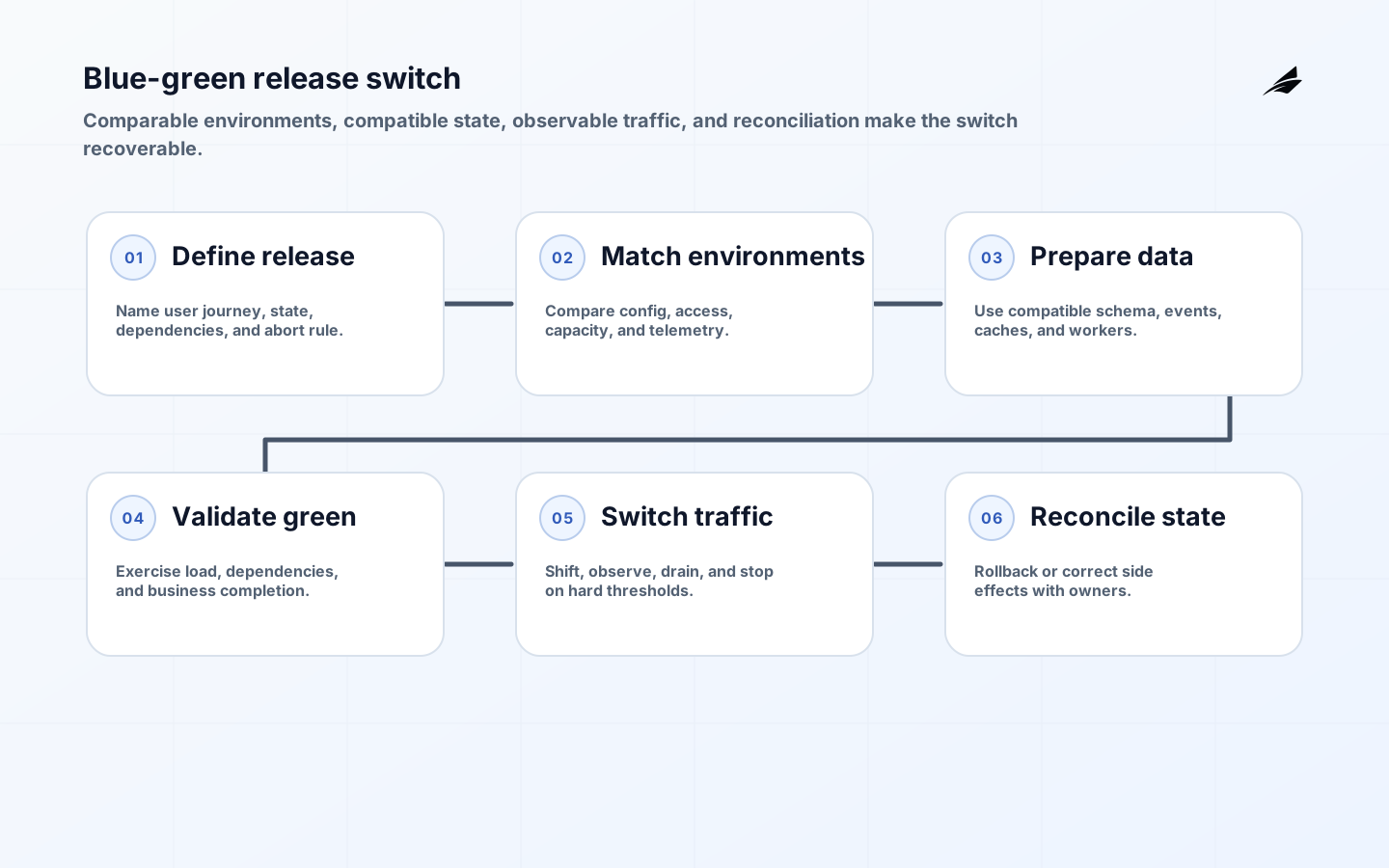
A blue-green deployment is a traffic and release pattern, not a guarantee of zero downtime. One environment serves the current version while a second environment is prepared, tested, and then made live through a controlled switch. The Kubernetes Deployment documentation explains declarative rollout and revision behavior; Google’s release-engineering guidance emphasises repeatable, auditable, reversible change. The hard problems are compatibility, data state, observability, and rollback—not the colour names.
Use the pattern when the service can run two versions at once and the team can direct traffic deliberately. It is a poor fit when stateful migrations are irreversible, environments cannot be made comparable, or the switch itself is an opaque provider action. Edilec’s platform scaling guide and deployment rollback guide help connect release decisions to user impact, while Kubernetes production operations covers the workload contract.
Define the switch and its consequence
Name what changes at the switch: application binaries, configuration, routing, schema, background workers, caches, and external contracts. Decide whether the blue and green environments share data, queues, secrets, identity, or observability. State the user-visible objective and an abort condition in advance. A switch can be technically successful while the business journey is broken, so include order creation, payment, notification, or other meaningful completion signals in the release decision.
| Decision | Safe question | Evidence |
|---|---|---|
| Environment parity | Are runtime, configuration, dependencies, and permissions comparable? | Rendered manifests and dependency diff. |
| Traffic control | Can traffic be shifted, observed, and restored without guessing? | Switch record, health checks, and routing audit. |
| Data compatibility | Can both versions read and write the same state? | Expand-migrate-contract test and reconciliation plan. |
| Rollback | What does reversal mean after writes have occurred? | Versioned procedure and business-state check. |
Make the two environments comparable
A common mistake is to call a warm standby green even though it has different configuration, network policy, secrets, database permissions, feature flags, capacity, or observability. Generate both environments from the same declared inputs and compare the resolved state before release. Confirm that green can receive realistic load, emit the same telemetry, reach the required dependencies, and serve a safe response when a dependency is unavailable. Parity is about behavior at the boundary, not identical infrastructure for its own sake.
Treat data change as part of the release
The most dangerous blue-green mistake is assuming application rollback can undo a data change. Prefer additive schema changes that old and new versions can both understand, backfill before the switch, and remove obsolete fields only after the old version is retired. Coordinate background jobs, cache formats, event schemas, and idempotency keys. If both environments can write, define ownership and conflict behavior. If green is read-only during validation, ensure the test is representative without creating false business records.
| Mistake | Observed symptom | Fix |
|---|---|---|
| Green is not production-like | It passes smoke tests but fails under real dependency or load conditions. | Compare resolved configuration, permissions, capacity, and traffic paths. |
| Switch has no business signal | Infrastructure is healthy while customers cannot complete work. | Gate on a user journey and service-level objective. |
| Rollback ignores writes | Old code returns errors after green has changed shared data. | Use compatible migrations and reconcile state before reversal. |
| Health checks are too weak | Traffic reaches instances that are alive but not ready. | Probe the dependency and readiness contract explicitly. |
Observe before, during, and after the switch
Collect comparable latency, error, saturation, availability, dependency, queue, and business-journey signals for both environments. A green environment that receives no realistic traffic may have no evidence of cache behavior, concurrency, or downstream rate limits. Use a short validation window with named owners and automatic abort where a hard threshold is crossed. Google SRE’s service-level objective guidance is useful because it keeps the release conversation tied to user-facing reliability rather than a collection of green infrastructure checks.
Make rollback a tested business operation
Write the rollback trigger, authority, sequence, and communication path before deployment. Restore traffic, pause incompatible workers, preserve evidence, and reconcile state rather than simply pointing a load balancer at blue. Test partial switch, stale cache, connection drain, duplicate message, provider outage, and a release that is healthy technically but harmful to a user journey. The AWS reliability pillar reinforces that recovery, testing, and change management belong in the reliability design.
Turn each release into operating knowledge
Keep a release record with source revision, environment versions, migration state, switch time, approver, measured signals, incidents, and final disposition. Review whether the pattern reduced risk or merely shifted effort into preparation. Track rollback frequency, change failure rate, recovery time, customer impact, and time spent reconciling state. If the same exception recurs, improve the release contract or environment generation rather than relying on a more experienced operator.
A useful rehearsal is to deploy a small change that affects a real read path, validate green, switch traffic, inject a dependency failure, and reverse while a background worker continues to process work. The exercise should answer whether the team can identify the affected version, stop new side effects, preserve the record, and confirm business state. The result is stronger than a successful switch because it tests the actual recovery boundary.
Make the release decision reconstructable
A blue-green release record should show the exact artifact, resolved configuration, data-migration state, dependency versions, environment health, traffic-switch authority, observation window, user-facing signals, and final decision. Record the point at which traffic moved, which thresholds were watched, and whether any side effects occurred before rollback. This is more useful than a screenshot of a deployment dashboard because it lets a later reviewer understand the state that made the decision safe or unsafe. Keep the record with the release and incident evidence rather than in an operator’s private notes.
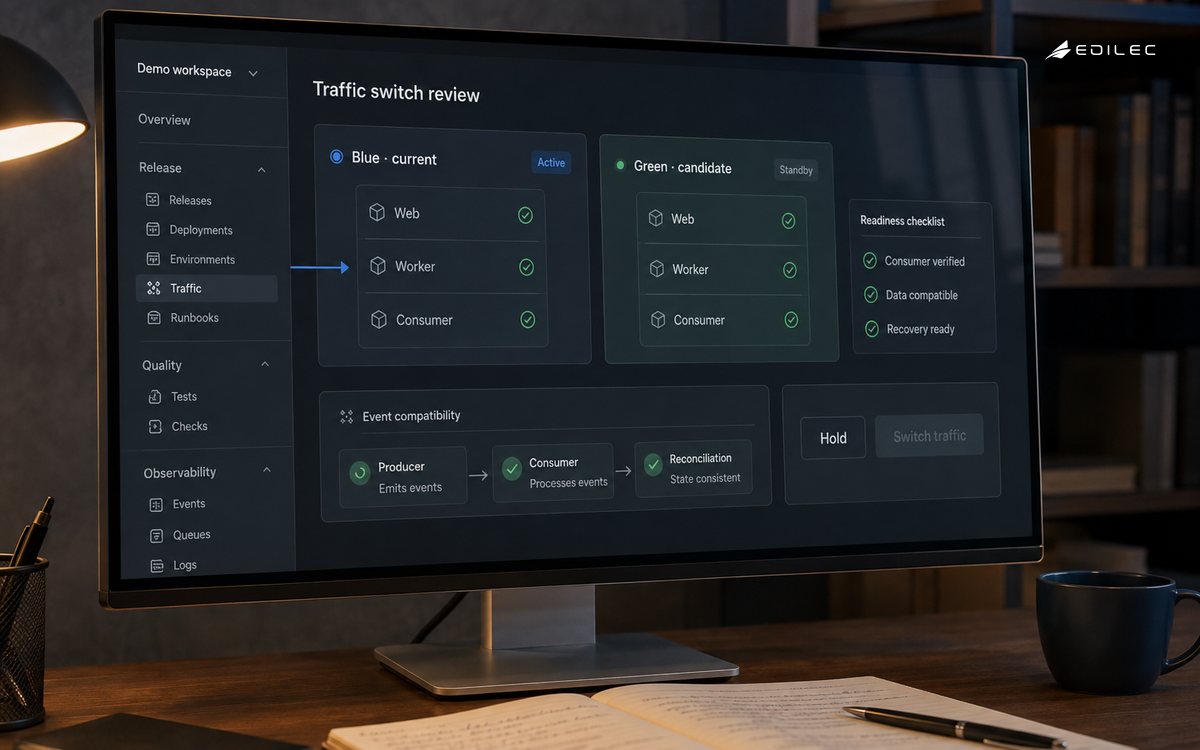
Consider an order service whose green version adds a field to an order event. Blue can ignore the field, but a background consumer may not. A successful switch can therefore be followed by a delayed failure when the consumer processes an event. The safe design adds the field compatibly, validates consumers, observes queue age and business completion, and retains a reconciliation path. If traffic returns to blue, the event history still needs to be understood. This example shows why the rollback boundary includes messages and business state, not only HTTP routing.
Review the pattern after each release by comparing preparation time, switch confidence, customer impact, rollback or reconciliation effort, and recovery time. If operators repeatedly discover configuration drift, automate parity checks. If the switch is safe but validation is slow, improve the business signal or test data. If rollback is never credible because state changes are irreversible, adopt a different release strategy or narrow the change. The best deployment pattern is the one whose failure and recovery behaviour the team can explain.
Test the cases that make rollback ambiguous
The most valuable blue-green tests are not a clean switch followed by a clean switch-back. Test partial traffic, a schema that has already received new writes, a background job that has run in green, an external callback that cannot be undone, and a cache populated by the new version. These cases show where rollback ends and reconciliation begins. Make that boundary visible in the runbook, release approval, and incident communication. If the business cannot tolerate the resulting ambiguity, redesign the change before using blue-green for it.
Use a release checklist that asks whether blue can continue serving while green is validated, whether green can be removed without losing evidence, and whether the switch can be observed by the people who own the user outcome. Include capacity for both environments and the additional load of draining, replaying, or reconciling work. The pattern often fails when teams budget for two copies of compute but not two copies of operational attention. A named release owner and recovery authority keep that responsibility explicit.
Release ownership should include the person who can pause traffic, the person who owns data compatibility, the responder who can recover service, and the business owner who can declare a user journey acceptable. Those roles may be small-team responsibilities, but they should not be assumed. Record who accepted the observation window and who can trigger rollback. This makes a fast release safer because the authority to stop is already clear when signals become ambiguous.
Blue-green should also be judged against operational cost and team capacity. Maintaining two environments may increase spend, configuration drift, data synchronization work, and the number of components that must be monitored during release. Compare those costs with the consequence of a failed change and consider whether a canary, rolling update, feature flag, or maintenance window would provide a clearer boundary. The right answer can differ by service. A pattern is successful when it reduces uncertainty for the people who release and recover the service, not when it merely looks sophisticated on an architecture diagram.
Key takeaways
- Blue-green is a controlled traffic pattern, not a promise that rollback is free.
- Make environments comparable in configuration, dependency access, capacity, and telemetry.
- Use additive, compatible data changes while both versions may run.
- Gate the switch on user journeys and service-level objectives, not only process health.
- Test reversal, reconciliation, communication, and partial failure before relying on the pattern.
Frequently asked questions
Question: Does blue-green deployment guarantee zero downtime? Answer: No; compatibility, state, routing, and dependencies can still fail. Question: What proves rollback is ready? Answer: A rehearsed return path with clear authority, compatible state handling, observable success criteria, and an owner for reconciliation.
What must blue-green deployment include besides two environments?
Answer: It needs a traffic switch, compatible data handling, health evidence, ownership, and a tested path for reversing or containing the change.
When is a blue-green rollback unsafe?
Answer: Rollback is unsafe when migrations, queues, caches, or external side effects cannot work with the previous version. Plan compatibility or forward repair before the switch.
How should a cutover be approved?
Answer: Use predeclared health, error, and business signals with an accountable release owner who can pause, reverse, or escalate the decision.
Is blue-green the same as canary release? No. Blue-green commonly switches between two environments, while canary sends a controlled portion of traffic to a new version. Can blue-green guarantee zero downtime? No; connection draining, schema changes, dependencies, and business state still matter. When should a team avoid it? Avoid it when the environment cost or state coupling is larger than the risk reduction, or when a safe rollback cannot be defined. What is the first test? Prove parity, data compatibility, observable switching, and a recovery rehearsal on a bounded service.
Conclusion
Blue-green deployment is valuable when it makes change reversible and evidence-rich. Treat parity, data compatibility, traffic control, objectives, and recovery as one release design. The switch is only the visible moment; the real reliability comes from what the team can prove before it, observe during it, and reconcile after it.