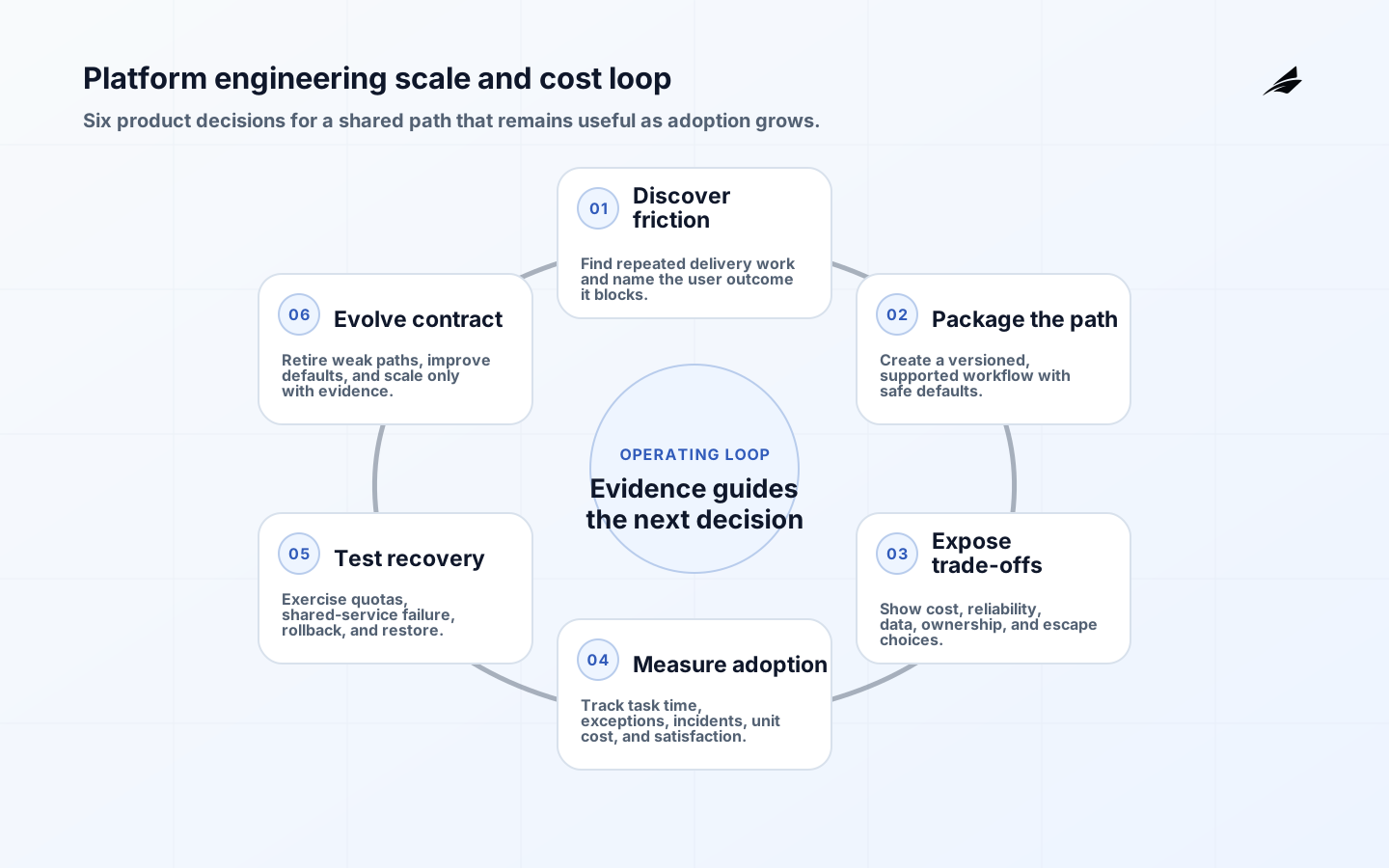
Platform engineering is often sold as a way to let product teams move faster. The useful question is more precise: which repeated operational decisions should a platform make easier, safer, and cheaper without taking ownership away from the teams that run the services? A platform is an internal product with users, a service boundary, operating costs, and reliability expectations. The AWS Well-Architected Reliability Pillar emphasizes recovery and operational readiness, while Google Cloud's operational excellence framework shows why repeatable automation matters. Together they frame platform engineering as an operating capability, not a ticket queue. See also platform engineering for small teams for a smaller starting point.
Establish the platform boundary
Start with the friction that appears across several teams: environment creation, deployment safety, identity, observability, secrets, dependency updates, or recovery. Do not build a platform around an abstract technology list. Name the user, the repeated job, the desired outcome, and the decisions the platform will and will not own. A good paved path hides accidental complexity while exposing important choices such as region, data class, resource size, retention, and service-level target. If a platform removes all visibility into those choices, it may reduce local effort while creating central waste and risk.

| Platform capability | Value to product teams | Cost or scaling question |
|---|---|---|
| Service template | Creates a compliant starting point quickly | Which defaults create unnecessary resources? |
| Deployment path | Makes releases repeatable and observable | How much pipeline and environment capacity is consumed? |
| Identity and secrets | Reduces bespoke security work | Who owns rotation, access review, and support? |
| Observability | Makes incidents easier to investigate | What data is retained and at what volume? |
| Runtime foundation | Standardizes compute and networking | What is the unit cost per service or workload? |
| Recovery path | Reduces time to restore | Is recovery tested at the scale the platform promises? |
Design the platform as a product
Give the platform a product owner, a support model, a documented contract, and feedback channels. A self-service interface should explain prerequisites, defaults, expected lead time, and how to exit the path when a workload has unusual needs. Measure the user's outcome: time to first safe deployment, number of manual exceptions, rollback success, incident contribution, and satisfaction after a real task. Avoid confusing adoption with value. Teams may use a platform because it is mandatory while still creating workarounds outside it. Regularly review whether the path remains the easiest safe option as application architectures and cloud services change.
- Choose a repeated workflow with a clear owner and measurable user outcome.
- Expose the decisions that materially change cost, reliability, data handling, or recovery.
- Provide documentation and support alongside automation.
- Treat exceptions as product feedback and classify why teams leave the paved path.
- Version templates and defaults so existing services are not changed unexpectedly.
Make cost a first-class signal
A platform can lower local effort while increasing the organization's bill. Assign cost to a meaningful owner and unit, such as service, environment, team, request, or tenant. Show baseline and incremental cost when a template creates storage, logs, compute, load balancing, or data transfer. Set retention defaults that are appropriate to the workload and make more expensive choices explicit. Cost is not only an optimization exercise; it is evidence about whether the platform's abstraction matches real usage. A low-cost path that causes outages or manual recovery is not efficient, while an expensive path may be justified for a critical service when the reliability benefit is visible.
Scale with reliability contracts
Platform scale changes the blast radius of a bad default. Define service-level expectations for the platform itself: availability of the developer portal, deployment pipeline, identity integration, artifact registry, and recovery mechanism. Connect the promise to the product teams that depend on it. The CNCF platform whitepaper provides a useful frame for treating the platform as a product with explicit service expectations and ownership. A platform should also make downstream reliability easier by providing safe health checks, controlled rollout, versioned configuration, and an escape route when a shared dependency fails.
| Signal | What it tells the platform team | Scaling action |
|---|---|---|
| Template adoption with low exception rate | The path fits common workloads | Invest in automation and documentation. |
| High manual intervention | Defaults or integrations are not reliable | Fix the path before onboarding more users. |
| Cost per deployed service rising | Shared capacity or defaults are inefficient | Add quotas, sizing guidance, or better allocation. |
| Platform SLO burn | The shared service is consuming its reliability margin | Reduce change rate and prioritize recovery work. |
| Frequent rollback from a template | A common change has a broad blast radius | Improve tests, staged rollout, and version pinning. |
Control shared change
The platform's most important release is often a default change that affects many services. Use versioned templates, compatibility notes, migration windows, and staged exposure. DORA's platform engineering guidance demonstrates why a platform path should be treated as a versioned product capability, but the broader lesson is to make platform changes observable and reversible. Test against representative application shapes, not only the platform team's reference service. Communicate deprecations early and preserve a supported path for workloads that cannot migrate immediately. Shared ownership requires a clear answer to who approves a breaking default and who responds when it misbehaves.
Test recovery and capacity
A platform that scales creation but not recovery creates a larger failure surface. Test restore, rollback, secret rotation, registry failure, quota exhaustion, region loss, and the loss of a central control-plane component. Measure time to detect, time to restore, data loss, and the amount of manual coordination required. Exercise capacity at the platform's shared bottlenecks, not only at the application layer. Include failure of the platform itself in product team continuity plans: can an existing service deploy an urgent fix if the portal is unavailable, and can an operator recover a workload without the preferred abstraction? Those answers should be documented before growth makes the question urgent.
Choose a sensible growth sequence
A small team rarely needs a broad internal cloud on day one. Start with one high-friction workflow and one supported workload shape. Instrument use, cost, exceptions, and incidents. Add capabilities only when evidence shows that the next constraint is shared and the team can operate the new surface. Keep the platform team small enough to understand the users and large enough to support the contract. If every request becomes bespoke, the platform is not a product yet. If every workload must conform to a central design, the team may be optimizing standardization at the expense of delivery. The balance is a deliberate choice that should be revisited as the organization grows.
Make platform discovery and adoption measurable
Platform work should begin with interviews, service reviews, and evidence from delivery friction. Ask teams where they lose time, which failures repeat, and which local solutions they maintain because no shared path fits. A platform backlog built from requests alone will overrepresent the loudest team. Group needs by workflow and outcome, then choose a thin slice that can be released, observed, and improved. A platform capability is ready for broader adoption when users can complete the target job without a support conversation for every important decision.
Multi-tenancy changes the cost and reliability model. A shared registry, cluster, pipeline, or observability service needs quotas, isolation, noisy-neighbor controls, and a clear incident boundary. Document what one team can consume and what happens when a shared limit is reached. Apply chargeback or showback carefully: the goal is to make choices visible, not to punish teams for using a service they were required to adopt. Unit economics should include platform engineering time, provider spend, support, and the reliability value of standardization.
Lifecycle management is part of the platform product. Every template, module, controller, and integration needs an owner, version policy, support window, migration guide, and retirement path. Deprecation messages should reach the teams that will be affected and include a safe test route. A platform that never removes old paths accumulates compatibility work and makes security updates harder. A platform that removes paths abruptly destroys trust. Publish a predictable lifecycle so teams can plan and the platform team can focus its support capacity.
Team boundaries should follow the service contract. The platform team can own the mechanism for deployment, identity, or telemetry, while product teams remain responsible for application behavior and user outcomes. Write the split into runbooks and incident roles. When a platform failure affects several services, the response should not depend on each product team independently discovering the same root cause. When an application uses a platform path incorrectly, the product team should have the documentation and diagnostic access to fix its part without waiting for a central operator.
Capacity planning needs a demand model. Estimate the number of services, deployments, environments, artifacts, log events, and support requests the platform will handle. Include peak release periods and incident load, not just daily averages. Test quotas and failure modes before growth makes them surprising. A shared platform should expose limits early through documentation and metrics so users can choose an appropriate path. Capacity is a product promise: if the platform cannot sustain its own growth, the teams depending on it inherit the resulting delay and risk.
Standardization should be selective. Make the safest common path easy, but leave documented extension points for workloads with unusual data, latency, regulatory, or recovery needs. A platform that forces every team into the same abstraction will accumulate hidden exceptions and shadow infrastructure. Review extension requests for patterns: several exceptions may indicate a missing platform capability, while one genuinely unusual workload may deserve a supported escape route. The objective is not identical architecture; it is a dependable way for teams to make and operate the choices their services require.
Cost and reliability reviews should use the same service catalog. If a platform cannot connect a deployment, environment, owner, budget, and SLO, it will be difficult to decide which optimization or recovery work matters most. Add ownership metadata at creation time and refresh it when teams or services change. Show teams the cost and reliability consequences of a template choice before they commit. This feedback loop lets the platform improve defaults based on observed operating outcomes rather than guesses about what users value.
A platform roadmap should make trade-offs explicit at portfolio level. Compare a new self-service capability with reliability fixes, cost controls, migration support, and documentation work. Prefer investments that remove repeated toil or reduce a shared failure mode, and stop capabilities that have low use or high exception cost. Publish the reasoning so product teams understand why a request is sequenced later. This protects the platform from becoming an ever-growing collection of tools and keeps the internal product aligned with the organization's most important delivery constraints.
Frequently asked questions
Question: Does a canary make a release safe automatically? Answer: No; the cohort, comparison, state handling, promotion gate, pause path, and rollback must be explicit. Question: What is a useful promotion signal? Answer: A combination of service health, user outcome, dependency behavior, and evidence that the candidate is attributable and reversible.
How should platform teams control cost while scaling?
Answer: Tie shared platform spend to workloads and outcomes, expose allocation, set capacity and reliability contracts, and review defaults before adding more layers.
When should a platform capability become self-service?
Answer: When the path is repeatable, owned, observable, secure by default, and easier to recover than the manual alternative.
What proves platform scaling is healthy?
Answer: Measure adoption, time to fulfillment, support demand, reliability, cost per supported workload, and the cognitive load reported by consuming teams.
How is platform engineering different from DevOps? DevOps is a broad way of working across development and operations; platform engineering packages repeated capabilities as an internal product. Compare GitOps cost and scaling and SLO planning when choosing the first shared capability. When is a platform team too early? When the organization has too little repeated friction or cannot support the service it would create. How should cost be justified? Connect it to a user outcome, a reliability benefit, reduced toil, or a measurable risk reduction. Does a platform remove team ownership? It should clarify shared and local responsibilities, not erase them. What is a good first capability? Choose a workflow such as safe deployment, service scaffolding, or observability where several teams have the same problem and the outcome can be measured.
Key takeaways
- Treat the platform as an internal product with users, a contract, and an operating owner.
- Make cost, reliability, data handling, and recovery visible in the paved path.
- Version shared defaults and release them in controlled, reversible steps.
- Measure outcomes such as safe deployment time, exceptions, incidents, cost per unit, and platform SLOs.
- Scale capabilities only when repeated evidence shows that a shared solution is worth operating.
Conclusion
Platform engineering is successful when it reduces cognitive load while preserving operational judgment. Build around repeated work, publish the contract, expose the meaningful trade-offs, assign cost and reliability owners, and test the platform's own recovery. That foundation lets a shared path scale with the organization instead of becoming a central system whose complexity is merely hidden from its users.