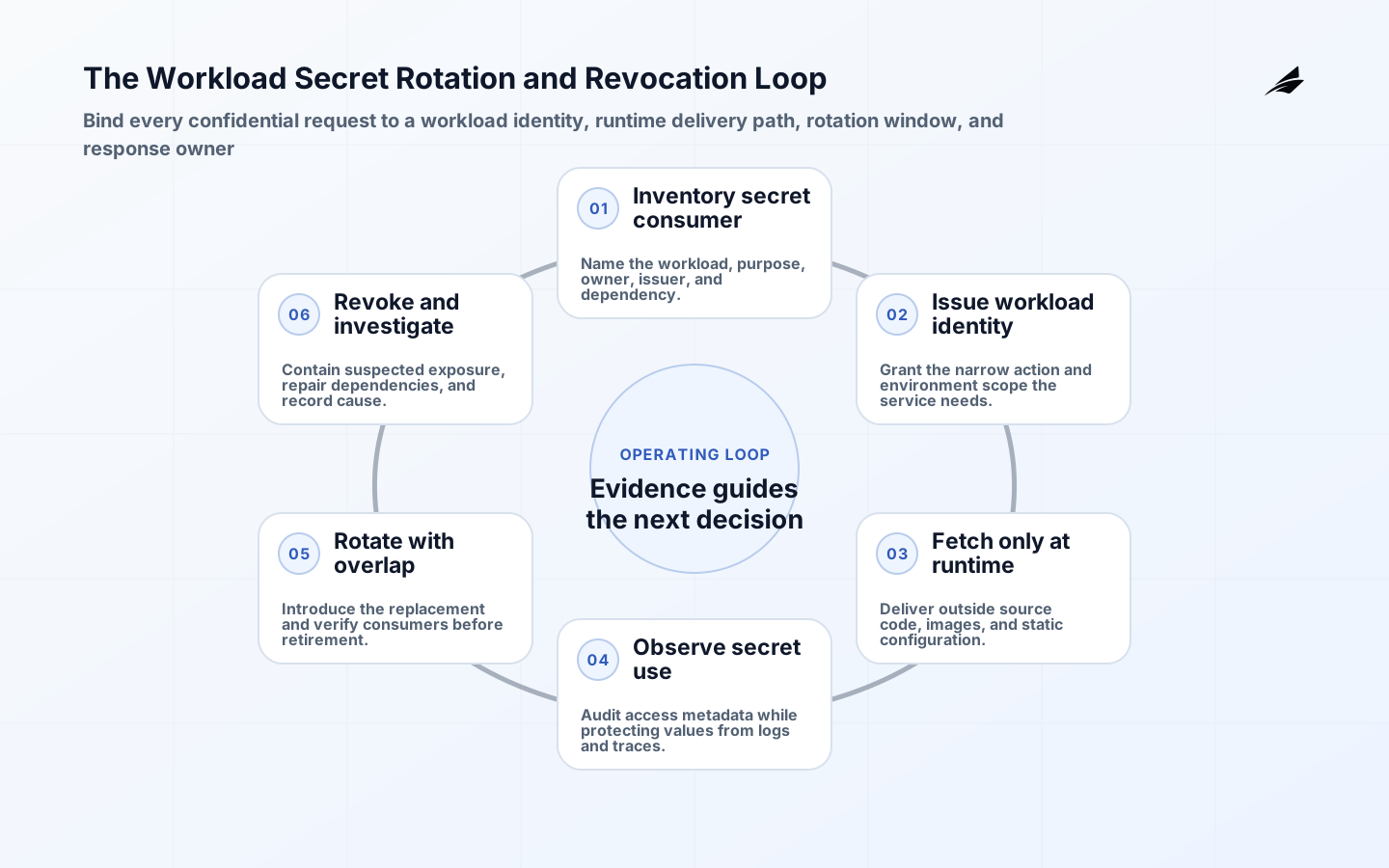
Secrets management is the discipline of controlling sensitive values throughout their useful life. A password, token, certificate, signing key, or connection string has a purpose, a consumer, an issuer, an expiry condition, and a response when exposure is suspected. Engineering teams need more than a secure store. They need a path that delivers the right value to the right workload, prevents accidental disclosure in code and logs, supports rotation without an outage, and makes emergency revocation practical. The value itself should stay hidden, while its ownership and lifecycle remain clear.
Map secrets to real workloads
Start with a workload inventory rather than a list of secret names. For each consumer, record the service, environment, purpose, issuer, access path, rotation owner, and dependent action. Distinguish a database credential from a signing key or a certificate because their failure and replacement procedures differ. Include CI jobs, local development, scheduled workers, Kubernetes controllers, and third-party integrations. Unknown consumers create the greatest rotation risk: a team may keep an old value alive indefinitely because it cannot tell what will break when the value changes. Ownership should belong to the service team that can change the consumer, with security providing policy and escalation support.
Prefer workload identity
Where the platform supports it, use a workload identity or short-lived credential instead of placing a long-lived shared secret in an application. Bind access to a service account, role, namespace, or deployment identity, and limit the actions that identity can perform. A Kubernetes pod should receive only the values required for its function, not a broad account credential that works across the cluster. Separate read, write, administration, and signing privileges. Identity-based access does not remove the need for lifecycle controls, but it narrows the damage when a process, node, or configuration is compromised.

Control delivery at runtime
Choose a delivery method that matches the workload and keeps sensitive values out of source control, images, tickets, and ordinary logs. Mount or inject values only where the process needs them, limit their lifetime when possible, and prevent diagnostic tooling from printing the environment indiscriminately. In Kubernetes, a Secret object can hold encoded data, but encoding is not the same as protection. Access to the object, encryption at rest, namespace boundaries, admission rules, and the permissions of the consuming service all matter. Make the retrieval path observable without recording the secret itself.
| Decision | Working rule | Evidence |
|---|---|---|
| Purpose | Name the confidential workload request. | Owner and scope. |
| Dependencies | Expose issuer, consumer, and delivery path. | Versioned change record. |
| Authority | Name the person who can revoke access. | Decision log. |
| Recovery | Test replacement and emergency containment. | Runbook and exercise. |
Rotate without breaking the service
Rotation is a change-management problem as much as a cryptographic one. Use overlapping validity when the issuer and consumer allow it: create the replacement, grant the consumer access, deploy or reload the new value, verify successful use, then revoke the old value. For certificates, watch the full chain and renewal window. For database credentials, confirm that pools, workers, migrations, and failover paths can all reload safely. A rotation job should report the stage it reached and the owner for the next action, while masking the value in every output. Expiry should be an expected transition, not the first signal that the system has no replacement path.
- Give each sensitive value a purpose, consumer, issuer, and owner.
- Use short-lived or identity-based access when the platform supports it.
- Keep values out of repositories, images, logs, tickets, and screenshots.
- Use overlap and verification to make ordinary replacement uneventful.
- Make emergency revocation available to an on-call authority.
Respond to suspected exposure
When a value may have been exposed, preserve the relevant evidence without copying the value into new systems. Identify the affected scope, revoke or disable the credential, issue a replacement, and update every confirmed consumer. Search for use and access patterns, check whether the credential performed sensitive actions, and involve the right incident and customer-response owners. If immediate revocation would interrupt a critical service, use a narrowly bounded containment step while the replacement is prepared. The decision and its timing should be visible to responders, but the secret must not become a shared incident artifact.
Separate environment and human access
Development, staging, and production should not casually share credentials or trust boundaries. Give each environment its own issuer, account, namespace, and replacement path. Production access for a person should be time-bound and justified, while normal service operation should use workload identity. Local development can use safe substitutes or scoped test values rather than a copied production credential. This separation reduces the blast radius of a laptop, build runner, or staging service compromise and makes it easier to understand which consumers need attention when a value is revoked.
Measure the lifecycle without leakage
Useful signals include failed retrievals, denied access, rotation age, expiring certificates, stale consumers, and the time required to complete a replacement. Build those signals from metadata and access events, never from the secret content. Alert on a pattern that needs action, such as repeated retrieval failures from a new workload or a credential approaching expiry without a replacement owner. A quiet dashboard is not proof that access is correct; it may mean the team has not instrumented the path. Pair technical signals with the lifecycle record so an alert leads to a person who can resolve it.
Test failure and recovery paths
Test the cases that expose lifecycle gaps: a new pod cannot retrieve its value, the issuer is temporarily unavailable, a credential is revoked before every replica reloads, and a certificate chain is incomplete. Confirm that the service fails in a bounded way and that an operator can distinguish an access problem from an application defect. Test a rotation while traffic is flowing, then test emergency revocation with the minimum required access. These exercises should use disposable values and realistic permissions. The result should be a short record of what worked, what surprised the team, and which owner will change the path.
Make access reviewable
Record access events with identity, workload, action, resource, and time while omitting the sensitive payload. Review unusual retrieval, unexpected environments, and permissions that outlive the workload they served. Remove dormant paths and separate administrative access from application access. Engineers should be able to see why a request was allowed and who owns the next change. The aim is not to create a mountain of records; it is to make the important path understandable during routine maintenance and credible during an incident.
Retirement deserves the same care as creation. When a service or integration ends, disable its identity, remove its bindings, confirm that scheduled jobs and build systems no longer retrieve the value, and record the owner who confirmed the change. This prevents forgotten access from surviving after the workload has disappeared.
Be precise about what rotation proves. A successful write to the secret store does not prove that every replica has reloaded, that a connection pool uses the new credential, or that a failover region can authenticate. Verification should exercise the real consumer and include the path used during maintenance or disaster recovery.
Build the lifecycle into delivery
Put secret creation, access binding, rotation, and retirement alongside the service definition. A new deployment should not depend on a manual value copied from a private message. A retired service should not leave an active credential behind. Test the ordinary path with a representative workload and test the uncomfortable path where the issuer is unavailable, a value is revoked early, or a pod starts with stale configuration. The blue-green deployment guide helps when two environments must use compatible credentials during a traffic cutover.
Review the full secret lifecycle
Secrets management is a lifecycle control, not a storage choice. The team should be able to trace why a secret exists, who or what may use it, how access is observed, and how trust is removed.
| Lifecycle point | Evidence to inspect | Operating decision |
|---|---|---|
| Inventory and ownership | Secret purpose, workload, environment, owner, classification, and expiry expectation. | Remove unknown or unowned credentials before expanding access. |
| Issuance | Identity proof, approval, scope, delivery channel, and initial policy. | Issue the narrowest credential that supports the bounded workload. |
| Runtime access | Workload identity, policy result, retrieval event, destination, and denied attempts. | Keep secrets out of source, build output, logs, and unnecessary operator workflows. |
| Rotation and revocation | Replacement order, dependent services, overlap period, emergency trigger, and verification. | Prove that compromised or obsolete trust can be removed without losing control of the service. |
Key takeaways
- Treat every secret as a lifecycle with an owner and purpose.
- Prefer workload identity and narrow permissions over shared credentials.
- Design delivery so values stay out of code, images, and diagnostics.
- Rotate through overlap, reload, verification, and revocation.
- Prepare emergency containment without exposing the sensitive value.
Frequently asked questions
Are Kubernetes Secrets sufficient by themselves?
No. The object is one part of the design. Encryption, access permissions, namespace boundaries, workload identity, delivery, logging, rotation, and revocation determine the practical protection.
How often should a secret rotate?
Use the issuer, exposure risk, access scope, and replacement capability to set the interval. A short interval is not helpful if the team cannot replace the value safely; improve the path as well as the schedule.
What is the first response to a leaked credential?
Limit its use, revoke or disable it, issue a replacement, identify affected consumers, and preserve only the evidence needed to understand access and impact.
For implementation context, consult Kubernetes documentation and Google SRE Book; these references help teams verify platform behavior and operating controls against maintained primary guidance. For adjacent decisions, continue with Edilec's How Operations Leaders Should Think About Blue-green Deployment and How Operations Leaders Should Think About Log Aggregation.
Conclusion
Engineering teams can make secrets management routine by making the value invisible but its lifecycle explicit. Inventory consumers, bind access to workload identity, deliver narrowly, rotate with overlap, and rehearse revocation. That combination reduces the chance of exposure and gives responders a controlled way to act when a credential must be withdrawn quickly.