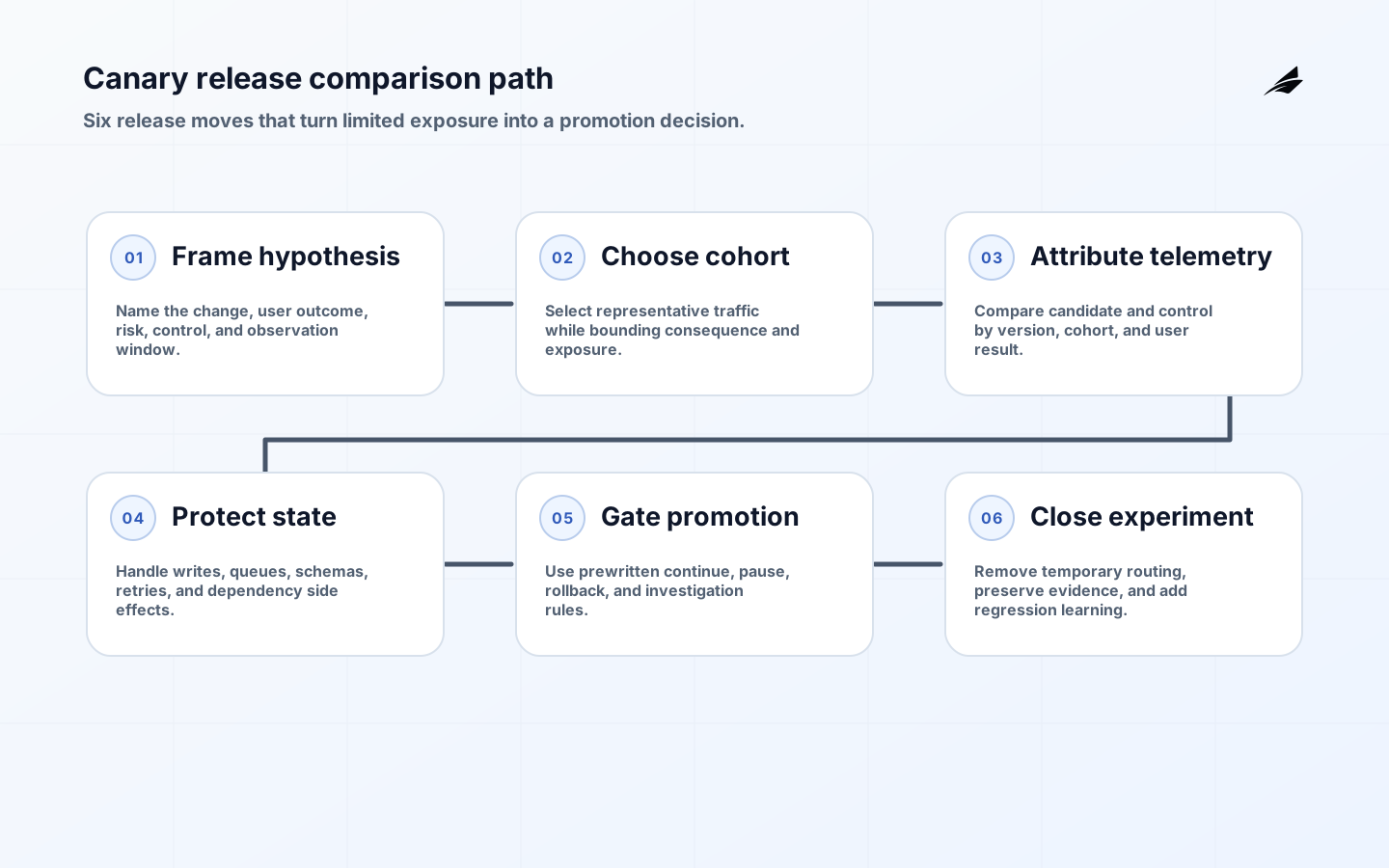
A canary release is a partial, time-limited deployment followed by an explicit decision about whether to continue. The new version receives a bounded slice of real traffic while the existing version acts as a control. Google SRE's canarying guidance describes this as a way to detect release defects with less user impact, but the traffic split is only the visible part. A useful canary also needs a representative audience, comparable telemetry, promotion criteria, a pause path, and a rollback that operators have practiced. For a deeper operating comparison, see canary releases security review.
Define the canary decision
Before changing traffic, write the decision the canary is meant to support. Is the team testing correctness, latency, error rate, resource use, a new dependency, or user behavior? Define the control population, canary population, observation window, and the conditions for continue, pause, rollback, or human investigation. A canary is not a general feeling that a release looks healthy. It is an experiment with a hypothesis and a bounded exposure. If the release changes several components at once, separate the changes where possible so a result can be attributed to something specific.
| Canary choice | Useful question | Common mistake |
|---|---|---|
| Traffic slice | Does this group represent the risk we need to observe? | Choosing a tiny or unusual group that hides the failure. |
| Control | Can the live version provide a comparable baseline? | Comparing different regions, cohorts, or workloads without adjustment. |
| Window | How long will the relevant behavior take to appear? | Promoting before delayed jobs, caches, or peak traffic are exercised. |
| Metric | Which user or service outcome can fail? | Watching only aggregate health and missing canary-specific regression. |
| Stop rule | What evidence requires pause or rollback? | Making the decision after the incident rather than before exposure. |
Build the traffic and version boundary
The routing mechanism should make the candidate identifiable and the exposure adjustable. Use version labels, a stable way to select a cohort, and an explicit control path. Kubernetes can provide deployment and service primitives, while a gateway, mesh, load balancer, or feature flag may determine how requests are split. Keep the candidate artifact immutable during the test. Do not change code, configuration, and traffic rules at the same time unless the experiment requires it and the release record says so. If a stateful service is involved, define compatibility for schemas, queues, migrations, and writes before the canary receives production traffic.
- Give the candidate and control distinct version or release identities.
- Choose a cohort that is safe to expose and meaningful for the hypothesis.
- Keep artifacts immutable during the observation window.
- Define database, queue, cache, and session compatibility before routing requests.
- Make traffic changes and rollback executable by an authorized operator or automation.
Instrument a comparable view
Canary telemetry should make candidate-versus-control comparison easy. Capture request rate, errors, latency distribution, saturation, retries, dependency failures, and business outcomes that matter to the service. Correlate traces and logs with release identity and cohort so a reviewer can investigate one bad request without guessing which version handled it. OpenTelemetry traces provides vendor-neutral concepts for collecting trace data, but the key design choice is attribution. Aggregate health can look normal while a small canary is failing badly. Use per-version and per-cohort views, and keep enough history to compare the same time window and traffic shape.
Set promotion and rollback gates
Promotion criteria should combine service health with user impact. A candidate may have an acceptable error rate but create duplicate transactions, degrade a critical workflow, or exhaust a dependency. Define thresholds, sample-size expectations, and a human review point for ambiguous evidence. Rollback must be specific: restore the previous version, move traffic away, disable a feature, or reverse a configuration. AWS Well-Architected emphasizes reliable operations and recovery; a canary is strongest when those concerns are part of the release path rather than a separate emergency plan. Test the rollback with representative state and confirm what happens to in-flight work.
Handle state and side effects
Stateless request routing is easier than canarying a workflow that writes data, schedules jobs, or changes external systems. Define idempotency, duplicate handling, versioned schemas, and how a rollback interacts with records created by the candidate. Consider whether control and canary should share a queue, cache, database, or rate limit. A release can appear healthy while it quietly changes the state that the control version expects. Keep destructive or irreversible actions behind additional checks during early exposure. When the candidate uses a new dependency, measure the dependency's behavior separately so the team can distinguish its own defect from an upstream change.
| Failure mode | Early signal | Control |
|---|---|---|
| Version-specific errors | Candidate error rate diverges from control | Pause exposure and inspect release-scoped telemetry. |
| Latency tail regression | p95 or p99 rises for the canary cohort | Set a tail threshold and limit concurrency. |
| Duplicate side effect | Repeated transaction or job identifiers | Use idempotency keys and quarantine writes. |
| Dependency saturation | Retries or downstream latency climb | Apply budgets, backpressure, and dependency alarms. |
| Hidden cohort harm | Business outcome worsens for a segment | Measure outcome by segment and include a human check. |
Operate the observation window
During the canary, name the person or team watching the evidence and the time at which the decision will be made. Avoid indefinite partial rollout: it creates configuration drift and makes it unclear who owns the candidate. Record notable events such as traffic changes, incidents, dependency deploys, and metric anomalies. If the window spans different demand patterns, note which portions have been observed. A pause is a valid outcome when the evidence is incomplete. The goal is not to promote quickly; it is to make the next exposure decision with enough confidence and a bounded risk.
Learn from the release
After promotion or rollback, retain the release hypothesis, cohort definition, metrics, decision, and outcome. If the canary caught a problem, turn the finding into a test, an alert, a safer default, or a change to the service contract. If it passed, ask whether it was sensitive enough to detect the risks the team cares about. Review false positives too: a canary process that blocks healthy releases without useful signal will be bypassed. Revisit the process when architecture changes, traffic becomes more heterogeneous, or a new class of side effect appears.
Select a cohort that teaches you something
The safest canary is not always the smallest. A cohort should expose the candidate to the paths that could reveal the stated risk while keeping the consequence bounded. If the change affects mobile sessions, selecting only internal desktop traffic teaches little. If it changes a payment path, selecting a small group of real transactions may require additional limits, synthetic checks, or a recommendation-only mode. Document why the cohort represents the hypothesis and what it excludes. A canary that cannot teach the team anything is only a delayed full rollout.
Statistical confidence is not a substitute for engineering judgment. A low-volume service may not produce enough observations for a narrow threshold, while a high-volume service can make a tiny difference look significant even when it has no user consequence. Use sample size, effect size, severity, and business outcome together. Define what evidence is sufficient for the decision and what uncertainty remains. When the signal is ambiguous, pause and gather more evidence instead of converting uncertainty into a promotion by default.
Schema and data migrations need their own canary design. A new application version may read fields that the control version does not understand, or it may write data that rollback cannot safely consume. Prefer backward-compatible changes, separate schema migration from feature exposure, and keep a repair path for partial writes. Queues and background jobs should carry version information when the producer and consumer can be different releases. The release record should state whether rollback means moving traffic, disabling a feature, or running a data repair.
Automation should encode the decision without hiding it. The pipeline can calculate candidate-versus-control metrics, enforce a minimum observation window, and stop on a defined threshold, but it should preserve links to the evidence and make human intervention possible. Log every traffic change, threshold evaluation, and override. If an operator overrides a gate, require a reason and a follow-up review. This balances repeatability with the reality that release evidence can be incomplete or affected by an unrelated incident.
Accessibility and support impact belong in the canary review. A release can pass backend metrics while changing keyboard navigation, screen-reader output, localization, or customer-support workflows. Add representative experience checks when the change affects a user interface or a support-visible behavior. Make it possible to identify the candidate version from a user report without exposing internal release details. Real production feedback is useful only when the team can connect it to the cohort, artifact, and decision that produced the experience.
The control must remain comparable throughout the release. A dependency update, capacity change, feature flag, or incident response that affects only one side can make the difference look like a property of the candidate. Record those confounders and pause the experiment when comparison is no longer fair. If the control itself is unhealthy, restore a known-good baseline before judging the candidate. A canary decision is only as strong as the assumptions behind its comparison.
When a canary is promoted, remove temporary complexity deliberately. Close the observation window, consolidate traffic rules, retire unused candidate resources, and preserve the evidence record. If the candidate is rolled back, keep its metrics and failure cases available for analysis and make sure background work does not continue using the old route. A short cleanup checklist prevents partial rollout settings from becoming permanent configuration that nobody owns. The final step of a canary is not the traffic switch; it is returning the system to a clear, documented state.
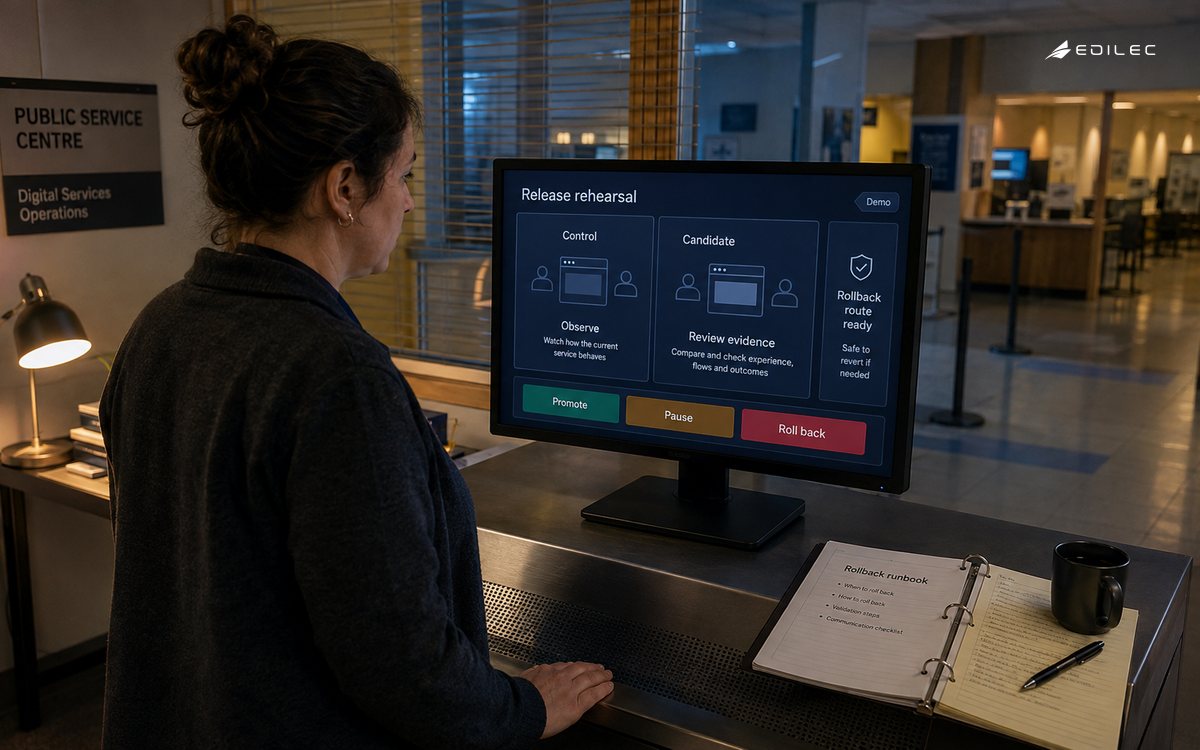
Teams should rehearse the decision with a deliberately imperfect release. Inject a known latency or error regression in a safe environment, verify that the candidate-specific signal appears, and confirm that pause and rollback reach the intended version. Then repeat with a dependency failure or delayed queue to test whether the process distinguishes release defects from environmental noise. These exercises build operator familiarity with the controls and reveal missing permissions, dashboards, or runbook steps before a real customer is affected.
A canary should leave a clear audit trail for the next operator. Record who approved the exposure, which gates were automated, which signals were reviewed, what uncertainty remained, and why the final action was taken. Preserve the candidate and control identities alongside the traffic history. This makes a later incident review faster and helps the team compare releases over time. A release process becomes more reliable when its evidence is reusable rather than recreated from screenshots and memory after each deployment.
Frequently asked questions
Question: Does a minimal Docker image eliminate container risk? Answer: No; provenance, dependencies, runtime identity, host controls, patching, and response ownership still matter. Question: What proves an image is release-ready? Answer: Immutable identity, reproducible inputs, tested contents, vulnerability triage, least privilege, and a refresh or rollback path.
What makes a canary representative?
Answer: The cohort should exercise the important traffic, dependency, data, and user behaviors while remaining bounded enough to contain a defect.
Which signals should gate promotion?
Answer: Use comparable error, latency, saturation, business completion, dependency, and recovery signals with a defined observation window.
How should a canary handle state?
Answer: Plan compatibility, idempotency, queues, caches, migrations, and external side effects before exposing stateful work to the candidate.
Is a canary the same as blue-green deployment? No. Blue-green usually maintains two complete environments and switches traffic, while a canary exposes a bounded subset and evaluates it progressively. Compare deployment rollbacks and blue-green deployment when selecting the recovery and traffic model. How much traffic should a canary receive? Enough to exercise the risk and gather useful evidence, but within an exposure budget the team can tolerate. Can a canary replace testing? No; it adds controlled production evidence to pre-release tests. What if there is no clean control? Use a baseline from the current version or a defined historical window, and be explicit about the limitation. Should every release use a canary? The process should be proportionate to change risk, traffic, and reversibility.
Key takeaways
- Define the hypothesis, cohort, control, observation window, and stop rules before exposure.
- Attribute telemetry to candidate and control so canary-specific regressions remain visible.
- Treat state, writes, queues, schemas, and dependencies as part of the canary boundary.
- Make promotion, pause, and rollback explicit and executable.
- Turn canary outcomes into tests, alerts, and safer release defaults.
Conclusion
Canary releases are a decision system for changing production with less blast radius. They work when the candidate is identifiable, the comparison is fair, the evidence is attributable, and rollback is real. A disciplined canary turns release confidence into an observable process that improves with every rollout.