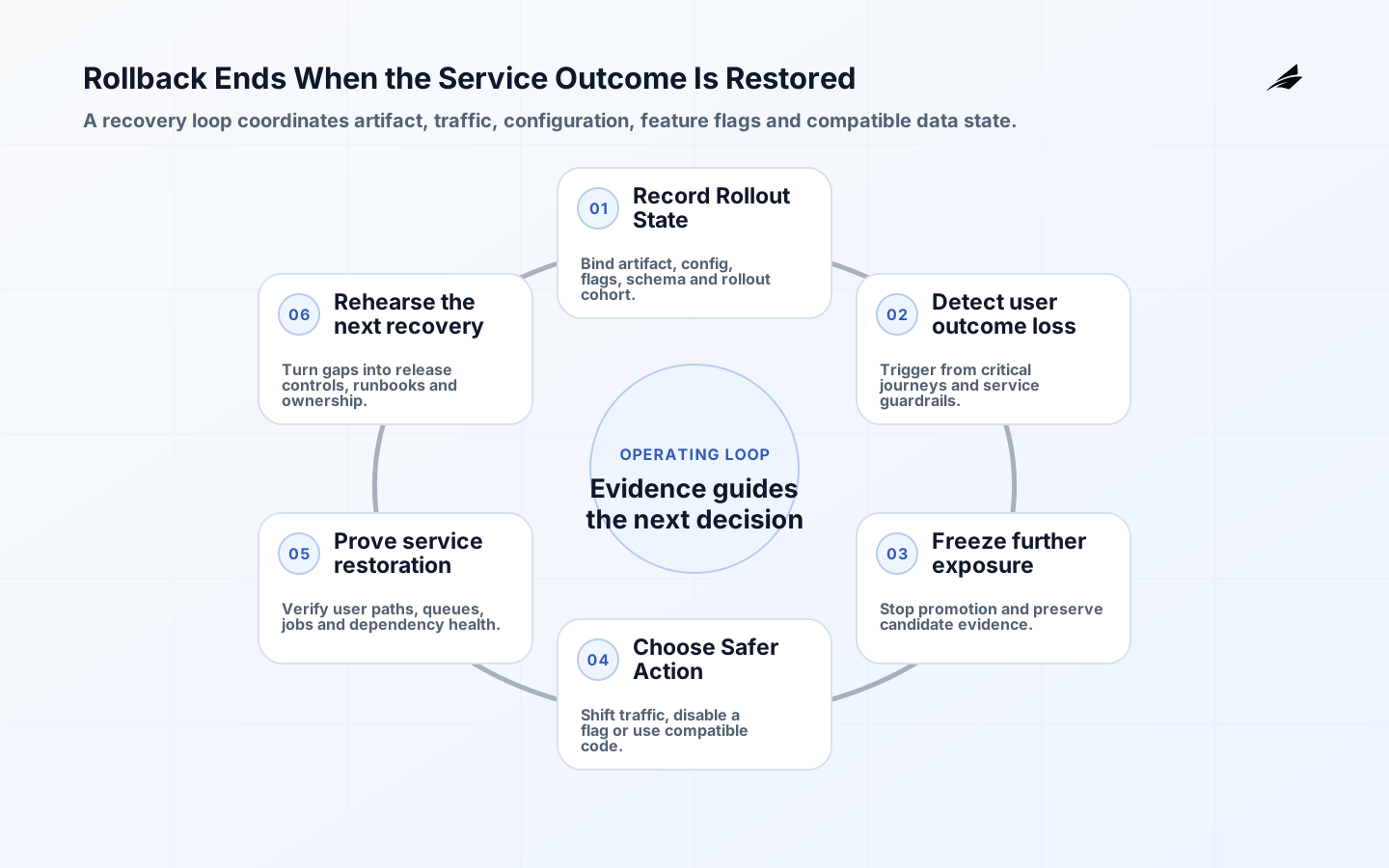
Deployment rollbacks are reliable only when a team knows what state it is restoring, what user data or schema change sits beside the code, and which signal authorizes the decision. Clicking a pipeline control after an alarm is not enough. A rollback can restore an old container image while leaving an incompatible database migration, a changed feature flag, a rotated credential, or an asynchronous job running. Treat it as a recovery procedure with a clear boundary: the affected service, the last known acceptable release, the traffic mechanism, and the person empowered to act. The Kubernetes Deployment documentation is useful for revision mechanics, but operational readiness begins before the release starts.
Define the recovery boundary
For each production release, record immutable artifact identity, configuration version, schema state, feature-flag state, dependency assumptions, and the intended rollout cohort. The record lets an incident lead tell whether reverting application code is sufficient or whether the safest path is to disable exposure, halt consumers, or roll forward with a corrective release. Separate deployment from release: deploying a revision may prepare it, while routing traffic or enabling a flag changes customer experience. That distinction gives deployment recovery more choices and avoids reverting healthy infrastructure simply because a business rule was exposed too soon.
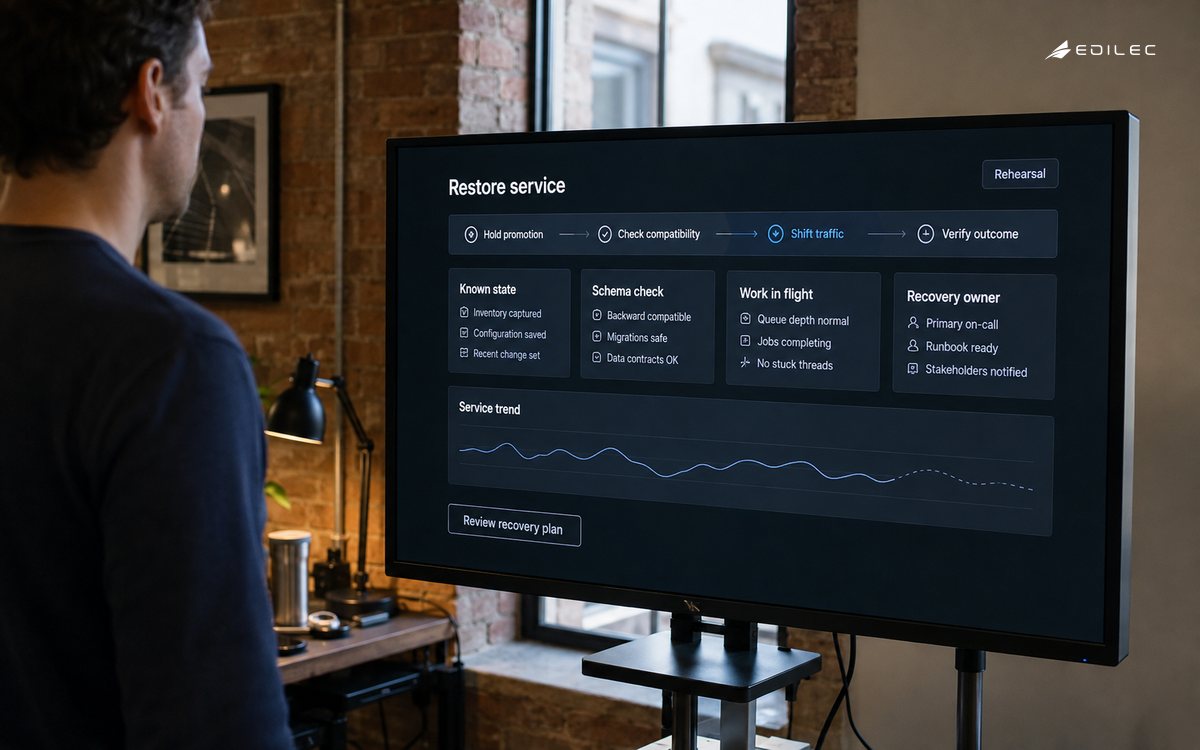
| Component | Recovery question | Evidence to retain |
|---|---|---|
| Artifact | Which image or package was known good? | Digest, build, and provenance |
| Data | Can old and new code read the current state? | Migration and compatibility status |
| Traffic | How is exposure removed? | Route, weight, or flag state |
| Background work | What continues after traffic shifts? | Queue consumers, jobs, and idempotency rules |
Use service signals, not pipeline status
A successful deployment says the platform accepted the change; it does not prove users can complete their work. Define rollback triggers from a small set of outcome and safety signals: failed requests for a critical journey, a material increase in tail latency, failed payments or writes, queue growth, and error budget burn. Compare the candidate with its control cohort over a window long enough to avoid reacting to one transient retry, but short enough to limit impact. Azure safe deployment practices recommends progressive exposure and health checks. Make the thresholds, observation window, and decision owner explicit in the release plan rather than improvising them while customers are affected.
- Alert on user-facing failure and saturation, not only CPU or a green deployment job.
- State whether a trigger pauses promotion, shifts traffic back, disables a flag, or begins an incident.
- Keep the control and candidate observable with the same labels and dashboards.
- Exercise the alert route and authority model before a high-risk change.
Execute recovery without creating a second incident
In the first minutes, protect users and preserve evidence. Freeze promotion, announce the incident channel, capture the candidate version and relevant graphs, then take the lowest-risk action that reduces impact. With weighted routing that may be a traffic shift; with a feature flag it may be disabling one behavior; with a bad schema migration it may require a compatibility mode rather than a blind down migration. The Amazon ECS deployment strategies reference illustrates that rollout type changes the available controls. Do not delete the failed environment or logs before validation. They are often the only comparison that distinguishes a release defect from a pre-existing dependency failure.
| Situation | First containment action | Validation before close |
|---|---|---|
| Candidate errors exceed threshold | Stop promotion and return traffic to control | Critical transaction succeeds on control |
| Flagged feature fails | Disable feature while keeping artifact deployed | Behavior and cache state are consistent |
| Migration is incompatible | Stop writers or use compatible code path | Read and write tests pass against current schema |
| Dependency is degraded | Hold release and isolate dependency impact | Baseline behavior recovers independently |
Prove that service is restored
A rollback completes when the affected outcome is stable, not when the old version is visible in a dashboard. Re-run synthetic and real-path checks, confirm queue and background activity are normal, and watch the error and latency signals for the stated stabilization window. Verify that the configuration and flag state match the intended recovery state. Argo Rollouts rollback guidance is a reminder that controller state and application state are related but not identical. Capture what was changed manually during response so later automation does not reintroduce the failure.
Practice recovery and improve the release path
Run a rehearsal against a noncritical production-like path: deploy a harmless known failure, detect it with the intended signal, shift exposure back, and confirm the service outcome. Measure time to detect, time to contain, and time to validate rather than celebrating a fast button press. After a real event, classify the gap: missing guardrail, ambiguous authority, incompatible contract, insufficient telemetry, or an unsafe default. Feed the correction into templates and runbooks. A healthy rollback strategy reduces the chance of using rollback at all because it makes release risk concrete during design and review.
Put the practice to work
- Define the operating boundary for deployment rollbacks in terms of release artifact, configuration, traffic route, feature flags, and compatible data; this turns a broad technical theme into work that an accountable team can review and improve.
- Name the user outcome and safety signals before changing anything. For this practice, compare customer completion, errors, latency, queue delay, and background-job health with an explicit baseline rather than relying on a tool status alone.
- Record assumptions that affect the decision, including demand, dependencies, time windows, and ownership. An assumption that stays implicit cannot be tested when conditions change.
- Choose a reversible first action and document the recovery path. This limits the cost of learning and gives the responder a known control when the observed result differs from expectation.
- Keep the evidence close to the service: versioned configuration, a short decision record, relevant dashboards, and the runbook used by the person who receives the alert.
- Review the change at a cadence that matches its risk. Look for an incompatible migration, an ambiguous decision owner, or incomplete service restoration; treat recurring exceptions as design feedback rather than as a reason to normalize manual work.
- Separate what the service team owns from what a shared platform or partner owns. The boundary should state who acts, who supplies evidence, and who approves an exception.
- Test the uncomfortable path deliberately. A quiet success case is not enough; exercise degraded dependencies, delayed work, recovery, and the handoff between ordinary operation and incident response.
- Use a small representative pilot before broad rollout. Capture what users actually did, which controls confused them, and whether the intended guardrail was visible at the moment of decision.
- Make exceptions visible, time-bound, and reviewable. An exception is useful when it reveals a real constraint; it becomes debt when it quietly replaces the supported path.
- Avoid measuring activity as proof of value. Count completed, safe outcomes and the effort required to achieve them, then use both quantitative evidence and operator feedback to choose the next improvement.
- Preserve context after an incident or failed change: identifiers, configuration state, timing, observed behavior, and the recovery action. This is more useful than a generic summary when the pattern returns.
- Review interfaces and contracts at the same time as the primary control. Many failures appear at boundaries: a client behavior, a delayed message, an identity assumption, or a shared dependency.
- Give the normal path a clear owner and a usable escalation route. Teams adopt controls that help them act quickly under pressure and abandon ones that require private knowledge to recover.
- Retire outdated rules when architecture, product demand, or customer commitments change. Keeping old controls without their original context can create risk as surely as leaving a system unconfigured.
- Turn the result into the next default for deployment rollbacks: keep what protected the outcome, simplify what caused friction, and schedule the next review while the evidence is still fresh.
Key takeaways
- A rollback restores a defined service state, not just a previous artifact.
- Keep code, configuration, flags, traffic, and data compatibility in the recovery boundary.
- Authorize decisions with customer outcome signals and a stated window.
- Validate restoration before declaring the incident resolved.
- Rehearse the path so authority and tooling work under pressure.
Frequently asked questions
Is rollback always safer than a fix forward? No. A compatible corrective release can be safer when data or contracts have progressed. Who calls the rollback? Pre-assign an incident or service owner who can act when the stated threshold is met. How long should we observe? Long enough to cover the affected workload pattern, including delayed jobs where relevant. Can a deployment tool prove recovery? It can prove controller state; customer and service signals must prove operational recovery.
Conclusion
Effective deployment rollbacks are designed into the release path. Define the recoverable state, expose the right signals, use the smallest safe containment action, and verify the user outcome before moving on. That turns a stressful reaction into a controlled operational capability.