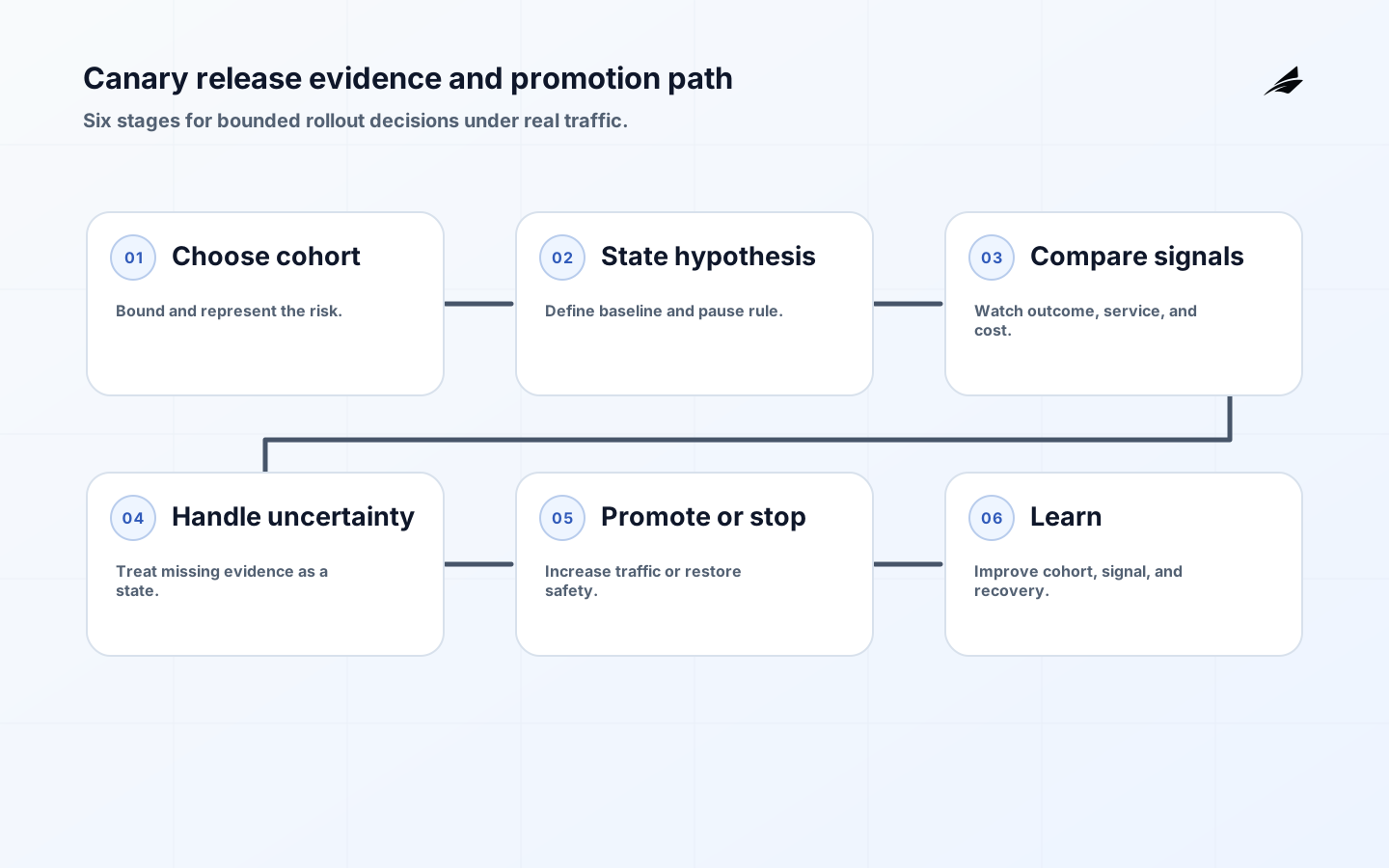
Canary releases are a decision discipline for changing a bounded part of a service while protecting the rest. A small percentage is not automatically safe; it may be unrepresentative, difficult to observe, or connected to a dependency that makes the blast radius larger than the traffic share suggests. Google SRE’s release engineering guidance treats canarying as a way to compare versions with production evidence. The practical question for a growing team is whether it can state the release hypothesis, choose a meaningful cohort, observe user and system outcomes, stop when evidence is concerning, and recover without improvising. Pair the release decision with CI/CD pipeline design and log aggregation when the service boundary spans delivery and operations.
Choose an honest first cohort
Select users, regions, tenants, hosts, or requests that are bounded and representative of the risk. Avoid choosing only friendly traffic if the change affects a different customer shape. Ensure the cohort can be isolated, measured, and removed without leaving inconsistent state. Write the boundary with the service owner, dependencies, protected outcome, and customer impact that must not worsen. The canary releases decisions guide is useful when selecting a first experiment, while the deployment rollback guide helps make the stop path concrete.
| Cohort choice | Useful when | Question to test |
|---|---|---|
| Small traffic slice | Risk is request behavior and can be routed reliably. | Are errors and latency different for comparable requests? |
| Representative tenant | Risk varies with data shape or account configuration. | Does the workflow work for the intended customer profile? |
| Region or zone | Risk involves infrastructure or locality. | Does the change interact safely with local dependencies? |
| Internal users | Early workflow and interface feedback is needed. | Does this expose defects before external impact? |
Define the release hypothesis
State what the new version is expected to improve or preserve, over what window, and what would cause a pause. Include user completion, correctness, latency, dependency health, resource use, and safety signals appropriate to the change. A hypothesis such as “the new checkout path will keep payment completion at baseline while reducing response time” is testable; “the release looks better” is not. Define the baseline and comparison method before traffic moves. If a signal is noisy, say how the team will handle that uncertainty rather than treating a green dashboard as proof.

Progressive delivery tools can automate traffic steps and analysis, but automation should not hide authority. Argo Rollouts canary documentation describes canary steps and analysis concepts; Kubernetes deployments provide the underlying workload behavior. Keep a named owner for promotion and a separate route for emergency containment. Google's release engineering guidance also supports gradual, evidence-based promotion. Record version, cohort, step, signal window, decision, and operator or controller identity so that a later review can explain why traffic increased or stopped.
Compare signals before promotion
Compare canary with a concurrent baseline when possible. Inspect error rate, successful business events, latency distribution, saturation, dependency failures, and customer support or review signals. Segment by request type and tenant class so a small mix change does not create a false conclusion. Give the canary enough traffic and time to encounter the behavior that matters, but do not wait so long that a harmful version spreads. A metric dashboard is evidence, not an automatic decision; make the promotion rule clear and show when data is incomplete.
| Evidence | Why it matters | Pause trigger |
|---|---|---|
| Business completion | Shows whether users finish the intended task. | Material drop against a comparable baseline. |
| Error and latency | Shows direct service behavior. | Regression beyond the agreed tolerance or trend. |
| Dependency health | Reveals indirect impact. | New timeouts, retries, or capacity pressure. |
| Resource and cost | Shows operational side effects. | Unexpected saturation or spend trajectory. |
Handle noisy or incomplete evidence
A canary can produce too little data, inherit a broken metric, or encounter a rare failure. Do not turn missing evidence into permission to promote. Mark the analysis as inconclusive, increase observation only when the risk remains bounded, or return to the previous version. If the baseline is also unhealthy, stop comparing and stabilize the service first. Preserve raw events and analysis results so the team can distinguish a release defect from an instrumentation defect. This is where canary practice becomes more than a traffic percentage: it gives uncertainty a defined response.
Grow a progressive delivery habit
Start with one service and a release that can be reversed without data repair. Define the first cohort, hypothesis, signal set, pause condition, approval, and recovery action. Run the change during a staffed window, then review whether the evidence arrived in time and whether the operator understood the result. Expand automation only after the team can explain a manual decision. The AWS rollback planning guidance is a useful check on recovery assumptions.
Work through the search canary case
A team releases a new search ranking path to five percent of traffic. The hypothesis is that relevant-result selection will improve without lowering completed searches or increasing latency. The owner verifies cohort routing, captures the build revision, and compares success, abandonment, latency, and downstream query cost with the baseline. A latency spike appears only for a large tenant segment; the team pauses promotion, routes that segment back, and preserves the traces. The later review finds an unbounded query pattern and adds a guard before the next canary.
Canary implementation details
Keep configuration and analysis definitions versioned. Make routing behavior explicit, especially when sessions or state must remain on one version. Ensure health checks test readiness and meaningful behavior, not only process presence. Give the release identity only the permissions it needs. Test rollback when the new version has written compatible state and when it has not. Record the last safe version, current cohort, and next decision in a shared operational view. The Kubernetes Deployment documentation is relevant for revision history and rollout status, but the business recovery contract still belongs to the service team.
Choose promotion steps that match the failure you are trying to limit. A traffic canary may not protect a schema migration, a background worker, or a scheduled job. For those changes, use compatible writes, staged readers, a shadow workload, or a reversible configuration boundary. Write the invariant that must hold across versions, and test it before exposing the new path. Canary practice is strongest when it is adapted to the system rather than applied as a percentage everywhere. This boundary belongs in the service review record.
Keep the cohort visible to support and customer teams. If a user reports a problem, the team should know whether the request was routed to the canary, which version responded, and how to move that user or tenant to safety. Avoid privacy-invasive cohort labels in customer-facing tools; use an internal correlation record with controlled access. This connects progressive delivery with communication and makes a small experiment less mysterious when something unexpected happens. This boundary belongs in the service review record.
Review false positives and false negatives after every meaningful rollout. A false positive may stop a healthy release because a baseline changed; a false negative may allow a defect because the cohort never exercised the risky path. Record the missing context and improve the signal or cohort rather than simply changing the threshold. Over time, the team should learn which measures predict customer harm and which only describe system activity. This boundary belongs in the service review record.
Retirement matters too. Once a canary mechanism, analysis route, or feature flag is no longer needed, remove stale traffic rules, dashboards, permissions, and rollback assumptions. Confirm that the service has one documented normal route and one deliberate emergency route. Leaving an old progressive-delivery layer in place can make a later incident harder because responders do not know which version or rule controls traffic. This boundary belongs in the service review record.
Choose promotion steps by the failure surface, not by a preferred percentage. A traffic canary can protect request handling while leaving a schema migration, worker queue, or scheduled job untested. For those paths, use compatible writes, staged readers, a shadow workload, or a reversible configuration boundary and name the invariant that must hold across versions.
Give support and customer teams a safe explanation of cohort behavior. They should know how to identify a canary request internally, which version responded, and how to move a user or tenant away from the experiment without exposing privacy-sensitive labels in customer-facing tools. That communication path is part of the release control, not an afterthought.
Review false positives and false negatives as evidence about the experiment design. A baseline shift can stop a healthy release, while an unrepresentative cohort can hide a defect. Record the missing context, then improve the signal, cohort, or comparison window instead of merely adjusting a threshold until the result looks acceptable.
Retire a progressive-delivery layer when its decision is no longer needed. Remove stale routes, analysis definitions, dashboards, permissions, and rollback assumptions, and verify that the service has one documented normal path plus one deliberate emergency path. Leaving an old rule active makes the next incident harder because responders cannot tell which version controls traffic.
Key takeaways
- Choose a bounded and representative cohort that can be isolated and removed.
- Write a release hypothesis, baseline, observation window, and pause condition first.
- Compare user outcomes, service behavior, dependencies, resources, and cost.
- Treat missing or noisy evidence as an explicit decision state, not as approval.
- Keep promotion and emergency containment authority visible and attributable.
- Review each canary for what the team learned about code, signals, and recovery.
Frequently asked questions about canary releases
How large should a canary be? Large enough to exercise the meaningful risk, small enough to protect users and remain observable; there is no universal percentage. Can a canary guarantee safety? No. It reduces blast radius and provides evidence, but it cannot cover every path. What if the baseline is already bad? Stabilize first or use a different comparison; a bad baseline makes promotion evidence unreliable. Should promotion be fully automatic? Only when the signal, authority, rollback, and consequence are well understood. Does canarying replace tests? No. It adds production evidence after pre-release checks.
Conclusion
Canary releases are valuable because they turn a risky release into a series of bounded decisions. Choose an honest cohort, define the expected outcome, compare meaningful signals, stop when evidence is incomplete, and preserve the path back. Growing teams gain confidence when each canary teaches them how their software, users, dependencies, and operating signals behave together.