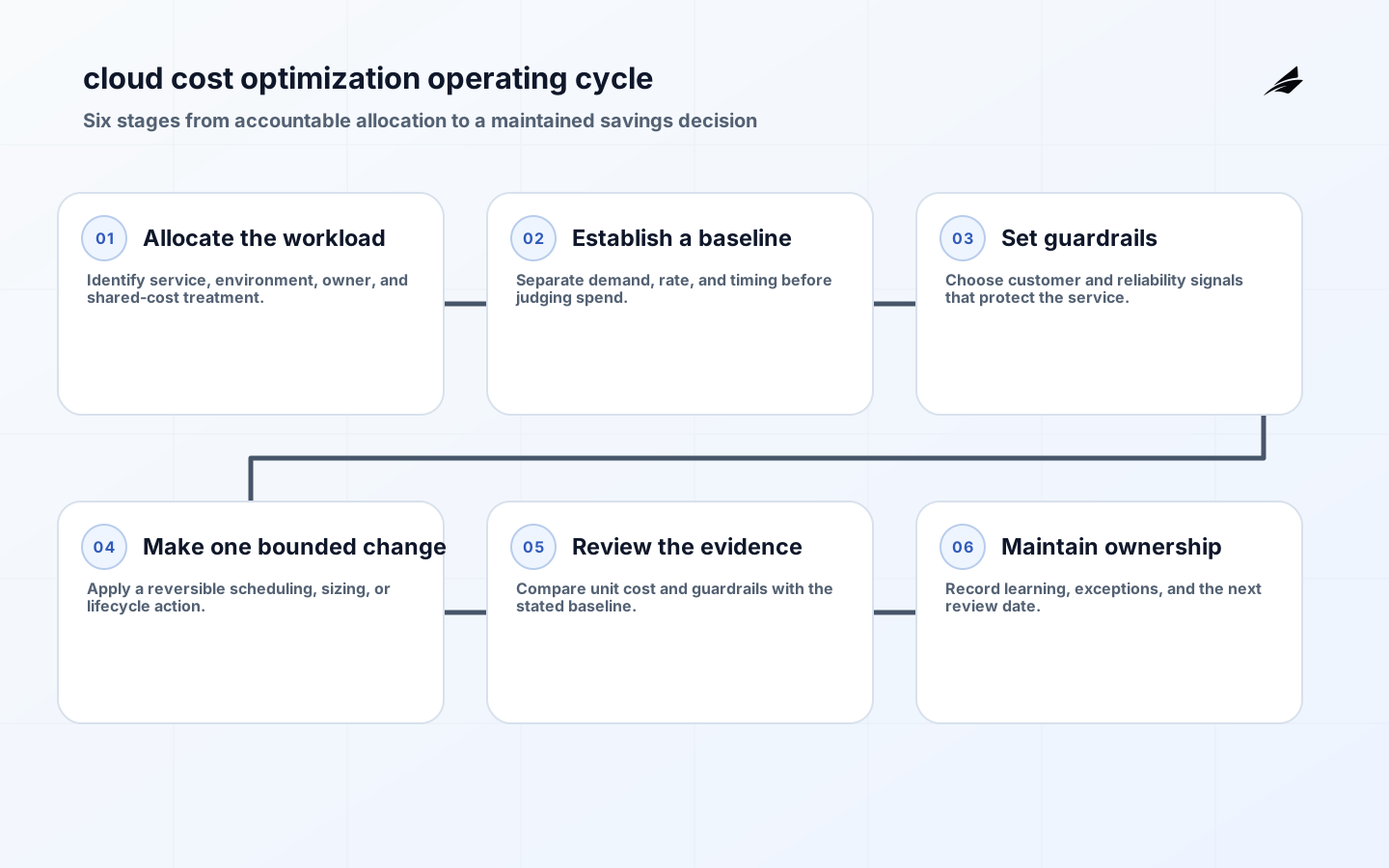
Cloud cost optimization is not a monthly exercise in making the invoice smaller. It is the discipline of choosing cloud resources that deliver an agreed business outcome at an understood cost, while keeping reliability, security, and delivery speed intact. A team that starts with a discount or a rightsizing recommendation often misses the question that makes the recommendation safe: which workload, customer journey, or product capability is this money buying? Start by naming that boundary, its accountable owner, and the service signal that must not worsen. The AWS Cost Optimization Pillar frames this as ongoing capability, not a one-time procurement event.
Set a cost boundary that a team can operate
Allocation is useful only when it supports a decision. Tagging or account structure should let an operator distinguish production from experiments, a customer-facing service from shared tooling, and a current owner from an abandoned project. Define a minimum allocation contract: workload, environment, owner, cost center or product, and lifecycle state. Publish exceptions rather than silently assigning unknown spend to a generic bucket. That makes data quality visible and prevents the finance view from drifting away from engineering reality. Cloud cost allocation should also identify shared costs explicitly; forcing every shared platform charge onto an application team creates false precision and damaged incentives.
| Decision | Evidence needed | Accountable role |
|---|---|---|
| Is the spend in scope? | Workload identity and environment | Service owner |
| Is the change safe? | Service guardrail and rollback option | Engineering lead |
| Is the saving real? | Usage, price, and demand comparison | FinOps partner |
| Can it persist? | Lifecycle rule and review date | Platform owner |
Make cost data decision-ready
Do not compare one invoice with the previous invoice and call the difference waste. Separate changes in demand, rate, architecture, allocation, and timing. A nightly analytics job may cost more because it processed more accepted records; that can be a successful outcome. A stable request volume with rising idle capacity deserves investigation. Establish a baseline with a stated period and denominator, such as cost per completed job, active tenant, or useful transaction. The FinOps Framework is helpful here because it treats cost data as a cross-functional practice. Pair it with freshness metadata so reviewers know whether a provider export is complete enough for action.

- Measure a cost against a business-relevant denominator, not an invoice total alone.
- Keep forecast, actual, commitment, and one-off migration costs visibly separate.
- Record incomplete tags and late billing data as known limits on a decision.
- Treat sudden spend drops as carefully as increases; they may reveal lost traffic or disabled protection.
Choose actions with service guardrails
The safest cloud cost optimization change is reversible and measurable. Turn off a nonproduction environment outside working hours, reduce a demonstrably idle worker pool, or move an object class after confirming access behavior. Then observe the service outcome before extending the policy. More consequential actions, such as changing database capacity, network architecture, or long-term commitments, need a longer usage history and an explicit exit condition. The Google Cloud cost optimization guidance emphasizes matching resources to demand; locally, that also means preserving headroom for a known peak and documenting the assumption behind it. Savings that move latency, incident risk, or operator time somewhere else are not savings.
| Action | Useful guardrail | Stop or reverse when |
|---|---|---|
| Schedule development capacity | Build availability | A planned team window needs the environment |
| Rightsize compute | Latency and saturation | Tail latency or queue age rises |
| Adopt a commitment | Stable usage floor | Demand is seasonal or a migration is imminent |
| Change storage tier | Restore and access time | A recovery test misses its objective |
Run a review that changes decisions
A practical review has three horizons. Daily or weekly, route anomalous spend and broken allocation to the owner who can investigate. Monthly, compare unit cost and budget movement with product demand and releases. Quarterly, revisit architecture, commitments, and ownership as workloads change. Keep a compact decision record with the hypothesis, resource or service identifier, expected effect, observed effect, owner, and next review date. This is more useful than a dashboard screenshot because a future engineer can reconstruct why a policy exists. Azure's cost optimization guidance likewise treats optimization as a recurring design and operations concern.
Work through a batch-processing example
Consider a document-processing service with rising compute cost. Before resizing it, split cost by worker type and compare it with accepted documents, queue age, processing time, retry rate, and peak-hour arrivals. If accepted volume rose, the total bill may be appropriate. If a new retry loop increased compute without improving throughput, repair the fault before buying a commitment. If workers are idle overnight while the queue is empty, schedule a lower floor and keep a capacity override for exceptional demand. The review should include the cost of observability and operational labor as well: a configuration that saves compute but produces recurring manual recovery is not an efficient operating state.
Put the practice to work
- Define the operating boundary for cloud cost optimization in terms of workload allocation, unit cost, capacity floor, and retention rules; this turns a broad technical theme into work that an accountable team can review and improve.
- Name the user outcome and safety signals before changing anything. For this practice, compare customer completion, latency, queue age, and recovery time with an explicit baseline rather than relying on a tool status alone.
- Record assumptions that affect the decision, including demand, dependencies, time windows, and ownership. An assumption that stays implicit cannot be tested when conditions change.
- Choose a reversible first action and document the recovery path. This limits the cost of learning and gives the responder a known control when the observed result differs from expectation.
- Keep the evidence close to the service: versioned configuration, a short decision record, relevant dashboards, and the runbook used by the person who receives the alert.
- Review the change at a cadence that matches its risk. Look for unexpected demand, inaccurate allocation, or a savings rule that removes needed capacity; treat recurring exceptions as design feedback rather than as a reason to normalize manual work.
- Separate what the service team owns from what a shared platform or partner owns. The boundary should state who acts, who supplies evidence, and who approves an exception.
- Test the uncomfortable path deliberately. A quiet success case is not enough; exercise degraded dependencies, delayed work, recovery, and the handoff between ordinary operation and incident response.
- Use a small representative pilot before broad rollout. Capture what users actually did, which controls confused them, and whether the intended guardrail was visible at the moment of decision.
- Make exceptions visible, time-bound, and reviewable. An exception is useful when it reveals a real constraint; it becomes debt when it quietly replaces the supported path.
- Avoid measuring activity as proof of value. Count completed, safe outcomes and the effort required to achieve them, then use both quantitative evidence and operator feedback to choose the next improvement.
- Preserve context after an incident or failed change: identifiers, configuration state, timing, observed behavior, and the recovery action. This is more useful than a generic summary when the pattern returns.
- Review interfaces and contracts at the same time as the primary control. Many failures appear at boundaries: a client behavior, a delayed message, an identity assumption, or a shared dependency.
- Give the normal path a clear owner and a usable escalation route. Teams adopt controls that help them act quickly under pressure and abandon ones that require private knowledge to recover.
- Retire outdated rules when architecture, product demand, or customer commitments change. Keeping old controls without their original context can create risk as surely as leaving a system unconfigured.
- Turn the result into the next default for cloud cost optimization: keep what protected the outcome, simplify what caused friction, and schedule the next review while the evidence is still fresh.
Key takeaways
- Cloud cost optimization begins with a workload boundary and an accountable owner.
- Use unit cost and service signals to distinguish growth from waste.
- Prefer reversible changes with explicit reliability guardrails.
- Keep allocation exceptions and shared costs visible instead of inventing precision.
- Turn each change into a reviewed operating decision, not a spreadsheet footnote.
Frequently asked questions
Do we need a FinOps tool first? No. Start with trustworthy usage data, allocation rules, owners, and a recurring decision rhythm; tooling should remove a demonstrated burden. Which metric is best? Use the denominator closest to the value the workload creates, then pair it with reliability signals. Who approves savings actions? The service owner should own the trade-off, with finance and platform partners supplying cost and technical constraints. When should a team pause? Pause when billing data is incomplete, the service guardrail is moving, or the rollback path is unclear.
Conclusion
Good cloud cost optimization makes spending easier to explain and technical change safer to repeat. Allocate the workload, establish an honest baseline, make a bounded change, and keep reviewing the result against the outcome that matters. That is how cost awareness becomes part of reliable digital operations.