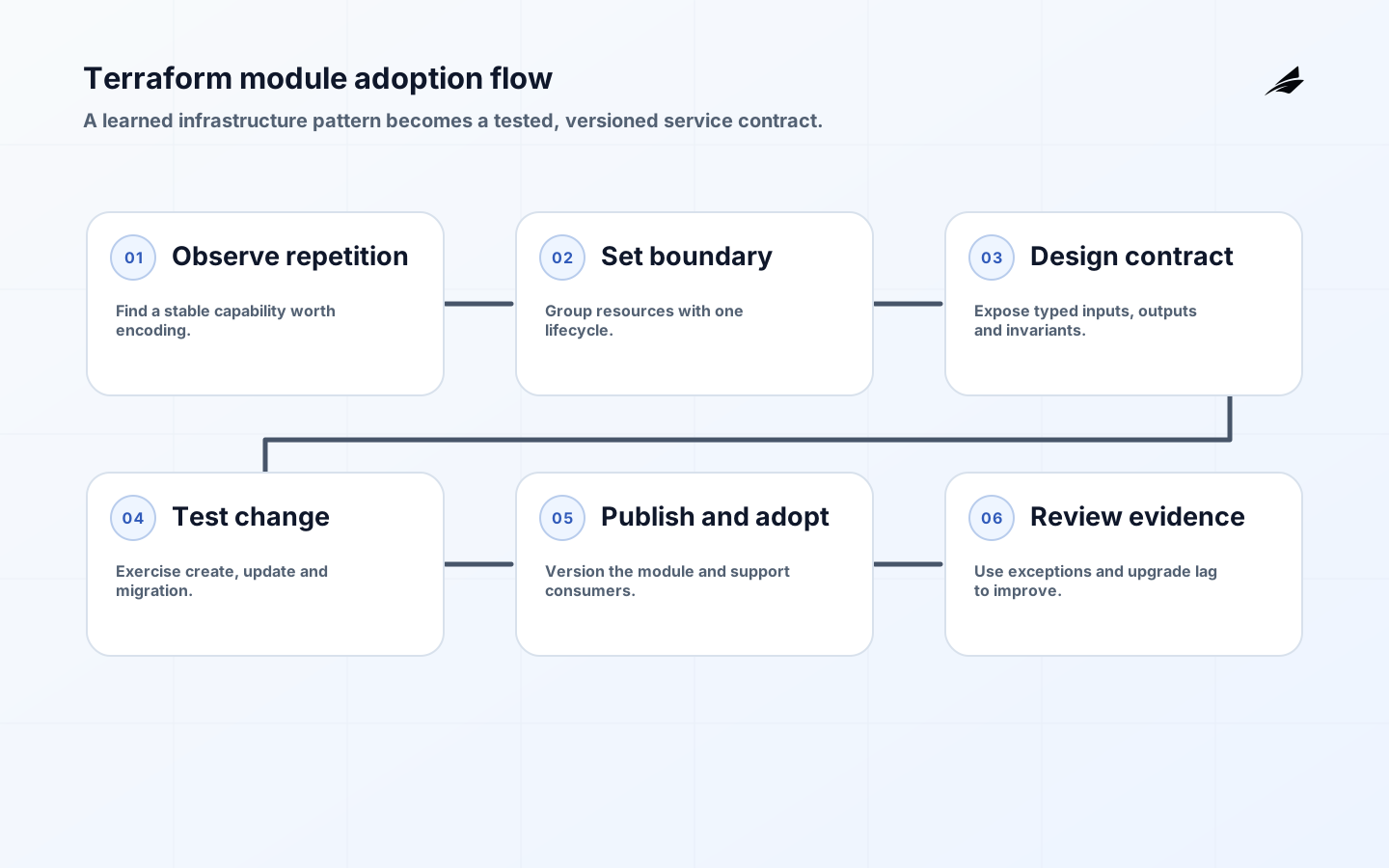
Terraform modules for founders are valuable when the company has infrastructure decisions worth repeating: how a service is networked, encrypted, tagged, observed and granted identity. A module can make the safe path fast, but it can also conceal cloud behavior behind dozens of switches. The founder-level question is not whether the code looks reusable. It is whether teams can understand the contract, predict change, recover from failure and evolve the abstraction without blocking delivery.
Start after a pattern has been implemented and learned at least once, not before the team understands it. The Terraform module security review covers supply-chain and boundary risks, while the GitOps architecture guide explains how declarative infrastructure fits a reconciled delivery model.
Key takeaways
- Create a module around one coherent infrastructure capability and accountable owner.
- Keep interfaces small, typed and explicit about security and cost consequences.
- Prefer composition in the root configuration to deeply nested modules.
- Version modules and providers; review plans before promotion.
- Test defaults, updates, failure conditions and migration between versions.
- Measure adoption, exceptions and upgrade lag rather than module count.
Choose a boundary people can explain
A good module represents a useful architectural unit such as an application service, network segment, database baseline or workload identity. It groups resources that change together and exposes the decisions a caller legitimately owns. HashiCorp's modules overview defines a module as resources managed together and describes develop, distribute and provision phases. That lifecycle is more useful than extracting every repeated line into a separate directory.
Avoid modules that mirror one provider resource with every argument exposed. They add indirection without creating a policy or workflow benefit. Also avoid a single company module that creates networking, compute, database, monitoring and deployment for every possible product. It accumulates conditionals, broad permissions and coordinated releases. Use the module boundary to express a stable promise: inputs, outputs, managed resources, invariants and known exclusions.
| Candidate | Good boundary when | Warning sign |
|---|---|---|
| Network baseline | Subnets, routes and controls change as one capability | Every workload needs internal route knowledge |
| Application service | Identity, logs and runtime share a lifecycle | It also provisions unrelated shared databases |
| Database | Backup, encryption and access defaults are standardized | Engine-specific behavior is hidden behind generic flags |
| Single resource wrapper | It enforces a meaningful invariant | It only renames provider arguments |
| Whole platform | One team owns the complete contract | Consumers wait for every unrelated module change |
Design a small, deliberate interface
Inputs should describe intent, be strongly typed, include useful validation and avoid asking consumers to understand implementation details. Defaults must be genuinely safe across supported cases; a default public network path or unencrypted store is not convenience. Outputs should expose identifiers needed for composition, not complete resource objects by habit. Document which inputs force replacement, affect cost, alter data location or weaken a control.
HashiCorp's creating modules guidance recommends moderation and relatively flat module trees. The composition guidance shows how root modules connect smaller capabilities through outputs and inputs. This leaves environment-level decisions visible. A root configuration can choose which network and database to combine without a child module secretly creating both.
| Interface element | Review question | Useful evidence |
|---|---|---|
| Input | Is this a caller decision or leaked implementation detail? | Typed variable, description and validation |
| Default | Is it safe for every supported environment? | Threat and cost review |
| Output | Does another module actually need it? | Named consumer |
| Invariant | What must always remain true? | Precondition, policy or test |
| Exception | How can a valid special case be expressed? | Documented extension or separate module |
Version, distribute and review module change
Publish reusable modules through a controlled registry or versioned source. Pin module and provider versions so a routine initialization does not silently change infrastructure behavior. Use semantic versioning as a communication tool, but verify the actual plan: provider behavior, default changes and cloud API evolution can produce surprises even when labels look compatible. Keep release notes focused on consumer action, replacement risk and migration.
Separate module code from live environment configuration. Review module changes like product changes, and environment plans like production changes. HashiCorp's Terraform style guide recommends version pinning, separate configuration organization and automated validation. Protect state and credentials independently; sensitive values can still appear in state even if a variable is marked sensitive. The secrets management checklist provides complementary controls.
Test the contract and the upgrade path
Run formatting and validation on every change, then test behavior. Exercise a minimal valid configuration, representative production shape, invalid input, update, import where supported and destroy in an isolated account. Assert outcomes that define the promise: encryption enabled, public exposure absent, identity scoped, required logs present and tags applied. HashiCorp's Terraform test documentation supports test files with runs and assertions.
Test migration from the oldest supported version to the proposed release. A module can create fresh infrastructure correctly and still be unsafe for existing resources because an address, default or resource type changed. Review the plan for replacement, data movement, temporary exposure and ordering. For state moves, import or provider changes, rehearse against a copy or disposable equivalent. Keep rollback realistic: reverting code does not necessarily undo a cloud-side replacement.
Adopt modules in stages
Select one repeated, painful capability with an owner and two willing consumers. Baseline delivery time, review comments, policy exceptions and incident history. Build the smallest opinionated module, pair with consumers, and keep an escape route for a legitimate unsupported case. Do not start by converting every existing stack. Brownfield adoption often works better when new services use the module first and existing services migrate during a meaningful change.

A three-service startup might begin with a workload module that creates runtime identity, encrypted logs, basic alerts and private networking hooks. Database and network remain separate modules composed by each environment. One regulated service can use a stricter database module without adding conditionals to every workload. After two releases, the platform owner reviews exception requests and upgrade effort. A repeated exception may deserve a new interface; a one-off need may remain explicit in the root.
Operate each shared module as a small product
A shared module creates a support obligation. Publish its purpose, supported Terraform and provider ranges, owners, upgrade policy and response route next to the examples. Keep a consumer inventory so a security correction or breaking change can reach every affected stack. The inventory can come from registry use, repository search or CI metadata, but it must identify deployed versions rather than only declared source references. Without that view, a module release is an announcement, not a completed change.
Use a deprecation window with specific evidence. Mark the old input or output, explain the replacement, provide an example migration and set the last supported release. Where possible, accept both forms temporarily and emit a validation message. For a change that moves resource addresses, publish the required state move and show the expected plan before and after. Do not describe a replacement as non-disruptive until it has been tested against representative state and the relevant provider version.
Review module health quarterly even when no feature work is planned. Useful signals include active consumers by version, age of the oldest supported release, failed upgrades, plan-time policy violations, exceptions, replacement incidents and time spent helping callers. A growing count of options can indicate that the boundary is absorbing unrelated capabilities. Conversely, repeated direct resources beside the module may reveal a missing extension point or an invariant callers do not accept.
Plan a brownfield module migration
Take an existing object-storage stack as a concrete case. First record bucket names, encryption keys, policies, lifecycle rules, replication and consumers. Configure the module to describe the current state rather than the preferred future state. Import or move addresses in an isolated branch and require a no-change plan. Only after ownership is stable should a second change tighten defaults or add logging. Combining adoption and remediation makes it difficult to distinguish an address mistake from an intended infrastructure change.
Define abort criteria before applying: unexpected replacement, permission broadening, a changed retention rule, a provider upgrade outside the tested range or an output that would break a consumer. Preserve the prior state version and the exact plan, but do not assume state rollback can reverse cloud actions. For data-bearing resources, pair module migration with service-specific backup and recovery checks. The safest migration is one whose intended cloud delta is small, explainable and independently verifiable.
Terraform module adoption checklist
- The module represents one capability with a named owner and support boundary.
- Inputs, outputs, defaults, invariants and exclusions are documented.
- Security, cost, region and replacement consequences are visible to callers.
- Source, module, Terraform and provider versions are controlled.
- CI runs validation, tests, policy checks and a reviewable plan.
- Upgrade tests cover the oldest supported release and representative state.
- Consumers have a documented exception and escalation route.
- Adoption reviews include upgrade lag, exception rate, lead time and incidents.
Frequently asked questions
When should a startup create its first Terraform module?
Create one when a coherent pattern is likely to be repeated and the team understands its constraints. The first implementation can remain direct configuration. After learning from it, encode the stable decisions and test the interface with the next consumer.
Should founders use public registry modules?
They can accelerate delivery, but evaluate ownership, release history, source, permissions, defaults, dependencies and upgrade practices. Pin a reviewed version and inspect its plan. A popular module is still third-party software executing with infrastructure authority.
Do Terraform modules require a platform team?
No, but every shared module needs an owner with time to review changes, support consumers and publish upgrades. Without that commitment, reuse creates an abandoned dependency. Start with few modules and explicit ownership before adding organizational structure.
Conclusion
Terraform modules should make important infrastructure decisions easier to repeat and easier to inspect. Choose coherent boundaries, expose deliberate interfaces, compose them visibly and test upgrades against real state. That gives founders leverage without replacing cloud understanding with a brittle internal abstraction.