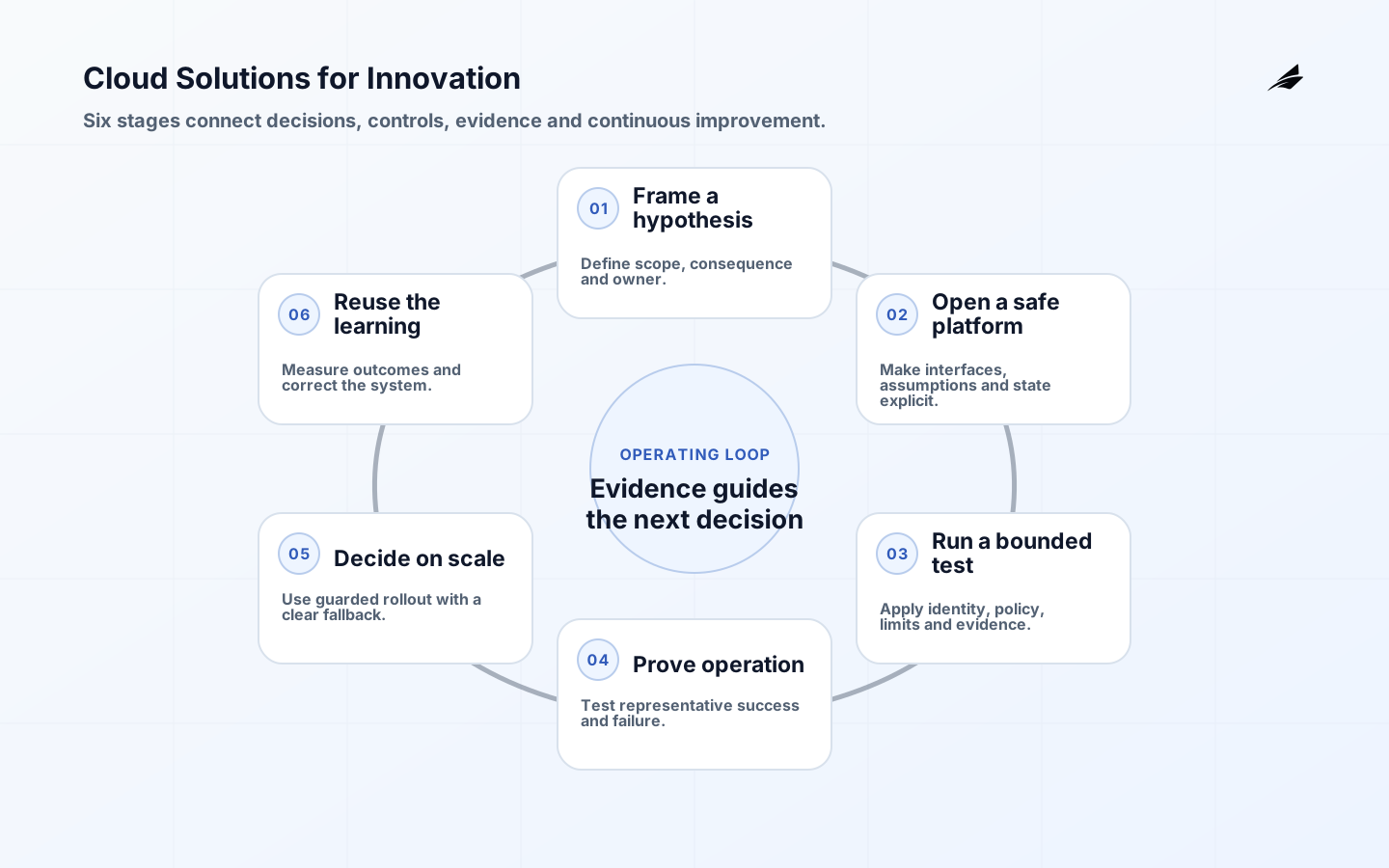
Cloud solutions for innovation create value when they shorten the path from a testable customer problem to a reliable product. Elastic infrastructure and managed services can reduce setup time, but novelty alone is not an outcome. Teams still need bounded experiments, trustworthy data, security, cost visibility, operational ownership and an explicit decision to scale, change direction or stop.
Use this FAQ with the cloud innovation delivery plan, production implementation checklist, cloud solutions delivery guide and strategy-to-operations checklist. The design target is a repeatable learning system, not an unrestricted sandbox.
What cloud innovation should deliver
The NIST cloud definition identifies on-demand self-service, broad network access, resource pooling, rapid elasticity and measured service. These characteristics can accelerate experiments, but only when teams can provision approved capabilities without long tickets. The useful product is often the internal platform path that makes a safe experiment easy to create, observe and remove.
Frame innovation as a hypothesis: a named user has a problem, a capability may change an outcome, and a bounded test can produce evidence. Define success, guardrails, cost ceiling, data boundary and stopping date before provisioning. Separate a technical spike that tests feasibility from a product experiment that tests user value; each needs different participants and measures.
Use a paved platform without freezing exploration
A platform should offer identity, networking, secrets, repositories, build pipelines, observability, cost attribution and approved service templates. It should make common needs self-service while exposing an exception path for legitimate experiments. The Google Cloud Adoption Framework emphasizes leadership, learning, scale and security; those themes apply even when a team is not using Google Cloud.
Treat platform APIs and templates as products. Publish supported capabilities, owners, service targets and upgrade policies. Collect developer feedback and measure setup time, failed deployments, support load and abandonment. Avoid building a giant platform before product demand exists. Start with a thin path for one experiment class, then add reusable capability when repeated friction or risk justifies it.
| Experiment type | Primary question | Production implication |
|---|---|---|
| Technical spike | Can the capability work within constraints? | May be disposable; preserve findings |
| User prototype | Does the interaction solve a real problem? | Needs representative users and accessibility |
| Operational pilot | Can teams run it safely at limited scope? | Requires support, monitoring and recovery |
| Scale trial | Do value, performance and unit economics hold? | Needs capacity and commercial evidence |
Create safe experimental boundaries
Use separate accounts or subscriptions, federated identities, least privilege, approved regions, network policies, budget alerts and automatic expiry. Synthetic or minimized data should be the default. If real personal or regulated data is essential, perform the required privacy, legal and security review before use. Prevent experiments from silently becoming customer-facing services by separating domains, credentials and deployment routes.

The NIST zero trust architecture rejects implicit trust based on network location or ownership. Apply that principle to experimental resources: authenticate users and workloads, authorize each resource interaction and log material actions. A sandbox is a governance boundary, not an exemption. Give teams enough autonomy to learn while making destructive or high-impact actions deliberately difficult.
Choose managed capability by reversibility and learning value
Managed databases, event services, serverless runtimes and AI APIs can remove undifferentiated operations. Compare time to evidence, portability, data gravity, skill, reliability, quota, pricing and exit. A managed service is attractive when its capability advances the hypothesis and the team accepts its constraints. Do not replatform a product merely to make an experiment look modern.
Prefer stable interfaces around volatile choices. Store authoritative business state separately from replaceable experiments, version events and keep data export practical. Test service limits and degraded behavior early. The current Azure cloud-native planning guidance connects business goals, architecture, risk and deployment planning; use that discipline regardless of provider.
Make experiment and scale economics visible
Set a budget envelope with owner, duration and unit assumptions. Tag or allocate spend to the experiment, including shared platform and data costs. The FinOps Framework emphasizes collaboration among engineering, finance and business teams to maximize technology value. Cost feedback should arrive during design and operation, not as a surprise after the pilot.
Measure cost per experiment, active user, transaction or other business unit. Model the scale curve and identify step changes such as dedicated capacity, data egress, commercial licenses and support tiers. An inexpensive prototype may have poor production economics. Conversely, a higher experiment cost may be justified if it produces decisive evidence sooner. Evaluate cost with outcome and risk, not in isolation.
| Gate | Minimum evidence | Decision |
|---|---|---|
| Start | Hypothesis, owner, data boundary, budget and stop date | Authorize bounded experiment |
| Pilot | Representative result, control checks and operating plan | Test with limited users |
| Production | Service ownership, resilience, security and economics | Release progressively |
| Scale | Sustained outcome, capacity, cost and support evidence | Invest, revise or retire |
Earn production through evidence gates
Production readiness includes an accountable service owner, support, security review, data governance, capacity, service objectives, monitoring, incident response, backup, recovery, accessibility and change control. Rebuild from version-controlled definitions rather than promoting a hand-configured sandbox. Retest the hypothesis with real operating overhead included in the business case.
Continuous delivery supports small, reversible changes when deployment is automated and quality is built in. The DORA continuous delivery capability links the practice to reduced deployment pain and rework. Use progressive exposure, feature controls and rollback. A prototype that cannot be operated safely may still have taught something valuable; stopping it is a valid outcome.
Manage an innovation portfolio, not isolated demos
Review experiments by strategic fit, evidence quality, option value, dependency and capacity. Limit work in progress so teams can finish tests and make decisions. Record assumptions, results and reusable assets in a searchable register. Terminate resources and revoke access when work ends, while preserving required evidence and learnings.
Portfolio measures should include time to first test, time to decision, percentage stopped with clear evidence, percentage scaled, realized outcome and platform reuse. Do not optimize for the number of proofs of concept. A healthy portfolio contains disciplined stops and changed hypotheses. Leadership should remove systemic barriers revealed across experiments rather than rescuing every individual project.
Example: test an AI-assisted service intake
A service team believes automatic classification can reduce routing delay. Build a bounded intake experiment using synthetic cases, then a reviewed sample of permitted historical data. Keep the case system authoritative; the model proposes category and confidence but cannot close or reassign a high-impact case without policy checks. Record model, prompt, data version and reviewer outcome.
- Define routing accuracy and customer wait as paired outcomes.
- Set a cost and latency ceiling per classified case.
- Route low-confidence and protected categories to trained reviewers.
- Test prompt injection, malformed attachments and unavailable model service.
- Use a feature control for limited queues and immediate disablement.
- Delete temporary data and resources at the experiment deadline.
A production decision should consider routing improvement, reviewer effort, error consequence, subgroup performance, operational support and unit cost. If the model helps only a narrow case type, scale that bounded use rather than expanding authority. Feed reusable ingestion, evaluation and observability patterns back into the platform.
Operate the capability as a managed system
An experiment register should remain lightweight but operationally complete. Record sponsor, team, hypothesis, users, data class, providers, region, resources, identities, budget, start date, decision date and outcome. Automate reminders and expiry, but require a person to confirm deletion where records or models may persist outside infrastructure accounts. Review failed experiments for reusable platform or policy lessons without treating every stop as poor performance. When several teams request the same exception, decide whether the platform lacks a legitimate capability or the boundary needs clearer explanation. This portfolio feedback turns local learning into safer, faster future experiments and prevents abandoned prototypes from accumulating hidden cost and access.
Review evidence before expanding scope
Before expanding cloud solutions for innovation, the accountable owner should review representative outcomes, exceptions, access, changes, operating cost, user feedback and recovery evidence. Confirm that metrics still reflect the intended business result, that known limitations are visible to users and that suppliers have not changed material behavior without evaluation. Exercise one realistic failure and reconcile the resulting records. Record the decision to scale, narrow, correct or retire the capability, including assumptions and a review date. This review keeps implementation evidence connected to authority and prevents a successful pilot from becoming an unmanaged dependency.
Key takeaways
- Start with a falsifiable customer or operational hypothesis, not a preferred cloud service.
- Provide paved identity, delivery, observability and cost capabilities for safe self-service.
- Separate experiments from production through explicit data, access and deployment boundaries.
- Model unit economics and operational work before declaring a prototype successful.
- Scale, narrow or stop through evidence gates and preserve reusable learning.
Frequently asked questions
Does innovation require a multicloud strategy?
No. Multiple providers can support specific regulatory, capability or resilience needs, but they also add identity, networking, skills and operating complexity. Choose workload placement from requirements and credible exit needs. Do not duplicate every experiment across providers merely to claim portability.
Should an experiment use production data?
Only when the hypothesis genuinely requires it and approved controls permit it. Prefer synthetic, anonymized or minimized data. Define purpose, access, retention and deletion, and prevent data from entering unapproved logs or model training. A short experiment does not reduce the consequence of mishandling data.
How long should a cloud experiment run?
Long enough to collect representative evidence, but with a fixed decision date. Technical spikes may take days; user and operational pilots may need weeks. Stop when the question is answered, the guardrail is breached or evidence cannot be obtained. Open-ended experiments become unmanaged services.
Conclusion
Cloud solutions for innovation are most effective when autonomy and discipline reinforce each other. Give teams a safe, observable path to test a meaningful hypothesis, make cost and risk visible, and require production evidence before authority expands. The result is faster learning with fewer abandoned resources and fewer prototypes quietly carrying production responsibility.