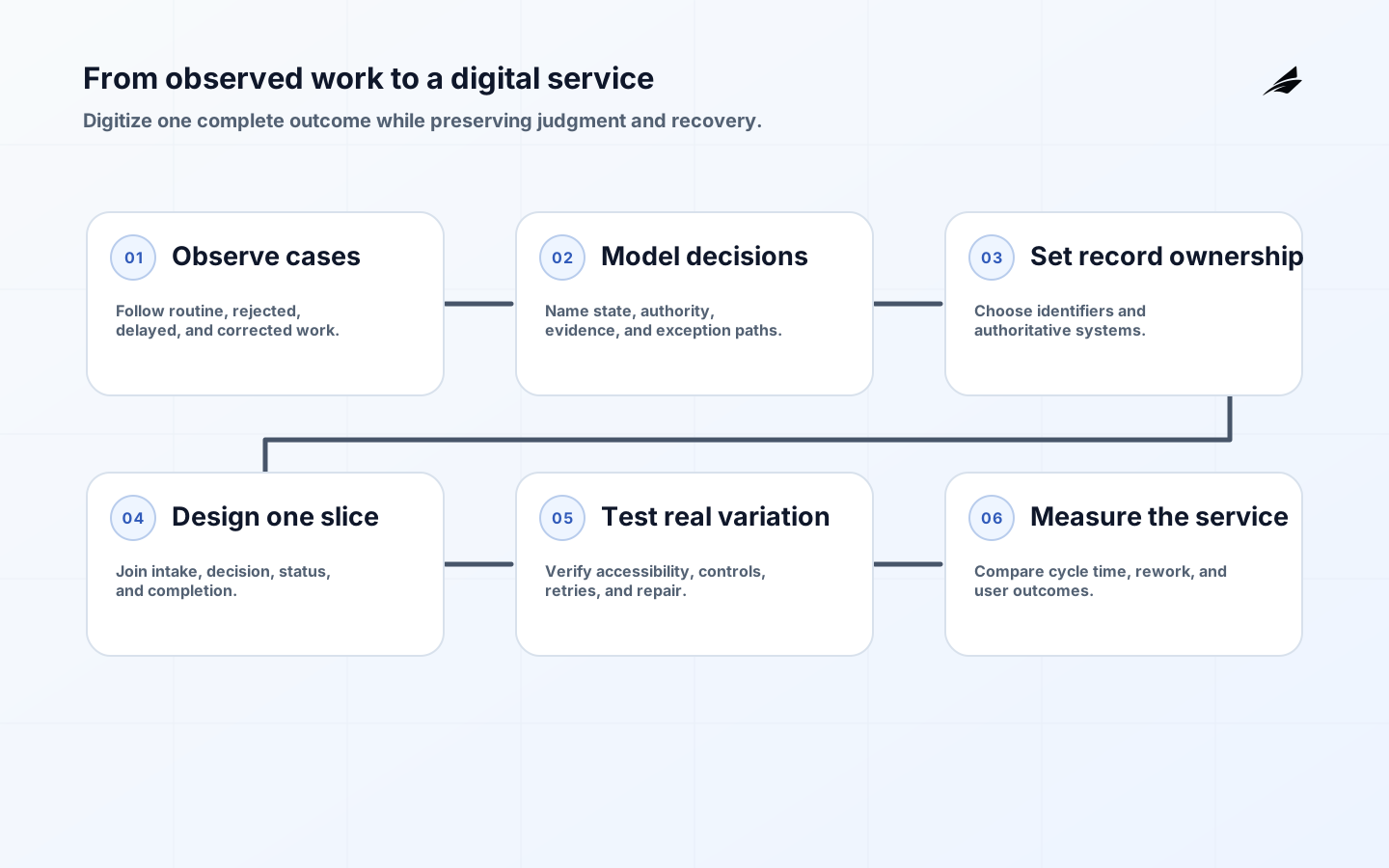
Business process digitization turns an operational journey into a shared, traceable system of work. It is not the act of converting a paper form into a web form or reproducing every spreadsheet column. Planning begins by observing representative cases, identifying the decisions that move each case forward, naming the authoritative records, and making exceptions visible. The first development release should remove a measurable failure from a complete slice of work while preserving accountable judgment and a route back from incorrect automation.
Map one service request before selecting software
Follow a request from arrival to closure with the people who perform it. Record triggers, waiting states, handoffs, duplicated data entry, approvals, customer communications, documents, deadlines, and repair work. Include a routine case, a rejected case, a corrected case, and one that crosses a team boundary. GOV.UK’s Service Standard advises teams to solve the whole user problem without attempting everything at once. That is the right balance: map the end-to-end outcome, then choose a narrow release that improves it. BPMN offers a standard notation when a precise process model is useful, but a model is valuable only if operators recognize their actual work in it.
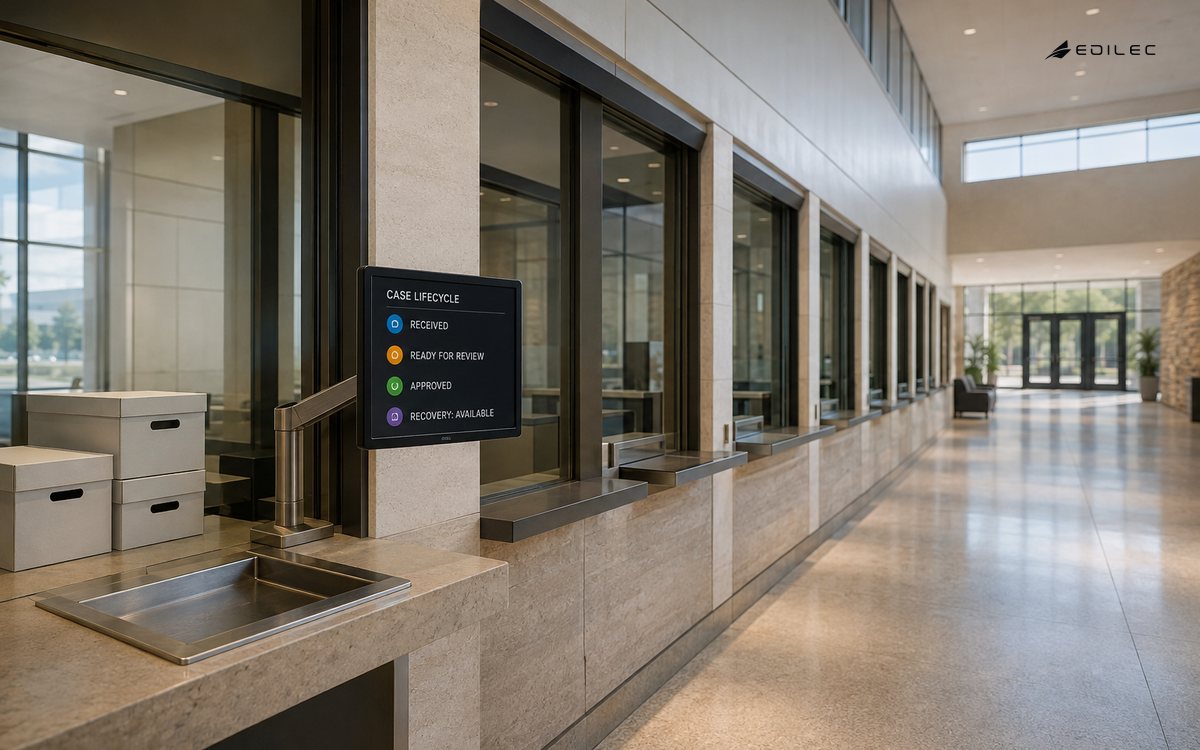
For example, digitizing equipment-service intake might begin with one validated request, triage decision, technician assignment, customer status, completion evidence, and exception queue. Do not automate the final technical judgment until the team has reliable inputs and review evidence. Apply WCAG 2.2 to the employee and customer interfaces, and use OpenTelemetry semantic conventions to make service events consistently observable. Edilec’s internal tools guide covers durable operational interfaces; the ERP, CRM and workflow integration guide addresses record authority; and the regulated-process checklist extends the controls where evidence requirements are higher.
| Observed moment | Planning decision | Acceptance evidence |
|---|---|---|
| Request arrives through several channels | Choose one case identifier and normalized intake record | Email, web, and phone examples create traceable cases without duplicate work |
| Triage depends on experience | Make decision inputs visible; retain accountable human choice | Operators explain priority from current evidence and record overrides |
| Approval waits in private messages | Create explicit owner, due time, delegation, and escalation | Delayed and absent approver scenarios route correctly |
| Data is copied into another system | Name record authority and synchronization direction | Conflict and retry tests reconcile without silent overwrite |
| A case must be reopened | Preserve history and define allowed state transitions | Correction changes the right fields without erasing prior evidence |
| Managers ask whether service improved | Define baseline, outcome and guardrail measures | Cycle time improves without higher rework or abandonment |
Key takeaways
- Frame business process digitization around a measurable outcome and one bounded end-to-end journey.
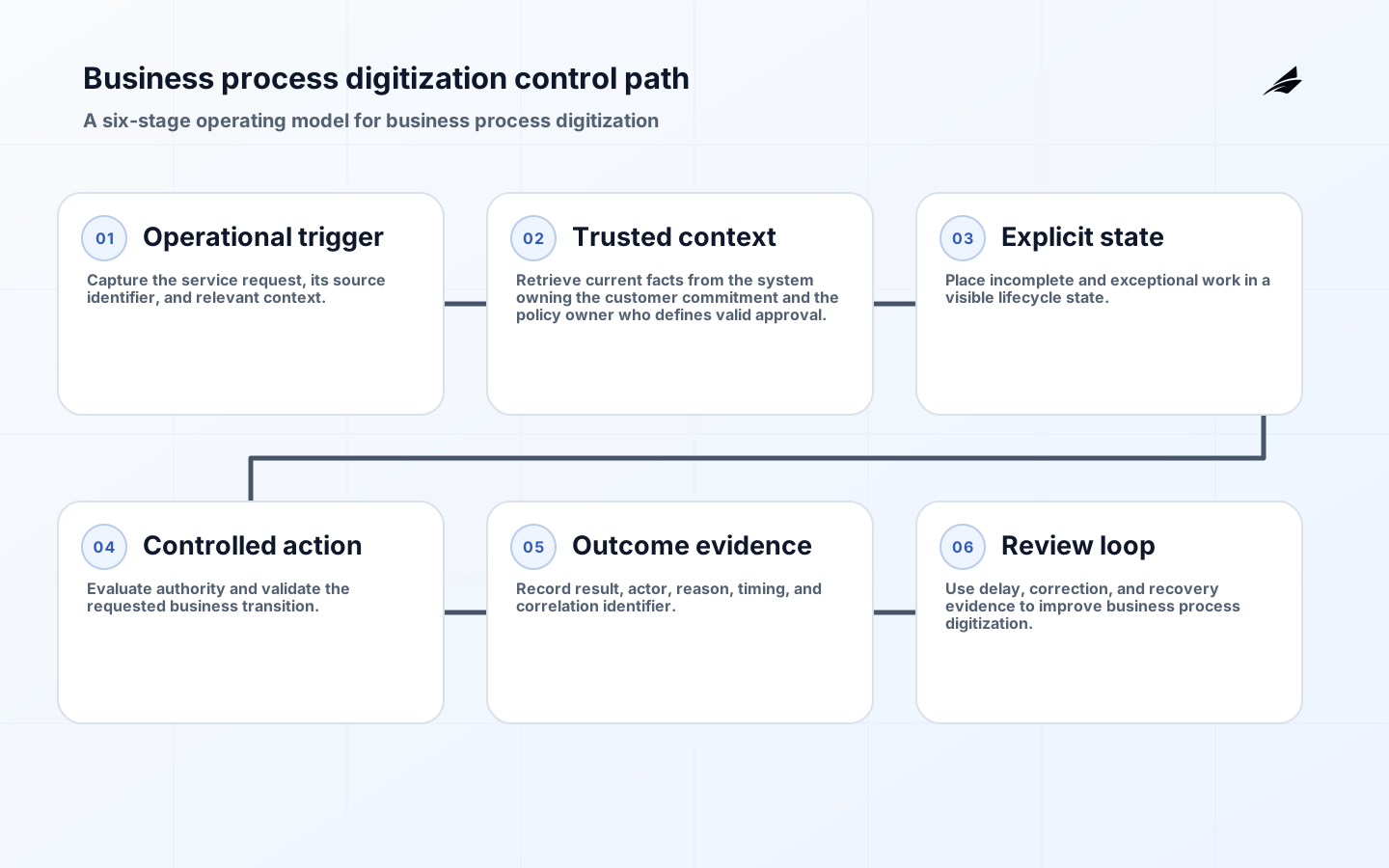
- Name the system owning the customer commitment and the policy owner who defines valid approval before designing copied data, automation, or interface polish.
- Model explicit states: received, incomplete, ready for review, approved, fulfilled, rejected, and recovery required.
- Enforce protected actions at the service boundary and preserve a recovery path.
- Release with representative service businesses and improve using observed exceptions, not opinions alone.
Define the business process digitization boundary
Write the outcome in plain language and make its boundary testable. For this work, that means turn an accepted service request into a completed, traceable outcome without re-keying information across inboxes and spreadsheets. Treat each service request as a working unit with a trigger, stable identifier, accountable owner, completion condition, and an understood error consequence. A boundary also names what is outside the first release. That protects the team when adjacent requests arrive from other parts of the organization. Review the boundary with intake staff, case owners, approvers, and service managers. Ask what evidence they need, which action they may take, and what happens when information is incomplete. The answer should be specific enough that a release reviewer can identify valid completion without interpreting a broad business aspiration.
| Question | Decision to document | Evidence to collect |
|---|---|---|
| Outcome | turn an accepted service request into a completed, traceable outcome without re-keying information across inboxes and spreadsheets | Baseline timing, rework, and named business owner |
| Working unit | A service request with stable identity and lifecycle | Recent normal and difficult cases |
| Authority | the system owning the customer commitment and the policy owner who defines valid approval | System owner, permitted editors, and policy reference |
| Completion | Durable result, visible confirmation, and recovery condition | Result record, receipt, and reconciliation rule |
| First release | One complete decision loop and its exceptions | Deferred work with owner and review date |
Model state, data, and authority
A state model prevents business process digitization from degrading into a collection of disconnected pages. Use states that explain what happened, what may occur next, who can act, and what is blocking progress: received, incomplete, ready for review, approved, fulfilled, rejected, and recovery required. Avoid a generic pending s…5540 tokens truncated…ine compatible reads and writes, and rehearse reconciliation before moving authority. Each initiative needs a measurable exit condition, such as a tested restore, a reduced deployment lead time, or an eliminated manual correction queue.
Build controls and evidence
Treat delivery safety as part of the roadmap. NIST’s Secure Software Development Framework is useful for making secure design, verification, release evidence, and vulnerability response regular work rather than a late review. Require automated checks that reflect the actual risk: contract tests for a changed integration, migration checks for data, and authorization tests for protected operations. Instrument both old and new paths with shared correlation identifiers. A rollback is credible only when the team knows what state it can reverse, what customer work must be reconciled, and who is authorized to decide.
| Condition | Control or test | Owner |
|---|---|---|
| New route is slower | Compare representative transactions and inspect traces. | Keep cohort small; tune or revert before expansion. |
| Data differs after migration | Reconcile identifiers, counts, and material values. | Pause authority transfer and repair with an audit trail. |
| Dependency fails during cutover | Exercise timeout, queue, and manual handling paths. | Route to an owned exception queue. |
| Parallel path persists | Set a dated ownership-transfer decision. | Retire it after evidence and sign-off. |
Roll out with real work
Sequence work so that learning arrives before the largest irreversible step. Start with observability, dependency mapping, and a thin adapter around the first constrained workflow. Run the new route for a controlled cohort where comparison is possible, and give support staff a clear escalation path. Avoid a permanent dual-write arrangement; it obscures authority and expands failure modes. Instead, set a date and evidence threshold for transferring ownership. The people who operate the system should attend release reviews, because their recovery knowledge often changes the safest order of work.
Measure and improve
Measure modernization as an operating improvement, not a percentage of code rewritten. Track customer task success, change failure rate, time to restore, aged operational exceptions, and the cost of keeping parallel paths alive. Pair aggregate measures with a review of representative incidents: a fast deployment that repeatedly produces bad account state is not progress. Revisit assumptions quarterly as product direction changes. A roadmap should be a living decision record, with completed risks retired, new constraints added, and deferred work still owned by someone.
Make the investment case from operating evidence
A modernization proposal needs an honest comparison with the work it displaces. Estimate the effort consumed by incident response, slow release preparation, manual reconciliation, supplier support, and delayed product decisions. Then identify the uncertainty in those estimates. A useful case does not promise that a new platform will eliminate all problems; it shows which recurring failure modes the team expects to reduce and how it will know. Include costs of transition such as training, temporary capacity, observability, and data reconciliation. Present several options, including stabilization without major replacement, so leaders can decide deliberately. This framing also protects engineering from being judged solely on delivery dates when it is actually reducing a reliability or change constraint.
Treat data as a migration program
Data migration should be planned as a business continuity activity. Establish a canonical identifier map, identify records that cannot be converted automatically, and specify the owner of every reconciliation difference. Validate both shape and meaning: a customer record can have all expected fields while carrying the wrong entitlement, timezone, or historical status. Decide whether a temporary read-only period, a queue drain, or a versioned compatibility layer is needed. The resulting runbook should include preconditions, checkpoints, abort criteria, and post-change sampling. This is where many roadmap estimates become more credible, because the cost of protecting customer history is finally visible.
Govern the roadmap without creating theatre
Use a monthly portfolio review to decide whether planned work still addresses the most material constraint. The review should examine outcomes, risk changes, capacity, and dependencies rather than only percentage complete. Ask whether a supposedly isolated replacement has created a new shared dependency, whether a vendor commitment has shifted, and whether recent incidents change the order of work. Record decisions, assumptions, and deferred risks in a form that future teams can inspect. Governance is successful when it makes a trade-off explicit early enough to change course, not when it produces a longer slide deck.
Set an operating cadence
Assign a named modernization sponsor for each journey, but do not make that person the owner of every technical detail. The sponsor resolves business trade-offs: whether a short maintenance window is acceptable, which customer cohort can participate first, and when a reduced feature set is preferable to a risky cutover. The architecture and service owners supply the dependency evidence that informs those choices. Establish a weekly working review during active migration, then reduce it to a monthly risk review after a capability stabilizes. Keep a short decision log that records the options considered, the evidence used, and the customer communication required. This makes later changes easier to govern when original project participants have moved on.
Implementation checklist
- Rank work by customer consequence, recoverability, and strategic change demand.
- Name an owner and exit evidence for every modernization initiative.
- Protect data authority before moving reads or writes.
- Instrument old and new routes with shared transaction context.
- Review incidents and operating cost as roadmap inputs.
Frequently asked questions
How much of a legacy system should be replaced at once? Replace only the smallest boundary that can improve a meaningful outcome while preserving an understandable recovery path. A complete rewrite may be justified when architecture, security, and operating model cannot be isolated, but that conclusion should follow evidence from dependencies, data movement, and delivery capacity. Most teams learn faster by proving one boundary and carrying that capability into the next.
Should modernization wait until growth slows down? No. Growth raises the cost of unstable deployments, ambiguous data ownership, and slow incident recovery. The sensible response is to reserve a visible share of delivery capacity for risks that threaten customer work, then explain the return in customer and operational terms. A roadmap that competes honestly with product work is more durable than an unfunded transformation wish.
Conclusion
A credible modernization roadmap gives leaders choices with consequences, not a decorative timeline. Bound the customer journeys, expose technical and operational risk, transfer ownership carefully, and use production evidence to revise the order of investment.