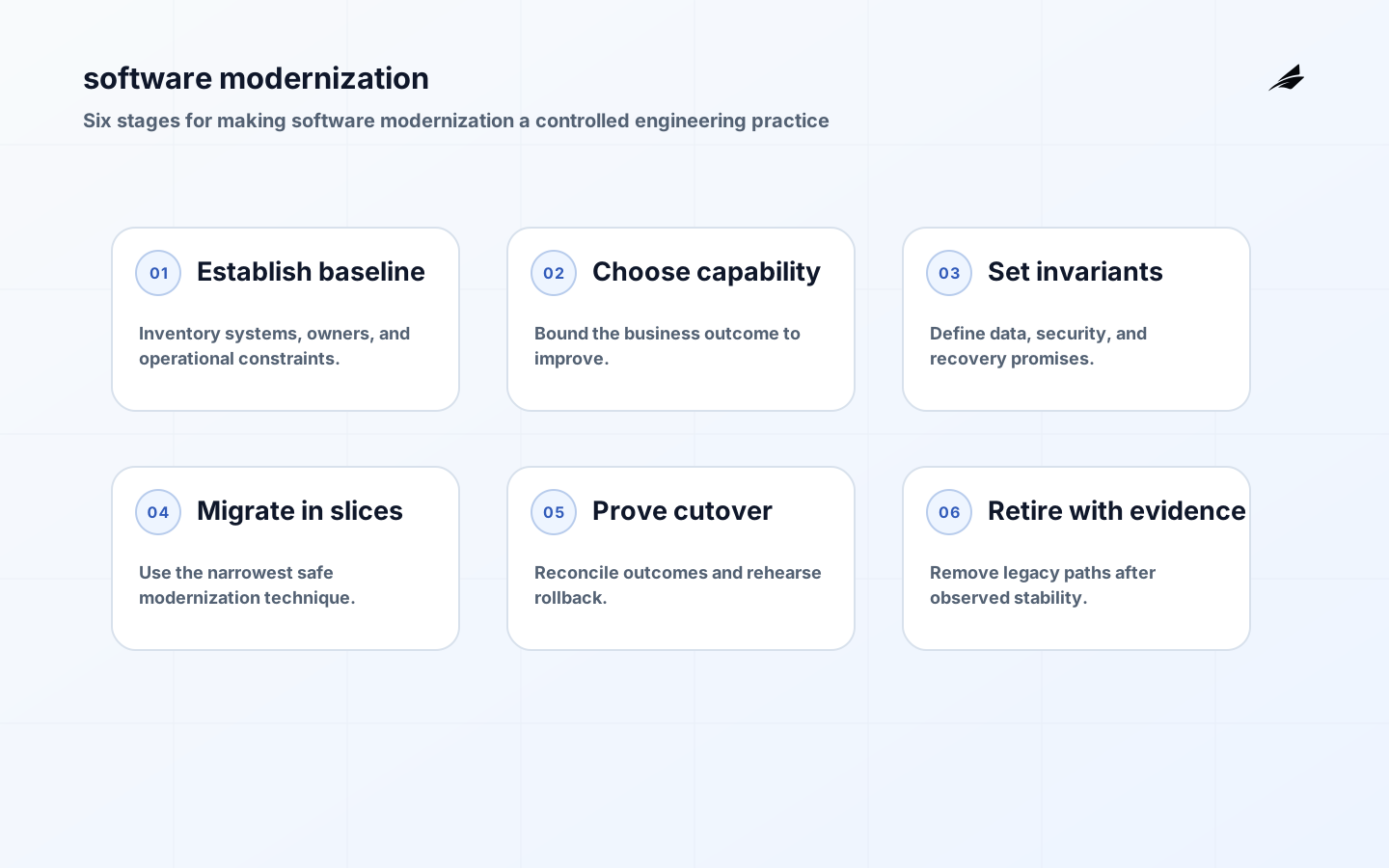
Software modernization is a change to an operating capability: how a system is secured, deployed, observed, integrated, and improved. Replacing a language or moving to a new hosting model may be part of that change, but neither guarantees a better outcome. A modernized application that loses its audit trail, introduces a larger recovery window, or cannot reconcile its data is not a success. Start with the business capability and the operational risks that make the current system hard to run.
Make software modernization an explicit operating decision
Build an evidence-backed baseline. Inventory services, data stores, integrations, owners, runtime versions, deployment path, recovery expectations, and known security obligations. Then identify a constrained capability, such as releasing a pricing rule without a weekend outage. AWS guidance on prioritization and migration strategy usefully frames modernization as a strategy exercise rather than a purely technical migration.
| Decision | Question to answer | Useful evidence |
|---|---|---|
| Target capability | What business operation must improve? | Baseline and outcome measure |
| Invariant | What behavior may not regress? | Migration gate and test |
| Migration path | What is the narrowest viable technique? | Bounded architecture decision |
| Retirement | When can the old path be removed? | Observed stability and rollback expiry |
Define the software modernization contract and boundaries
Set non-negotiable invariants before choosing a path: ledger totals reconcile, authorization decisions remain explainable, contractual data retention is preserved, recovery meets the agreed objective, and critical workflows have a support owner. Map those invariants to migration tests and cutover gates. NIST SP 800-218 provides a durable reference for integrating secure development practices as systems and suppliers change.
- Inventory runtime, data, integration, owner, and recovery dependencies.
- Choose one capability whose current constraint has a measurable consequence.
- Write security, data, and availability invariants before selecting technology.
- Select rehost, replatform, strangler, or rewrite based on the constraint.
- Test migration and reversal with representative data and failure cases.
- Observe the new path before retiring the old one.
Build and roll out software modernization in a bounded slice
Choose the narrowest technique that removes the material risk. Rehost can be sensible for an urgent infrastructure deadline. Replatform may improve operability while preserving behavior. A strangler pattern can replace a bounded capability behind a stable interface, while a rewrite is justified only when the existing boundary cannot support reliable incremental change. Create production-like data tests, run parallel reconciliation where appropriate, and rehearse rollback before user traffic is moved.
| Failure mode | Guardrail | Signal to monitor |
|---|---|---|
| Unknown dependency | Cutover breaks an unrecorded consumer | Inventory and traffic observation |
| Data divergence | Old and new calculations disagree | Parallel reconciliation |
| One-way cutover | Failure cannot be reversed safely | Rehearsed rollback |
| Modernized but unowned | New stack has no operating support | Named service and on-call owner |
Operate software modernization with evidence
Track error budget impact, recovery rehearsal results, deployment lead time, reconciliation mismatches, security patch exposure, and cost relative to the workload outcome. A migration is not done at cutover; it needs a period of heightened observation, clear escalation, and removal of the old path only after the new one has earned trust.
Make software modernization tradeoffs explicit
Avoid a broad 'cloud migration' or 'rewrite' program without owned slices. The most defensible roadmap sequences a few capabilities with shared enablers such as identity, observability, and data contracts. Infrastructure discipline matters here too; the monorepo structure guide explains how build and ownership boundaries can either support or undermine incremental modernization.
A concrete example keeps the design grounded. Suppose a claims application runs on an unsupported runtime and deploys through a manual overnight procedure. A useful first slice separates document upload behind a stable interface, adds automated deployment and tracing, and reconciles claims before and after the new path. Replacing every module at once adds uncertainty without improving the immediate constraint. Use the example to identify the authoritative record, expected outcome, failure that changes it, and operator who must choose the next action. That turns an architectural claim into a reviewable slice of production behavior.
Create a migration test pack containing authorization cases, representative data volume, partial-failure recovery, backup restoration, contract compatibility, and reconciliation totals. Run it where real identity and integration assumptions apply. A green unit suite cannot prove a migrated data flow preserves a financial or regulatory invariant. Keep evidence with the change: a reproducible command, expected telemetry, and a note about the failure being exercised. Checks should state the capability being protected, not merely mirror implementation details.
A modernization program needs a capability owner, service owner, data steward, security partner, and operations owner able to stop cutover. Vendors can add capacity, but accountability for an accepted risk and a business record must remain clear inside the organization. Agree on a review cadence and escalation route before the first exception arrives. The aim is a timely decision by someone with the right context, not a large committee or a static policy nobody can apply.
Use progressive traffic movement, shadow comparison, or parallel runs where the process permits. Define a pause threshold, a rollback authority, and a time limit for operating two paths. The old system must not become an unmonitored fallback that drifts beyond recovery. Publish entry and exit criteria for each step, including the condition that stops expansion. A narrow rollout gives a better learning loop because intended and observed behavior can be compared while scope remains correctable.
Track the original constraint and migration safety together: deployment lead time, recovery rehearsal time, reconciliation mismatch rate, error-budget burn, critical patch age, and operator effort. Cost matters when connected to a workload outcome, not merely because a new platform reports a lower bill. Ask what action each signal would justify. A metric without an owner, threshold, or practical response is not useful observability; a smaller trusted set is stronger during a release or incident.
After stabilization, remove unused credentials, infrastructure, batch jobs, dashboards, and documentation for the retired path. Record the final architecture decision and recovery procedure. Value remains only when the new operational model is simple enough for the next team to sustain. Include this in dependency review, planning, and incident follow-up so it does not depend on one person's memory. Clear notes should cover normal operation, known limits, emergency authority, and recovery evidence.
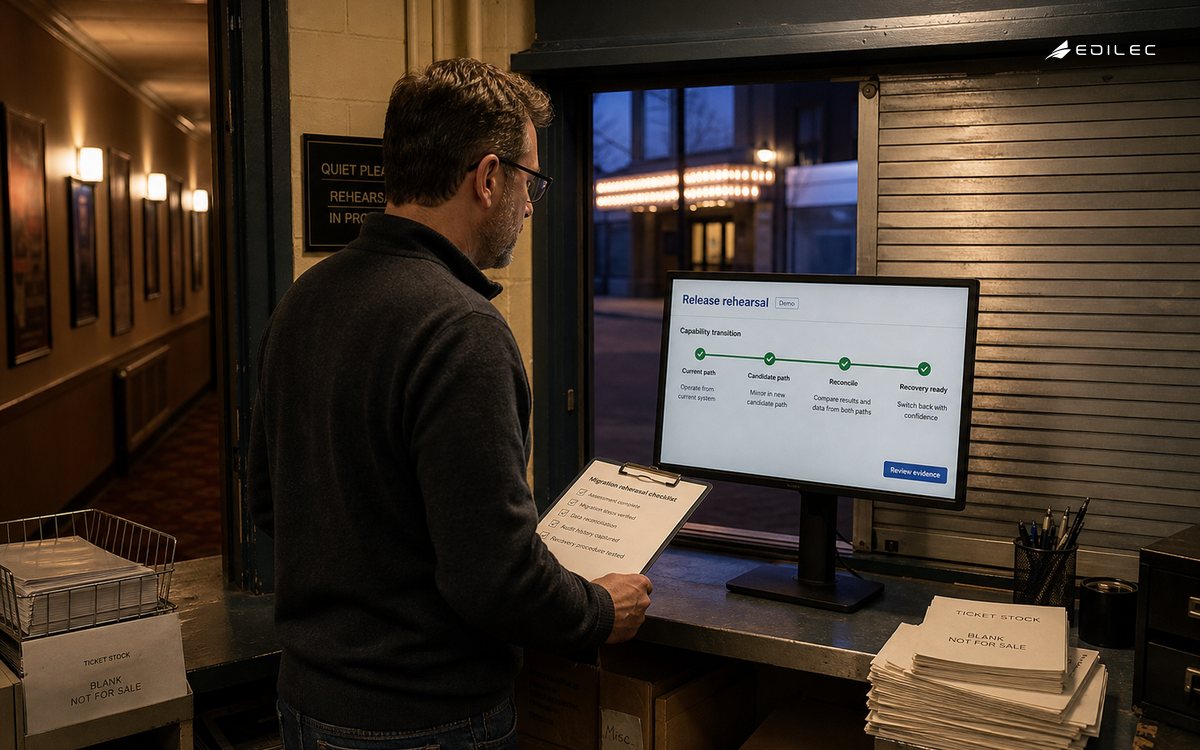
Before treating a plan as ready, turn it into a small review exercise. Use a representative business record to verify that migration preserves identifiers, authorization, calculated values, and recovery behavior across old and new paths. The exercise should name an owner, expected evidence, and a concrete result that would cause the team to pause. It is intentionally more demanding than a demo: demonstrations often assume ideal data and a cooperative dependency, while real confidence comes from showing that the boundary responds predictably when assumptions fail. Store the result with the relevant change record so the next engineer can repeat the check rather than reconstruct its purpose from an old ticket.
Failure rehearsals are a practical way to protect operational knowledge. Ask an on-call engineer to perform the cutover rollback from the runbook in a rehearsal, including evidence that downstream records reconcile. The person running the rehearsal should use ordinary documentation and permitted tools, not private memory or administrator shortcuts. Note the time needed to detect the condition, make a decision, and verify recovery. Those observations often reveal a missing identifier, unclear authority, or unsafe default before an incident turns the same omission into customer harm. Feed the learning back into tests, runbooks, and the next release rather than treating the exercise as a one-time audit.
Change needs a decision record as well as code or configuration. Record each migration wave's invariant results and residual risks so leaders can approve expansion from facts instead of a generic completion percentage. Include the scope, assumption, approval authority, observable success condition, rollback or correction route, and date for reconsideration. This discipline keeps temporary controls from becoming invisible permanent architecture. It also gives product, operations, security, and engineering a common artifact for resolving tradeoffs, which is far more useful than asking each group to infer intent from dashboards, implementation details, or an incomplete support history.
A portfolio roadmap should distinguish enabling work from migration waves. Identity, logging, release automation, and data-reconciliation tooling can unlock several applications, while each wave should still have a bounded business capability and recovery plan. This makes shared investment visible without allowing a foundation program to become an indefinitely deferred migration.
A completed wave should leave behind reusable tests, runbooks, and delivery controls. Those assets reduce uncertainty for the next capability and turn a one-off migration into a repeatable operating improvement.
Key software modernization takeaways
- Modernization is an operational improvement, not a technology refresh.
- A baseline inventory prevents false assumptions about dependencies.
- Invariants should become migration gates and tests.
- Incremental replacement reduces uncertainty when a stable boundary exists.
- Cutover is the start of an observation period, not the finish line.
- Legacy retirement needs as much evidence as the new release.
Software modernization FAQ
Must modernization mean cloud migration? No. It may mean improving supportability, security, or deployment while retaining a hosting model. When is a rewrite appropriate? When incremental change cannot satisfy critical invariants at an acceptable cost and the replacement scope is bounded. How do we protect data? Treat reconciliation, backup recovery, and cutover reversal as testable deliverables.
Conclusion: make software modernization dependable
Software modernization is credible when it improves a defined capability while preserving the records, controls, and recovery behavior the business depends on. Make invariants testable, migrate in owned slices, and keep evidence through the last legacy shutdown.