Business process digitization in a regulated environment is not the conversion of paper forms into screens. It is the redesign of an accountable process so policy, identity, decisions, records, signatures, system effects, exceptions, retention, and oversight remain reliable in software. The legal or regulatory obligation does not disappear when work becomes faster. A digital workflow can improve completeness and traceability, but it can also scale an incorrect rule, hide informal overrides, or produce records that are difficult to reconstruct if the control model is treated as an afterthought.
Start by identifying which obligations actually apply with qualified legal, compliance, records, security, and operational owners. This guide uses official materials such as 21 CFR Part 11 as an illustration of controls for electronic records and signatures; it is not a claim that every workflow falls under that rule. Record the jurisdiction, regulated activity, required record, decision owner, signature meaning, retention period, privacy purpose, and evidence expected during review. Translate each obligation into a testable system or operating requirement.
Map the obligation to the real operating process
Observe the current process from trigger through closure, including email, spreadsheets, calls, physical documents, system edits, supervisory review, and exception handling. Mark the authoritative source for every material fact and the point where responsibility changes hands. Separate policy from habit. A manual step may exist because an old system was limited, while an undocumented call may be the actual control that prevents harm. Do not automate either until its purpose and consequence are understood.
Create a control-and-record matrix. For each process step, specify the actor, required competence, permitted action, input, validation, decision rule, evidence, resulting record, downstream system, retention, and failure path. Include timing obligations and business calendars. If a reviewer must decide within two days, the software needs visible clocks, ownership, escalation, and evidence of delay; a reminder email alone does not establish control.
| Process element | Question to answer | Acceptance evidence |
|---|---|---|
| Obligation | Which rule or approved policy governs this step? | Mapped citation, owner, and interpretation |
| Actor | Who may perform or sign the action? | Current identity, role, qualification, and scope |
| Input | Which version and source are authoritative? | Validated fields, provenance, and completeness |
| Decision | What rule and judgment apply? | Policy version, rationale, and reviewer |
| Record | What must be retained and protected? | Chronology, integrity, access, and disposition |
| Exception | How is failure contained and resolved? | Owner, due time, escalation, and closure proof |
Design records, signatures, and provenance
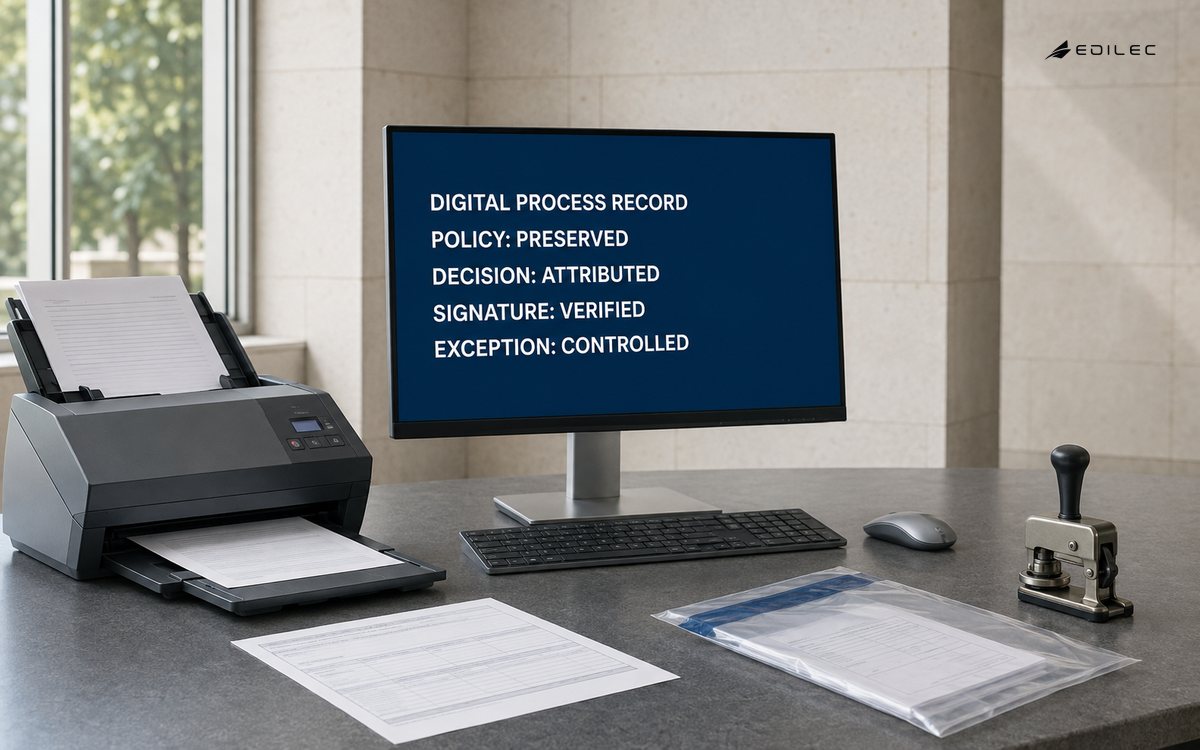
Define the record as more than its current screen. Preserve the material request version, source references, validation results, actor, decision, reason, signature meaning, timestamps, policy version, downstream outcome, corrections, and disposition. Keep chronology append-only where feasible and make corrections additive rather than silently replacing history. The W3C PROV overview provides a vocabulary for describing entities, activities, and agents, which can help architects reason about how a record was derived without requiring every application to implement the standard directly.
An electronic signature needs a defined meaning and binding to the record. Determine whether it expresses authorship, review, approval, acknowledgement, or another intent. Verify identity at the appropriate assurance, present the material record, require an intentional act, bind the signature to that version, and prevent later changes from appearing covered by the old signature. The FDA's Part 11 scope and application guidance explains its enforcement approach and the importance of predicate rules. Consult the relevant regulator and counsel for the actual implementation boundary.
- Preserve the original or authoritative input where policy requires it.
- Version material data before review or signature.
- Record the meaning of each signature and decision.
- Make corrections attributable and historically visible.
- Protect retention and legal holds from ordinary deletion.
- Define export formats that remain readable outside the application.
Build controls where the action can be enforced
Interface guidance is not a control if the API accepts the forbidden action. Enforce identity, role, separation of duties, record scope, process state, threshold, required evidence, and signature validity server-side. Re-read authoritative state when the command is submitted. Use the internal-tool RBAC checklist to design roles and assignment lifecycle, and treat elevated or emergency access as a time-bound exception with stronger evidence.
NIST SP 800-53 Rev. 5 offers a broad catalog of access control, audit, configuration, contingency, identification, integrity, and system-development controls. Select controls based on the workflow's obligations and risk rather than copying a checklist wholesale. For each selected control, identify implementation, owner, test method, evidence location, exception process, and review cadence. A policy statement without an operating owner is not an implemented control.
| Failure mode | Preventive or detective control | Recovery requirement |
|---|---|---|
| Wrong record version signed | Version lock and material-change invalidation | Reopen review with clear supersession |
| Unqualified actor | Current role and qualification check | Block action and route to eligible owner |
| Duplicate downstream action | Idempotent command and state guard | Reconcile before retry |
| Missing evidence | Required-field and source validation | Return to accountable preparer |
| Integration timeout | Durable delivery and unknown-state handling | Query destination before replay |
| Unauthorized record change | Least privilege and attributable history | Contain, investigate, correct, and notify |
Preserve a regulated evidence chain
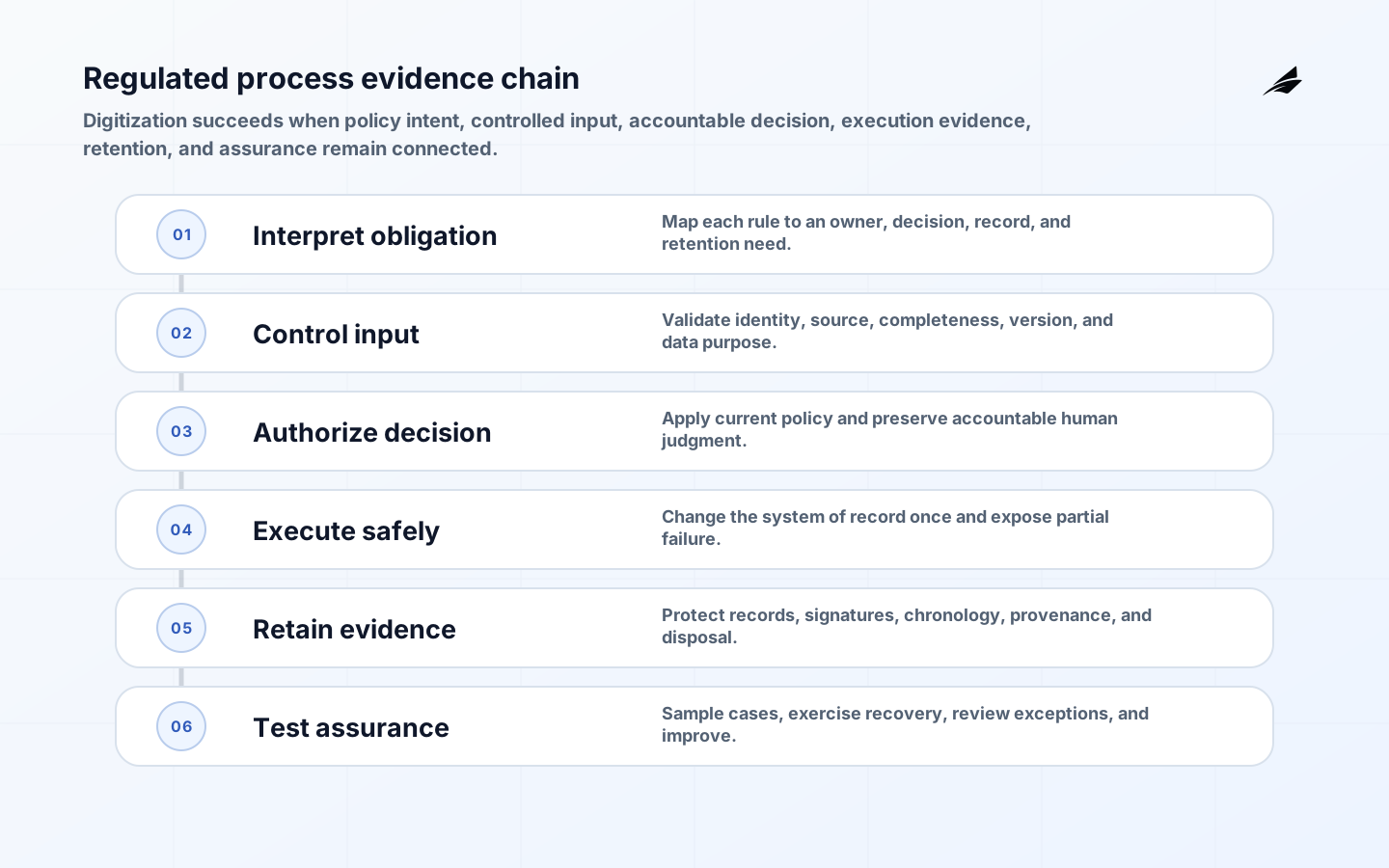
The evidence chain connects policy intent to the final business effect. A reviewer should be able to reconstruct which rule applied, which record version was considered, who acted under what authority, what the system changed, and whether an exception occurred. This does not mean collecting every possible event. Define evidence purpose, access, integrity, retention, and disposal so the audit trail itself does not become an uncontrolled store of personal or confidential data.
Validate the system and release a controlled slice
Validation should show that the configured system consistently supports its intended use. Build traceability from requirement to design, implementation, test, result, deviation, and approval. Test normal cases and hard failures: incomplete input, stale policy, removed qualification, self-approval, concurrent edit, inaccessible attachment, duplicate submission, dependency outage, partial fulfilment, correction, retention hold, export, restore, and disaster recovery. Use representative users and records, including accessibility needs.
Release one process family or risk-bounded cohort. Reconcile old and new paths daily and define which system is authoritative during transition. Migrate records with source counts, transformation rules, validation, exceptions, and sign-off. Do not run two editable masters indefinitely. The ERP, CRM, and workflow integration guide explains record authority, integration contracts, and reconciliation. Train people on decisions and exceptions rather than only on button placement.
Operate policy change, retention, and assurance
Regulated workflows change when rules, products, organizations, integrations, and interpretations change. Version policy and configuration, assess impact, test representative cases, approve the release, communicate the effective date, and retain the previous behavior where required for reconstruction. Separate configuration that changes control behavior from ordinary content. Emergency changes need retrospective review and a plan to remove temporary bypasses.
Third-party platforms and service providers do not remove accountability. Record which party hosts records, manages identity, changes configuration, performs support, operates backups, and supplies evidence. Review contractual access, incident notification, subcontractors, data location, export, retention, and termination. Test whether the organization can retrieve complete records and continue critical work during an outage or provider transition. Restrict vendor support access to named, time-bound sessions and include it in the same audit and review path as employee access. Reassess the supplier when the workflow, data class, or service architecture changes materially.
Records management continues through disposition. The U.S. National Archives records-management policy resources illustrate the discipline of schedules, ownership, and lifecycle management. Define retention by record class and jurisdiction, preserve legal holds, restrict deletion authority, verify backups, test readable export, and document defensible disposal. Retaining everything forever increases privacy, security, discovery, and operational risk.
Measure control effectiveness and process health
Track incomplete submissions, validation failures, time by state, overdue reviews, conflicting duties blocked, expired qualifications, missing evidence, signature failures, integration exceptions, reconciliation gaps, corrections, emergency access, policy versions in use, and record-disposition backlog. Segment by process, risk, team, and rule version. A falling cycle time is valuable only when error, exception, and control-failure rates remain acceptable.
Conduct periodic case sampling with compliance, operations, security, records, and product owners. Walk from source evidence to final outcome and ask whether an independent reviewer can understand the decision. Exercise restoration and continuity, not just backups. Review whether automation has displaced meaningful human judgment or created alert fatigue. Use incidents, near misses, appeals, and recurring manual work to improve both policy and implementation. The approval workflow software guide provides a detailed transaction model for controlled decisions.
Key takeaways
- Digitization must preserve the purpose of each obligation and control.
- Records include provenance, decisions, signatures, outcomes, corrections, and disposition.
- Authorization and process-state rules belong at the enforceable service boundary.
- Validation connects intended use to objective test evidence.
- Migration, exceptions, recovery, retention, and policy change are part of the design.
- Measure control effectiveness together with speed and user effort.
Frequently asked questions
Must a digital process reproduce the paper form exactly?
No. Preserve required information, intent, decisions, and evidence, but redesign interaction for validation, accessibility, and clear workflow. Confirm with the applicable owner which layout or record characteristics are legally significant.
Is a typed name an electronic signature?
That depends on the applicable law, policy, identity assurance, intent, and binding to the record. A signature implementation should establish who acted, what they signed, what the act meant, and whether the record changed later.
Does every update require full revalidation?
Use documented impact and risk assessment. Test affected requirements and regression paths proportionately, while preserving configuration, code, data, and release evidence. High-impact control changes need stronger review than cosmetic changes.
Conclusion
Regulated business process digitization succeeds when software makes control more explicit, not less visible. Map obligations to real work, protect authoritative records, bind decisions and signatures to the right version, enforce rules at the service boundary, reconcile downstream effects, and maintain evidence through retention and review. Release a bounded process, validate normal and failure paths, and keep policy owners involved after launch. That creates a digital service that can be faster while remaining explainable and accountable.