Software modernization roadmaps should make a risky system easier to change without interrupting the business it already supports. That requires more than a list of frameworks, cloud services, or target dates. A legacy application usually contains business rules, data authority, interfaces, scheduled jobs, manual workarounds, and recovery knowledge that are unevenly documented. The roadmap must identify those capabilities, select a measurable slice, define how old and new paths coexist, and state what evidence permits traffic or responsibility to move. A full rewrite can be justified in rare cases, but defaulting to one hides migration risk until the final cutover. This guide presents an incremental planning method that preserves continuity while improving security, delivery speed, observability, and ownership one bounded capability at a time.
The roadmap should align secure delivery with the NIST Secure Software Development Framework, application controls with OWASP ASVS, observability with the OpenTelemetry specifications, and performance learning with the DORA research program. AWS also documents the Strangler Fig pattern for incremental replacement with controlled coexistence. Edilec’s guides to custom software discovery, API platform design, and quality assurance for custom systems help turn those principles into deliverable slices.
Design the coexistence period as a first-class product state
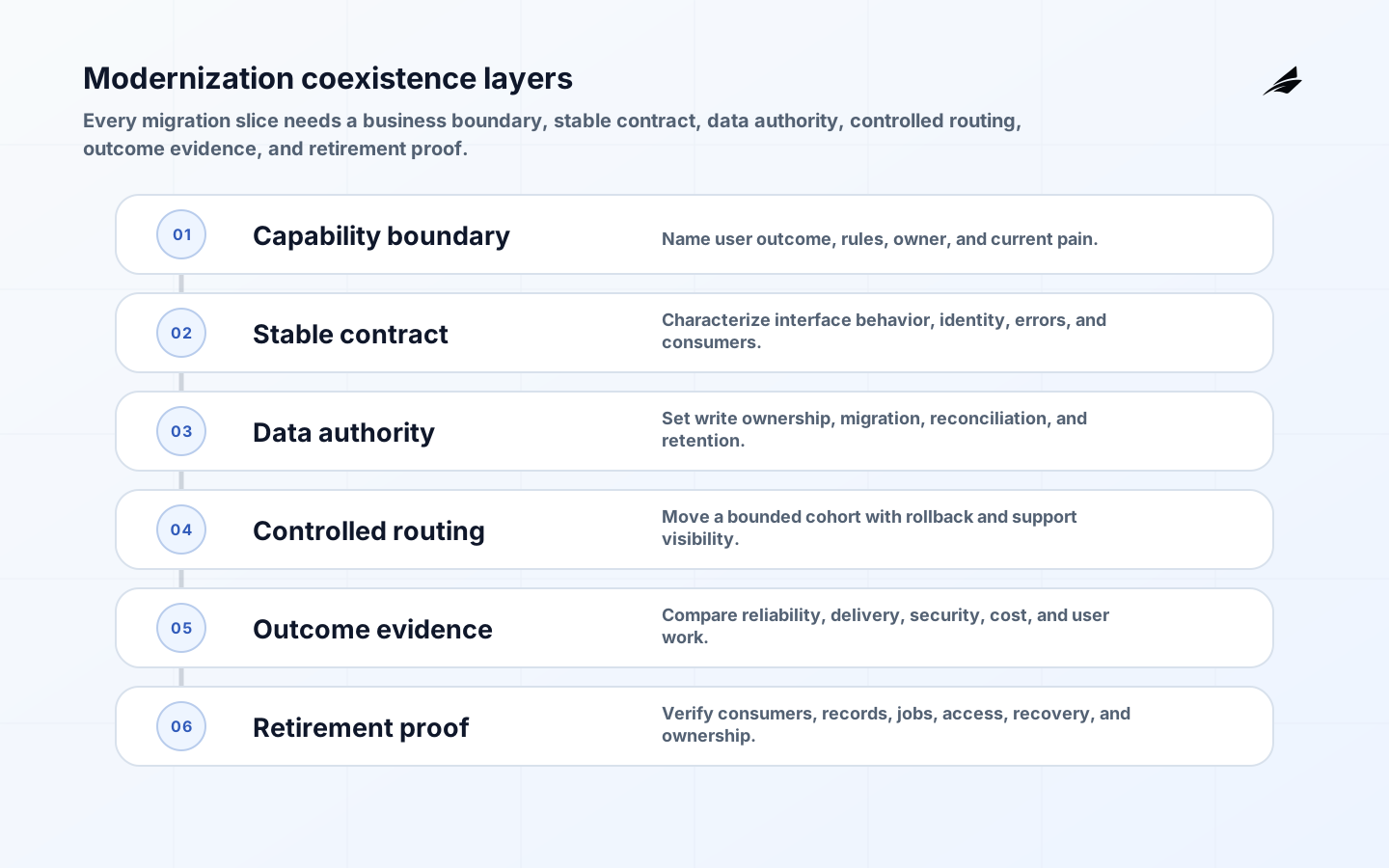
Most modernization failures occur between “new component works” and “legacy component is retired.” During coexistence, decide which route serves each user or transaction, where the authoritative write occurs, how results are compared, and how support can identify the path that handled a case. The AWS strangler fig guidance describes incremental replacement through a routing boundary; the useful idea is not that every system must become microservices, but that change can be isolated behind a stable contract. A modular component inside a monolith, a managed platform replacement, or a new service can all use the same discipline. The important property is that a slice can be released, observed, reversed, and judged independently.
Create a cutover sheet for each slice. It should name the business capability, current owner, new owner, consumers, data authority, compatibility rule, migration mechanism, baseline measures, rollback trigger, reconciliation query, and retirement evidence. Rehearse failures while both paths exist: delayed events, duplicate writes, stale reads, partial data migration, and a consumer that still calls the legacy endpoint. DORA research is helpful for measuring delivery and operational performance, but roadmap governance also needs business signals such as case completion, reconciliation differences, support burden, and policy exceptions. A modern platform is not an outcome if customers experience more errors or operators need two consoles indefinitely.
| Roadmap gate | Evidence required | Decision |
|---|---|---|
| Capability baseline | Users, rules, data, dependencies, failures and cost | Keep, retire, replace, replatform or refactor |
| Slice design | Boundary, contract, owner, security and observability | Approve a bounded implementation |
| Coexistence readiness | Routing, authority, reconciliation and rollback | Expose limited traffic or users |
| Outcome review | User result, defects, reliability, cost and support load | Expand, revise or return traffic |
| Consumer migration | Usage evidence and compatibility status | Remove legacy interface support |
| Retirement | Records preserved, access removed, jobs stopped, recovery updated | Decommission the old path |
Key takeaways
- Build a factual landscape of capabilities, data, dependencies, and ownership before choosing a migration pattern.
- Prioritize slices by business risk, change frequency, and recoverability rather than code age alone.
- Preserve data authority and reconciliation rules while old and new paths coexist.
- Instrument baseline behavior so migration success can be measured, not assumed.
- Retire a legacy path only after consumers, support, and records have been verified.
Build a modernization baseline
Create a landscape that business and technical owners can read. List the capabilities the system supports, the users who depend on them, the databases and files involved, inbound and outbound interfaces, scheduled processes, access boundaries, and known support burdens. Include the manual work that begins when a dependency fails. This exercise should use evidence from production behaviour, support tickets, and experienced operators, not only diagrams from a previous project. Mark data sensitivity, transaction volume, change frequency, and outage consequence. A baseline is not an inventory for its own sake; it allows a sponsor to compare modernization candidates and see why a seemingly small component may carry high risk because it connects several critical flows.
| Candidate slice | Value signal | Migration concern |
|---|---|---|
| Customer intake | Frequent rework and slow response | Validation must match existing policy |
| Reporting extract | Manual reconciliation effort | Metric definitions and historical continuity |
| Partner interface | High support volume | Compatibility and consumer migration |
| Authentication boundary | Security exposure | Session transition and account recovery |
Choose modernization slices
A useful slice has a business outcome, a limited dependency boundary, and a way to compare old and new results. Prefer a capability that can be placed behind an interface or introduced beside the existing path. Do not assume that an extract, replace, or rehost pattern is universally right. Rehosting can buy time; replacing a bounded workflow can improve user experience; rebuilding a core rule can be dangerous if the policy is poorly understood. Rank candidates with explicit criteria: customer impact, compliance risk, rate of change, current failure burden, technical feasibility, and rollback ability. The ranking discussion is valuable because it exposes whether the organization is optimizing for speed, assurance, cost, or learning.

Protect data and contracts
Parallel operation is often the hardest part of modernization. Decide which system is authoritative for each business fact during every phase, how changes are synchronized, and how a discrepancy is detected and resolved. Avoid uncontrolled dual writes; they make failures difficult to explain. Stable identifiers, versioned events, and a clear reconciliation owner matter more than an elegant diagram. Existing consumers may depend on response fields, timings, or undocumented error handling, so characterize the current interface before changing it. RFC 9110 is a sound reference when reviewing HTTP behaviour. Where sensitive data crosses the new boundary, use OWASP ASVS to review authorization, validation, secrets, and logging requirements.
| Coexistence decision | Rule | Check |
|---|---|---|
| System of record | Name one authoritative writer per fact | Reconciliation report and owner |
| Read migration | Compare selected results before switching traffic | Mismatch rate and sampled investigation |
| Write migration | Use an explicit command path and idempotency | Duplicate and failed delivery tests |
| Interface retirement | Measure consumer adoption before removal | Consumer inventory and deprecation notice |
Make risk visible
A roadmap should show more than dates. Record assumptions, unresolved policy questions, dependency commitments, security concerns, data quality gaps, and rollback triggers for each increment. Treat knowledge held by one long-serving employee as a delivery risk: capture examples, decision rules, and failure recovery while the legacy path is still running. NIST SSDF provides useful practices for secure requirements, supplier controls, code integrity, and verification. Keep risk reviews tied to a specific slice so mitigation leads to an action, such as building a reconciliation report or running a disaster-recovery exercise, rather than becoming a permanent red item on a programme dashboard.
Measure before, during, and after
Measure the current path before changing it. Depending on the outcome, track completion time, error rate, manual touches, incident frequency, recovery time, cost per transaction, or customer abandonment. Instrument the old and new paths with comparable correlation identifiers where possible. The OpenTelemetry Specification offers a common model for linking traces, logs, and metrics across services. During rollout, watch discrepancies, latency, failed retries, and support contacts alongside business measures. DORA research encourages teams to connect delivery performance with outcomes; for modernization, that means asking whether safer deployments and better reliability are also improving the work customers and staff experience.
Use gates to keep modernization increments honest
Treat each gate as a conversation about evidence, not a calendar milestone. A team should be able to show which facts came from production observation, which are assumptions, and which risks remain open. For a selected slice, ask the legacy support team to demonstrate a difficult case and its recovery path; the new design must preserve the business outcome even if its technical implementation differs. Require an explicit rollback decision before traffic moves, including who makes the call and how duplicate work is prevented. Keep the gate materials small enough to review regularly: a capability map, risk list, contract note, comparison report, and ownership record are more useful than a giant programme binder. This discipline protects against the seductive claim that a new component is complete when its surrounding data, consumers, and support duties are not.
| Gate | Question before proceeding | Evidence required |
|---|---|---|
| Landscape | Do we understand the capability and its dependencies? | Current behaviour, owners, interfaces, and support history |
| Value | Which business risk or constraint does this slice reduce? | Baseline measure and sponsor-confirmed outcome |
| Data | Who remains authoritative while paths coexist? | Written source-of-truth and reconciliation decision |
| Contract | Which consumers depend on current behaviour? | Consumer list, compatibility tests, and notification approach |
| Security | Does the new boundary preserve or improve controls? | Authorization, secret, logging, and access-review evidence |
| Migration | How will traffic or records move without silent loss? | Cohort plan, idempotency, comparison report, and rollback |
| Operations | Can support diagnose an issue in both paths? | Runbooks, telemetry, escalation owner, and safe access |
| Performance | Does the new component meet realistic workload needs? | Load profile, observed limits, and capacity response |
| Acceptance | Can real users complete the selected outcome? | Representative cases and process-owner sign-off |
| Coexistence | What discrepancy rate triggers intervention? | Threshold, investigation owner, and communication route |
| Retirement | Are all consumers and records safely accounted for? | Usage evidence, retention plan, and credential removal |
| Learning | What changed in the next roadmap choice? | Increment review with updated assumptions and priorities |
Retire deliberately
Retirement is a project phase, not an administrative afterthought. Before turning off a legacy route, verify that all consumers have migrated, historical records remain accessible for their required period, support staff know the new recovery procedure, and access is removed from the old environment. Archive configuration, runbooks, key decisions, and evidence needed for audit or investigation. Revoke unused credentials and monitor for unexpected traffic after shutdown. A clean retirement removes operating cost and attack surface; a rushed one leaves an emergency dependency waiting to surface. Close each roadmap increment with a review of what was learned and how it changes the sequence of the next slice.
Frequently asked questions
When is a full rewrite justified?
A full rewrite may be justified when the current system cannot safely support necessary change and its boundaries are too entangled for incremental replacement. Even then, preserve learning from real workflows, data, and interfaces, and plan coexistence and migration as carefully as the new build.
What is the first success measure for a modernization roadmap?
Choose a measure tied to the selected business risk, such as fewer failed submissions, faster recovery, reduced reconciliation, or safer deployments. Milestones and cloud spend are useful management signals, but they do not demonstrate that the changed capability is more dependable for its users.
Conclusion
Software modernization roadmaps work when they turn a large legacy problem into accountable, measurable increments. Know the current landscape, choose a bounded capability, guard data and consumers during coexistence, and retire old paths with evidence. That is a far steadier route to modern systems than a rewrite promise alone.