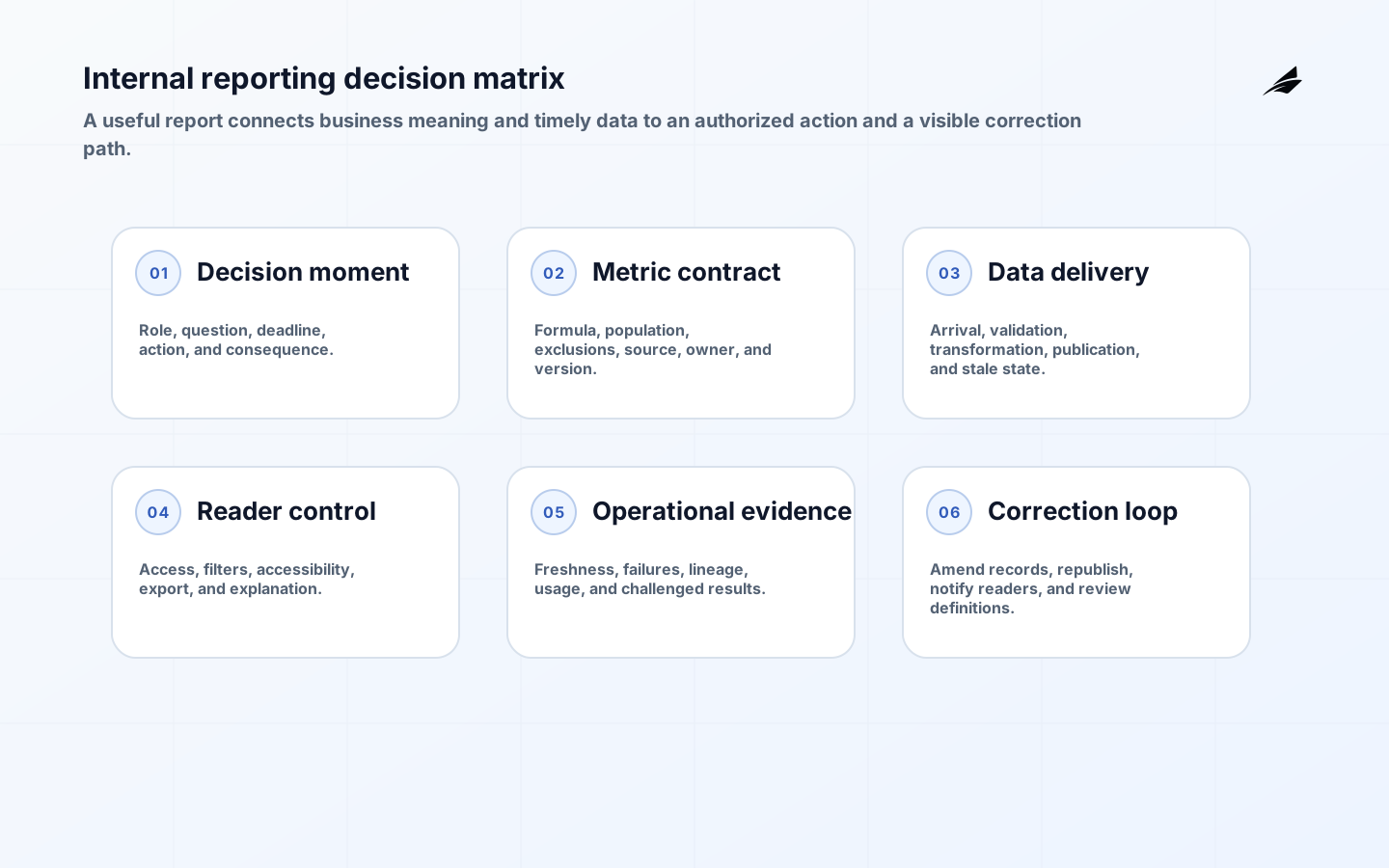
Internal reporting tools should reduce uncertainty around a recurring decision. They should not begin as a collection of charts or a request to reproduce every spreadsheet. Before development, define who will use the report, what decision they make, the time window in which the information remains useful, the population included in each metric, and the action that follows an exception. That decision contract determines source data, calculation rules, freshness, access, interaction design, exports, observability, and ownership.
Start with the decision the report must support
Write each material metric as a contract: business meaning, numerator, denominator, exclusions, time zone, source, transformation owner, publication schedule, and response when data is incomplete. A weekly staffing report and an intraday fraud queue may use similar counts but need different latency, confidence, and escalation. The OpenTelemetry observability primer explains how traces, metrics, and logs reveal system behavior; reporting products also need business-level telemetry for source arrival, transformation completion, publication age, query errors, and export failures. These signals should answer why a report is late or changed, not merely whether its page loaded.

Design interpretation and access together. WCAG 2.2 covers perceivable content, keyboard use, focus, labels, and programmatically determinable status messages that matter in filters and asynchronous refreshes. OWASP ASVS provides a basis for verifying authentication, authorization, validation, logging, and data protection. The NIST Secure Software Development Framework keeps these controls connected to the development lifecycle. Test with late data, empty populations, revised records, revoked access, large exports, narrow screens, keyboard-only navigation, and users who challenge a number.
| Planning question | Required answer | Design consequence |
|---|---|---|
| What decision follows? | A named role chooses, investigates, approves, or escalates. | Prioritize the smallest views and actions needed for that moment. |
| What does the metric mean? | Formula, population, exclusions, owner, version, and effective date. | Store definitions with the result and expose them to readers. |
| How fresh must it be? | A decision-based objective and visible stale-data behavior. | Choose ingestion, caching, refresh, alert, and fallback paths. |
| Who may inspect or export? | Role, tenant, row, field, and purpose constraints. | Enforce access server-side and audit sensitive exports. |
Key takeaways
- Start each report with a decision, reader, cadence, and action threshold.
- Define metric grain, inclusion rules, source ownership, and freshness before visual design.
- Show quality and reconciliation status alongside measures that drive intervention.
- Protect sensitive reports and exports with contextual access controls.
- Treat reports as maintained operational products with feedback and retirement decisions.
Define the decision and metric contract
Write a metric contract in ordinary language before calculating it. State the business question, numerator, denominator, grain, time boundary, exclusions, source records, owner, and refresh expectation. For example, an on-time completion rate needs a definition of completion, the promised date, treatment of cancellations, and a rule for late-arriving events. Ask the future reader what action changes when the number moves. If no action follows, the metric may be interesting but not operationally useful. Give definitions stable names and version them when policy changes. This prevents a common reporting failure: two teams use the same label for different calculations and then debate whose spreadsheet is right instead of resolving the decision at hand.
| Metric element | Question to settle | Visible signal |
|---|---|---|
| Grain | What does one row represent? | Label such as one order or one account-month |
| Freshness | When did source processing complete? | Timestamp and delayed-source notice |
| Exclusion | Which records are intentionally omitted? | Definition link or concise note |
| Owner | Who resolves a definition dispute? | Named team and review route |
Design the data path
Map the data path from source event to report result. Register each source system, its owner, identifier, event time, extraction method, and expected delivery pattern. Decide whether the report needs a snapshot, an incremental model, or a query against an operational store; the decision should reflect workload and risk, not a fashionable stack. Preserve raw or reconciled evidence long enough to investigate a surprising result, while limiting sensitive data to the minimum needed. Build checks for record counts, duplicate keys, missing values, changed distributions, and delayed feeds. The report should tell its reader when a quality check is failing instead of quietly presenting an apparently exact number. A trusted blank or warning is better than false confidence.
Make interpretation safe
Design presentation to reduce plausible mistakes. Put the period, scope, freshness, and comparison basis near the number. Avoid implying causal conclusions from a simple trend. When a ranking drives intervention, make the underlying criteria and drill-through records available to authorized users. Tables are often more useful than a chart for a manager who must compare exact values or identify a case owner. Ensure filters state what they changed and preserve their meaning in shared links or exports. WCAG 2.2 helps with contrast, keyboard operation, programmatic labels, and non-colour cues. Test the report with people who must make the decision, not just the team that built the metric.
| Reader task | Interface choice | Failure to avoid |
|---|---|---|
| Spot an exception | Sorted table with owner and age | A chart that hides the actionable record |
| Compare periods | Aligned values and explicit date ranges | Mixing partial and complete periods |
| Investigate movement | Drill-through to permitted evidence | A metric with no explainable source |
| Share a result | Controlled export with context | Detached spreadsheet without definitions |
Control access and exports
Reporting often brings together data that was appropriately separated in source systems. Define access at the report, row, field, and export levels where needed. A regional manager may view aggregated performance for all regions but detailed cases only for their own. Enforce that rule in the query path, then test direct access to filtered URLs and exports. The OWASP Application Security Verification Standard offers useful requirements for access control, session handling, and logging. Record significant exports with the actor, scope, time, and purpose where policy requires it. Keep the experience usable; a secure report that forces legitimate users into shadow spreadsheets simply moves the risk elsewhere.
Operate for freshness and change
Reporting needs production signals just like any other service. Monitor source arrival, pipeline duration, schema change, failed quality checks, refresh completion, query latency, and unusual export activity. Use common identifiers in source events and processing logs so an analyst can trace a disputed result. The OpenTelemetry Specification can provide a consistent approach to traces, metrics, and logs. Assign owners for incidents and definition changes, and communicate a data delay before executives discover it themselves. A small, visible quality panel in the report can prevent decisions based on an incomplete refresh. It turns freshness from an invisible engineering detail into usable business context.
Review whether a report deserves operational trust
Schedule a regular trust review with both the metric owner and a person who uses the report to act. Select several values, trace them to source records, and confirm that the definitions still match the current business policy. Examine a delayed refresh or deliberately malformed input so readers and operators know what warning they will see. Ask whether any spreadsheet export has become a shadow source for a decision; that may indicate missing context, inaccessible detail, or an access rule that no longer fits the job. When the report changes, communicate the impact in the same place people consume it, including the effective date and whether prior periods are comparable. Trust is maintained through this small operational habit, not through a one-time data-model sign-off.
| Trust question | Question to ask | Evidence for the reader |
|---|---|---|
| Decision | What action should this report enable this week? | Named decision, owner, cadence, and intervention threshold |
| Definition | What exactly is counted or compared? | Metric contract with grain, exclusions, and version |
| Lineage | Where did this value originate and when? | Source owner, timestamps, and drill-through route |
| Completeness | Could delayed or missing feeds change the result? | Visible quality checks, delay notices, and reconciliation status |
| Scope | Which organisations, periods, or records are included? | Filter summary and plain-language scope label |
| Access | Who may view rows, fields, or exports? | Enforced access rule and export receipt where needed |
| Interpretation | What conclusion would be unsafe from this view? | Context note, comparison basis, and limitation guidance |
| Change | How are definition or source changes communicated? | Version history, owner, and affected report notice |
| Performance | Can users inspect a busy report without timeouts? | Query limits, pagination, and observed response behaviour |
| Support | Who resolves a disputed number? | Metric owner, incident route, and investigation procedure |
| Adoption | Are decisions replacing private spreadsheets? | User feedback, export patterns, and recurring questions |
| Retirement | When should an obsolete report disappear? | Usage evidence, replacement decision, and archived definition |
Release and maintain the product
Release a report with representative data, documented definitions, access review, and a feedback route. Compare the first results with existing operational evidence and investigate material differences before claiming a replacement. Use NIST SSDF practices to protect implementation and verify changes. Review adoption through decisions made, recurring questions, manual exports, and data-quality incidents, not simply visits. DORA research is a useful reminder that delivery health and organizational outcomes should be considered together. Retire reports that no longer serve a decision, and preserve their definitions when history still matters. An internal reporting tool remains credible only while its meaning remains maintained.
Frequently asked questions
What does a single source of truth mean for reporting?
It means each fact has a named authoritative owner and the report states how it derives its result from that authority. It does not require all data to live in one database. A governed reporting model can combine sources when lineage, timing, and reconciliation are explicit.
When is real-time reporting worth the complexity?
Use it when the reader must safely act within a shorter interval than a scheduled refresh permits, such as active incident response or capacity dispatch. Otherwise, prioritize reliable definitions, freshness visibility, and reconciliation. A dependable hourly report can be more useful than a fragile live feed.
Conclusion
Internal reporting tools should make a consequential decision clearer, not merely make more data visible. Set the metric contract, build a controlled data path, show quality and scope, and maintain access and definitions over time. That is the work that turns reporting into dependable operational evidence.