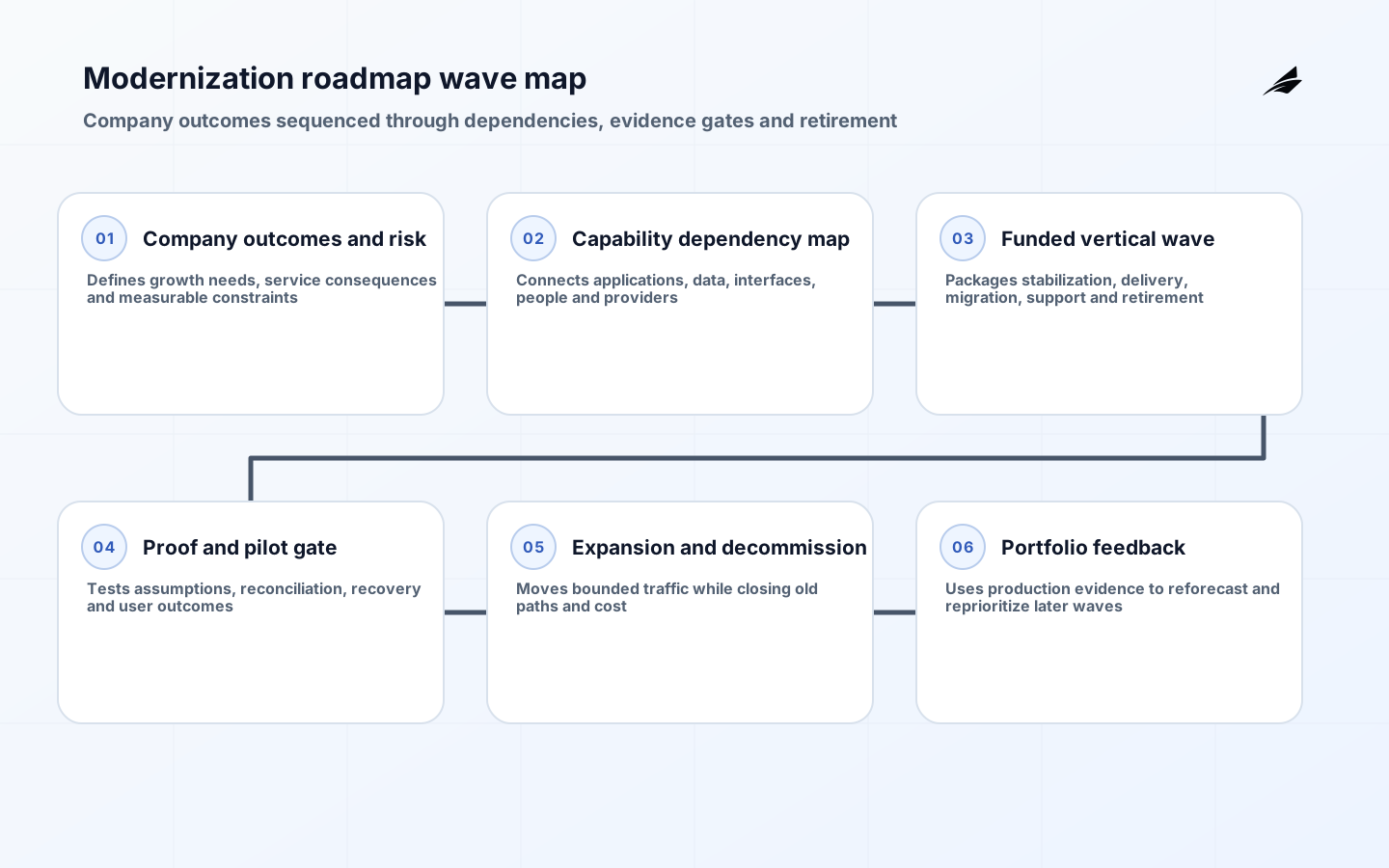
A software modernization roadmap is a sequence of funded decisions that reduces business and engineering constraints while current services continue to run. It is not a color-coded application inventory or a promise to move everything to one platform. Growing companies need a roadmap that balances customer commitments, security exposure, unsupported technology, delivery speed, operating cost and limited specialist capacity. The plan should show why each wave exists, which dependency it unlocks, what evidence will permit expansion and what legacy cost or risk will actually end.
Start with company outcomes and risk
Translate strategy into service needs: enter a region, support larger customers, release pricing changes safely, improve recovery or reduce reliance on one engineer. Define the affected user and operational journeys and the consequence of failure. Baseline relevant measures such as change lead time, incident impact, recovery, support effort, capacity, security findings and infrastructure cost. Avoid universal maturity scores. A system can be old yet stable and well controlled, while a newer service can be the real growth constraint.
Create a risk register tied to services, not abstract technology labels. Include unsupported components, concentrated knowledge, data integrity, access, resilience, accessibility, vendor lock-in and manual controls. Use NIST CSF outcomes to check governance, protection, detection, response and recovery coverage without turning the roadmap into compliance theater. Record owners and time horizons. Some risks need immediate containment before a strategic replacement; others can be accepted while a higher-value capability moves first. Make those tradeoffs explicit to leadership.
| Roadmap input | Evidence | Decision enabled |
|---|---|---|
| Business service | Journey, owner and growth constraint | Where modernization creates value |
| Technology condition | Versions, builds, dependencies and defects | What must be stabilized or replaced |
| Operational evidence | Incidents, recovery, support and capacity | Urgency and service guardrails |
| Data condition | Authority, quality, volume and retention | Migration feasibility and wave design |
| Delivery capability | Skills, tests, pipelines and ownership | Achievable concurrency and prerequisites |
| Economics | Run, change, overlap and exit cost | Funding and retirement priority |
Build a portfolio map that reflects dependency
Inventory applications, data stores, integrations, jobs, infrastructure and providers, but organize them around business capabilities and services. Trace representative transactions to validate dependency maps. Record system owner, business owner, lifecycle status, criticality, change demand, deployment method, recovery, data classification and consumers. Mark manual bridges and shadow spreadsheets. Do not spend months perfecting the entire inventory before acting; reach sufficient confidence for a candidate wave, then improve metadata as delivery reveals the estate.

Classify candidate treatment per capability: retain, retire, remediate, rehost, replatform, refactor, repurchase or replace. Add prerequisites and retirement dependencies. A customer portal replacement may depend on identity consolidation and a stable account API; those foundations belong visibly in the roadmap. Sequence enabling work just ahead of the value it unlocks, not as an endless platform program. Group changes that need one migration or business cutover, but avoid giant waves whose components cannot be released or reversed independently.
Prioritize with evidence, not a single score
Compare candidates across business value, risk reduction, urgency, dependency unlock, confidence, effort, change capacity and retirement potential. A weighted score can support discussion but should not hide uncertainty or hard constraints. Show ranges and assumptions. Review the top candidates qualitatively: does the wave contain a complete outcome, can it be observed, is rollback credible and will old components retire? Favor slices that create learning about the hardest assumptions while improving a real service.
Reserve capacity for mandatory maintenance, vulnerability response and reliability alongside roadmap waves. NIST SSDF practices such as protected development environments, provenance and vulnerability response are continuing capabilities, not one-time migration tasks. Fund platform improvements when multiple near-term outcomes depend on them, and give them consumer-backed acceptance criteria. Limit work in progress according to leadership, domain and operations capacity. Starting more migrations than the company can reconcile and support creates a larger, riskier hybrid estate.
| Priority factor | Useful question | Misleading shortcut |
|---|---|---|
| Value | Which customer or operating outcome improves? | Revenue label without causal path |
| Risk | What consequence and exposure are reduced? | Age alone |
| Unlock | Which funded waves depend on this work? | Generic platform benefit |
| Confidence | Which assumptions have direct evidence? | Precise estimate from an inventory |
| Reversibility | Can traffic, data and users move safely? | Rollback means redeploy old code |
| Retirement | Which cost, access and attack surface end? | Migration completion without decommission |
Design waves around vertical outcomes
Each wave should state an outcome, boundary, target users or traffic, architecture decision, migration path, evidence gate and retirement step. Begin with discovery and a production-like slice that crosses interface, logic, data, deployment and support. Use compatibility patterns, flags or controlled routing for gradual exposure. Include old and new state reconciliation. Define pause conditions such as unexplained data difference, rising incident rate or support backlog. A calendar date alone is never sufficient evidence to expand.
Plan data transition early. Profile sources, map authority, preserve history and define rejected-record handling. Rehearse transformations and cutover at realistic scale. Decide how in-flight work and writes during coexistence are handled. Backward-compatible schema changes and short, monitored dual-running periods reduce risk; indefinite dual write increases it. Assign ownership of reconciliation and archived records. The wave is not complete until consumers move, old paths stop receiving writes and retention or deletion obligations are met.
Fund whole waves and temporary overlap
Estimate discovery, stabilization, build, integration, data work, assurance, migration, dual run, support and retirement. Add internal subject-matter and change capacity. Model target operating cost and temporary overlap separately. Use ranges until a slice reduces uncertainty. Fund outcomes across product, engineering and operations rather than creating unfunded handoffs. Include contingency for named risks such as unknown source behavior or partner certification. Reforecast at evidence gates and stop work whose assumptions no longer support value.
Make economic completion visible. Track licenses, infrastructure, support contracts and specialist effort scheduled to end. Some modernization increases direct hosting cost while reducing incident or change cost; compare whole service economics. FinOps-style collaboration among engineering, finance and business stakeholders helps teams understand unit cost and tradeoffs, even when no formal FinOps program exists. Do not claim savings before decommission, and do not retain an unsafe component solely because its sunk cost is large.
Run the roadmap as a learning system
- Review business outcomes, service risk and portfolio evidence quarterly or after material change.
- Maintain one visible dependency and retirement map for funded waves.
- Require architecture, security, data and operational evidence at expansion gates.
- Reforecast ranges after proofs, rehearsals and production learning.
- Limit concurrent waves to domain, migration and support capacity.
- Remove completed temporary bridges, flags, credentials and duplicate infrastructure.
Roadmap governance needs clear decision rights. Business owners approve outcome and disruption tolerance; architecture owns cross-service constraints; security and privacy owners accept residual risk; engineering and operations own delivery and readiness evidence; finance validates economic assumptions. A small forum should resolve cross-wave dependencies and stop work when evidence changes. Keep technical decision records near the roadmap. Communicate changes to affected teams and customers with enough notice for integration or workflow migration.
Measure both wave outcomes and portfolio health. Track the original business or engineering constraint, plus change lead time, deployment failure, recovery, incidents, vulnerabilities, unsupported components, operating effort, unit cost and retired assets as applicable. Do not average away a critical service. Include leading signals such as test coverage of priority journeys, migration rehearsal results, ownerless systems and overdue deprecations. A roadmap is healthy when it closes risk and increases safe change capacity, not when every box remains green.
Maintain a decision log for every funded wave. Record the constraint, options considered, evidence, owner, expected outcome, guardrails, cost range and review date. Link actual results when the wave completes. This history prevents the roadmap from reopening the same debate without new evidence and helps new leaders understand why a bridge or platform investment exists. It also makes stopping a wave legitimate: when assumptions fail, leadership can compare the current evidence with the original decision instead of defending a plan because work has already begun.
Key takeaways
- Tie modernization to company outcomes and service risk, not technology age alone.
- Map capabilities and dependencies deeply enough to design complete waves.
- Prioritize with value, risk, unlock, confidence, reversibility and retirement evidence.
- Fund stabilization, migration, overlap, support and decommissioning together.
- Treat the roadmap as a learning system that changes when evidence changes.
Frequently asked questions
How far ahead should the roadmap go?
Keep near-term waves detailed and funded, the next horizon directional with explicit assumptions, and later work as outcomes or options. Technology, strategy and evidence change too quickly for a precise multi-year task plan to remain credible.
Should every application receive a modernization score?
A consistent assessment can aid comparison, but one score hides different consequences and dependencies. Preserve the underlying evidence and qualitative decisions. Prioritize business services and capabilities, not inventory rows in isolation.
Should platform work come first?
Only enough platform work to unlock near-term outcomes safely. Give platform increments named consumers, acceptance evidence and a delivery horizon. Otherwise the roadmap can spend heavily on generic capability before proving business use.
When should the roadmap be updated?
Review it on a regular business cadence and whenever a major incident, acquisition, regulatory need, provider change, proof result or strategy shift invalidates assumptions. Preserve decision history so changes remain explainable.
Conclusion
A credible modernization roadmap connects strategy to a finite sequence of service changes. It makes dependencies, uncertainty, funding, evidence gates and retirement visible. Growing companies should keep near-term waves concrete, test the hardest assumptions early and limit concurrency to what teams can operate. When every wave reduces a measured constraint and closes an old path, modernization becomes a compounding improvement in safe delivery rather than a permanent parallel estate.