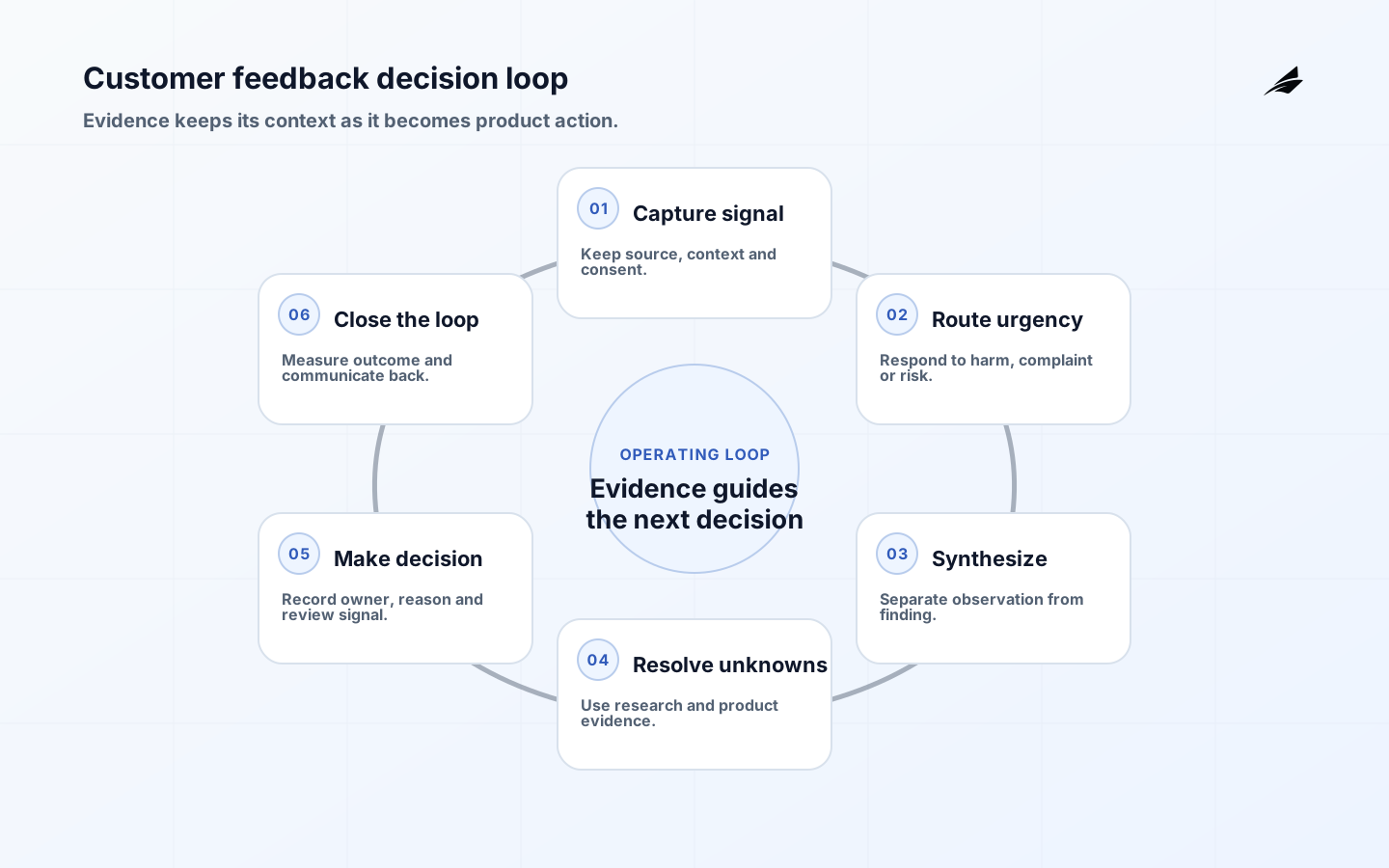
Customer feedback workflows turn comments, complaints, interviews, support conversations and behavioral signals into product decisions without pretending every request is a requirement. The workflow must preserve what the customer experienced, who reported it, the product and context, source evidence, consent and the decision that followed. It should also distinguish feedback from user research and telemetry: each reveals something different. GOV.UK guidance says user research improves service design when teams continually observe real users and share learning. A professional feedback system combines those qualitative findings with support and product data, then closes the loop visibly.
Define the feedback record
Create a source record before adding themes or scores. Capture channel, date, customer segment, product area, task, exact observation, severity, evidence reference and permission to reuse material. Separate the customer’s words from the team’s interpretation. Link duplicate reports without deleting their frequency or context. Keep personal and commercially sensitive data out of broad product views; use pseudonymous references where possible. The product-market validation guide extends this evidence discipline into early product decisions.
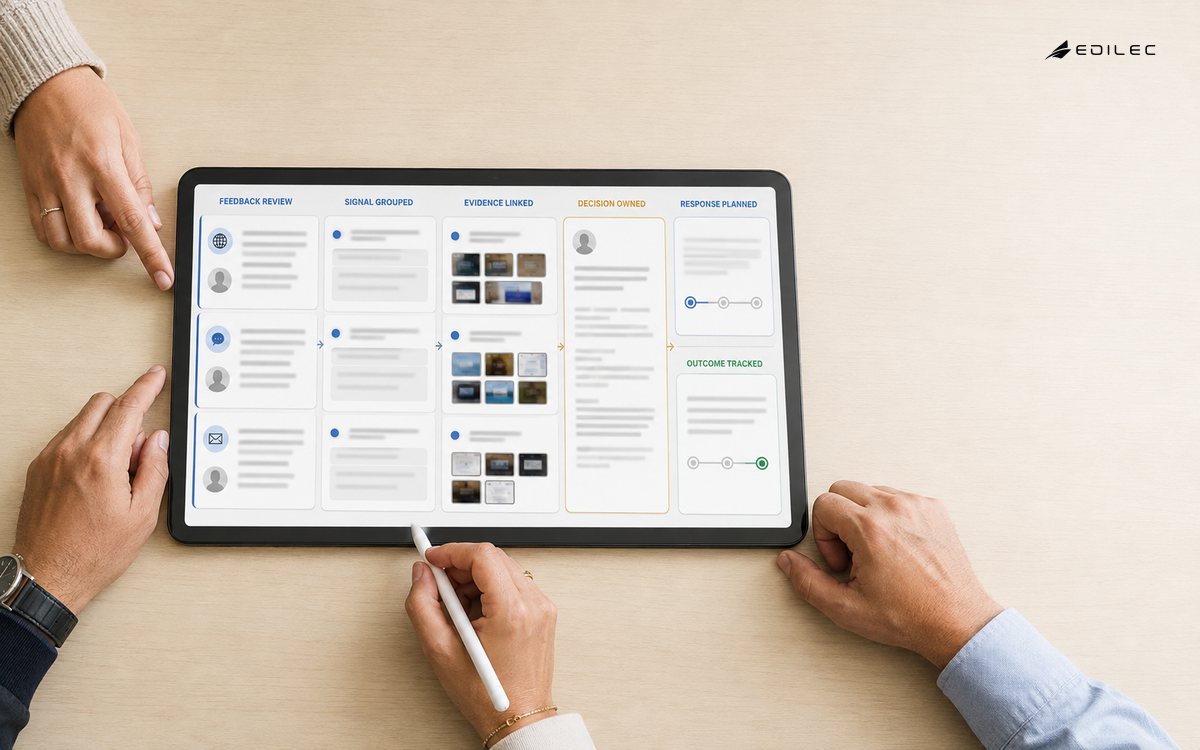
| Signal type | What it can show | What it cannot prove alone |
|---|---|---|
| Complaint | A harmful or unresolved experience | How common the issue is across all users |
| Feature request | A desired outcome or proposed solution | That the proposed feature is the best answer |
| Interview finding | Why a participant behaves or struggles | Population frequency without broader evidence |
| Support trend | Repeated friction and service burden | Root cause without product investigation |
| Behavioral event | What users did in the instrumented path | Motivation, expectation or unobserved workaround |
Triage for response, safety and product learning
Route urgent security, privacy, accessibility, safety and service failures immediately; they should not wait in a product-insight backlog. Complaints need acknowledgement and resolution ownership. ISO 10002 frames complaints handling as an open, effective process that should improve products and services. Product discovery signals can move to weekly synthesis. Define service targets by class and show the customer-facing team what happened next. A useful system has separate states for received, needs response, under investigation, linked to decision, planned, declined and resolved.
Synthesize observations without losing provenance
Group feedback around user task, unmet need and experienced outcome, not convenient keywords. Review original evidence before merging themes and preserve links back to each source. GOV.UK’s guide to analysing research sessions separates raw observations, interpreted findings and actions; use the same separation across channels. Invite support, research, design, product and engineering so one stakeholder does not control the narrative. Record contradictory evidence and segments that experience the issue differently.
| Decision field | Useful content | Why it matters |
|---|---|---|
| Problem statement | Who struggles with which task and consequence | Prevents a proposed feature becoming the problem |
| Evidence breadth | Sources, segments, frequency and confidence | Shows what is known and what remains uncertain |
| Business effect | Support cost, retention, risk or strategic fit | Connects insight to product responsibility |
| Option considered | Product, process, content or support alternatives | Avoids treating build as the only response |
| Decision and review | Owner, reason, date and revisit signal | Makes prioritization accountable and reversible |
Connect themes to a decision forum
A theme becomes actionable when a named product owner can compare it with strategy, risk, opportunity cost and delivery evidence. Scores can help sort a queue, but they should not replace judgment or hide weak inputs. Write the user problem, affected segment, desired outcome, evidence strength and alternatives before estimating effort. The scaling product operations guide provides a broader cadence for cross-team decisions. Keep declined items with a reason and revisit condition rather than allowing them to reappear as new discoveries each quarter.
Use research to resolve uncertainty
When feedback identifies a question rather than an answer, plan targeted research. GOV.UK recommends defining research questions and feeding findings into planning and prioritization through a shared team process in its research planning guidance. Recruit participants who represent the affected context, not only the loudest account. Use prototypes or service observations to test alternatives. Record consent for notes, audio, images and quotations; the official recording guidance emphasizes privacy and clear handling.
- Acknowledge customer reports without promising a roadmap item.
- Link a product decision to the evidence it used.
- Keep source language available beside normalized themes.
- Segment feedback by user and work context before counting it.
- Tell customer-facing teams when a problem is fixed, mitigated or consciously declined.
Measure whether the workflow improves decisions
Track time to acknowledge urgent reports, unresolved complaint age, source-to-decision time, percentage of decisions with multiple evidence types, repeat reports after resolution and customer follow-through. Do not optimize for the number of ideas collected. Review whether feedback coverage overrepresents large, vocal or digitally confident customers. Connect releases to support and usage signals after launch. The SaaS launch checklist shows how to carry customer evidence into launch and stabilization.
Govern the taxonomy lightly
A feedback taxonomy should help retrieval and comparison, not force every observation into a rigid hierarchy. Start with stable dimensions such as product area, user task, journey stage, segment, severity and evidence type. Give each term an owner and definition, allow “unclassified” during intake and review new labels before they proliferate. Avoid sentiment as the main organizing principle; a calm report can describe a severe failure, and an angry request can point to a support misunderstanding. Track taxonomy changes so historical trends remain interpretable. Periodically merge redundant labels and verify that teams still use categories in actual decisions.
Set privacy and retention boundaries
Feedback can contain names, contact details, contracts, health information, screenshots and confidential product plans. Collect only what the response or research purpose needs. Restrict raw records more tightly than synthesized product findings, redact before broad sharing and keep consent terms attached to quotations or media. Define retention by source and obligation; a support case and a research recording may require different schedules. Honor deletion and access requests across integrated tools. When using automated transcription or classification, review provider data-use terms and prevent feedback content from becoming uncontrolled training material.
Close the loop without overpromising
Create response patterns for acknowledged issues, requests under investigation, planned changes, declined proposals and delivered improvements. Customer-facing teams need the decision reason and current workaround, not a vague roadmap promise. For widely reported problems, publish release notes or service updates that explain the outcome in customer language. Link the communication to the decision record and measure whether contacts or failure signals decline. Closing the loop also means telling internal reporters when evidence changed a priority; that behavior improves future signal quality and demonstrates that the system is more than an intake form.
Worked example: repeated onboarding confusion
Support contacts show that administrators repeatedly ask whether invited users can see historical records. Product analytics shows invitations are sent but many users do not complete the first task. Two interviews reveal that the invitation language implies broader access than the actual role. The workflow keeps these as separate observations, links them to one onboarding theme and records which customer segments and product versions are affected. The product owner frames the problem as unclear permission expectation, not “build a new roles screen.” Options include invitation copy, a role preview, better defaults and a permission redesign.
The team tests revised copy and role preview with target administrators, then releases the smallest effective change. The decision record cites support, behavioral and research evidence, names the expected outcome and sets a review date. After release, invitation completion improves and permission-related contacts fall, but a regulated segment still struggles. That exception becomes a focused research question rather than being hidden by the average. Customer-facing teams receive the change and workaround, and participating customers are thanked without being promised every requested feature. The workflow has moved from signal to learning, decision and measured follow-through.
Source coverage deserves its own review. Compare feedback channels with the actual customer population: account size, region, role, accessibility needs, lifecycle stage and engagement level. Silence can mean satisfaction, lack of awareness or inability to report. Add proactive research where support and advisory boards systematically miss users. Weighting feedback does not require a single formula; it requires visible awareness of who is represented and what consequence they experience. Record gaps beside decisions so a confident theme from one segment is not presented as a universal customer truth. Revisit those coverage gaps after major launches, pricing changes and market expansion because the reachable feedback population changes with the product.
Key takeaways
- Preserve the original observation, context and consent before classification.
- Route complaints and high-impact issues separately from discovery themes.
- Separate observations, findings, options and decisions.
- Use targeted research when feedback exposes uncertainty.
- Close the loop with customer-facing teams and post-release evidence.
Frequently asked questions
Do we need a dedicated feedback platform?
Not initially. A consistent record model, ownership and decision cadence matter more than software. Adopt a platform when integrations, permissions, volume and traceability exceed what a well-governed shared repository can handle.
How should feature requests be prioritized?
Translate the proposed feature into the underlying task and outcome, assess who is affected and how, compare alternatives, then weigh evidence, strategy, risk and effort. Request counts are an input, not the decision.
Should every customer receive a response?
Every complaint or support case should follow its service commitment. Research and passive feedback may use aggregate follow-through, but teams should still explain major changes and make reporting outcomes visible where consent and channel allow.
Conclusion
Customer feedback workflows create value when evidence remains traceable to an accountable decision. Thoughtful intake, synthesis, research and follow-through help product teams learn without turning the roadmap into a popularity contest.