Roadmap systems for founder-led products should preserve the founder’s speed of judgment while removing the hidden queue of promises, intuitions, customer requests, and technical obligations that otherwise competes inside one person’s head. The roadmap is not a release calendar or a decorative list of features. It is a visible decision system that connects product direction to a small set of outcomes, shows what will not be pursued, and changes when evidence invalidates a bet.
A useful founder roadmap sits between strategy and delivery. The SaaS MVP scope guide helps define the first coherent product boundary, while multi-tenant architecture planning exposes platform decisions that can constrain sequencing. When automation enters the roadmap, use the human approval design guide to make consequence and escalation explicit rather than treating AI as an undifferentiated feature theme.
Give the roadmap one job
The roadmap’s job is to communicate the sequence of product bets that best advances the current strategy under real capacity and risk constraints. A backlog stores possible work; a release plan coordinates committed delivery; a sales forecast estimates commercial results. Mixing all four makes every item look promised. Keep one canonical roadmap, link to deeper evidence and delivery records, and label horizons by confidence so readers can distinguish a near-term commitment from an option being explored.
Start with a product intent that names target user, important problem, differentiated approach, business constraint, and evidence of progress. Then define three to five outcome areas. GOV.UK guidance emphasizes that roadmaps show what a service is trying to achieve, should be easy to adjust, and should capture intent rather than fixed solutions. That principle is especially useful for founders, whose access to customers can shorten learning cycles if the system leaves room to change course.
| Artifact | Question it answers | What it must not become |
|---|---|---|
| Product strategy | Where will we play and why can we win? | A list of inspirational adjectives |
| Outcome roadmap | Which bets should move which measurable outcomes? | A feature calendar presented as certainty |
| Discovery record | What evidence supports or weakens a bet? | A research archive nobody uses |
| Delivery plan | What is committed in the current execution window? | A multi-quarter prediction at task level |
| Decision log | Why did priority, scope, or timing change? | A transcript of every conversation |
Create a single intake for evidence and requests
Route customer requests, sales opportunities, support pain, usage signals, market changes, incidents, security work, and founder ideas into one intake. Capture the source, affected user, observed problem, frequency, consequence, current workaround, urgency, and links to raw evidence. Do not translate every request directly into a feature. Several requests may reveal one underlying constraint, while one loud request may represent a contractual edge case rather than a strategic market need.
Review inputs on a fixed cadence and merge duplicates around opportunities. Tag evidence by customer segment and product journey so concentration is visible. Revenue context matters, but requested contract value should not automatically outrank retention, reliability, legal obligations, or the needs of the product’s target segment. Maintain a separate expedite policy for active security, severe reliability, and binding compliance issues; otherwise everything urgent will bypass comparison.
Turn opportunities into bounded product bets
Write each bet as: for a named user in a defined situation, changing a behavior or removing a constraint should improve a stated outcome, and this evidence would make the company continue, revise, or stop. Include leading indicators that can move during the horizon and lagging business measures that matter over time. A bet should also state its major assumption, smallest useful intervention, explicit exclusions, operational impact, and the date on which evidence will be reviewed.
Compare bets with a consistent conversation, not a magic score. Examine strategic alignment, user reach, severity, confidence in evidence, expected outcome, delay cost, delivery effort, operational load, reversibility, and risk reduction. Numerical scoring can reveal disagreements but should not launder uncertain estimates into precision. Record the decisive tradeoff in plain language. A founder can still make the call; the system ensures the team understands the evidence and what would overturn it.
| Decision factor | Evidence to inspect | Founder question |
|---|---|---|
| Strategic fit | Target segment and product position | Does this deepen the market we chose? |
| Outcome potential | Baseline behavior and expected change | What becomes measurably better? |
| Confidence | Usage, interviews, experiments, support patterns | What fact would make this bet wrong? |
| Capacity | End-to-end work, dependencies, operational ownership | What must stop or wait to make room? |
| Risk | Security, reliability, legal, data, reputation | Is the exposure bounded and reversible? |
| Learning speed | Time to a credible signal | Can a smaller test answer the key question sooner? |
Use horizons that express confidence, not false dates
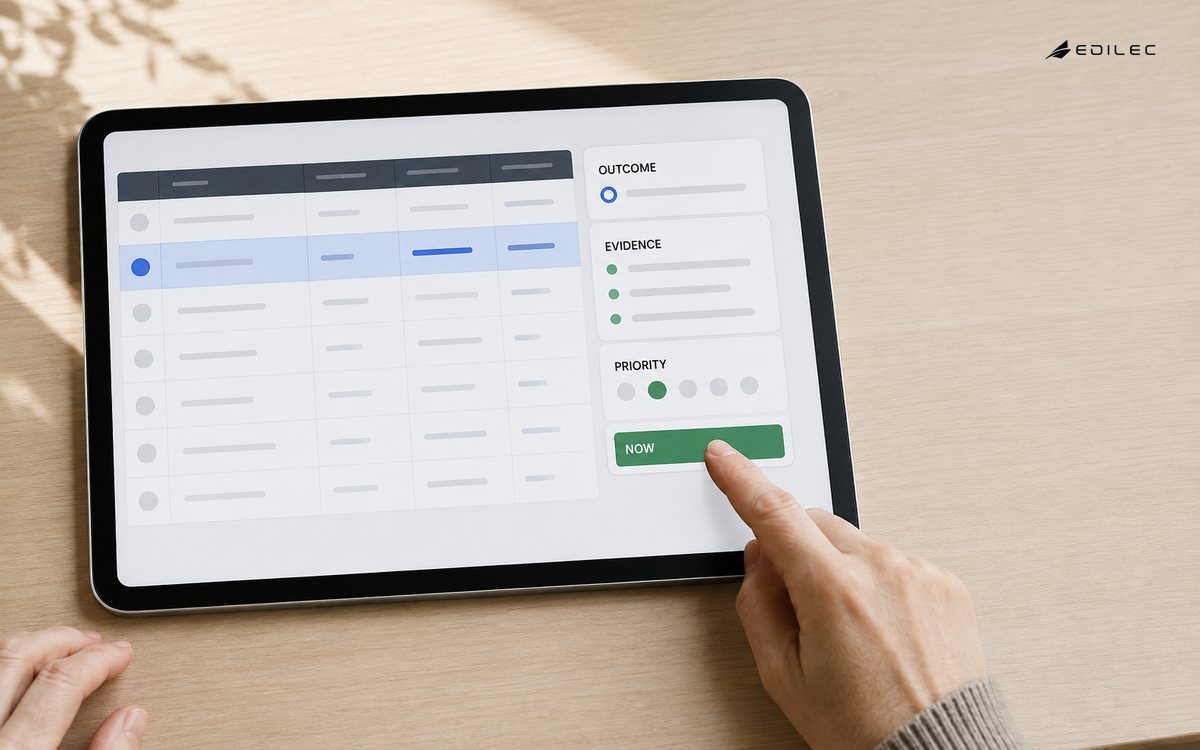
A practical roadmap can use Now, Next, and Later with a separate discovery lane. Now contains a small number of funded bets with an owner, outcome, capacity boundary, and review date. Next contains ordered candidates that have enough evidence for further shaping but are not commitments. Later contains strategic options described at outcome level. Publish exact dates only where a real external constraint exists and the team has validated the dependency and delivery path.
Reserve capacity deliberately. A founder-led team that allocates every hour to visible features creates an invisible queue of reliability, security, support tooling, accessibility, and platform work. Set a capacity policy appropriate to the product’s state, then revisit it using incidents, customer friction, delivery flow, and architecture evidence. Platform work should name the product constraint it removes; product work should include the operating cost it creates. This keeps technical and commercial priorities in one system.
Run a lightweight roadmap operating cadence
Use weekly evidence triage, monthly bet review, and quarterly strategy refresh as a starting cadence. Weekly triage cleans intake and flags material changes. Monthly review examines outcomes, assumptions, capacity, and new constraints, then continues, reshapes, stops, or promotes bets. Quarterly refresh asks whether the target segment, differentiation, economic model, and outcome areas still hold. The meeting should inspect the product and evidence directly, consistent with agile governance guidance to make timely decisions at the right level.
Keep a concise decision log: date, decision owner, choice, evidence, alternatives, consequence, and review trigger. Update the canonical roadmap immediately after a decision and notify affected teams or customers with language appropriate to their relationship. Do not erase changed plans; preserving the reason builds organizational memory and makes forecasting calibration possible. A roadmap becomes trustworthy when stakeholders can see uncertainty and still understand how decisions are made.
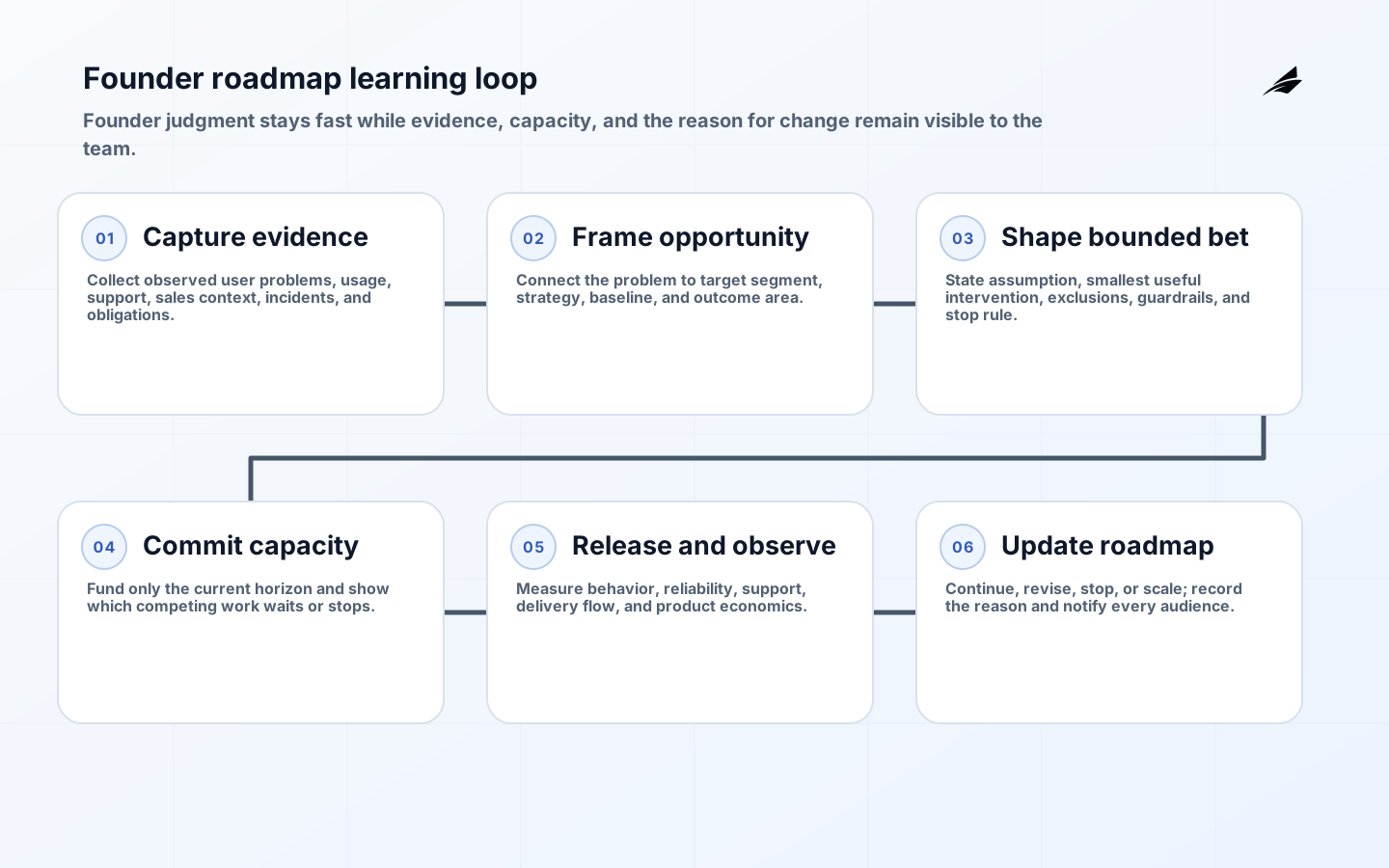
Move each roadmap bet through a learning loop
- Capture the observed problem and link it to a target user and strategic outcome.
- Collect enough qualitative and quantitative evidence to state the key assumption.
- Shape a bounded bet with exclusions, capacity, safety constraints, and a review date.
- Commit only the current horizon and translate it into a delivery goal and acceptance evidence.
- Release the smallest coherent intervention and observe behavior, reliability, support, and economics.
- Continue, revise, stop, or scale the bet; record the decision and update every roadmap view.
Communicate commitments without turning options into promises
Tailor detail, not truth. The team needs assumptions and sequencing; investors need strategic progress and material risks; customers need problems being addressed and confidence appropriate to the horizon; sales needs approved language about current capability and committed work. Mark shipped, committed, exploring, and not planned distinctly. Never let a private customer slide become a second roadmap. Link each audience view to the same canonical decisions and owner.
When a strategic customer request is conditional to a deal, write the condition, commercial value, segment relevance, delivery and support cost, data or security implications, and approval authority. If accepted, place it in capacity by displacing something visible. If declined, explain the product direction and available workaround. This prevents the roadmap from becoming an accumulation of individually rational promises that collectively destroy product coherence.
Key takeaways
- Use the roadmap to sequence outcome bets, not to store every idea or imply certainty.
- Create one intake and translate requests into evidence about user problems.
- Make the founder’s decision explicit, including what was displaced and what could reverse it.
- Express future work at decreasing levels of confidence and commit only a bounded horizon.
- Review bets through observed outcomes, delivery flow, operating load, and product economics.
Frequently asked questions
Which roadmap tool should a founder-led team use?
Use the simplest shared tool that supports one canonical view, clear ownership, links to evidence, change history, and useful exports. A spreadsheet or issue tracker can work. Specialized software helps when audiences, dependencies, and portfolio views grow, but it cannot repair unclear strategy or decision rights. Define the operating model before migrating data into a tool.
Should a product roadmap contain dates?
Near-term committed work can have dates or windows when dependencies and capacity are understood. Longer-horizon options should communicate sequence and confidence rather than invented precision. Regulatory, contractual, or market deadlines should be visible with their assumptions and contingency. A date is useful when it changes a decision, not when it merely makes a slide look complete.
How often is it acceptable to change the roadmap?
Whenever material evidence changes the best decision, through the agreed review or expedite path. Frequent unexplained changes signal weak strategy; refusing to change despite evidence signals theater. Record why the change occurred, which outcome or assumption moved, what capacity was reallocated, and who must be told. Consistency should come from the decision method, not from preserving stale features.
Conclusion
A founder-led roadmap should make judgment more powerful by giving it structure and memory. Ground direction in a target user and outcomes, collect evidence through one intake, shape a few bounded bets, and communicate confidence honestly. The result is not less founder influence. It is a product organization that can act quickly, learn why a decision worked, and protect its strategy from a growing pile of accidental promises.