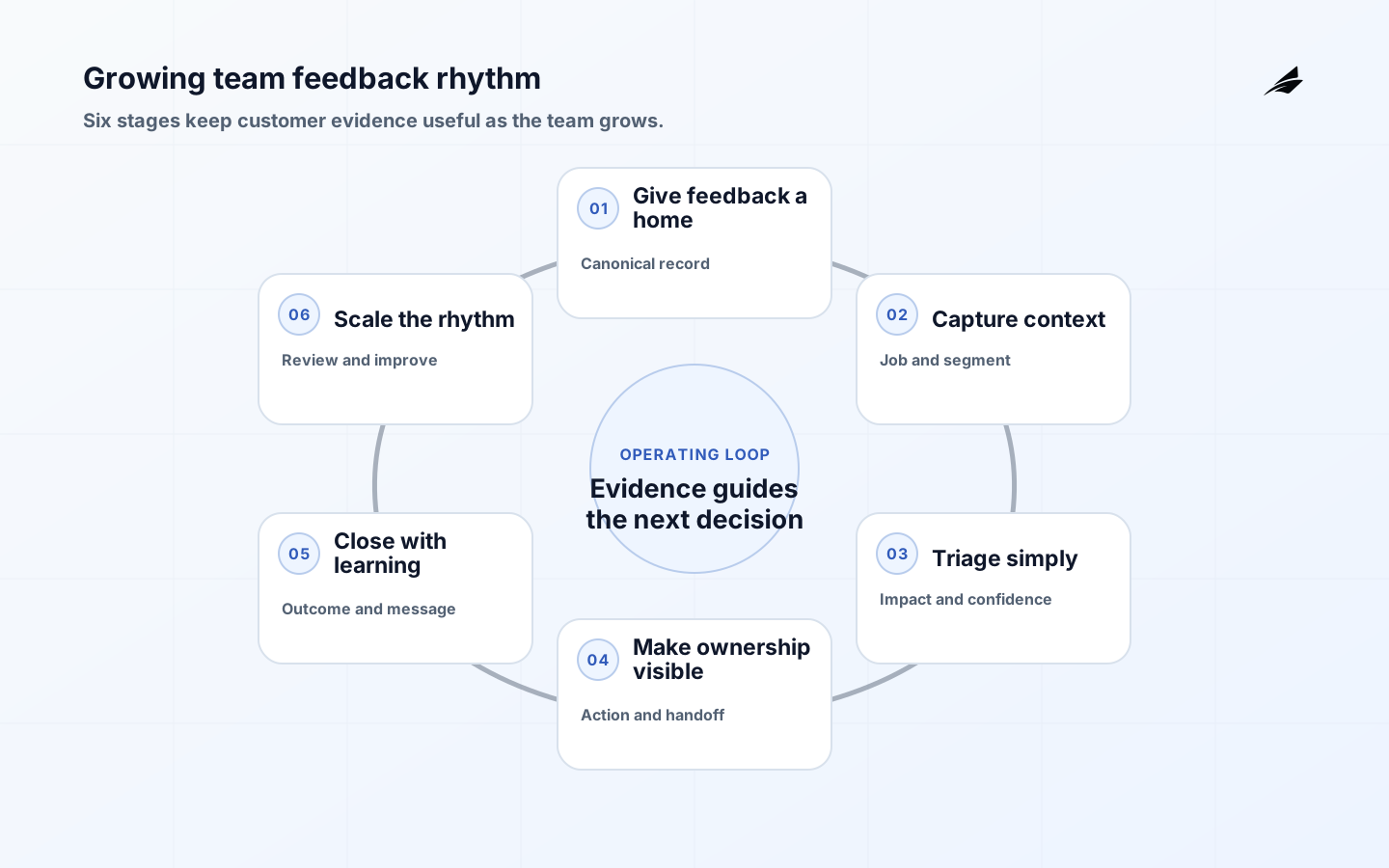
Growing teams often have plenty of customer feedback and too little shared meaning. A request arrives in a chat, a complaint lives in a support ticket, an account manager keeps a private list, and product analytics shows a different story. A useful customer feedback loop gives every signal enough context to become a decision, while keeping the system light enough that people will use it. Atlassian’s customer feedback guide supports the basic discipline of connecting customer problems to product outcomes. This field guide focuses on the operating details that help a team move from scattered evidence to a measured improvement.
Give feedback one dependable home
The first goal is not to centralise every conversation. It is to create one place where a signal can be found, understood, assigned, and revisited. Choose a canonical record and link other systems to it. Require source, customer or segment, product area, problem summary, time, owner, and status. Preserve the original wording separately from the team’s interpretation. A single home reduces duplicate requests, but it must not become a dumping ground. Define what belongs, what is an urgent escalation, and what is only research material.
| Loop stage | Small-team habit | Evidence |
|---|---|---|
| Capture | Record source and customer job | Signal with context |
| Clarify | Ask one focused follow-up | Question and answer |
| Decide | Name owner and tradeoff | Decision note |
| Learn | Check result after change | Measure and follow-up |
Capture context that changes the decision
The same request can mean different things for a new user, a power user, an administrator, or a customer with a contractual obligation. Record the task, trigger, current workaround, frequency, consequence, and desired outcome. Note whether the evidence is direct, observed, inferred, or quantitative. Add account and segment context with appropriate access controls. Shared event names help compare feedback with product behaviour; OpenTelemetry semantic conventions offer a useful example of consistent vocabulary. The team should be able to explain why two apparently similar signals were grouped or kept separate.
Create a simple triage rhythm
Use a regular review that separates urgent customer harm from discovery and roadmap evidence. New signals can be acknowledged quickly, grouped into a problem, tagged with confidence, and assigned a next question. Do not require a complete business case before a team can record a useful observation. At the same time, do not let every request become a commitment. States such as new, needs context, grouped, considered, planned, delivered, measuring, and closed are enough when each has an owner and a definition. Publish the decision and revisit it when evidence changes.
Prioritise without theatre
A growing team needs a rubric that is understandable in a ten-minute review. Consider severity, number and importance of affected customers, strategic fit, confidence, effort, risk, and learning value. Record the reason for a deferral or decline. Do not use a score to disguise a leadership decision or suggest that qualitative evidence is less real. When a high-severity issue needs immediate action, define who can interrupt the normal cadence. When a request is interesting but uncertain, choose a small experiment rather than promising a large feature.
Reliability matters as volume grows. If feedback is copied between systems, use a stable ID and design for duplicate delivery. Stripe’s webhook signature documentation is a useful official reference for verifying event origin before processing; a feedback loop also needs a human recovery path when delivery fails. Connect this guide to what changes when feedback loops move into production, SaaS reliability decisions, and customer feedback loop decisions so the team treats its own feedback service as production software.
Make ownership visible
Assign different responsibilities deliberately. Support may own acknowledgement and context; product may own problem framing and priority; engineering may own reproduction and delivery; customer success may own communication; a product leader may own the tradeoff. A signal without a next action should not remain in a high-priority state. Show due date, owner, escalation path, and last meaningful update. When the team is small, one person may hold several roles, but the record should still distinguish the accountabilities. This makes handoffs easier and stops customer evidence from disappearing when someone is away.
| Role | Question | Healthy signal |
|---|---|---|
| Support | Has the customer been understood and acknowledged? | First-response age |
| Product | What problem and tradeoff are being chosen? | Decision clarity |
| Engineering | Can the issue be reproduced and changed safely? | Release linkage |
| Customer success | What should this customer hear? | Communication completion |
Close with learning, not a status change
After release, compare the intended outcome with observed behaviour. Did the workaround disappear, did task completion improve, did support contacts fall, or did the change create a new burden? Use product analytics and customer follow-up together. Vercel’s observability documentation provides a useful mindset for connecting production signals to diagnosis; apply that to the feedback outcome, not just application uptime. A closed record should contain the decision, release or non-release reason, measure, communication, and what the team would do differently next time.
Handle sensitive feedback carefully
Feedback may include personal information, security reports, contractual terms, or customer-specific operational details. Separate customer-visible notes, internal analysis, and restricted incident evidence. Limit access by tenant, role, and need. Keep attachments and transcripts only as long as the product and policy require. If a report may indicate a security incident, preserve evidence and route it to the responsible response owner; NIST incident response recommendations provide a useful structure for preparation, detection, response, and learning. A feedback loop must be safe for customers to use.
Scale feedback review without losing context
As the customer base expands, make the feedback cadence visible without making it bureaucratic. Review new signals promptly, group them into problems on a defined cadence, and reserve deeper research for decisions that warrant it. Rotate the person who brings customer evidence so the loop does not belong to one advocate. Sample closed feedback cases to verify that the promised outcome changed. If a field or review step creates effort without a better product decision, remove it. Good operations make it easier to listen, decide, deliver, and learn without turning every customer conversation into a ticket.
Use a small set of measures to guide improvement: first response age, unassigned age, decision age, release linkage, outcome confirmation, duplicate rate, and feedback coverage by segment. NIST’s incident response recommendations are a useful reminder that evidence, ownership, communication, and learning matter when feedback indicates serious harm. For everyday product requests, keep the same discipline at a lighter weight and protect the customer’s trust.
- Review the cadence with the people who record signals and make product decisions.
- Look for missing voices and repeated workarounds.
- Connect delivery claims to outcome evidence.
- Change the loop when the team’s decision needs change.
A monthly review can be enough for a small team if it includes real records and a named decision. The cadence matters less than preserving the habit of checking whether the loop changed customer work.
The loop is healthy when a team can explain both what it learned and what it chose not to do. Preserve those decisions so growth does not turn old customer evidence into repeated rediscovery.
Scale the review rhythm
As more people join the team, protect the loop from becoming a private practice. Review new signals quickly, synthesise problems on a regular cadence, and rotate who presents evidence. Sample closed records to check whether the stated outcome was real. Look for missing voices and repeated workarounds, not just the number of requests. If a field or stage creates work without improving a decision, simplify it and record why.
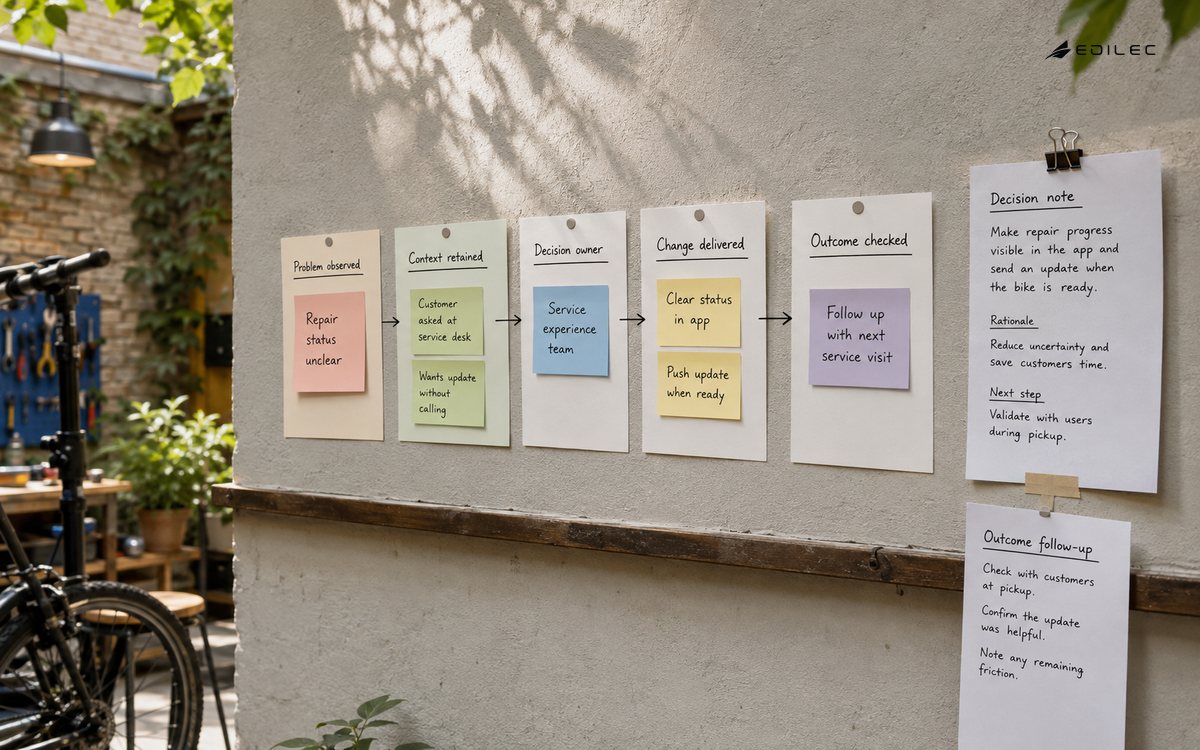
Keep the measures modest: first-response age, unassigned age, decision age, release linkage, outcome confirmation, duplicate rate, and coverage by customer segment. Customer Feedback Loops in Production: What Changes for Product Teams gives the companion view for operating the loop as software. The aim is a habit that helps the team listen, decide, deliver, and learn without turning every customer conversation into a ticket.
- Review the loop with people who capture and act on feedback.
- Connect delivery claims to outcome evidence.
- Protect restricted evidence and customer-visible communication.
- Change the loop when the team’s decision needs change.
Measure the loop itself
Track time to acknowledgement, time to clarification, unassigned age, duplicate rate, time to decision, signals linked to a release, outcome confirmation, and the percentage of high-impact signals with a current update. Also monitor blind spots: which segments never submit feedback, which sources fail to arrive, and which problem categories are repeatedly deferred. Avoid rewarding the team for closing records quickly. A short time to close with no customer outcome is a form of data loss. Review the measures monthly and retire fields or stages that no longer improve a decision.
Key takeaways
- Give feedback a dependable home with context and clear boundaries.
- Separate what customers say from what the team infers.
- Use a simple triage rhythm and an explainable rubric.
- Name ownership at capture, decision, delivery, and follow-up.
- Close the loop with an outcome measure and respectful communication.
Frequently asked questions
Does a small team need a dedicated feedback tool?
Not necessarily. A well-defined canonical record in an existing tool can work if it preserves context, ownership, permissions, status, and links to delivery and outcomes. Add a dedicated tool when the current system creates measurable loss.
How can a team avoid the loudest customer winning?
Group signals into problems and compare severity, affected segment, confidence, strategic fit, effort, and learning value. Record why a decision was made so volume is one input rather than the entire rule.
What should a customer hear after a request is declined?
A clear, respectful reason, what the team learned, and any safe alternative or future condition for revisiting the decision. Avoid implying a commitment when none exists.
Conclusion
Growing teams do not need more feedback; they need more usable evidence. Give signals a home, context, ownership, a decision rhythm, and a measured ending. A lightweight loop that reliably changes the right work will outperform a sophisticated intake system that only grows the backlog.