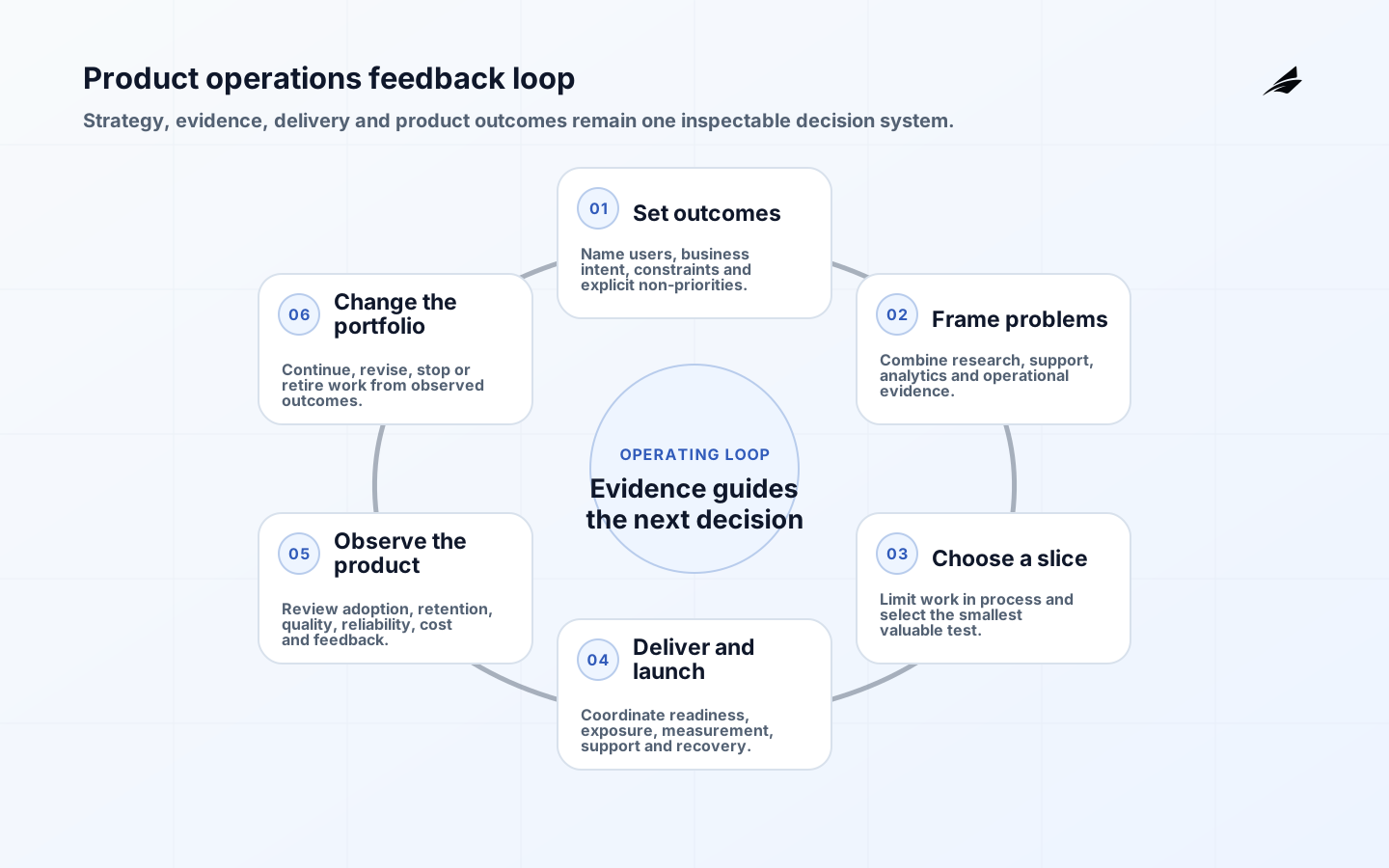
Scaling product operations means making product decisions easier to prepare, inspect and learn from as teams multiply. It is not a central team that writes status reports or inserts an approval between product and engineering. A strong product operations model connects strategy, discovery evidence, prioritization, delivery, launch readiness, feedback and product health through common definitions and a clear cadence. It reduces duplicate research, hidden commitments and executive escalation while preserving team autonomy. Technical leaders should design the model as an information and decision system: who decides, which evidence is required, where work is recorded, how capacity is protected and how production outcomes change the roadmap.
Key takeaways
- Define the decisions product operations supports before choosing tools or meetings.
- Use common outcome, discovery, delivery and product-health definitions across teams.
- Limit work in progress and make cross-team dependencies visible early.
- Connect customer feedback to product decisions and close the loop with contributors.
- Measure operating flow and product outcomes, not reporting activity.
Give product operations a precise mandate
A useful mandate may include portfolio evidence, research operations, planning cadence, launch coordination, product analytics definitions, tooling and decision records. It should exclude owning every roadmap, acting as project manager for every team or replacing product leadership. Document decision rights: executives set strategy and portfolio constraints; product leaders own outcome choices; teams own discovery and delivery within boundaries; product operations improves the system and exposes unresolved conflicts. The Edilec guide to customer feedback workflows provides a focused example of this enabling role.
| Decision | Owner | Product operations contribution |
|---|---|---|
| Strategy allocation | Executive and product leadership | Comparable evidence, assumptions and capacity view |
| Problem selection | Product team | Research access, outcome framing and prior learning |
| Delivery sequence | Product and engineering | Dependency, WIP and readiness visibility |
| Launch | Accountable product owner | Checklist, evidence and cross-functional coordination |
| Continue, change or retire | Product leadership | Outcome trend, cost, risk and customer evidence |
Create common definitions without forcing identical teams
Standardize the minimum metadata required to compare work: customer or user, problem, intended outcome, owner, evidence, confidence, leading signal, guardrail, dependency and decision date. Define product metrics centrally enough that adoption or retention means the same thing across reports. Let teams choose discovery and delivery techniques suited to their product. DORA’s user-centric focus emphasizes user needs, feedback and product measures such as adoption, retention and satisfaction. The operating model should keep those outcomes beside technical and delivery evidence so velocity does not become the goal.
Design a cadence around different decision horizons
Use a small number of forums with explicit inputs and outputs. Quarterly or periodic strategy review allocates attention and names assumptions. Monthly portfolio review resolves cross-team constraints and stops low-value work. Team-level weekly discovery and delivery review manages evidence and flow. Launch review confirms support, security, analytics, communication and recovery. Product-health review examines adoption, reliability, support, unit economics and retirement. Replace presentations with durable records and pre-read evidence. Cancel meetings that only repeat tool state.

| Cadence | Question | Output |
|---|---|---|
| Strategy review | Which outcomes deserve capacity now? | Bounded priorities and explicit non-priorities |
| Portfolio review | What dependency or risk needs leadership action? | Owner, decision and date |
| Team review | What did we learn and what is the next smallest test? | Updated assumption and experiment |
| Launch review | Can customers adopt and operations support this change? | Release, hold or bounded rollout decision |
| Health review | Should we invest, correct, maintain or retire? | Product action tied to evidence |
Connect feedback to decisions
Centralize discoverability, not necessarily every conversation. Capture source, segment, task, context, evidence and consent; separate a customer request from the underlying problem. Link feedback to an outcome or product area and show whether it informed a decision. DORA’s customer feedback capability warns that teams fail when they cannot act on feedback or are measured only on delivering a predefined feature. Product operations can reduce that gap by maintaining research repositories, participant access, synthesis standards and a visible route from insight to changed priority.
Protect flow with small batches and WIP limits
Make all material work visible, including discovery, enablement, compliance, incidents and technical debt. Set work-in-process limits that match actual team capacity and require leadership to choose when demand exceeds them. DORA’s WIP guidance connects limits, visual management and monitoring feedback to improved delivery flow. Its small-batch guidance recommends independent, valuable and testable slices whose feedback begins after production release. Product operations should expose aging and blocked work, not push teams to start more.
Design the information architecture before buying tools
Define authoritative systems for strategy, roadmap, work execution, research, analytics, customer records and decision history. Integrate only the fields needed for a workflow; copying every object creates conflicting records. Use stable product and customer identifiers, access controls and retention. Build views for each decision rather than one universal dashboard. Tool administration should include schema ownership, change control, onboarding and deletion. A new platform does not solve unclear product taxonomy or decision rights; settle those first.
Make experiments comparable and ethical
Record hypothesis, target population, intervention, success signal, guardrails, duration and decision rule before exposure. Preserve failed and inconclusive results to avoid repeated work. DORA’s team experimentation guidance supports small experiments and learning, but technical leaders must also protect privacy, accessibility and customer trust. Not every question needs an A/B test; interviews, prototypes, operational data and phased releases may be more appropriate. Product operations should improve method selection and evidence quality, not maximize experiment count.
Measure the operating system
Track decision lead time, research reuse, work age, blocked time, WIP, launch readiness misses, adoption, outcome movement, guardrail breaches and time from feedback to acknowledged decision. Segment by product and team without creating rankings that encourage gaming. Measure product-operations work by friction removed and decision quality: fewer duplicate tools, clearer ownership, earlier dependency resolution and stronger outcome learning. The multi-team SaaS launch checklist adds a release-focused view of cross-functional readiness.
Scale the model in stages
Begin with one portfolio pain, such as inconsistent launch readiness or feedback disappearing across tools. Baseline it, introduce the minimum shared record and cadence, and evaluate whether decisions improve. Add analytics definitions or research operations only when ownership is ready. Staff product operations with facilitation, product, data and systems capability rather than treating it as administrative support. Publish the service it provides and the responsibilities that remain with teams. Expand from demonstrated value, not a mandate for every team to fill more fields.
Practical review checklist
- Map the current path from customer evidence to a funded decision and measure waiting, rework and handoffs. This reveals whether the first constraint is research access, priority conflict, analytics trust or delivery capacity.
- Define a lightweight decision record with context, alternatives, evidence, owner, date and revisit condition. Store it where teams can find it and link subsequent outcomes rather than rebuilding the rationale in presentations.
- Create one product taxonomy shared by roadmap, analytics, support and finance. Assign an owner and change process so product names, segments and lifecycle states remain comparable across systems.
- Reserve explicit capacity for discovery, reliability, security, support and retirement. A portfolio view that records only feature work hides material demand and encourages teams to exceed sustainable work-in-process.
- Close the feedback loop with customers and internal contributors when possible. Explain the decision or learning without promising a feature; this improves trust and helps teams verify that they understood the underlying problem.
- Review the operating cadence every quarter. Remove meetings that do not produce a decision, combine duplicated reports and measure whether leaders intervene earlier on real constraints rather than requesting more status.
A worked operating example
A practical first initiative is launch readiness across three product teams. Product operations interviews support, security, sales, product and engineering to identify the evidence repeatedly discovered late. It creates one small launch record covering target users, rollout, analytics, support ownership, security decisions, migration, communication and recovery. Teams attach existing evidence instead of rebuilding slide decks. A weekly launch review discusses only unresolved risks and decisions, while routine status remains asynchronous. After several launches, the group measures late surprises, blocked time, adoption and support demand, then removes checks that never change a decision. This proves whether the function reduces friction before it expands into portfolio planning or research operations. The SaaS MVP planning guide offers a complementary way to keep early product scope tied to learning.
Frequently asked questions
Is product operations the same as a PMO?
No. Both may improve coordination, but product operations centers on product decisions, discovery, feedback, outcomes and health. A PMO often emphasizes project governance, budget and schedule. Organizations can coordinate the functions, but should not let reporting replace product learning.
When should a company hire product operations?
When recurring cross-team friction consumes product leadership time and has a definable operating solution. First clarify the problem and owner. A dedicated role is justified when research, tooling, planning or product data needs sustained stewardship across several teams, not simply because the product organization reached a particular headcount.
Conclusion
Scaling product operations requires a coherent decision system, not more ceremony. Clear rights, common evidence, bounded cadence, customer feedback, protected flow and product-health measures let teams remain autonomous while leadership sees where intervention matters. Start with one costly friction and build the operating model from outcomes.