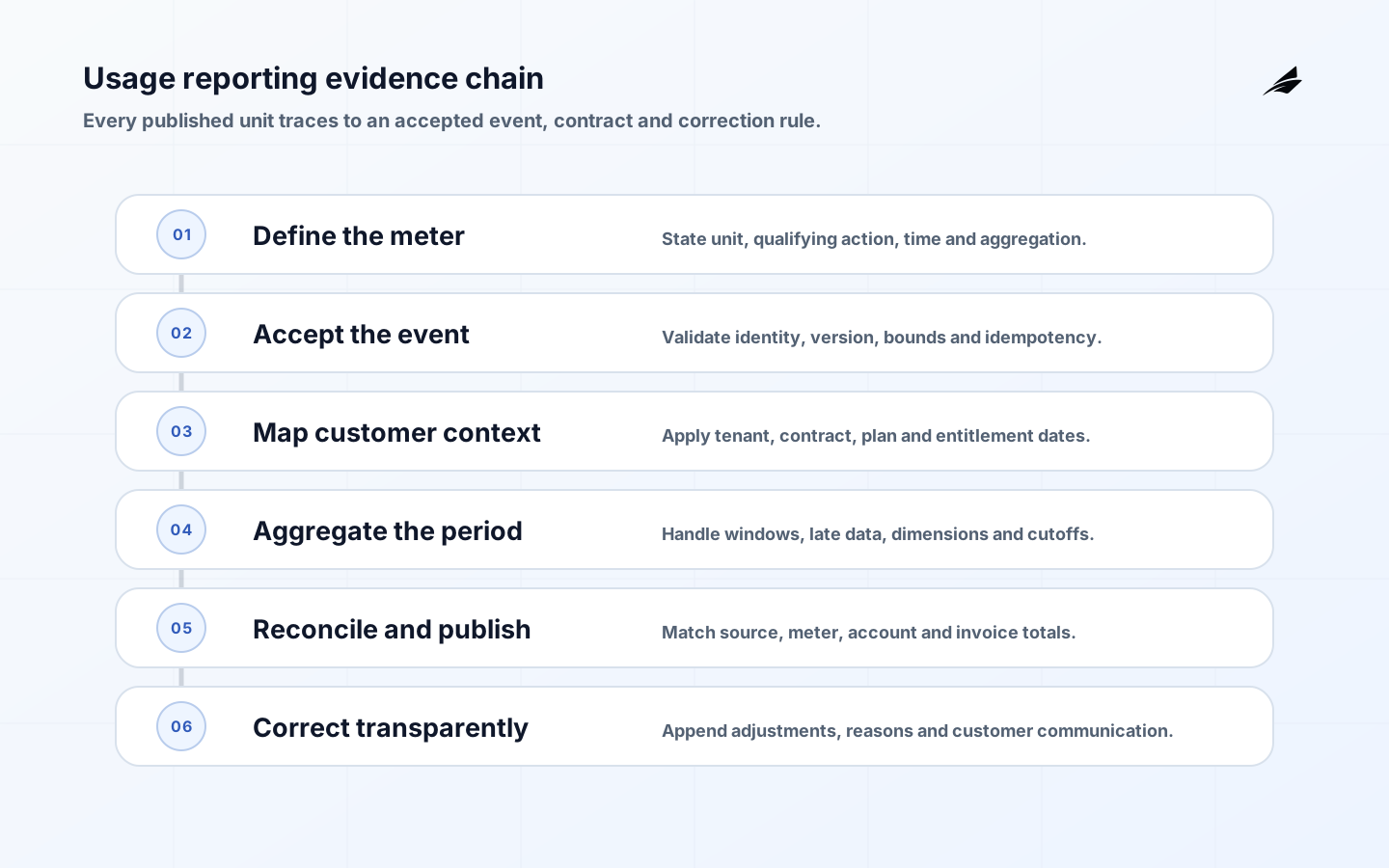
Usage-based reporting is the product capability that turns raw customer activity into an explainable statement of consumed units. It may inform billing, entitlements, capacity, customer operations, or all four. Because the report can affect money and trust, teams need more than an event counter. They need a stable meter definition, tenant and contract mapping, idempotent ingestion, late-data policy, aggregation rules, reconciliation, customer-visible evidence, and a controlled correction path. A growing company should design that chain before attaching a price to it.
Pair this guide with Edilec’s SaaS usage-reporting plan, billing-operations checklist, and product analytics guide. Metering, invoicing, and behavioral analytics can share events, but they should not silently share definitions or correction rules.
Define the usage-based reporting operating boundary
A useful boundary starts by naming meter definition, raw event, aggregation window, account mapping, adjustment, and published report. Those are not merely data fields; together they explain why the system took an action and who can correct it. Write down the initiating event as a product action that consumes a billable or governed unit. Then test the model with a normal case, a late or duplicate event, a request from an unauthorized actor, and a case that requires support intervention. The difficult example is often the one that reveals a missing state or unclear owner. Do not delegate this work solely to an implementation ticket. Product, engineering, support, finance where relevant, and security need the same vocabulary before their work can fit together.
| Boundary question | Decision to make | Evidence before release |
|---|---|---|
| Outcome | What completed result proves value? | a defensible account of customer consumption that product, finance, and customers can explain |
| Authoritative record | Which data settles a disagreement? | meter definition, raw event, aggregation window, account mapping, adjustment, and published report |
| Decision right | Who may approve, override, or reverse? | Named role and reviewed policy |
| Failure route | What happens when the normal path breaks? | two teams use different definitions of use and invoices cannot be reconstructed |
Design decisions before interfaces
Treat the workflow as a sequence of decisions, not a sequence of screens. For Usage-Based Reporting, each transition should have a triggering fact, a permitted actor, a visible state, and a consequence that can be checked later. Put policy in one reviewable place rather than scattering it among browser conditions, background jobs, and operator memory. Where an integration participates, preserve its event identifier and ordering information; retries without idempotency can quietly produce a second grant, charge, report, or message. The design should also distinguish customer action from staff action. Support may need limited tools, but broad impersonation or unlogged edits destroy the evidence needed to resolve a dispute.
- Describe the smallest complete path from a product action that consumes a billable or governed unit to a defensible account of customer consumption that product, finance, and customers can explain.
- Give every state a plain-language definition and an accountable owner.
- Record why an override is allowed, who may apply it, and how it is reviewed.
- Keep identifiers that connect the customer view, service logs, and downstream record.
- Make failed work visible in a queue instead of silently retrying indefinitely.
- Design the recovery message so a customer or operator knows the next safe action.
Build usage-based reporting controls into delivery
Security, accessibility, and reliability are part of the customer experience here. An authorization decision should be evaluated at the point an action is requested, with tenant or account context carried through services and jobs rather than inferred from a convenient client value. Logging should capture an actor, target, action, decision, and correlation reference without dumping sensitive payloads. For customer-facing steps, keyboard operation, labels, focus management, error identification, and understandable status changes are release criteria, not polish. Finally, exercise recovery in a non-production environment: restore the expected state after a malformed event, temporary dependency failure, revoked access, and staff correction. The resulting runbook is evidence that the design can be operated. For Usage-Based Reporting: A Practical Guide for Growing-Company Operators, the controls must protect the particular outcome this workflow promises, rather than serve as a generic delivery checklist.
| Control area | Practical question | Release check |
|---|---|---|
| Authorization | Can a valid actor cross the intended boundary? | Negative tests cover role, tenant, object, and action |
| Integrity | Can retries or out-of-order messages duplicate work? | Idempotency and ordering cases are exercised |
| Accessibility | Can people complete and understand the workflow? | Keyboard and error paths are reviewed |
| Operations | Can the team locate and repair a failed case? | Runbook, alert owner, and audit trail are tested |
Review a real operating case
Metering design deserves a dispute simulation before customers see the report. Choose an account with a retrying client, a plan change in the middle of the reporting period, a delayed event, and an approved adjustment. Walk through the raw events, deduplication rule, aggregation logic, displayed amount, and invoice input. The operator should be able to reproduce the published figure from retained evidence without changing a production query by hand. Decide how long raw events are kept, how corrections are represented, and when an adjustment is final. These details are product behavior: a customer reading a usage report needs a clear unit, time boundary, and explanation of any change, not only a number that appears authoritative.
Measure the outcome, not activity
Instrument the behavior that would change the next product decision. For this guide, a central measure is percentage of reported usage traceable to accepted source events. Pair it with a quality measure such as failed transitions, support-assisted completions, policy denials, reconciliation adjustments, or time spent in an exception queue. Segment results by the customer, plan, entry route, or tenant type that matters to the decision; a blended average can hide a damaging failure for a valuable group. Review a small set of representative records alongside the dashboard. Quantitative signals say where to look, while the underlying case reveals whether the model, interface, integration, or operating procedure needs attention.
Establish a metering reconciliation review
Schedule a metering reconciliation review while the workflow is still small enough to inspect. Bring a handful of completed records, one failure or near miss, and the measure that shows whether the intended result is improving. For usage-based reporting, examine source-event coverage, adjustments, and period boundaries. Ask whether the policy was understood at the point of action, whether the durable record matches what the customer saw, and whether recovery required an undocumented workaround. The purpose is not status theater. It is to give product, finance, and data teams a regular place to resolve ambiguity before it becomes an irreversible product promise. Write down the decision, owner, and next observation so the next review begins with evidence rather than recollection.
Write a meter contract before emitting events
Define the billable or governed unit in language a customer can understand: event name, qualifying action, unit, value, account identity, timestamp semantics, dimensions, exclusions, aggregation, reporting period, and correction rule. Stripe’s meter configuration documentation distinguishes sum, count, and last-value aggregation and notes that most meter settings become immutable after configuration. Treat a meter change as a product and contract change, not a dashboard edit.

| Contract element | Example decision | Risk if omitted |
|---|---|---|
| Qualifying event | Completed document processing, not request attempt | Retries inflate usage |
| Identity | Bill-to account derived from effective entitlement | Usage assigned to wrong customer |
| Time | Service-completion time in UTC | Events fall into wrong period |
| Aggregation | Sum accepted units by account and period | Dashboard and invoice disagree |
| Correction | Compensating event with reason and reference | History changes without evidence |
Make ingestion idempotent and observable
Give each source event a stable identifier and preserve the raw accepted event before aggregation. Retries must not duplicate consumption. Validate tenant, meter version, unit, time window, and numerical bounds; route invalid events to an owned exception queue. Stripe processes meter events asynchronously, as its usage recording guide explains, so customer views should expose freshness and pending state rather than imply immediate finality. Monitor event lag, rejection, duplicate detection, unmapped accounts, and gaps between source activity and accepted usage.
Reconcile before publishing a final statement
Aggregate from accepted immutable events, then reconcile totals at several levels: event source to meter, meter to account, account to entitlement or contract, and report to invoice where billing applies. AWS Marketplace’s SaaS metering guidance documents hourly reporting, deduplication boundaries, and the fact that a received metering record may not be amendable. Those constraints illustrate why retry behavior, cut-off times, and late-event policy must be designed explicitly. Close a period only after exceptions are understood, and preserve reopen authority.
Design a report customers can verify
Show the meter definition, period, timezone, freshness, total, relevant dimensions, plan or entitlement context, and a route to supporting detail. Avoid exposing raw sensitive event content when a safe reference or grouped view is enough. Use consistent metric names and units; the OpenTelemetry metric conventions are a useful example of why semantic clarity, units, and meaningful aggregation matter. Provide downloadable evidence and a dispute workflow that records the questioned units, investigation, correction, and communication.
Key takeaways for usage-based reporting
- Scope the release around one accountable outcome: a defensible account of customer consumption that product, finance, and customers can explain.
- Model meter definition, raw event, aggregation window, account mapping, adjustment, and published report before selecting screens or integrations.
- Test the failure that matters most: two teams use different definitions of use and invoices cannot be reconstructed.
- Treat access, auditability, accessibility, and recovery as product requirements.
- Use percentage of reported usage traceable to accepted source events to decide whether to expand the workflow.
Frequently asked questions
How much should the first release automate? Automate only the portion of a product action that consumes a billable or governed unit whose inputs, policy, and correction path are understood; route ambiguous or consequential cases to a named reviewer. Is a dashboard enough to prove progress? No. The team needs traceable records and sampled cases showing that the measured outcome is genuine. When should the scope grow? Add adjacent paths after the core route reaches a defensible account of customer consumption that product, finance, and customers can explain reliably and the support team can explain exceptions. What should be documented? State definitions, decision rights, integration contracts, access rules, recovery steps, and the metric review cadence. That compact operational record is more valuable than a broad promise of future capability.
Conclusion
Usage-based reporting earns trust when every published unit can be traced to an accepted event, an effective customer context, and a versioned meter rule. Design idempotency, late data, reconciliation, and correction before scale. The result is a report that product teams can operate, finance can defend, and customers can understand.