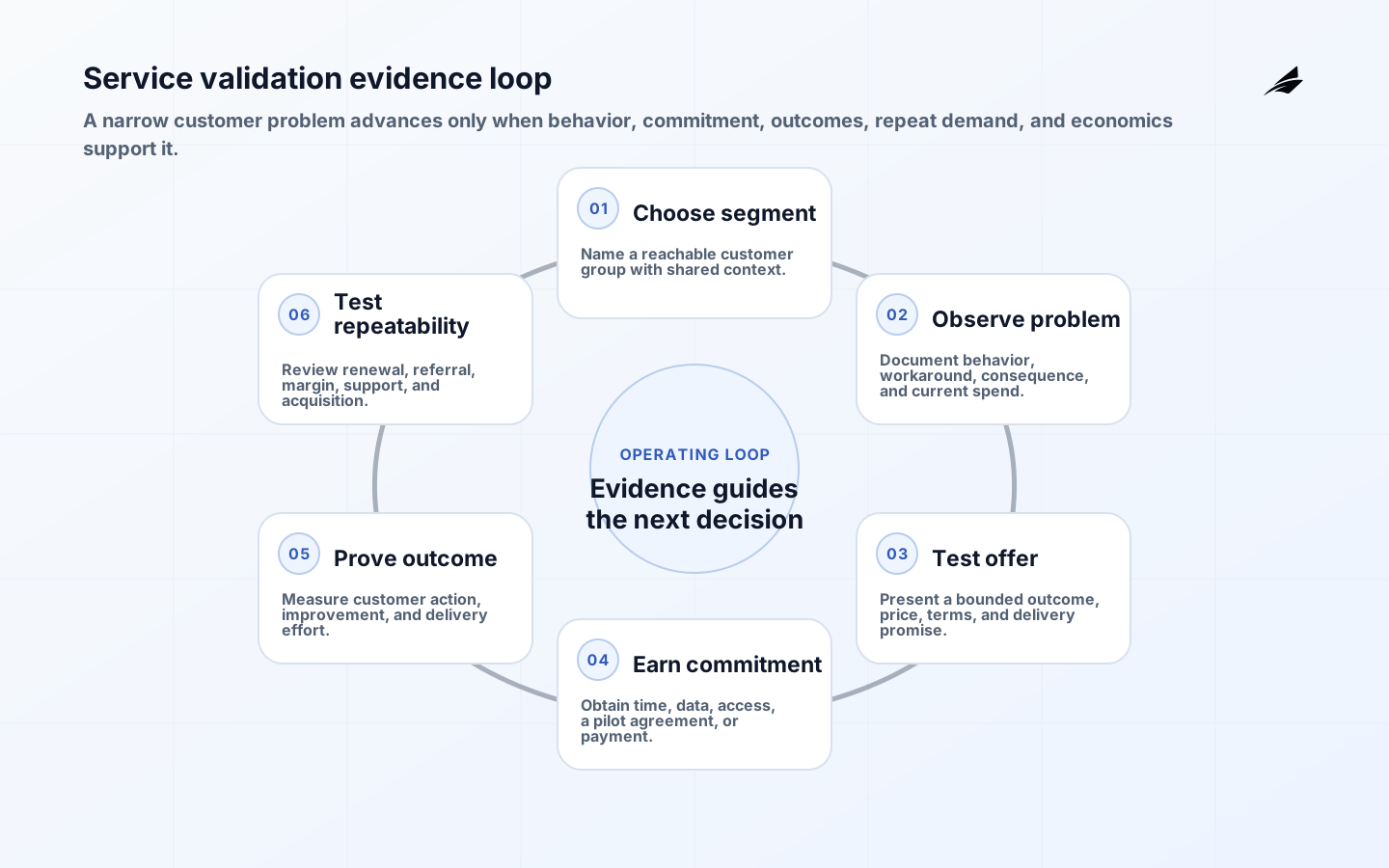
Product-market validation for a service business is an evidence system, not a collection of compliments. It connects a narrowly defined customer and costly problem to an offer, a real commitment, a delivered outcome, repeat demand, and workable economics. Service firms have an advantage because they can observe work closely and test an offer before building a large software product. They also face a trap: bespoke founder effort can make almost any pilot look successful. A useful validation system separates repeatable value from heroics, records disconfirming evidence, and makes the next investment decision explicit.
Define the product-market validation systems operating boundary
A useful boundary starts by naming customer segment, problem statement, test offer, observed behavior, and decision log. Those are not merely data fields; together they explain why the system took an action and who can correct it. Write down the initiating event as a research finding, pilot request, offer response, or completed customer task. Then test the model with a normal case, a late or duplicate event, a request from an unauthorized actor, and a case that requires support intervention. The difficult example is often the one that reveals a missing state or unclear owner. Do not delegate this work solely to an implementation ticket. Product, engineering, support, finance where relevant, and security need the same vocabulary before their work can fit together.
| Boundary question | Decision to make | Evidence before release |
|---|---|---|
| Outcome | What completed result proves value? | evidence that a specific customer problem is worth solving repeatedly |
| Authoritative record | Which data settles a disagreement? | customer segment, problem statement, test offer, observed behavior, and decision log |
| Decision right | Who may approve, override, or reverse? | Named role and reviewed policy |
| Failure route | What happens when the normal path breaks? | teams mistake polite interviews or page views for proof of urgent, repeatable demand |
Design decisions before interfaces
Treat the workflow as a sequence of decisions, not a sequence of screens. For Product-Market Validation Systems, each transition should have a triggering fact, a permitted actor, a visible state, and a consequence that can be checked later. Put policy in one reviewable place rather than scattering it among browser conditions, background jobs, and operator memory. Where an integration participates, preserve its event identifier and ordering information; retries without idempotency can quietly produce a second grant, charge, report, or message. The design should also distinguish customer action from staff action. Support may need limited tools, but broad impersonation or unlogged edits destroy the evidence needed to resolve a dispute.

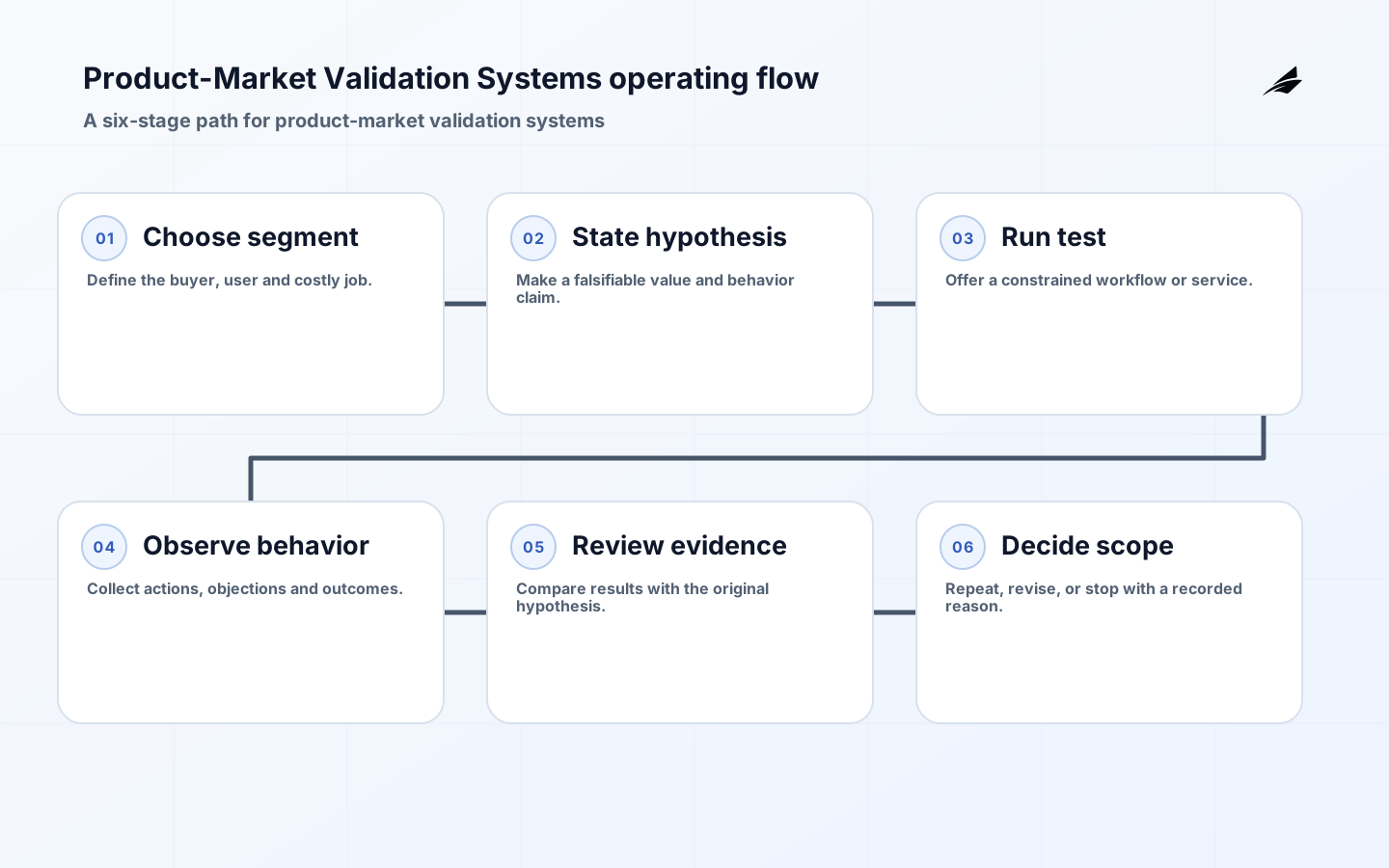
- Describe the smallest complete path from a research finding, pilot request, offer response, or completed customer task to evidence that a specific customer problem is worth solving repeatedly.
- Give every state a plain-language definition and an accountable owner.
- Record why an override is allowed, who may apply it, and how it is reviewed.
- Keep identifiers that connect the customer view, service logs, and downstream record.
- Make failed work visible in a queue instead of silently retrying indefinitely.
- Design the recovery message so a customer or operator knows the next safe action.
Build product-market validation systems controls into delivery
Security, accessibility, and reliability are part of the customer experience here. An authorization decision should be evaluated at the point an action is requested, with tenant or account context carried through services and jobs rather than inferred from a convenient client value. Logging should capture an actor, target, action, decision, and correlation reference without dumping sensitive payloads. For customer-facing steps, keyboard operation, labels, focus management, error identification, and understandable status changes are release criteria, not polish. Finally, exercise recovery in a non-production environment: restore the expected state after a malformed event, temporary dependency failure, revoked access, and staff correction. The resulting runbook is evidence that the design can be operated. For Product-Market Validation Systems: A Practical Guide for Service-Business Leaders, the controls must protect the particular outcome this workflow promises, rather than serve as a generic delivery checklist.
| Control area | Practical question | Release check |
|---|---|---|
| Authorization | Can a valid actor cross the intended boundary? | Negative tests cover role, tenant, object, and action |
| Integrity | Can retries or out-of-order messages duplicate work? | Idempotency and ordering cases are exercised |
| Accessibility | Can people complete and understand the workflow? | Keyboard and error paths are reviewed |
| Operations | Can the team locate and repair a failed case? | Runbook, alert owner, and audit trail are tested |
Review a real operating case
Validation becomes credible when a team chooses a behavior that would be expensive for the customer to fake. For a service business, a useful test may be a paid diagnostic, a scheduled handoff of source data, or a repeat use of a workflow after the first novelty has passed. Record the alternative the customer used before the test and the consequences of switching. Then compare what people said they valued with what they actually completed, paid for, or asked to repeat. A small number of well-observed cases can be stronger than a broad survey if the segment, promise, and outcome are explicit. Keep dissenting evidence in the decision log; it protects the team from rewriting history when an appealing idea fails to generalize.
Use an evidence ladder from problem to repeatable economics
Begin with observed behavior in a specific segment: recurring workarounds, delay, rework, risk, abandoned purchases, or budget already spent on alternatives. GOV.UK’s guidance on learning user needs is useful well beyond public services because it insists that needs come from research and describe the user’s problem rather than a preferred solution. Turn each assumption into a test that could change the decision. Interviews can clarify context; a priced offer, access to representative data, scheduled pilot, paid trial, renewal, referral, or expanded use provides stronger commitment evidence.
Prototype the riskiest part before building the full delivery system. The GOV.UK prototyping guidance recommends testing multiple approaches before committing to production code. For a service business, the prototype may be a manual concierge workflow, sample deliverable, limited integration, or facilitated session. Track staff time, specialist intervention, turnaround, error correction, support demand, customer action, and willingness to repeat. A pilot only validates a scalable offer when the team can explain which work will remain human, which can be standardized, and whether the economics survive without exceptional founder attention.
| Evidence level | Example | Decision it can support |
|---|---|---|
| Problem signal | Repeated workaround observed in a defined segment | Continue discovery; do not claim demand |
| Commitment | Buyer shares data, introduces stakeholders, or schedules a trial | Invest in a bounded offer test |
| Commercial proof | Customer accepts a price or pays for a pilot | Test delivery and value realization |
| Outcome proof | Customer completes the target task with measurable improvement | Refine the offer and operating model |
| Repeat proof | Renewal, expanded use, referral, or repeat purchase | Invest in repeatability and acquisition |
| Economic proof | Contribution margin remains viable after true delivery and support effort | Scale deliberately or redesign the service |
Measure the outcome, not activity
Instrument the behavior that would change the next product decision. For this guide, a central measure is rate at which a defined segment reaches and pays for the promised outcome. Pair it with a quality measure such as failed transitions, support-assisted completions, policy denials, reconciliation adjustments, or time spent in an exception queue. Segment results by the customer, plan, entry route, or tenant type that matters to the decision; a blended average can hide a damaging failure for a valuable group. Review a small set of representative records alongside the dashboard. Quantitative signals say where to look, while the underlying case reveals whether the model, interface, integration, or operating procedure needs attention.
Establish a validation evidence review
Schedule a validation evidence review while the workflow is still small enough to inspect. Bring a handful of completed records, one failure or near miss, and the measure that shows whether the intended result is improving. For product-market validation systems, examine the original hypothesis, counterexamples, and repeat behavior. Ask whether the policy was understood at the point of action, whether the durable record matches what the customer saw, and whether recovery required an undocumented workaround. The purpose is not status theater. It is to give research, delivery, and commercial teams a regular place to resolve ambiguity before it becomes an irreversible product promise. Write down the decision, owner, and next observation so the next review begins with evidence rather than recollection.
Key takeaways for product-market validation systems
- Scope the release around one accountable outcome: evidence that a specific customer problem is worth solving repeatedly.
- Model customer segment, problem statement, test offer, observed behavior, and decision log before selecting screens or integrations.
- Test the failure that matters most: teams mistake polite interviews or page views for proof of urgent, repeatable demand.
- Treat access, auditability, accessibility, and recovery as product requirements.
- Use rate at which a defined segment reaches and pays for the promised outcome to decide whether to expand the workflow.
Frequently asked questions
How much should the first release automate? Automate only the portion of a research finding, pilot request, offer response, or completed customer task whose inputs, policy, and correction path are understood; route ambiguous or consequential cases to a named reviewer. Is a dashboard enough to prove progress? No. The team needs traceable records and sampled cases showing that the measured outcome is genuine. When should the scope grow? Add adjacent paths after the core route reaches evidence that a specific customer problem is worth solving repeatedly reliably and the support team can explain exceptions. What should be documented? State definitions, decision rights, integration contracts, access rules, recovery steps, and the metric review cadence. That compact operational record is more valuable than a broad promise of future capability.
Conclusion
Product-market validation systems become dependable when the service can explain its own behavior. Define the boundary, make decisions and records explicit, build controls into the normal path, and use operating evidence to decide what changes next. That discipline gives service-business leaders a smaller but more useful release: one that can produce evidence that a specific customer problem is worth solving repeatedly, surface its exceptions, and improve without losing the trust of the people who depend on it.