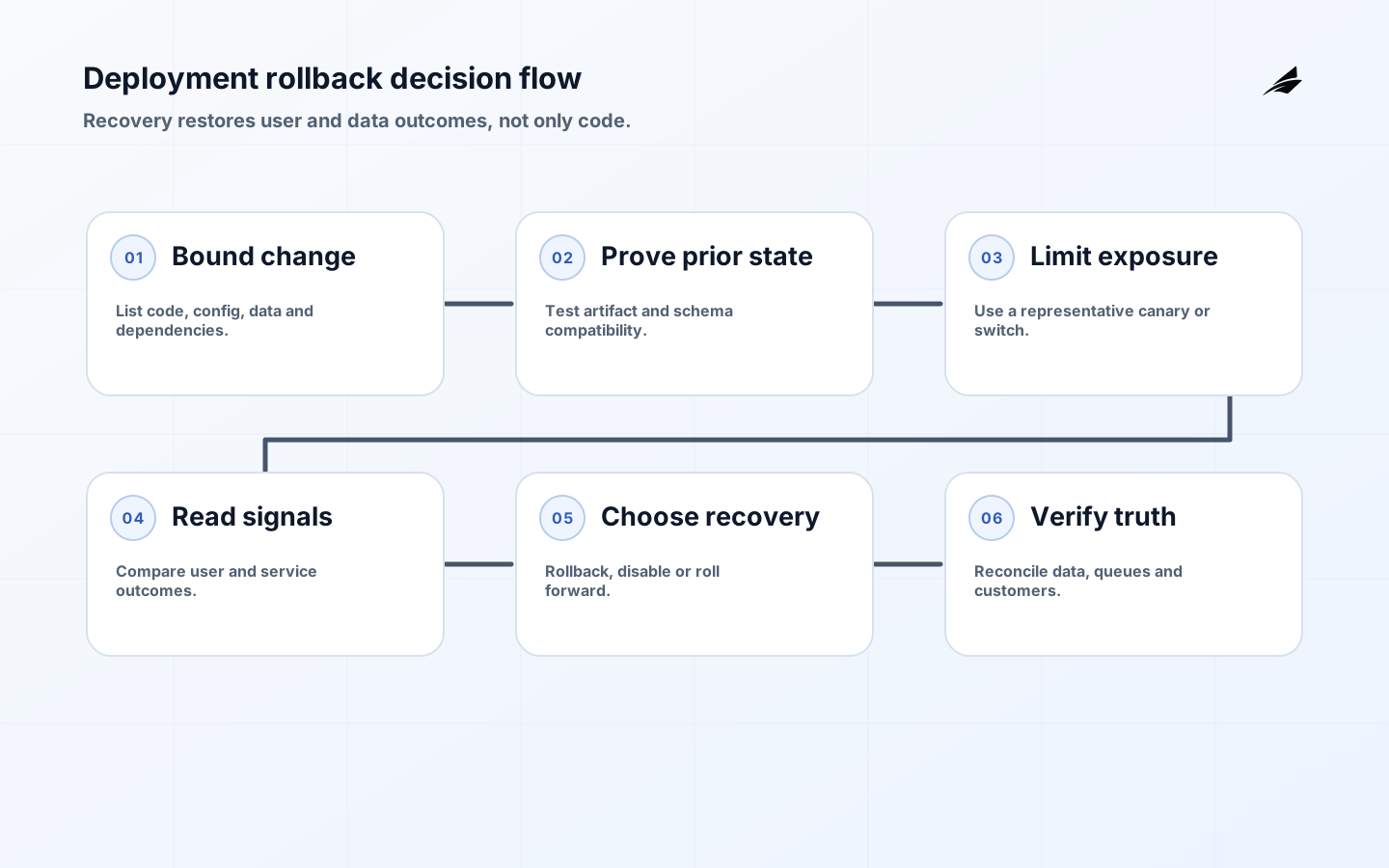
Deployment rollback plans are recovery designs for a specific change, not a generic instruction to “redeploy the previous version.” A release can modify application code, database schema, configuration, infrastructure, queues, caches, search indexes, contracts and user-visible state. Reverting only the binary may leave the system incompatible or repeat a damaging side effect. A professional plan identifies the rollback unit, known-good artifact, health signals, data compatibility, authority to stop, recovery time and verification of the customer outcome. Google SRE’s canarying guidance shows why partial exposure reduces the cost of learning from production and makes rollback more useful.
Define the rollback unit
Inventory every artifact that crosses the release boundary. Pin immutable application and infrastructure versions, configuration bundles, feature flags and migration identifiers. Record external changes that cannot be reversed by the deployment system. Kubernetes retains Deployment revisions for pod-template changes, but its Deployment documentation makes clear that scaling changes do not create a revision; database and managed-service changes are outside that rollback too. Use the rollback architecture guide to map these boundaries for distributed systems.
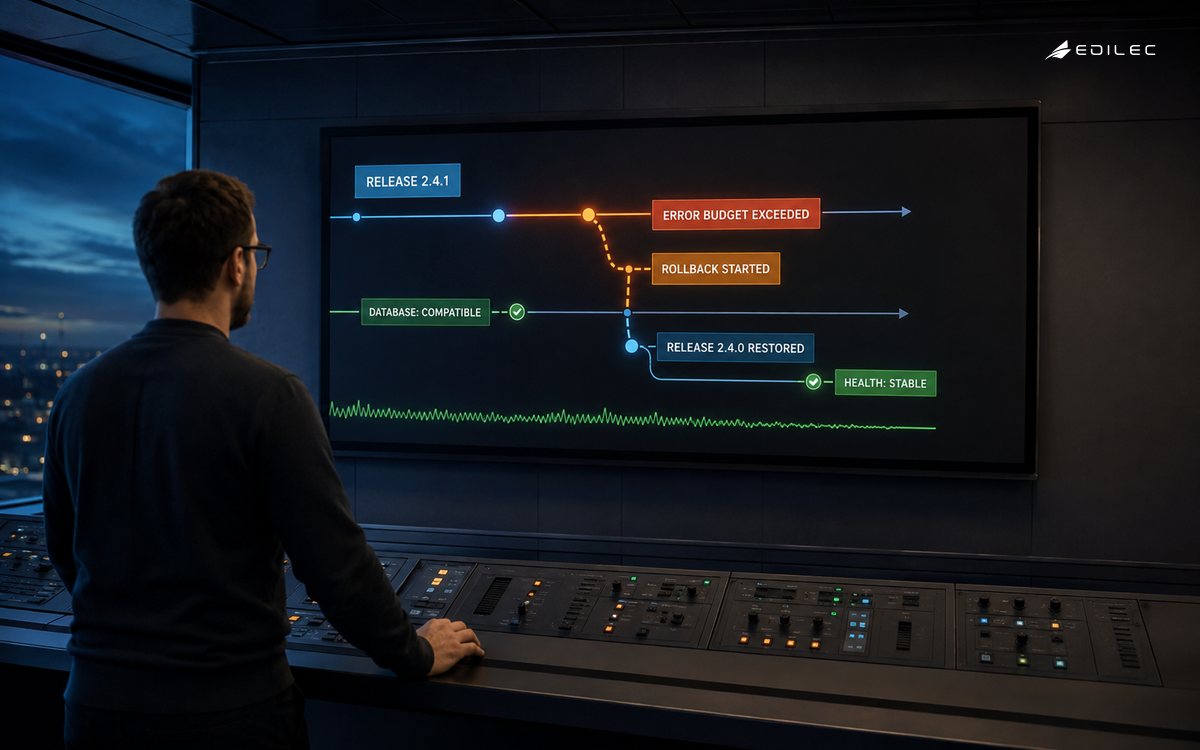
| Change type | Recovery option | Pre-release proof |
|---|---|---|
| Stateless application | Route traffic to the prior immutable artifact | Prior version starts with current dependencies |
| Configuration or flag | Restore versioned values or disable exposure | Defaults and ownership are documented |
| Database schema | Backward-compatible migration or verified restore | Old and new code work during transition |
| Infrastructure | Apply reviewed prior definition or replace immutably | State, provider and dependency versions are known |
| External side effect | Compensating action and reconciliation | Idempotency key and affected population are traceable |
Set rollback decision signals
Choose signals that represent user harm and system health before deployment. Include error rate, latency, saturation and availability, but also business outcomes such as payment completion, record reconciliation or successful authentication. Define the comparison window, minimum traffic and threshold for pause or rollback. A canary that runs for less time than its metric aggregation window gives a blurred signal. Name one release lead with authority to stop; avoid a meeting during impact. The canary security review extends this approach to authorization and data-boundary failures.
Design data changes for coexistence
Database rollback is usually the limiting factor. Prefer expand-and-contract: add compatible structures, deploy code that can read both forms, migrate data with observable progress, move writes deliberately and remove the old form in a later release. Do not rename or drop a field in the same step that releases the only reader of the new schema. Backups are not instant rollback; restoration has a recovery point, duration and reconciliation burden. Test with realistic volume, late events and repeated migrations. Where a write cannot be reversed, design a compensating business action and preserve the records needed to find every affected item.
| Gate | Question | Evidence retained |
|---|---|---|
| Ready | Can the prior version run against the intended state? | Compatibility test and artifact digest |
| Expose | Is the first cohort small and representative? | Routing rule and cohort definition |
| Observe | Are technical and business signals trustworthy? | Dashboard links and comparison window |
| Decide | Who can pause, rollback or roll forward? | Named lead and threshold record |
| Verify | Did recovery restore the user outcome? | Synthetic test and reconciliation result |
| Learn | What must change before the next release? | Incident actions and updated runbook |
Automate the runbook without hiding judgment
DORA recommends keeping deployment scripts and environment configuration in version control and making the process idempotent and automated. The rollback path should use the same authenticated pipeline as normal deployment, with a fast emergency route that still records actor, artifact and result. Automate traffic shift, artifact selection, smoke tests and notifications. Keep human judgment for ambiguous data risk and compensating actions. Practice on a schedule and after architecture changes; a runbook that has never been executed is a hypothesis.
Choose rollback, disable or roll forward deliberately
Rollback is not always the fastest safe option. A feature flag may isolate the failing behavior while preserving unrelated improvements. A roll-forward patch can be safer when new data has already been written in a non-backward-compatible form. A traffic shift may work for stateless services but not for a shared queue consumer. The decision should compare time to mitigate, confidence, data impact and reversibility. Blue-green environments make router reversal simple but double capacity and can still share databases; the blue-green mistakes guide covers those less visible dependencies.
- Keep the previous artifact available and prove it can start.
- Version feature flags and configuration with the release.
- Pause irreversible migrations before the point of no return.
- Record the affected cohort and reconcile it after recovery.
- Use normal telemetry and customer checks to verify restoration.
Finish recovery after traffic returns
A successful command is not the end of rollback. Confirm user journeys, queue depth, background work, data totals, notifications and partner state. Preserve logs and change evidence before cleanup. Communicate the current state and any remaining limitation to support and customers. Then decide whether to retry, redesign or abandon the release. AWS guidance for unsuccessful changes recommends measuring outage duration and making change data visible so recovery improves rather than becoming folklore.
Coordinate rollback across distributed services
In a distributed system, one deployment may depend on several teams and release trains. Maintain consumer-driven compatibility for APIs and events, and identify the order in which versions can safely move backward. A producer rollback can break a consumer that has already adopted a new required field; a queue consumer rollback can replay messages under old rules. Record dependency owners and a communication channel in the release plan. For tightly coupled changes, use staged compatibility and flags instead of a synchronized “big rollback.” The safest recovery may isolate one route while other services remain on the new version.
Plan for releases that cannot be pulled back
Mobile applications, firmware and customer-installed clients remain in the field after a server rollback. Support a compatibility window, feature negotiation and server-side disable controls. Do not make a new client depend immediately on a new API response that the rollback removes. For firmware, consider interrupted updates, device state and physical recovery. Publish minimum-supported versions deliberately and measure the active population before removing compatibility. The rollback plan should state what users on every supported client see, how queued work behaves and whether support can identify the affected version.
Run rollback exercises that expose assumptions
Choose a realistic change and simulate a failed health signal, an unavailable dependency and a data discrepancy. Time detection, decision, technical recovery, business verification and communication separately. Ask a responder who did not write the runbook to execute it. Confirm permissions and artifact access under incident conditions. Inject one ambiguous signal so the team must decide whether rollback is safer than a flag or roll-forward. Record gaps as owned delivery work and rerun after changes. An exercise is valuable when it changes architecture or decision clarity, not when it produces a ceremonial pass.
Write a rollback plan that can be executed
A practical plan begins with release identifier, change owner, deployment window and affected services. It lists immutable artifacts, configuration and schema changes; the prior known-good state; compatibility proof; exposure strategy; decision signals; stop thresholds; and the person authorized to act. It states the exact rollback, disable and roll-forward commands or pipeline jobs, but also the data reconciliation and customer verification after each. Add communication channels, provider contacts, support messaging and a point after which reversal becomes unsafe. Keep links to dashboards and runbooks current through automated checks where possible.
During the release, record times for start, cohort expansion, anomalies, decision and recovery. Do not edit the original approved plan to make history look cleaner; append what changed and why. If rollback occurs, capture affected users or records before logs expire, then run the verification checklist and assign follow-up actions. If it does not occur, still review whether the decision signals were timely and whether operators had the required access. This small discipline turns each release into evidence for improving the next plan rather than a sequence of undocumented instincts.
Recovery ownership should also cover scheduled and background work. A release may be healthy for interactive traffic while cron jobs, event consumers or delayed notifications continue under the failed version. Inventory these execution paths and decide whether rollback drains, pauses or replaces them. Preserve leases and checkpoints so two versions do not process the same item. Verify the next scheduled cycle after recovery and reconcile work completed during mixed-version operation. Batch and asynchronous behavior belongs in the rollback plan because its impact often appears after the release team has declared success.
Key takeaways
- Define the complete rollback unit across code, configuration, data and dependencies.
- Set decision thresholds and authority before exposure begins.
- Use compatible data evolution and compensating actions for irreversible effects.
- Automate rollback through the normal controlled pipeline and rehearse it.
- Verify customer and data outcomes after the technical state appears healthy.
Frequently asked questions
Should rollback be fully automatic?
Automatic rollback works when signals are reliable, the action is reversible and data consequences are bounded. For ambiguous or irreversible changes, automation should pause exposure and present evidence to a named decision-maker.
How many previous versions should be retained?
Retain enough to meet the tested recovery strategy and incident horizon, not an arbitrary count. Confirm artifacts, dependencies and schema compatibility; an old binary is useless if its runtime or data contract no longer exists.
How often should rollback be tested?
Test when the delivery architecture changes and on a regular schedule appropriate to release frequency and consequence. Include traffic, stateful dependencies, permissions, monitoring and communication rather than testing only one deployment command.
Conclusion
Deployment rollback plans reduce release risk when they are specific, observable and practiced. Designing compatibility and decision authority before a change lets teams recover users and data without improvising under pressure.