Infrastructure as code standards should make a cloud change easy to understand before execution and easy to investigate afterward. Formatting rules matter, but they are only the outer layer. A complete standard defines repository and module boundaries, provider and module versioning, state protection, identity, plan review, policy checks, testing, drift handling, emergency change and retirement. It also distinguishes reusable platform contracts from workload configuration so a central team does not become a ticket queue. This guide presents an operating standard that teams can adopt incrementally, with Terraform examples where the concepts are concrete but principles that apply to other declarative infrastructure tools.
Key takeaways
- Standardize the change path and evidence before policing minor syntax preferences.
- Keep state small enough to limit blast radius and protect it as sensitive operational data.
- Design versioned, composable modules with clear inputs, outputs, ownership and upgrade policy.
- Generate and review an immutable plan using short-lived workload identity and policy checks.
- Test recovery, import, drift and retirement—not only resource creation.
Define what the standard governs
List resource classes and environments that must be managed as code, exceptions that may remain manual, and the deadline for reconciling an emergency change. Cover cloud resources, identity bindings, network policy, DNS, managed databases and platform configuration where providers are reliable. Some bootstrap credentials or provider limitations may require a separate controlled path. Assign ownership for platform modules, workload roots, policy, CI runners and state. The standard should be short at the top level, with versioned examples and automated checks underneath. The Edilec guide to planning infrastructure standards helps map the organizational boundary before tool configuration.
Separate reusable modules from live configuration
A reusable module is a product contract. Give it a narrow purpose, typed and documented inputs, useful outputs, semantic versioning, examples, tests, ownership and a deprecation policy. Keep provider-specific resource details inside the module only when that abstraction remains understandable. Avoid a “company module” with dozens of booleans that builds unrelated architectures. HashiCorp’s module overview describes modules as collections of resources managed together, while its style guide recommends separating reusable module code from the live infrastructure configurations that consume it. That separation allows modules and deployments to change at different rates.
| Artifact | Owns | Review emphasis |
|---|---|---|
| Platform module | Supported infrastructure capability | Interface, defaults, security and upgrade path |
| Root configuration | One deployable environment or bounded system | Composition, environment values and blast radius |
| Policy library | Organization constraints | Rationale, exceptions and tests |
| Pipeline definition | Identity and change workflow | Plan integrity, approvals and artifacts |
| Runbook | Failure, import and recovery | Commands, authority and verification |
Design state boundaries around ownership and failure
State links declared resources to real objects and may contain sensitive values. Protect it with encryption, access control, locking, versioning and recovery. Do not commit it to version control or expose it broadly for convenience. HashiCorp’s state documentation recommends a remote backend for collaboration and warns against storage that lacks state locking and secure access. Divide state where ownership, lifecycle, privilege or blast radius differs—for example, shared network foundations, cluster platforms and individual applications. Avoid one state file for an entire company, but also avoid tiny fragments that create a fragile web of remote-state dependencies.
Prefer provider data sources, explicit published outputs or a configuration registry over granting broad read access to another team’s full state. Define backup and restore, and rehearse it in a disposable environment. Importing an existing resource should include ownership confirmation and a plan showing no unintended replacement. State moves and refactors need peer review and a rollback plan because a syntactically correct address change can still detach or recreate a critical object.
Make configuration legible and constrained
Run canonical formatting and validation automatically. Require provider and module version constraints, descriptions and types for variables, descriptions for outputs, meaningful resource names and minimal use of dynamic indirection. Use validation, preconditions and postconditions for assumptions that can be checked close to the configuration. Keep secrets out of literals and remember that marking a value sensitive controls display, not whether it enters state. HashiCorp’s current Terraform style guide includes repository, variable, output, module, state-sharing and testing recommendations; use it as a baseline, then record the few organization-specific rules that materially reduce risk.
Standardize the pull-request change path
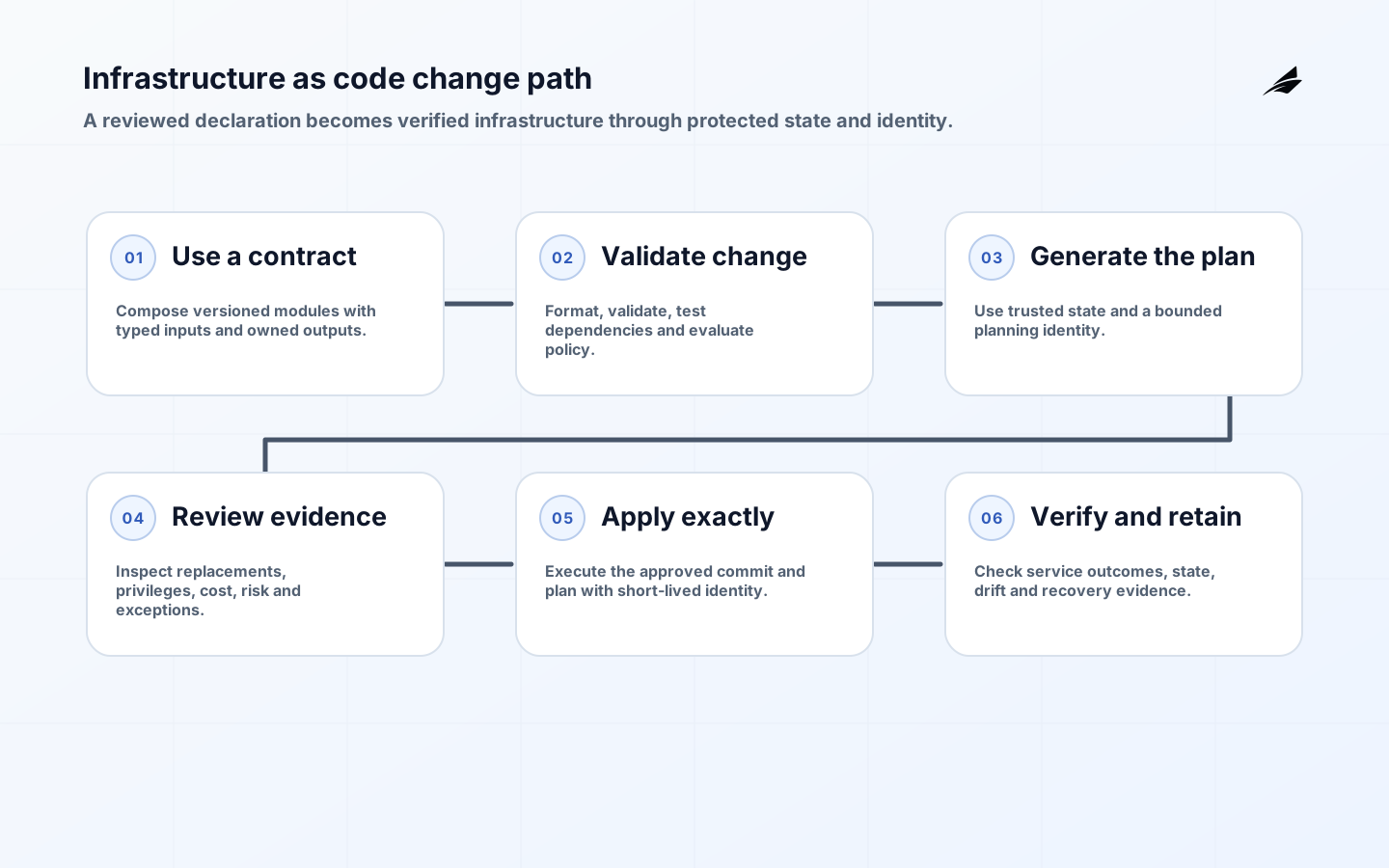
Every production change should connect a reviewed commit to a generated plan and an apply result. CI formats and validates, initializes from a locked dependency set, runs static and policy checks, executes tests, and generates a plan under a read-only or planning identity. Store the plan and machine-readable summary as review artifacts. Apply only the reviewed commit through a protected environment with short-lived credentials, then record result, state version and verification. Avoid copying plan output into chat or regenerating it after approval without showing the difference. Large plans should be split by design boundary rather than accepted because no reviewer can read them.

| Pipeline gate | Question | Evidence |
|---|---|---|
| Validate | Is configuration internally coherent and formatted? | Tool output tied to commit |
| Supply chain | Are providers and modules approved and pinned? | Lock file, provenance and scan |
| Test | Do module behavior and critical assertions hold? | Unit or integration results |
| Policy | Does the plan satisfy required constraints? | Versioned policy decision |
| Review and apply | Is this exact plan authorized and executed? | Approver, immutable plan and apply record |
| Verify | Did the service and control outcome remain healthy? | Post-apply checks and telemetry |
Test behavior and policy at several layers
Syntax validation cannot prove that a module creates a recoverable database or a private service. Test variable validation and outputs quickly, run module tests in isolated accounts, evaluate representative plans against policy and exercise critical end-to-end stacks on a schedule. HashiCorp’s Terraform test documentation supports test files with run blocks and assertions. Add organization-specific checks for public exposure, encryption, logging, backup, identity, region and mandatory metadata. Policies need tests for allowed, denied and exception cases, plus owners who can revise them when architecture changes.
Treat infrastructure code as software supply chain material. Review provider and module origin, pin versions, retain lock files where applicable, scan dependencies and restrict CI credentials. The NIST Secure Software Development Framework provides practices for preparing the organization, protecting software, producing well-secured software and responding to vulnerabilities. Apply those practices to modules, pipeline actions and provider plugins, not only application packages.
Handle drift and emergency work explicitly
Schedule read-only plans or provider inventory checks and route material drift to an owner. Do not auto-apply every detected difference: drift may reflect an incident action, provider normalization or a resource created by another authority. Investigate, then import, codify, revert or document the exception. Emergency change should use controlled break-glass identity, a time-bound reason and immediate evidence capture. Reconcile the code and state before routine delivery resumes. Track repeated exceptions; they often reveal a missing module capability or an operating process that the standard does not yet support.
Adopt standards without freezing teams
Start with a reference workload and a small set of enforceable rules: remote protected state, reviewed plans, pinned dependencies, no long-lived CI credentials and ownership metadata. Publish paved-road modules for common capabilities, but allow a documented route for legitimate variation. Measure adoption, plan lead time, failed applies, drift age, policy exceptions, recovery success and module upgrade lag. The infrastructure standards operations checklist can support periodic review, while the Terraform module security review covers third-party adoption in more depth.
Practical review checklist
- Publish a reference repository that demonstrates the supported module, root configuration, state, test, policy, plan, apply and verification path. Keep it executable so guidance cannot drift into screenshots and prose.
- Define service levels for the platform capabilities behind infrastructure delivery: CI runners, state backend, identity federation, provider registry and policy service. Teams need a documented fallback when a shared control is unavailable.
- Require module maintainers to publish compatibility, upgrade and deprecation information. Consumers should know the supported provider versions, whether an update replaces resources and how long a superseded major version receives security fixes.
- Exercise state restoration, resource import and a failed apply in a disposable account. Capture the permissions and commands responders need, and verify that recovery does not depend on one person’s local configuration.
- Review standards quarterly against incidents, policy exceptions and delivery data. Remove rules that do not improve risk or readability, and turn recurring manual review comments into automated checks with clear error messages.
Frequently asked questions
Should all infrastructure code live in one repository?
Not necessarily. Choose boundaries that preserve clear ownership, independent lifecycle and manageable review. A monorepo can improve discoverability and coordinated changes, but its pipelines and permissions must remain scoped. Separate repositories can improve isolation while making cross-cutting upgrades harder. The standard should define either supported shape and its evidence.
Should cloud console changes be forbidden?
Routine changes should flow through code. Emergency console work may be necessary, but it needs a break-glass identity, captured reason, bounded authority and rapid reconciliation. Read-only console access can remain useful for investigation if permissions and audit are appropriate.
Conclusion
Infrastructure as code standards are effective when they govern the whole change lifecycle. Clear modules, protected state, readable plans, short-lived identity, layered tests, policy evidence, drift response and rehearsed recovery let teams move quickly without making cloud change opaque. Begin with the controls that improve real decisions, automate them, and evolve the standard from incidents and adoption evidence.