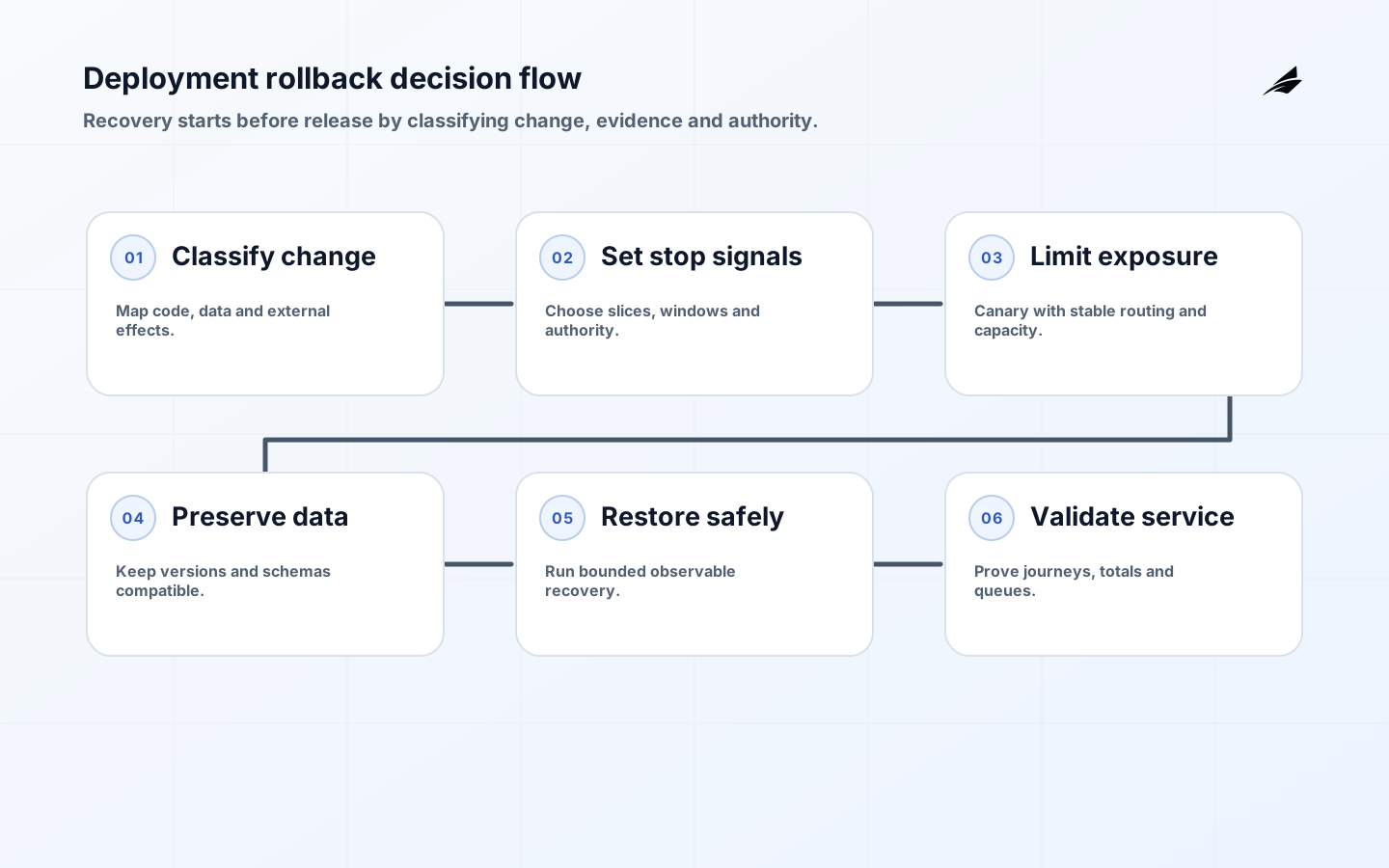
Deployment rollback plans are pre-agreed recovery decisions, not a command copied into a release ticket. They identify which parts of a change are reversible, what customer and system signals should stop progression, who can decide, how data remains compatible, and how the team proves the prior service state is healthy. Without that preparation, “roll back” can create a second incident.
Use this guide with Edilec's deployment rollback design guide, pre-release rollback planning guide and staging environment design guide. Together they connect architecture, test evidence and operator authority.
Key takeaways
- Classify code, configuration, schema, data and external side effects separately for reversibility.
- Choose stop and rollback conditions from user impact and service objectives before release.
- Keep old and new versions interoperable during the rollback window.
- Automate mechanical recovery while preserving explicit authority for ambiguous business decisions.
- Verify customer journeys and data consistency after rollback, not process completion alone.
Classify what can actually be reversed
Decompose the release into application artifact, configuration, infrastructure, database schema, data transformation, queue or event contract, cache, client and third-party changes. For each component, record the previous version, compatibility window, recovery action and irreversible effects. Sending an email, charging a card or publishing an event cannot be undone by redeploying old code. Those effects need idempotency, compensation or human resolution.
Configuration deserves the same discipline as code. Google SRE's configuration design guidance notes that rollback reduces incident duration and that hermetic configuration is easier to move backward and forward. Store production configuration in version control, remove mutable external references where possible, and test that operators retain control after a bad network or identity rule.
| Change type | Rollback pattern | Main hazard | Required proof |
|---|---|---|---|
| Stateless code | Redeploy prior artifact | Old version cannot read new state | Compatibility test |
| Feature behavior | Disable flag or route | Flag does not stop side effects | Journey and event test |
| Database schema | Expand, migrate, contract | Destructive change | Old/new read-write test |
| Data correction | Compensating migration | Lost provenance | Reconciliation |
| External action | Compensation or manual case | Action is irreversible | Owned recovery queue |
Define stop conditions and decision rights
Write release invariants: authentication succeeds, checkout completes, error budget burn stays below a threshold, financial totals reconcile, and no critical security control is bypassed. Select leading technical signals and lagging business signals. Define observation periods and minimum sample sizes. A single global error rate can hide a severe regression in one region, browser, tenant or payment route, so specify slices that must remain healthy.
Name the release commander, service owner, database owner and business validator. State who can pause, roll back, roll forward or accept degraded operation. Automation may halt a rollout on an unambiguous threshold; a person should decide when signals conflict or rollback carries greater risk. Record communication routes and what the customer-facing team should say. Decision authority must remain available outside normal hours.
Limit exposure with progressive delivery
Separate deployment from broad exposure. Release to an internal environment, a small production cohort, a region or a controlled traffic percentage. Compare the new version with a meaningful control. Google SRE defines canarying as a partial, time-limited deployment and evaluation used to decide whether to proceed. A canary reduces the population exposed while the team learns; it does not make weak telemetry safe.
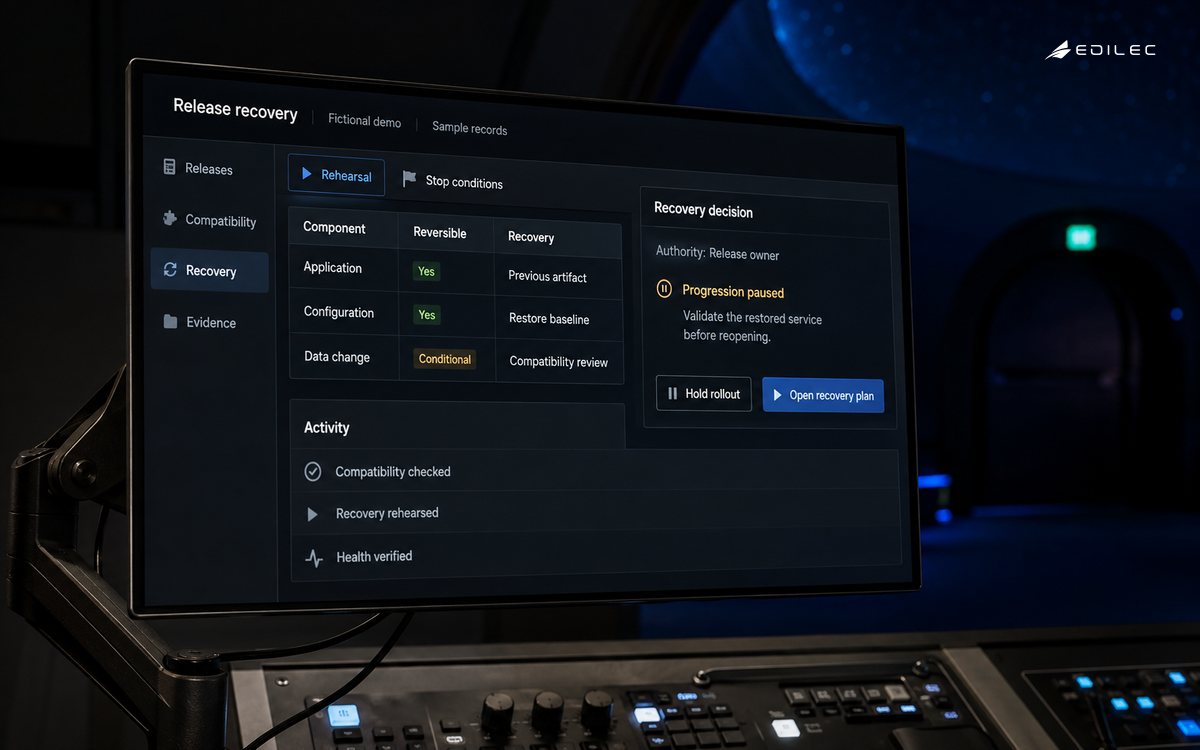
Route consistently when user sessions or workflows span requests, and consider background jobs and events that bypass the primary router. Preserve enough old capacity for the rollback window. Pause between stages long enough to observe the risks that matter. Avoid automatically promoting at the end of a timer when required business evidence is missing. The safest default is no progression without a positive gate.
| Gate | Entry evidence | Stop signal | Recovery action |
|---|---|---|---|
| Pre-production | Compatibility and restore tests | Critical scenario fails | Fix before release |
| Internal | Known build and telemetry | Access or data defect | Disable and investigate |
| Small cohort | Representative traffic route | Slice objective breached | Route cohort back |
| Broad rollout | Canary and business validation | Error-budget burn or reconciliation gap | Pause or roll back |
| Completion | Stable observation and clean queues | Late side effect appears | Forward repair or compensate |
Protect data and interface compatibility
Prefer expand-and-contract database change: add compatible structures, deploy code that works with both, migrate and verify data, switch reads or writes, then remove old structures after the rollback window. Avoid renaming or dropping fields in the same release that adopts the replacement. Keep migration checkpoints, backups and restore instructions, but recognize that restoring a database can discard valid transactions created after the release.
Version events and APIs compatibly. Old consumers may receive new messages during rollback; new consumers may have written states old code cannot interpret. Test mixed-version operation and delayed messages. Freeze irreversible maintenance during a risky release when possible. If rollback cannot preserve data, call the plan forward repair and define the patch, compensation and customer remediation path honestly.
Automate a bounded, observable rollback
A rollback workflow should identify the target revision, verify artifact provenance, change traffic or deployment, report progress, prevent concurrent releases and preserve an audit trail. Kubernetes Deployment documentation explains rollout history and rollback behavior, including that a Deployment revision covers the Pod template rather than every external dependency. Test the exact orchestration and understand what it does not restore.
Make recovery idempotent and interruptible. Operators need status for traffic, replicas, migrations, queues and feature controls. Do not hide raw failure behind a generic pipeline result. Keep a manual method for control-plane outage, with credentials and instructions tested under secure break-glass procedures. Automation should reduce toil, not remove situational awareness.
Validate the recovered service
After the mechanism completes, run synthetic and real-traffic checks for critical journeys, compare business totals, inspect queues and verify version distribution. Confirm customer-visible state, access controls and downstream effects. Trace release markers through the service using a common telemetry foundation such as OpenTelemetry. Maintain a distinct “rollback complete” state only after service validation, not when the deployment command exits.
Practice in production-like conditions and periodically in production with a low-risk change. The DORA continuous delivery capability emphasizes keeping software deployable and making low-risk changes on demand. Record recovery time, manual steps, unclear authority, missing telemetry and data inconsistencies. Feed findings into architecture and runbooks rather than merely updating the drill date.
Include configuration and third-party dependencies
Many releases change more than application code. Feature flags, secrets, identity policy, CDN rules, queue settings, scheduled jobs, search indexes and vendor configuration can determine behavior. Record the intended version or value for each consequential dependency and include it in the release timeline. Confirm whether configuration changes are versioned, how propagation works and whether old application versions can tolerate the new value. A code rollback that leaves a restrictive permission or incompatible flag in place may deepen the outage.
For external APIs and SaaS dependencies, understand whether the release creates irreversible state outside your boundary. A payment, message, shipment or identity change may already have completed when the application fails. Use provider idempotency support where available, preserve external identifiers and define compensation. Simulate timeout after commit and delayed webhook delivery. The recovery plan should tell operators whether to retry, query status, compensate or escalate; guessing during an incident risks duplicate customer impact.
Feature controls need their own governance. Name the owner, eligible population, default state, dependencies and expiration. Test both enabled and disabled paths in production configuration. Keep an emergency disable route separate from the primary deployment system when that system is a plausible failure point, but protect it with strong identity and audit. Remove stale flags once the rollback window closes so future releases do not inherit unknown combinations.
Finally, rehearse a rollback when one dependency cannot be reversed. This forces the team to identify a safe mixed state, forward repair or temporary operating restriction. Document customer communication and data reconciliation for that case. A plan that succeeds only when every supplier and control plane behaves normally is a deployment script, not a resilience strategy. Capture the actual time for detection, decision, execution and validation separately. Those intervals point to different improvements: telemetry, authority, automation or business verification.
Keep rollback readiness visible at release review. Show the last successful exercise, current compatible revision, remaining old-version capacity, migration status and any expired credentials or flags. Block progression when the recovery path has silently aged out. This is especially important for low-frequency services, where months may pass between releases and the documented command may no longer match the runtime. Verify the evidence again immediately before a consequential production change.
Rollback plan review checklist
- Every release component and side effect has a documented reversibility class.
- Old and new code, schema and messages interoperate during the recovery window.
- Stop signals include critical user and business slices, not only infrastructure health.
- Decision makers, communication and break-glass access are available.
- The workflow is idempotent, observable and tested with realistic failure.
- Completion requires journey, data and downstream validation.
Frequently asked questions
Should every failed metric trigger automatic rollback?
No. Automate when the signal is reliable and rollback is clearly safer. Pause and involve a decision maker when telemetry may be faulty or data compatibility makes reversal risky.
When is roll-forward better?
When state has changed irreversibly, a small understood fix is safer than restoring old behavior, or customers depend on a new contract. Prepare and test forward-repair paths for these cases.
Is a backup a rollback plan?
No. A backup protects data, while rollback coordinates application, configuration, traffic, schemas and side effects. Restoring data also needs recovery-point and transaction-loss decisions.
Conclusion
Deployment rollback plans reduce risk when architecture, evidence and authority are prepared before release. Classify reversibility, limit exposure, protect mixed-version data, automate bounded recovery and validate the restored business service. A rollback is successful only when customers and operators can rely on the recovered state.