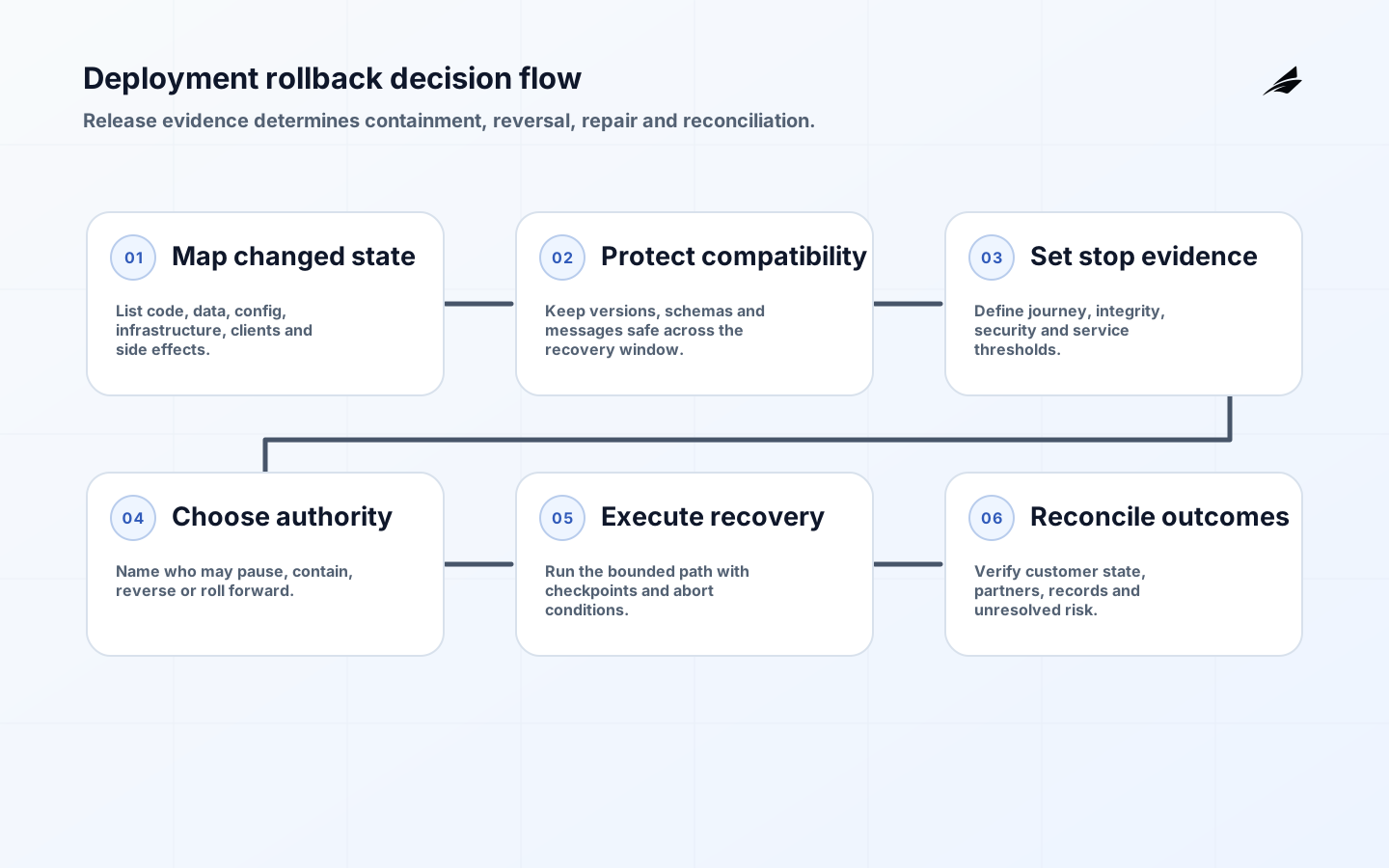
Deployment rollback plans should answer a business question under pressure: what is the safest way to restore an acceptable customer outcome after a change behaves badly? Reinstalling a previous binary may be one action, but it does not reverse a database migration, an email already sent, an external payment, an entitlement change or corrupted state. A professional plan identifies the release unit, affected journeys, compatibility window, irreversible effects, stop signals, decision authority, execution steps, reconciliation and proof of recovery. This checklist turns those elements into reviewable evidence before production, so the team is not inventing policy while users are already affected.
Key takeaways
- Define rollback per release and service; a generic runbook cannot capture every data and dependency boundary.
- Separate rollback, roll forward, traffic removal, feature disablement and containment as distinct recovery options.
- Choose stop conditions and an authorized decision maker before exposure begins.
- Verify business state and reconcile side effects after technical service restoration.
- Rehearse the plan with production-like data shape, identity and observability.
Map what the release changes
List code, configuration, schema, data backfill, infrastructure, queues, caches, APIs, clients, flags and third-party behavior. For each, record whether an older version can coexist with the new state and for how long. A Kubernetes Deployment revision, for example, covers changes to the Pod template; the official Deployment documentation notes that rolling back restores that template revision, not every external effect. That distinction should appear in the plan. Link each component to an owner and verification method, and identify changes that require a roll-forward repair rather than a mechanical revert.
| Change type | Rollback question | Safer preparation |
|---|---|---|
| Application binary | Can the previous version read current data and messages? | Backward-compatible contracts and immutable artifacts |
| Database schema | Are writes reversible without loss? | Expand-and-contract migration plus backup evidence |
| Configuration or flag | Will reversal restore all affected cohorts? | Versioned config and exposure audit |
| External side effect | Can it be cancelled, compensated or reconciled? | Idempotency key and compensation procedure |
| Infrastructure | Will state and dependencies survive reversal? | Reviewed plan, import path and recovery test |
Define production stop conditions
Use a small set of signals tied to customer and control outcomes: failed checkout rate, incorrect authorization, data-integrity check, queue age, elevated error ratio, latency objective, support reports or a security event. State thresholds, observation windows and segmentation by release cohort. Avoid relying only on host health. A canary can limit exposure and compare a candidate with a control; Google’s Canarying Releases explains that gradual exposure can spend less error budget while producing evidence. The plan must also say when weak or contradictory evidence requires a pause rather than continued expansion.
Assign decision authority and communication
Name the release commander or service owner who can pause, roll back, roll forward or invoke containment. Define which security, data or business owners must join for their failure class without creating a committee for every routine reversal. Record the decision, evidence, time and chosen path in the incident or release system. Prepare internal and customer communication templates but write the actual message from observed facts. The Edilec guide to release management helps connect this authority to the broader change calendar and customer commitment.
| Condition | Default action | Required confirmation |
|---|---|---|
| Candidate violates SLO with no data effect | Stop exposure and restore known version | Journey metrics return to expected range |
| Schema incompatibility detected | Stop writes; choose compatible roll forward or restore | Integrity checks and version compatibility |
| Incorrect external action occurred | Contain and run compensation | Partner record reconciles with internal ledger |
| Security boundary failure | Contain access and begin incident process | Authorization and evidence preserved |
| Signal is ambiguous | Hold rollout and investigate cohort | Owner records decision and next observation |
Design data recovery and reconciliation
For every write path, identify source of truth, transaction boundary, replay behavior and reconciliation query. Backups are useful only if restoration time and data loss fit the service obligation. Prefer backward-compatible schema changes: add fields, deploy tolerant readers and writers, backfill, then remove old structures after the rollback window closes. For messages, preserve stable event IDs and make consumers idempotent. If a release changed prices or permissions, compare authoritative records with downstream systems and customer-visible state. A green deployment status is not proof that the business is repaired.
Write an executable, bounded runbook
The runbook should identify exact artifact versions, commands or pipeline actions, required access, prerequisites, expected duration, checkpoints, abort conditions and verification. Prefer automated, peer-reviewed actions over commands copied from memory, but retain a manual path if automation itself is unavailable. Do not embed long-lived credentials. Make logs and artifacts available to the responder and protect destructive steps with explicit confirmation. The related deployment rollback planning guide provides a design-stage companion to this production checklist.
Rehearse beyond a happy path
Test a failed canary, a partially completed migration, a duplicate message, loss of an integration, a stale client and an operator arriving without prior context. Measure detection, decision and execution time separately. Confirm that on-call staff can find the plan and access the required pipeline. Google’s on-call guidance warns that rollback may be necessary but insufficient when a change corrupts data. Include the business validation and reconciliation in the exercise, then update the plan from observed friction.
Report evidence that improves future releases
After a reversal, report affected cohort, detection source, time to stop exposure, time to restore service, reconciliation status, customer effect and unresolved risk. Preserve the exact release artifact, configuration and telemetry. Avoid ranking teams by rollback count; frequent safe reversals can indicate strong detection and small changes. DORA’s small-batch guidance emphasizes independently deployable, testable changes whose feedback begins in production. Review which release size, dependency or missing signal made recovery harder, and fund that improvement.
Practical review checklist
- Attach the rollback plan to the exact release artifact and change set. Verify that responders can identify the previous known-good version, retrieve it from trusted storage and deploy it without rebuilding from a mutable branch.
- List database and message compatibility for at least one version before and after the candidate. State which readers and writers may coexist, when old code becomes unsafe and which migration step closes the reversal window.
- Prepare synthetic checks for the complete business journey and run them before, during and after reversal. Include authorization, data correctness and external integrations rather than relying on container health or HTTP status alone.
- Record every irreversible or compensating action, including customer communications, payments, notifications and partner updates. Assign an owner and reconciliation query so partial completion is visible after service restoration.
- Time the decision and execution in rehearsal. If access, approval or artifact retrieval dominates recovery time, improve that operating path before optimizing deployment commands.
- Keep a current contact and communication map for service, data, security, support and business owners. During an incident, communicate observed impact, current containment and next update time without speculating about cause.
A worked operating example
Consider a release that changes an order API, adds a database column and emits a new fulfillment event. Reverting only the API may restore request handling while leaving new rows and messages that old consumers interpret incorrectly. Before release, the team should prove that old and new readers tolerate both schemas, that event consumers ignore unknown fields, and that duplicate delivery is safe. The stop condition should compare completed orders and fulfillment acceptance by release cohort. If reversal occurs, operators restore traffic, pause incompatible consumers, run an integrity query and reconcile partner acknowledgements. The decision record then distinguishes customer recovery from the later root-cause fix. This example is why rollback planning must follow a business transaction through storage and partners rather than end at the deployment platform. The technical rollback design guide expands this architecture view. A reporting owner should keep the incident open until unexplained order differences are resolved, even if latency and error charts have returned to normal.
Frequently asked questions
Is roll forward better than rollback?
Neither is universally better. Rollback is attractive when the previous version remains compatible and side effects are limited. Roll forward may be safer when data has changed or the defect is understood and a small fix can restore consistency. The plan should precompute both boundaries and let evidence guide the choice.
Do feature flags replace rollback plans?
No. Flags can reduce exposure and disable behavior independently of a binary, but they introduce configuration state and may not reverse completed actions. Track flag ownership, cohorts and removal, and include flags as one recovery mechanism inside the plan.
Conclusion
Review this boundary before every material release and after every exercise.
Reliable deployment rollback plans cover more than an old artifact. They map every changed state, define stop evidence and authority, preserve compatible paths, reconcile external effects and prove the customer outcome after recovery. Rehearsing that full path turns rollback from a hopeful command into a governed production capability.