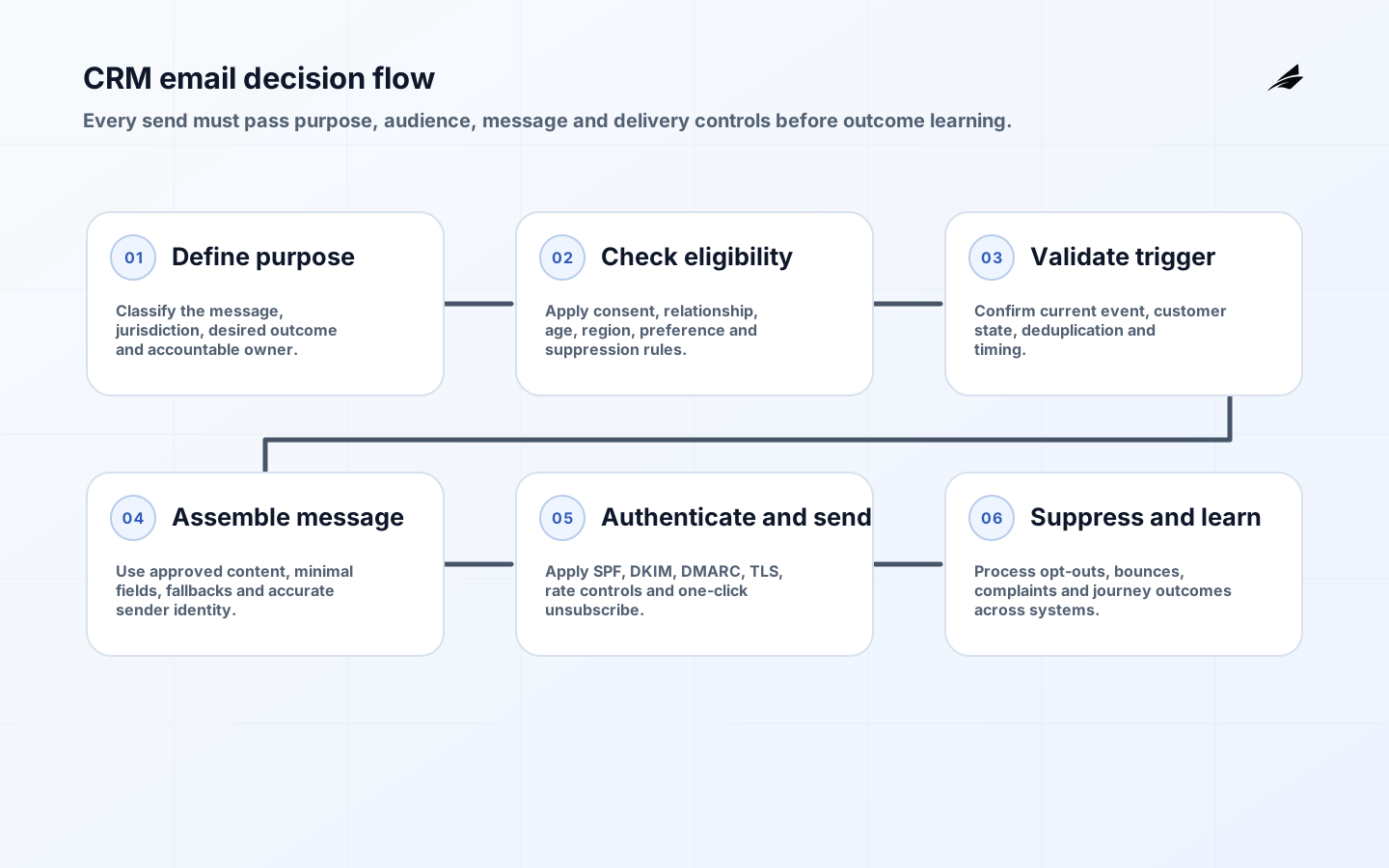
CRM email automation turns customer events and records into timed messages, but a trigger is not permission and a populated field is not necessarily trustworthy. A dependable program decides whether a message may and should be sent, assembles only the approved content, authenticates delivery, honors preferences everywhere and measures the customer outcome. The workflow must distinguish marketing from transactional or service communication because rules, expectations and suppression behaviour differ.
This CRM email automation FAQ supports the implementation checklist, scope and delivery plan and readiness checklist. Legal advice is jurisdiction-specific; use counsel to confirm the rules for audiences and markets in scope.
Which emails should be automated?
Start with a customer need and a reliable event: account verification, receipt, delivery update, renewal reminder, abandoned application or requested content. Define the message purpose, expected action, timing, stop conditions and owner. Keep promotional material out of urgent service notifications unless reviewed for the applicable rules and customer expectation. Automate a small number of high-confidence journeys before creating a web of overlapping campaigns.
Classify each template and trigger as transactional, relationship, marketing or mixed, with jurisdiction and audience type. The FTC CAN-SPAM guide explains that U.S. requirements cover commercial email, including business-to-business messages, and that primary purpose matters for mixed content. The sender remains responsible when another company handles delivery.
| Message type | Typical trigger | Key control |
|---|---|---|
| Transactional | Purchase, security or account event | Keep content necessary and routing information accurate |
| Lifecycle marketing | Eligible customer reaches journey state | Permission, preference, frequency and easy opt-out |
| Sales follow-up | Documented request or qualified relationship | Purpose, regional rule, suppression and human ownership |
| Operational alert | Service state affects the customer | Verified event, severity, clear action and status source |
How should consent and preferences be modeled?
Store the evidence, not a single boolean: subject, address, purpose, channel, brand, wording or version, method, time, source, jurisdiction, status and withdrawal. Keep service communication preferences separate from marketing. Apply the rule that was valid when the send decision occurred and retain enough history to explain it. Imported lists need provenance and compatible permission; purchased addresses create legal, trust and deliverability risk.
The ICO electronic-mail marketing guidance was updated in April 2026 and explains UK PECR requirements in detail. Build regional policy as configurable rules reviewed by counsel, not assumptions embedded in campaign names. A lawful basis for processing personal data does not automatically satisfy a separate electronic-marketing rule.
What architecture keeps CRM email automation reliable?
Separate customer and consent records, event ingestion, eligibility decision, journey state, template and content approval, personalization, sending provider, webhook processing and analytics. Give each message a stable journey ID, recipient decision ID and idempotency key. The eligibility service should evaluate current consent and suppression at send time, not only when the customer entered a journey days earlier.
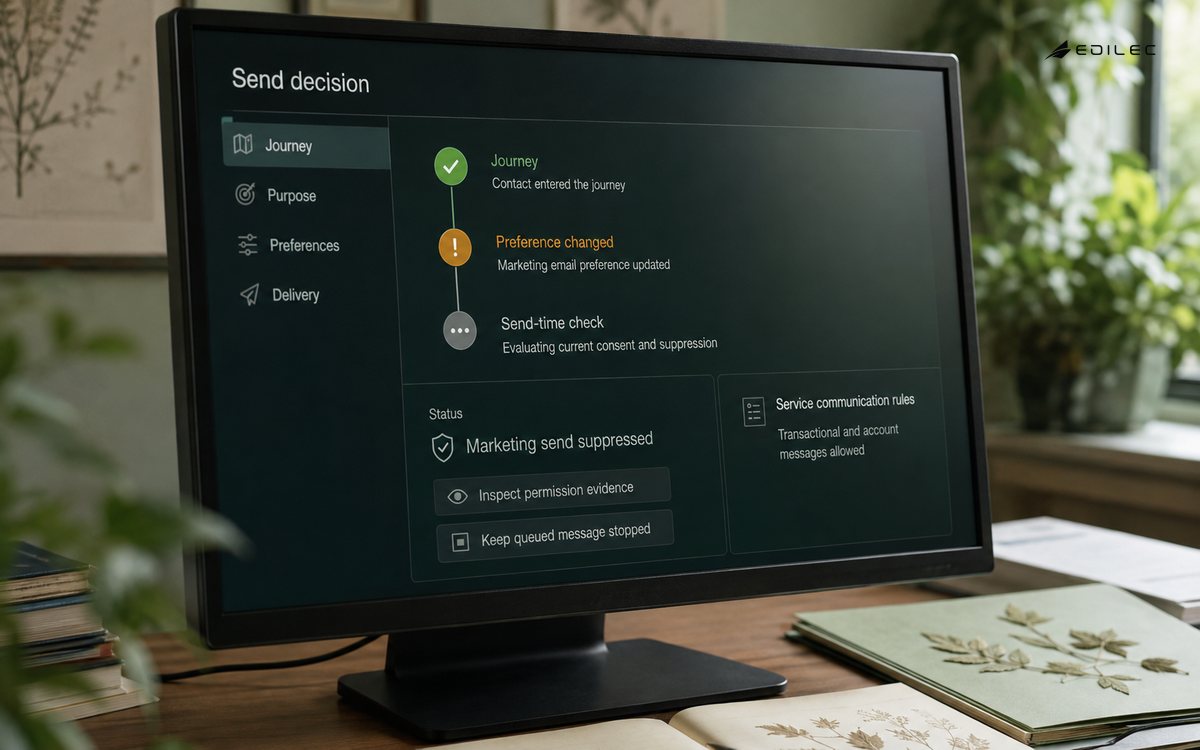
Treat events as assertions that need validation. Confirm source, schema, event time, customer match and whether a later event supersedes them. A paid invoice should cancel a reminder; a returned order should stop a review request. Persist journey state so retries do not send duplicates. Send transactional and promotional streams through appropriately separated identities and reputation controls.
| Failure mode | Preventive control | Recovery |
|---|---|---|
| Duplicate send | Idempotency key and journey state lock | Suppress retry and record one outcome |
| Wrong recipient | Verified identity match and field provenance | Pause journey, contain data and run incident process |
| Stale personalization | Freshness check and safe fallback content | Remove field or switch to generic approved copy |
| Late opt-out | Central suppression checked at send time | Stop all queued sends and reconcile providers |
| Event storm | Rate, frequency and anomaly controls | Pause trigger and drain queue under review |
What technical deliverability controls are required?
Authenticate every sending domain and align visible identity with technical identity. Google’s email sender guidelines require SPF or DKIM for all senders to personal Gmail accounts and SPF, DKIM and DMARC for senders above its bulk threshold, alongside DNS, TLS, message format and spam-rate requirements. The page also requires one-click unsubscribe for marketing and subscribed bulk messages. Monitor the sender-guidelines FAQ because enforcement evolves.
Warm new domains and traffic patterns gradually, separate message categories, process bounces and complaints promptly, and never use deceptive subjects or display names. Implement RFC 8058 correctly: one-click uses signed List-Unsubscribe and List-Unsubscribe-Post headers with an HTTPS endpoint. Keep a visible body link too. Test authentication alignment and headers from actual delivered messages, not only configuration screens.
How should personalization and content be controlled?
Use approved templates with version, owner, locale, purpose and expiry. Allowlist fields and transformations; escape untrusted values; provide fallbacks; and preview representative records including missing and long data. Sensitive attributes should not appear merely because the CRM holds them. Avoid inferring personal circumstances for persuasive messaging without an assessed and permitted purpose.
Test subject, preheader, sender, plain-text alternative, links, tracking, mobile layout, dark mode and accessibility. Use a seed group and controlled canary before a large send. Experiments need a hypothesis, sample rules, guardrails and stopping condition. Do not optimize clicks by making identity, urgency or unsubscribe deceptive. Customer trust and complaint rate are product outcomes.
How are suppression, incidents and change managed?
Create one suppression service or a rigorously synchronized source that covers brands, systems and providers. Process unsubscribe immediately in the customer experience and within applicable legal deadlines; preserve a minimal suppression record so deleted contacts are not reimported and mailed. Reconcile provider webhooks, CRM state and queued journeys. Define ownership for hard bounces, complaints, block listings and authentication failures.
Playbooks should cover wrong audience, exposed personal data, duplicate campaigns, compromised sending credentials, sudden complaint increase and provider outage. Make it possible to pause one journey, template, region or sender. Require review for changes to eligibility, frequency, template purpose, domains and providers. Keep an audit trail of who approved content and policy.
Which measures matter beyond open rate?
Open tracking is incomplete and privacy features can distort it. Focus on delivered eligible messages, customer action, conversion or task completion, unsubscribe, complaint, bounce, support contact, duplicate rate, suppression latency and downstream value. Use holdouts where appropriate to estimate incrementality. Segment by journey and sender; aggregate success can hide one damaging automation.
Track operational health: event delay, queue age, eligibility rejection reasons, webhook lag, authentication pass, provider deferrals and cost per achieved outcome. Review frequency across all journeys from the customer perspective. A campaign can meet its own target while the combined program overwhelms the recipient.
Design preference experiences around understandable choices. Let people see which brands, topics and channels they are subscribed to, change them without signing up again, and distinguish marketing from necessary account communication. Confirm changes immediately and propagate them to queued journeys and downstream providers. Avoid manipulative controls, hidden defaults and repeated confirmation prompts. Preference data is part of the customer record and needs the same access, audit, correction and retention discipline as other personal information.
For migration, compare contact identities, consent evidence, suppression lists, template versions, journey state, custom fields and provider events before cutover. Run old and new decision logic against a controlled sample and investigate disagreements. Freeze nonessential campaign changes during the transition, drain or deliberately recreate queues, and reconcile unsubscribe events after the final legacy send. Keep the old provider able to process late bounces and complaints until all relevant messages have aged out.
Establish a content and policy review cadence. Legal owners review regulatory classifications and claims; security owners review domains and access; brand and accessibility specialists review templates; journey owners review performance and fatigue. Emergency service messages need a preapproved path that does not accidentally inherit marketing tracking or suppression rules. Archive retired variants so an incident can reconstruct exactly what a recipient received.
Apply least privilege to campaign builders, data selectors, template approvers and domain administrators. Separate the ability to define an audience from approval to send unusually large or sensitive campaigns. Use test recipients that cannot accidentally expand to real customers, and protect API keys and webhook secrets in a managed store. Review dormant users and agency access promptly after engagements end.
Key takeaways
- Classify purpose and audience before automating a message.
- Store permission evidence and check current preferences at send time.
- Design validated events, journey state and idempotency to prevent stale or duplicate sends.
- Implement sender authentication, one-click unsubscribe and reputation monitoring as production requirements.
- Measure customer outcomes, complaints, suppression and incrementality across the whole program.
Frequently asked questions
Does an email address in the CRM mean we can market to it?
No. Determine why it was collected, the message purpose, audience and applicable rules, and whether valid consent or another permitted condition applies. Preserve evidence and honor objections and suppression.
Can generative AI write automated emails?
It can assist drafting inside approved claims, tone and data boundaries. Human owners should approve templates, facts and variants; high-risk personalization should be prohibited or reviewed. Never let generated copy change audience eligibility or legal classification.
Will changing email providers fix deliverability?
Not when the underlying problem is poor permission, complaints, identity or sending practice. Assess authentication, reputation, list provenance, content and frequency first. A provider migration adds its own warming, webhook and suppression-reconciliation risks.
Conclusion
CRM email automation is a controlled decision and delivery system. Purpose and permission determine eligibility; reliable events determine timing; governed templates and minimal data determine content; authentication and unsubscribe protect delivery and choice; outcome monitoring guides improvement. Build one journey with the full control loop, then reuse its policy, state and evidence patterns.