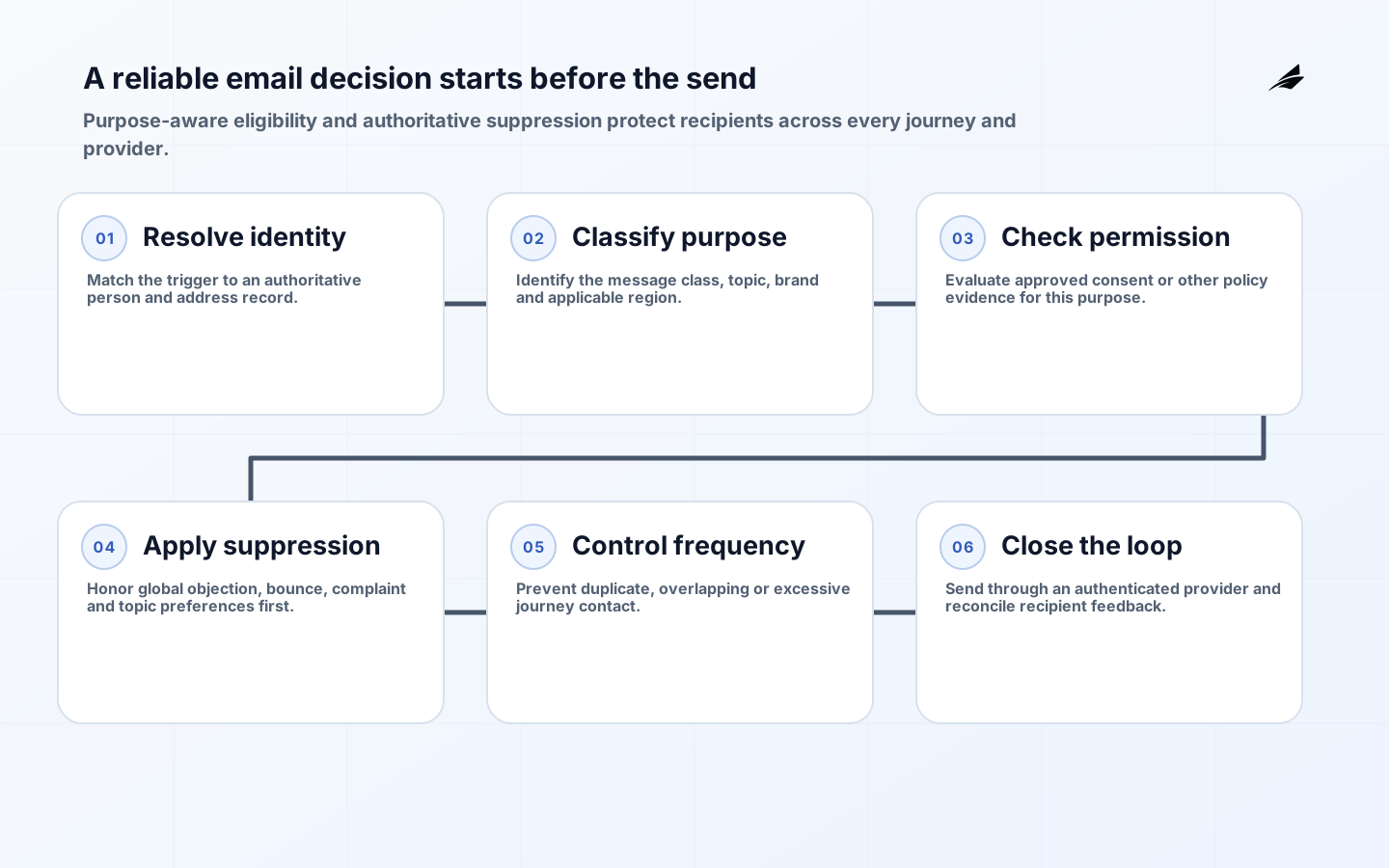
CRM email automation sends or prepares messages when customer data meets defined conditions: a lifecycle stage changes, a renewal approaches, a form is submitted or an account owner requests a sequence. The mechanism is straightforward; dependable operation is not. A mature program must know why a person is eligible, which record governs that decision, what message is allowed, who owns it, how a recipient can object and how the system stops future sends everywhere.
This FAQ addresses the questions enterprise teams should settle before scaling. It is operational guidance, not jurisdiction-specific legal advice. Applicable rules depend on location, recipient, message purpose and the organization's relationship with that person. Legal and privacy owners should approve the policy interpretation, while product, CRM, marketing operations, security and data teams implement it consistently.
What does CRM email automation include?
It includes more than a journey builder. The operating chain covers identity resolution, CRM field governance, eligibility and suppression rules, templates, approvals, sender domains, authentication, dispatch, bounce and complaint events, preference updates, reporting and incident response. Transactional service messages and promotional messages should be classified before design because their purpose and applicable rules may differ. Mixing them carelessly can confuse recipients and controls.
| Layer | Decision | Owner evidence |
|---|---|---|
| Identity and CRM data | Which person, account and address records are authoritative? | Field dictionary, matching rules and data steward |
| Permission | What purpose, channel, region and topic permit a send? | Consent or other approved basis, notice version and timestamp |
| Journey | What event starts, pauses and ends communication? | State model, frequency policy and acceptance tests |
| Content | Who approves claims, personalization and required notices? | Template owner, version and approval record |
| Delivery | Which domains, providers and authentication controls are used? | SPF/DKIM configuration, DMARC policy and monitoring owner |
| Feedback | How do unsubscribe, bounce, complaint and reply events update the CRM? | Event contract, processing target and reconciliation report |
Do we always need consent before sending?
There is no universal answer. Requirements vary by jurisdiction, recipient type, channel and purpose. The US CAN-SPAM framework governs commercial email and includes truthful headers and subjects, identification, a postal address, an opt-out mechanism and prompt honoring of opt-outs; it also says responsibility cannot simply be contracted away. UK electronic-marketing rules and data-protection obligations use a different framework. EU data protection adds requirements around lawful processing, transparency and rights.
The system should therefore evaluate an approved policy, not a single global consent checkbox. Store purpose, channel, brand or business unit, topic where relevant, source, time, notice or policy version, jurisdiction inputs and withdrawal. Keep evidence separate from mutable profile attributes. When the policy cannot determine eligibility, suppress the send and route the case for review.
Where should preferences and suppressions live?
Choose one authoritative preference service or clearly documented system of record, then distribute decisions to sending tools. A global suppression should outrank campaign membership, scoring and salesperson enrollment. Topic preferences can allow a person to stop a newsletter while retaining an eligible service update, but the taxonomy must be understandable to recipients and systems. Local unsubscribe lists in disconnected tools create preventable risk.
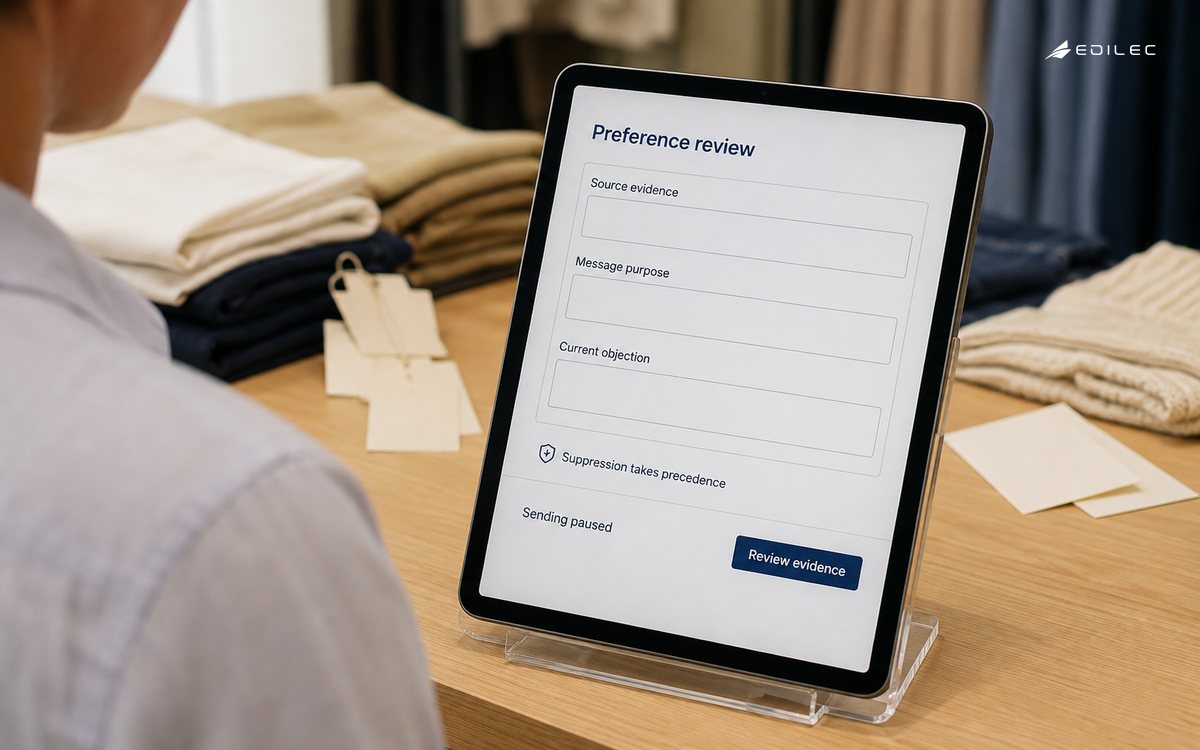
Use idempotent events so repeated unsubscribe or bounce notifications do not corrupt state. Record the original provider event, normalized decision, processing time and downstream acknowledgements. Reconcile provider suppressions against the CRM because integrations fail. Restrict who can reverse a suppression, require a valid reason and retain an audit trail. A bulk import must pass the same eligibility evaluation as a real-time trigger.
During a CRM or provider migration, preserve both positive permission evidence and negative suppression history. Map old purposes and topics to the new taxonomy explicitly; do not turn an unmapped value into permission. Run the old and new eligibility decisions against the same sample, investigate differences and keep the old suppression path active until downstream acknowledgements reconcile. Freeze uncontrolled list uploads during cutover. Afterward, audit a sample from source record through policy decision, provider handoff and recipient choice.
What does deliverability require beyond good copy?
Deliverability starts with authenticated, aligned identity and wanted mail. Configure SPF and DKIM for authorized senders and establish a DMARC policy and reporting process appropriate to the domain. Google publishes sender requirements covering authentication, message formatting, spam rates and, for qualifying subscription traffic, easy unsubscribe behavior. Requirements evolve, so assign an owner to monitor official provider guidance rather than treating setup as permanent.
Separate streams when reputation, purpose and operating ownership differ, but do not use domain separation to evade poor practices. Warm new infrastructure conservatively with genuinely eligible recipients. Monitor delivery by provider, domain, campaign and message class. A high accepted rate does not prove inbox placement, and opens have technical limitations. Complaints, hard bounces, unsubscribe behavior, replies and downstream outcomes provide a more useful operational picture.
How much personalization is appropriate?
Use only fields with a clear purpose, adequate quality and recipient expectations. A first name is not useful when identity matching is uncertain. Sensitive inferences, private account facts or unexpectedly specific behavior can damage trust even if technically available. Define fallbacks for every merge field, preview representative combinations and prevent empty or malformed content from sending.
If a model drafts or adapts content, keep approved claims, prohibited topics, brand rules and required notices outside free-form generation. Review high-consequence messages, validate links and personalization tokens, and log the model and template version. Do not place sensitive CRM fields into an unapproved model endpoint. Generated content does not change the organization's responsibility for accuracy, eligibility or the final send.
How should an enterprise roll out automation?
- Inventory every sender, domain, list source, preference store and automated journey before adding a new platform.
- Define message classes, approved eligibility policy, frequency limits, suppression precedence and owners.
- Authenticate a controlled sending domain and verify event flow in a non-production or internal test path.
- Run seeded tests covering duplicates, missing fields, region differences, withdrawal, hard bounce and concurrent journey enrollment.
- Pilot one low-risk journey with a small eligible audience, manual approval and a rapid pause control.
- Reconcile sends and provider feedback daily during the pilot; sample actual rendered messages across major clients.
- Expand by audience and message class only after legal, data, deliverability and business acceptance criteria are met.
| Risk | Preventive control | Detection or response |
|---|---|---|
| Ineligible recipient | Purpose-aware eligibility and global suppression before send | Pre-send count review and post-send audit |
| Duplicate or excessive contact | Identity matching, journey exclusion and frequency policy | Per-person send ledger and anomaly alert |
| Broken personalization | Typed fields, required fallbacks and rendered previews | Seed accounts and send-time validation failure |
| Domain reputation decline | Authentication, list hygiene and controlled volume | Provider metrics, complaints and pause thresholds |
| Integration delay | Durable events, retries and idempotency | Queue-age alert and preference reconciliation |
| Unowned content | Template lifecycle and approval expiry | Periodic inventory and automatic retirement of stale journeys |
Which metrics matter?
Build a balanced scorecard. Operational measures include eligible records, send latency, provider acceptance, hard bounces, complaints, preference-processing time, duplicate sends and reconciliation gaps. Experience measures include unsubscribes, replies and useful downstream actions. Business measures should match the journey, such as completed onboarding steps or renewed subscriptions, without claiming causation from a click alone. Segment metrics by provider, region, source and journey so an aggregate does not conceal harm.
Create an incident runbook for an incorrect or unauthorized send. It should identify who can pause journeys, preserve audience and decision evidence, notify legal and security owners, correct preference state and coordinate recipient communication when appropriate. Rehearse the pause control and provider contacts. Deleting a campaign after dispatch does not recall delivered mail, so prevention and rapid containment both matter.
Key takeaways
- Treat eligibility as a purpose-aware policy decision, not one global checkbox.
- Make suppression authoritative across every CRM, journey and sending provider.
- Own authentication, provider requirements and reputation as ongoing operations.
- Test identity, personalization, frequency and feedback loops before audience scale.
- Measure recipient experience and control health alongside campaign outcomes.
More frequently asked questions
Should we buy a journey platform or build automation?
Use a supported platform when its consent model, connectors, controls and reporting fit the requirements. Build custom components only where differentiated policy or integration needs justify lifecycle ownership. In either case, test data semantics and exit access; a feature list does not prove that preference and audit behavior fit.
Can sales teams enroll contacts directly?
Only through a governed path that applies the same eligibility, suppression, frequency and audit rules as centralized journeys. Role-based permissions, approved templates and enrollment limits reduce accidental over-contact. Manual intent should not bypass an explicit objection.
Can transactional messages contain promotions?
Message classification depends on applicable rules and the message's primary purpose, not its internal label. Keep essential service communications focused. Have legal owners approve mixed-content policy and ensure promotional additions do not undermine delivery of necessary account information or recipient choices.
Where can implementation teams start?
Use the companion CRM email automation implementation checklist to assign evidence and release gates. The checklist should be adapted to the organization's jurisdictions, platforms and internal policies rather than used as legal sign-off.
Conclusion
Good CRM email automation is a controlled customer-data system that happens to send messages. It can explain eligibility, respect objections quickly, authenticate its identity, render accurate content and show who owns every journey. Start with one message class and one well-defined audience, prove the full feedback loop, and expand only when suppression, delivery and measurement remain trustworthy under real operating conditions.