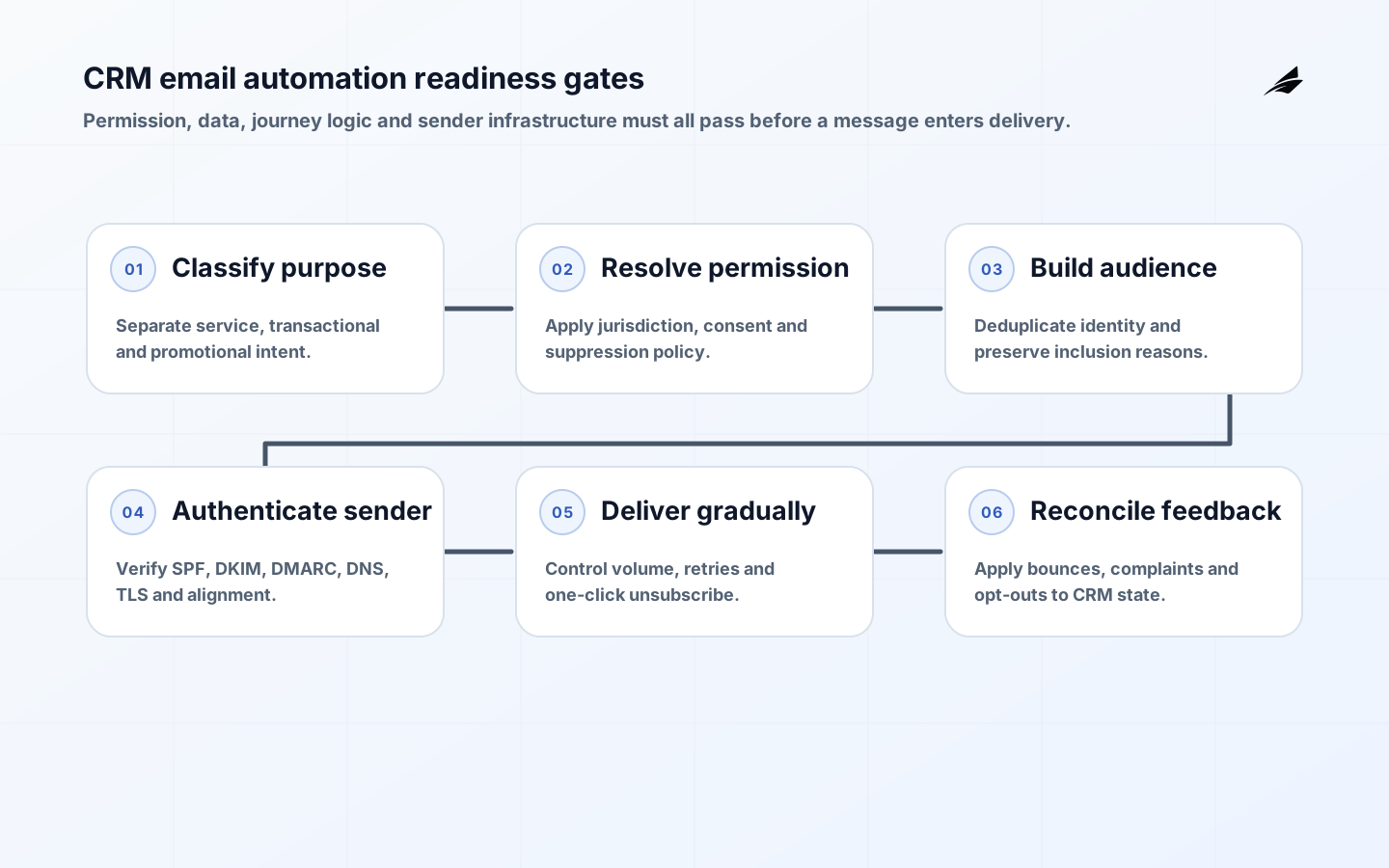
CRM Email Automation Implementation Readiness Checklist requires more than selecting tools or assembling a feature list. The implementation must connect a defined business outcome to data, authority, failure behavior and permanent ownership. This guide explains the decisions a buyer, product leader and delivery team should settle before committing the full build. It uses current primary standards where they define a useful control, while keeping the architecture proportional to the actual workflow and consequence.
The practical goal is an operable service: people can complete the intended work, understand state and exceptions, and recover when a dependency or decision fails. Scope therefore includes discovery, design, integration, security, delivery, rollout and support. The sections below can be used for proposal review, architecture workshops and acceptance planning. Related reading includes CRM Email Automation Implementation: Scope, Cost, Risks and Delivery Plan, CRM Email Automation Implementation FAQ, CRM Email Automation for Support Teams: Implementation Checklist.
Define message purpose and legal basis
Inventory every automated message and classify it as transactional, service, lifecycle or promotional according to the applicable jurisdiction and actual content. The label inside the CRM does not determine legal treatment. Record audience, trigger, sender identity, purpose, legal basis, suppression rules and owner. The FTC explains that CAN-SPAM covers commercial email, including business-to-business messages, while the ICO’s electronic-mail guidance describes consent and limited exceptions under PECR. Obtain legal review for the markets you serve rather than copying a universal consent rule into software.
Maintain a jurisdiction matrix with counsel-approved rules and a review date. The automation should choose policy from recipient and sender context, not from an assumed global default. Separate evidence required to send from evidence used for personalization. If purpose changes, obtain or document the necessary permission rather than reinterpreting an old record. Store the exact notice or form version associated with consent.
Make CRM identity and consent data reliable
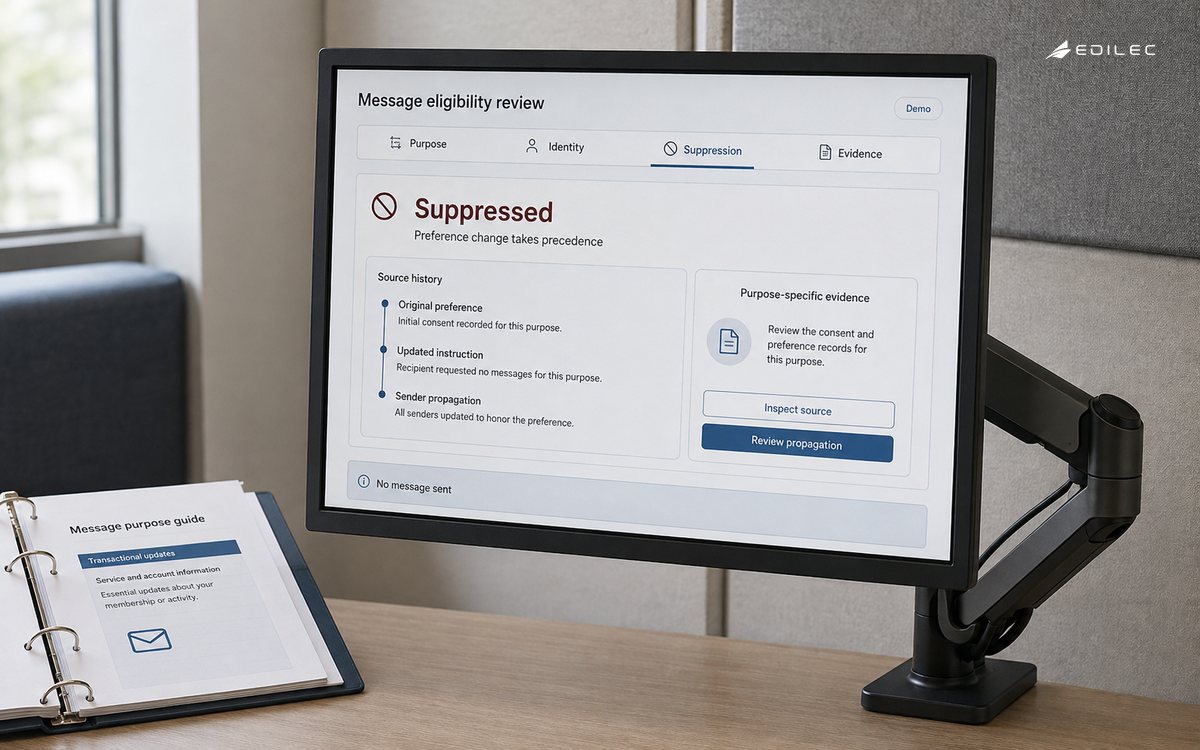
A campaign cannot be more trustworthy than its recipient record. Define the contact identifier, account relationship, preferred address, locale, consent evidence, source, timestamp and applicable purpose. Merge duplicates without erasing suppression history. Treat a bounced address, unsubscribe, complaint and withdrawal as governed events that must propagate to every sender. Establish which system is authoritative for each field and how quickly changes synchronize. Before launch, reconcile sample cohorts from trigger through final send list and prove that ineligible recipients are excluded even when enrichment or segmentation data is late.
Define a global person or address suppression service with durable identifiers and auditable updates. When several CRMs or business units send mail, establish precedence for conflicting preference records and test propagation time. Imports should produce a provenance report showing source, transformations, rejected rows and defaulted values. Do not activate a purchased or historical list simply because its addresses pass syntax checks.
| Area | Decision | Evidence |
|---|---|---|
| Readiness area | Required evidence | Block launch when |
| Permission | Purpose-specific consent or documented lawful route | Eligibility cannot be explained per recipient |
| Identity | SPF, DKIM, DMARC, DNS and TLS verified | A legitimate sender is absent from authentication |
| Audience | Deduplicated cohort with global suppression applied | Counts cannot reconcile to source records |
| Journey | Re-entry, cancellation and concurrency rules tested | Retries or late events can duplicate sends |
Specify triggers, timing and concurrency
Write each automation as a state machine, not a sequence of visual boxes. Define entry criteria, exit criteria, waiting periods, re-entry, priority, cancellation and behavior when a contact qualifies for several journeys. Decide which event time matters and how late or duplicate events are handled. Use idempotency keys to prevent repeated messages after retries. Preserve a reason code for every inclusion and suppression so operations can explain a send. Time-zone and quiet-hour rules should follow the recipient policy, with explicit behavior when location or locale is unknown.
Set frequency caps across journeys, not only inside one campaign. Priority rules should prevent a promotional sequence from colliding with an outage notice, renewal warning or unresolved complaint. Define what happens when a customer changes account, region or lifecycle stage while waiting. Version the journey and template so investigators can reconstruct the exact rules that applied to a particular recipient.
Prepare sender identity and authentication
Authenticate every sending domain and inventory all legitimate senders. Google requires SPF or DKIM for all senders to personal Gmail accounts and SPF, DKIM and DMARC for bulk senders, plus alignment, TLS and one-click unsubscribe for relevant messages. The current DMARC specification is RFC 9989. Configure dedicated subdomains or streams where reputation and purpose need separation. Validate forward and reverse DNS, DKIM rotation, return paths and monitored DMARC reports. Authentication is necessary but does not compensate for unwanted mail, poor list hygiene or sudden volume spikes.
DMARC reports can contain sensitive operational information and should have controlled retention and access. Inventory third-party platforms before moving toward an enforcement policy so legitimate sources are not rejected unexpectedly. Rotate DKIM keys according to provider capability and incident needs. Keep marketing and high-value transactional streams operationally distinguishable, while ensuring customers can still verify a consistent organizational identity.
Build accessible, honest message content
Headers, subject and sender identity must accurately represent the initiator and message. Provide a visible unsubscribe path for promotional mail and implement RFC 8058 one-click behavior where required by mailbox providers. Design responsive HTML with a meaningful text alternative, semantic reading order, sufficient contrast and useful link labels. Avoid hiding essential account information in images. Keep transactional content focused so promotional material does not change its purpose. Test personalization with missing, malformed and hostile values; escaping and safe defaults are part of message security.
Render tests should include dark mode, blocked images, large text, keyboard navigation and long localized strings. Validate every dynamic URL against an allowed destination pattern. Avoid embedding confidential values in tracking parameters. Archive the approved subject, headers, body, footer and landing-page behavior as one release artifact. If an unsubscribe page fails, the message has not met its operational acceptance even when delivery succeeds.
| Area | Question | Control |
|---|---|---|
| Signal | Meaning | Operational response |
| Deferral | Receiver temporarily declined delivery | Slow volume and inspect SMTP reason |
| Hard bounce | Address or domain cannot receive | Suppress according to policy and investigate source |
| Complaint | Recipient marked message as spam | Stop affected cohort and examine expectation mismatch |
| Unsubscribe | Recipient ended the relevant subscription | Propagate suppression promptly across senders |
| DMARC failure | Authentication or alignment failed | Identify unauthorized or misconfigured source before sending |
Test the complete delivery path
Unit tests for merge tags are insufficient. Use seeded accounts to test trigger eligibility, consent, deduplication, suppression, rate limits, retries, rendering, links, localization and downstream analytics. Run mailbox tests across major providers and inspect authentication results. Simulate provider delay, webhook duplication and CRM outage. A dry run should produce the exact proposed audience and reason codes without sending. Approvers need a preview tied to the same template and data version that production will use, followed by a phased launch that can stop automatically on complaints, errors or abnormal volume.
Use test addresses that exercise major mailbox providers without contaminating real analytics. Confirm that seed messages reach the intended folder and that headers show aligned authentication. Load-test event ingestion and provider callbacks before major campaigns. Test kill-switch behavior while messages are queued: stopping new journey entries is insufficient if millions of already scheduled sends continue. Reconcile expected, submitted, accepted and final outcomes by immutable message identifier.
Operate deliverability as a shared service
Assign owners for CRM data, campaign logic, creative, privacy, sending infrastructure and incident response. Monitor accepted, delivered, deferred, bounced, complained and unsubscribed events separately; opens are an imperfect signal because privacy features can generate or suppress them. Track Google Postmaster signals where available and keep complaint rates well below the provider threshold. Reconcile provider events back to the CRM. Establish a kill switch, communication plan and evidence-retention period for accidental sends. Review automations after product, policy, domain or data-model changes.
Create alert thresholds by message class and baseline; a password-reset stream and a newsletter have different urgency. Incident runbooks should cover compromised domain, mistaken audience, broken personalization, provider block and suppression failure. Assign authority to stop sends without waiting for a marketing approval chain. After an incident, identify affected recipients, preserve evidence and correct the source process rather than only deleting a campaign.
Key takeaways
- Classify every message by real purpose and jurisdiction.
- Treat consent and suppression as authoritative shared data.
- Model journeys as state machines with deduplication and cancellation.
- Prove authentication, deliverability and incident controls before scale.
Frequently asked questions
Can the CRM consent checkbox be trusted automatically?
Only if its meaning, collection source, timestamp, purpose and synchronization are defined. A checkbox copied during migration without evidence is not a reliable permission record.
Is a DMARC policy of p=none enough?
It can support monitoring and may satisfy a minimum mailbox-provider requirement, but it does not request quarantine or rejection. Move toward enforcement only after legitimate senders are aligned and reports are reviewed.
Should open rate be the main success metric?
No. Privacy protections and image loading make it noisy. Use business outcomes, clicks where appropriate, conversions, complaints, unsubscribes, bounces and cohort-level incremental impact.
Conclusion
CRM email automation is ready when the organization can explain why each recipient qualifies, prove that identity and consent are current, predict journey behavior under retries and conflicts, and stop safely when signals deteriorate. Combining legal review, reliable CRM data, modern sender authentication, complete-path testing and named operations turns automated email into a controlled customer capability rather than an unattended campaign machine. Repeat the readiness review whenever domains, providers, consent language, journey ownership or mailbox requirements change. Keep an evidence pack for every production release, including audience reconciliation, authentication results, approvals, templates, provider events and incident decisions. Audit the evidence periodically and close obsolete journeys before their permissions, templates or source assumptions decay.