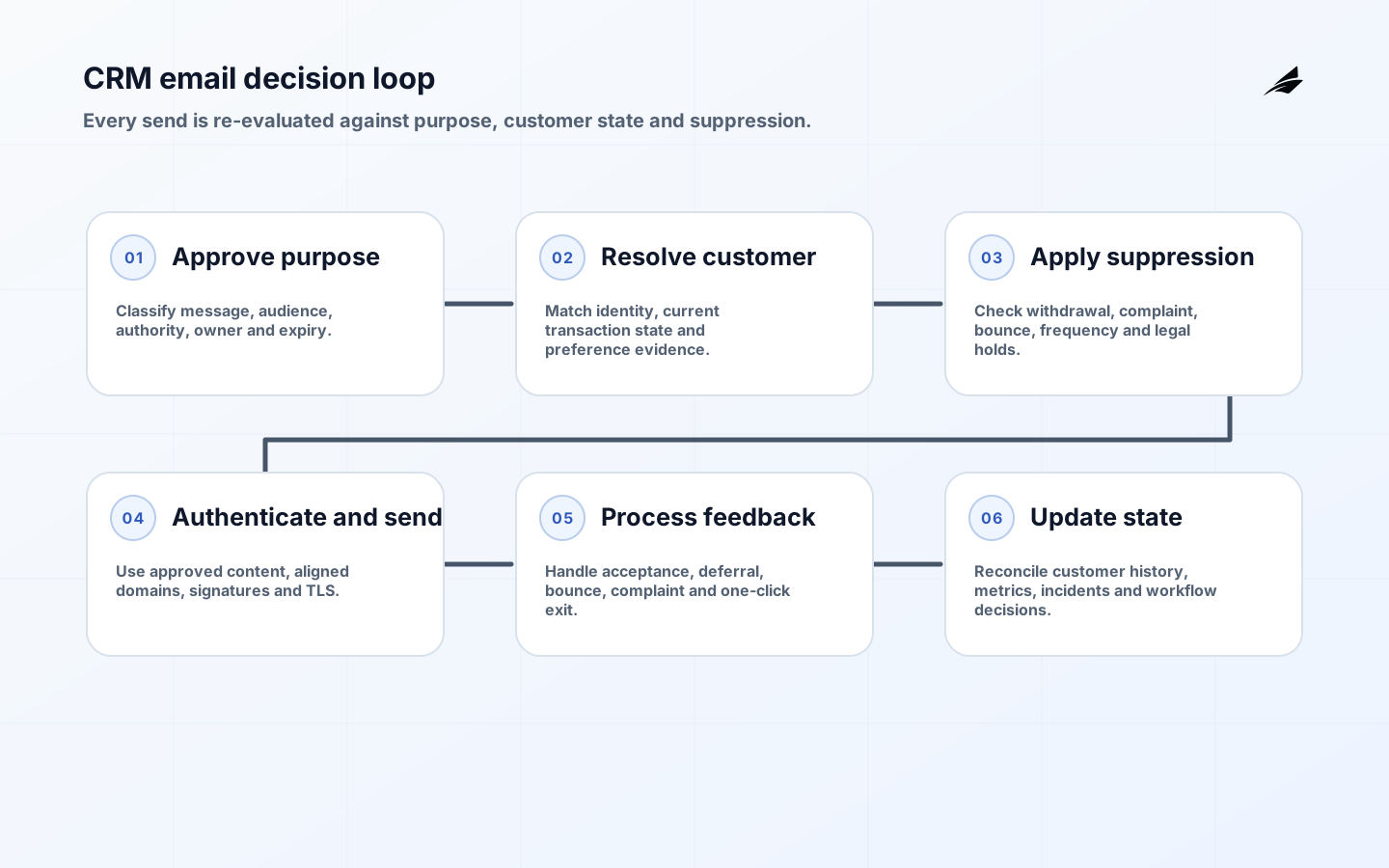
CRM email automation implementation turns customer and operational events into messages, but the hard part is deciding whether a message should be sent now, to this person, for this purpose. Reliable automation combines source data, current customer state, consent or another valid basis, suppression, template approval, sender authentication, provider feedback and auditable ownership. A journey canvas without those controls can scale mistakes faster than useful communication.
This guide covers scope, cost, risks and delivery for lifecycle, transactional and marketing workflows. Use the CRM email readiness checklist before procurement and the implementation FAQ for stakeholder questions. The consent, data and deliverability checklist provides a detailed launch review for teams already building.
Define message purpose and authority
Inventory every proposed message and classify its primary purpose: security, service administration, transaction, lifecycle assistance or promotion. Record trigger, recipient, content owner, sending entity, country or audience, data fields, urgency, frequency, expiry and stop conditions. Do not hide promotion inside a message labeled transactional. The ICO’s current electronic-mail marketing guidance distinguishes genuine service messages from direct marketing and was updated in April 2026 for UK legal changes. Obtain jurisdiction-specific legal review.
Create a message authority record that tells the runtime what evidence permits sending: active contract and service need, recorded consent, qualifying existing-customer rule where applicable, or another reviewed basis. Include collection source, wording or notice version, timestamp, channel, audience and withdrawal. Store policy decisions separately from campaign configuration so a marketer cannot bypass them by copying a journey. The CRM should expose current state, not become the only immutable evidence store without design.
| Message class | Typical trigger | Required control |
|---|---|---|
| Security | Credential or risk event | Immediate, non-promotional content and verified account context |
| Transactional | Order, payment or requested action | Idempotent event and accurate transaction state |
| Service | Planned interruption or contract change | Affected-service eligibility and message expiry |
| Lifecycle | Product milestone or inactivity | Purpose approval, frequency cap and current customer state |
| Marketing | Segment and campaign decision | Valid audience basis, suppression and easy withdrawal |
| Human follow-up | Assigned sales or support task | Ownership, context, contact policy and CRM audit |
Build a governed customer and consent model

Define a canonical contact identity and rules for merging, householding, business accounts, aliases and shared addresses. Preserve source-system identifiers and confidence. Model channel preferences by purpose, brand, region and account where needed; one global boolean is rarely expressive enough. Keep a suppression ledger for withdrawals, hard bounces, complaints, legal holds, internal exclusions and temporary frequency controls. Apply suppression at send time, not only when a campaign audience is built.
Handle late and conflicting events. A customer may unsubscribe after entering a queue, cancel an order before a delayed reminder, or merge two accounts with different preferences. Give events identifiers, occurrence and ingestion times, source and version. Establish precedence and reconciliation. Record why each message was eligible using references to purpose, policy and customer state without copying excessive personal data into logs. Restrict exports and test-data use.
Configure sender identity and authentication
Separate sending domains or subdomains by message class where reputation and operations justify it, while keeping identity clear to recipients. Publish SPF for authorized infrastructure, sign with DKIM and establish DMARC alignment and reporting. RFC 7489 defines DMARC’s domain alignment, disposition and feedback mechanisms. Inventory every legitimate sender before tightening policy, protect DNS changes and rotate signing keys through a tested process.
Google’s current email sender guidelines require authentication, valid DNS and TLS for senders to personal Gmail accounts; bulk senders face SPF, DKIM, DMARC alignment, low spam-rate and one-click unsubscribe requirements. The page advises keeping reported spam below 0.10 percent and avoiding 0.30 percent or higher. Treat those as Gmail-specific operational guidance, not universal legal thresholds. Monitor provider responses, domain reputation and authentication by message stream.
Design deterministic, interruptible workflows
Each workflow needs entry, wait, decision, send and exit states. Define idempotency so replayed source events do not send duplicates. Recheck customer, transaction, consent and suppression immediately before send. Expire messages whose context is stale. Bound retries and route persistent failure to an observable queue. Set frequency and quiet-hour policy by purpose and geography. Priority rules should prevent a marketing sequence from obscuring a critical service message.
Version templates, data mappings and policy references. Use approved fallbacks for missing optional data; never expose placeholder text. Escape untrusted values and restrict links to approved domains. Make preview data synthetic or access-controlled. Provide plain text, meaningful subject and sender identity, accessible structure and localization review. A/B tests still need approved purpose and audience rules. Record the exact variant sent for support and audit.
Make withdrawal immediate and reliable
Provide a visible unsubscribe route in marketing messages and process provider feedback promptly. RFC 8058 specifies HTTPS one-click unsubscribe using List-Unsubscribe and List-Unsubscribe-Post headers covered by DKIM. Use signed, opaque recipient tokens, accept the POST without login or promotional detours, make processing idempotent and update the suppression authority before future queued sends.
Legal requirements differ. The U.S. FTC’s CAN-SPAM compliance guide covers accurate routing and subject information, advertising disclosure, physical address and opt-out duties for commercial email. Other regimes may require prior consent and impose different timelines or scope. Encode reviewed policy by audience and message purpose, keep evidence and route changes through legal and operational approval. This implementation guidance is not a substitute for legal advice.
| Release gate | Test | Pass evidence |
|---|---|---|
| Eligibility | Consent, contract, service and suppression combinations | Expected decision plus reason code |
| Identity | SPF, DKIM, DMARC and DNS across each stream | Authenticated sample headers and reports |
| Workflow | Duplicate, late, cancelled and out-of-order events | Single correct outcome and visible exception |
| Content | Missing fields, localization, accessibility and link checks | Approved render across representative clients |
| Withdrawal | Body link and RFC 8058 one-click path | Suppression applied before another send |
| Feedback | Bounce, complaint, deferral and provider outage | State update, bounded retry and escalation |
Pilot, monitor and model cost
Start with one bounded, high-value journey and engaged recipients. Validate source accuracy, eligibility, rendering, provider response, support handling and suppression before increasing volume. Ramp sending gradually; sudden changes in volume, domains or content can affect deliverability. Keep transactional and marketing monitoring distinct. Define rollback as disabling entry and draining or cancelling queued work safely, not merely turning off a user interface toggle.
Track eligible, suppressed, attempted, accepted, deferred, bounced, complained, unsubscribed and completed outcomes by message class and provider. Opens are unreliable as a primary control because privacy features and image behavior distort them. Use downstream business outcomes with holdouts where appropriate. Cost includes CRM and delivery licenses, contact tiers, message volume, data integration, template operations, monitoring, legal review, support and reputation recovery. Model peak transactional demand separately from campaigns.
Operate automation as a controlled service
Assign owners for source events, customer data, consent policy, templates, domains, deliverability, platform administration and incidents. Separate content approval from deployment where consequence warrants it. Review unused journeys, stale segments, expired purposes, administrator access, sender inventory and suppression health. Exercise a compromised sending credential, accidental broad audience, missing suppression feed and provider outage. Define who can halt all sends and preserve a channel for critical service communication.
Maintain a change calendar around major commercial and operational events. Require peer review and automated tests for workflow and data changes. Investigate complaints and support contacts as product evidence. Retire templates, events and integrations cleanly when products close. Export policies, workflows, suppression records, authentication configuration and audit history in usable formats so changing CRM or email providers does not erase customer choices or operating knowledge.
Prepare a launch and incident runbook
The runbook should show how to stop one journey, one message class or all nonessential sending; identify queued work; revoke credentials; switch provider routes where approved; preserve message and decision evidence; and notify legal, security, support and business owners. Define conditions for resuming. Test controls with synthetic recipients so the first attempted global pause is not during a real audience error.
Include provider status and escalation, DNS and signing-key contacts, suppression-source health, current volume limits, bounce and complaint thresholds, and approved customer communication. A sender compromise may require credential and DNS action, while a bad segment may require queue cancellation and suppression repair. Distinct scenarios need distinct containment. After resolution, reconcile attempted messages and customer state before restarting automation.
- Expose scoped and global stop controls to authorized operators.
- Make queued recipients and message variants inspectable without broad exports.
- Keep DNS, provider, privacy, legal and security escalation current.
- Preserve eligibility, content, authentication and delivery evidence.
- Reconcile customer and suppression state before resuming workflows.
- Turn incident findings into tested workflow and governance changes.
Key takeaways
- Classify every message by purpose and require current authority at send time.
- Model identity, consent and suppression with versioned evidence and conflict rules.
- Authenticate each sending stream and monitor reputation and provider feedback separately.
- Make workflows idempotent, interruptible, expiring and observable under late or duplicate events.
- Test one-click withdrawal, bounce, complaint, outage and emergency-stop behavior before scaling.
Frequently asked questions
Should consent live in the CRM?
The CRM may present current preference, but the architecture should preserve authoritative evidence, history and source. Define one system of record or a governed synchronization pattern and make conflicts visible. Campaign tools should consume the decision, not invent it.
Can automation use purchased email lists?
This is legally and operationally risky. Permission, notice and audience rules vary, and recipients who did not expect contact are more likely to complain. Obtain jurisdiction-specific legal review and provider approval; do not treat vendor assurances as sufficient evidence.
Do transactional messages need an unsubscribe link?
Requirements depend on purpose and jurisdiction. Genuine necessary service or transaction messages may be treated differently from marketing, but adding promotion can change classification. Keep content purpose clear and apply reviewed policy rather than a single rule to every template.
Conclusion
Good CRM email automation is a governed decision system. It combines current customer context, lawful and documented authority, authenticated delivery, interruptible workflows and feedback-driven operations. Build those controls before scaling volume, and the platform can improve timely communication without sacrificing customer choice, deliverability or auditability.